Innhold Show
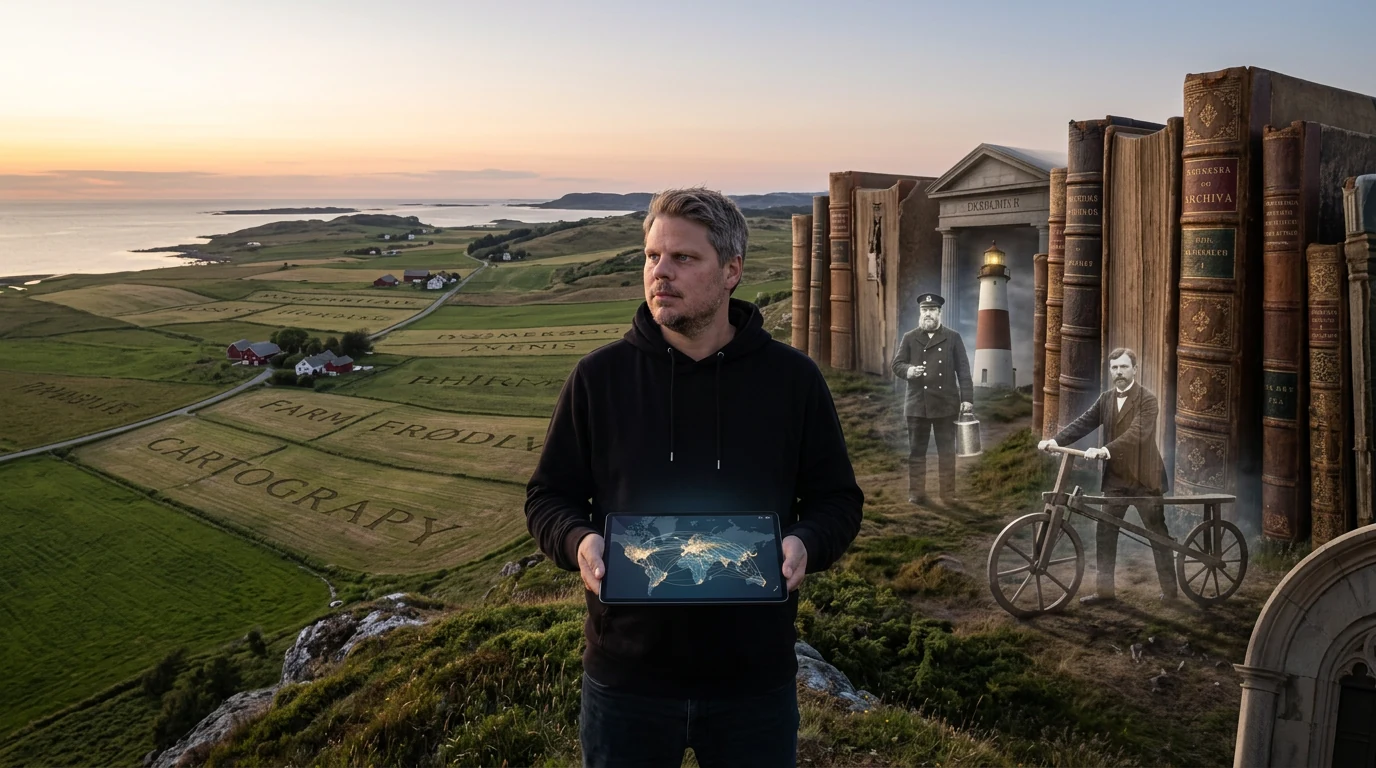
Genealogy with AI began for me with a few boxes I nearly threw away. It ended with a discovery that still makes me smile: On my father’s side, the family is written into the map. On my mother’s side, it is written into the history books.
I wish I had been more interested while the older members of the family were still alive. I could have asked who the people in the photographs were, why somebody had kept a particular envelope, and what the real story was behind those two candlesticks. My interest only became serious after both my parents had died. By then, the easiest source was gone.
Instead, I found myself with MyHeritage, old documents, family stories, AI, and eventually a database I built myself. At first there were names, dates, and connections. Then came the moments that made the names come alive: a lighthouse builder with a royal privilege, a district judge who served the Karmsund area while also designing practical things, an ophthalmologist whose instrument was used around the world, an artist who made the landscape of Jæren her main subject, police chiefs, industrial workers, and a poet whose voice had been lying beneath a wig in my garage.
It is easy to be dazzled by names that already have encyclopedia entries. But visibility in history also tells us who had public office, education, property, and institutions around them. People who worked a farm, moved between communities along the fjords, or stood beside a factory machine may have lived equally rich lives without ever receiving a biography. The sources are different. That is why the contrast between the map and the history books matters to me. It is not a ranking of two families, but two ways in which lives are preserved.
In time, I had a rather strange feeling: Ah. Much of what occupies me today can be traced surprisingly far back. Not as a recipe written into my genes. I naturally notice people who resemble me more readily, and another descendant would have followed different threads. Even so, I recognize the curiosity, the sense of justice, the need for documentation, and the urge to build systems. Those moments of recognition were what turned the family tree from a diagram into a story.
The story was beneath a wig in the garage
My sister Lillian and I were going through our parents’ belongings in my garage. There were boxes, folders, photographs, and papers in the sort of quantity that gives you a very close relationship with garbage bags after a few hours. I came close to throwing out several boxes. Lillian had more patience.
Beneath a wig, she found handwritten poems by our great-great-great-grandfather, Gustav Johan Carlén. “The poems were beneath a wig” sounds like an embellished version of the story. But that is exactly where they were. The family archive had its own sense of theater.
What still gets to me is how little distance there was between preservation and loss. Lillian lifted the wig. I had the garbage bags ready. That was about as sophisticated as the rescue operation got.
Suddenly, family history was no longer a tree made of boxes. Here was a person who wrote about work, hunger, nature, faith, contempt, and dignity. Gustav Johan had a Swedish Romani/Traveller background and lived a hard life, including work in the Norwegian paper industry. He belonged to a group that authorities and others were fond of describing from the outside. In his poems, he got to describe life in his own voice.
The discovery became the book Lys på veien – en reisende fants etterlatte dikt, published in 2025 with Lillian Bauge Carlén and me as editors. The Norwegian title roughly means Light on the Road – The Poems Left Behind by a Traveller. I used AI to decipher, organize, and present the material. The poems later became more than 30 songs and several AI videos. The words were his. The technology helped me move them out of the box and into forms through which more people could encounter them.
That work changed my entire relationship with genealogy. I could not travel back and ask the questions I had failed to ask. But I could make sure that those who come after me do not have to begin with an unlabeled box and sheer luck.
Why I built my own genealogy database with AI
MyHeritage was useful. It gave me matches, connections, and a starting point. At the same time, the work itself became both boring and stressful. I could sit there with a long list of green hints and still not feel that I understood the people. A hint can connect two names. It rarely explains why a family moved, what lay behind an old song, or how an invention and an illness meet again several generations later.
I wanted to search stories, documents, places, and relationships in my own way. So I did what I tend to do when a system does not fit my head: I built my own. With the help of AI, I made a genealogy system using SQLite, FTS5, Flask, and Markdown. It contains about 390 people, 91 families, and documented lines spanning 12 generations back to 1618.
The number is not the most interesting part. What matters is what I can ask. Who in the material worked with law and justice? Where do the Hoel and Carlén branches meet? Which stories point toward Kvitsøy? Who built, measured, or tried to improve something? Which claims come from public sources, and which come from Eli or other family members? The material began to answer questions I actually wanted to ask.
AI helps with handwriting, name variants, timelines, and connections. The database keeps track of the documents. But the most important feature of the system is that it can show me what I do not yet know. A missing citation must not be filled with a pretty story. It must remain a task. That applies to parts of my father’s side, Kristoffer Hoel’s wartime years, the exact outcome of Elizar Saxlund’s actions, and the history of the candlesticks in Eli’s care.

A certificate can explain a move. A farm name opens a landscape. An old song gives a police station humor and voices. Two details that seem small on their own can meet in a place such as Rjukan and explain how two family lines were moving toward each other long before they actually became one family.
That is what I like about databases when they are used properly. They do not make people smaller. They give me room to hold enough pieces together, for long enough, that the person can emerge.
On my father’s side, the names are still in the landscape
On my father’s side, I first encounter places. My father, Sølve Bauge, is the nearest. Behind him are my grandfather Sverre Bauge and grandmother Helga Jegteberg, followed farther back by names such as Bauge, Baugstø, Fatland, Skromme, Holven, Jegteberg, and Lothe. They form a western Norwegian axis through Kvinnherad, Etne, Bømlo, Suldal/Jelsa, Kinsarvik, and Hardanger, with a smaller trail toward Telemark.
Read quickly, it can look like a list. Put it on a map and it becomes something else. Farm names are historical addresses. They tell us where people had work, family, land, and belonging. A person might be recorded under the name of the farm they came from and later under the name of the farm they moved to. The name was both identity and location data.
Baugstø and Ytre Skromme draw the line into Kvinnherad. Lothe points toward Kinsarvik and Ullensvang in Hardanger. Knud Jegteberg was born in Jelsa, creating a connection south to Ryfylke. Torstein Hanson is recorded with Telemark and breaks the otherwise clear western route. Such breaks are often the most interesting part. When one person appears outside the pattern, I want to know which road he took, what drew him there, and which documents might follow the journey.
The registered material includes the tenant farmer Erik Olson Furdal-Nes and the carpenter Lars Ellingsen. Otherwise, farmers and rural people dominate, often without a recorded occupation. An empty occupation field does not mean they did no work. Life on a farm could consist of land, animals, repairs, fishing, transport, crafts, and everything else required to carry people through the year. The archive simply did not always give that work a title.
This is where my father’s side differs from several branches on my mother’s side. A professor receives an institutional biography. A district judge leaves official records. A farmer may be visible through baptism, marriage, probate, property, and the name of the place. The life is scattered across parish registers, land registers, mortgage records, local histories, and maps. It demands a different kind of detective work.
I like how the family tree almost becomes geographical by itself. When I follow Bauge, Baugstø, Skromme, and Jegteberg, I am also following fjords, valleys, farms, and migration. The history still has a physical address. The places can be found even when the people have no encyclopedia entries of their own.
There is resilience in this kind of documentation too. A farm name survives because the place continues to be used, discussed, and mapped. The people on my father’s side did not necessarily put their names on instruments or streets. Many took their names from the soil that sustained them. That is another form of permanence.
My father’s side is still the part of the project that needs the most systematic work. Local history books for Kvinnherad, Etne, Bømlo, Suldal, Jelsa, and Ullensvang must be compared with parish registers, probate records, and land registers. I want to know more about the moves, the farms, the crafts, and everyday life. For now, the honest answer is that the sources give me more landscape than biography.
But landscape is not a lesser story. It tells us how families stayed, how they moved along natural routes, and how names could follow land and farms through generations. When I see Bauge or Jegteberg on a map, I do not see an empty space where a famous person should have been. I see another kind of archive.
On my mother’s side, the sources opened more quickly because more people held office, wealth, education, or positions that institutions recorded. One of the earliest clear stories begins out at sea, with a coal fire, reefs, and a payment arrangement that made me laugh out loud.
Heinrich Petersen charged for a light in the darkness
One of the oldest clear trails in the direct line leads to Heinrich Petersen and Kvitsøy. The story also has a dramatic opening in family and local tradition: Heinrich is said to have been caught in a storm, found himself in danger, and promised to build a lighthouse if he survived. I have no contemporary source proving the storm or the promise. As a story handed down, however, it says something important about how the family understood the beginning: A person experiences the danger of the sea and responds by creating light for those who come after.
The documented story begins with the privilege. The Norwegian Coastal Administration’s conservation plan reproduces the royal resolution of April 27, 1700. Heinrich received permission to build and operate a lighthouse on Kvitsøy at his own expense. To finance it, he could charge passing vessels four Danish skilling per shipload.
Seen through modern eyes, the arrangement is almost irresistible. A direct ancestor received a royal privilege, a private monopoly, and a small fee per shipload to help people pass reefs and dangerous waters. I am skeptical of both privileges and monopolies, and there it is in my own family line. At the same time, Heinrich had to finance, build, and keep the light running. The state handed out the exclusive right while the family did the work. The story gives me something to chuckle about and something to consider.
The early installation was a lever light. A coal basket was raised at the end of a moving arm so the fire would be high enough to be seen from the sea. It required coal, supervision, and people who made sure the light actually burned when darkness and weather made it necessary. A privilege on paper helped no sailor if the coal basket was dark.
The lighthouse operation remained in the family for generations. Descendants used forms of the name such as von Fyren and von Fyhren, derived from the lighthouses. Older sources described the family as ennobled. More recent research presented by the Norwegian Lighthouse Association found no basis for formal ennoblement. What is secure is the use of the name and the family’s responsibility for operating the lighthouse across several generations.
The state took over the lighthouse in 1815. A new stone tower was built in 1829, and the site was developed further later. The story therefore moves from private operation under royal privilege to a state lighthouse service and a physical site that still makes the past visible.
The line runs from Heinrich to his son Morten Henrich Petersen von Fyren and then to his granddaughter Johanna Margaretha Petersen von Fyren. She married Søren Schiøtz, who was connected to Sunnhordland. Their son, Eiler Hagerup Schiøtz, carries the story from the lighthouse into law, construction, and the Karmsund district where I live today.
I made “Slektens lys” – “The Light of the Family” – as an AI music video about the family across the generations. When I brought images, music, and names together, I noticed how different the history felt from an ordinary family tree. The lighthouse, the farms, the instruments, the poems, and the people no longer stood in separate columns. They began to answer one another.
Eiler Hagerup Schiøtz had both a courtroom and a workshop in his head
Eiler Hagerup Schiøtz is my maternal grandmother’s mother’s mother’s mother’s father’s father. That relationship takes a breath to say, but the point is simple: He is a direct ancestor, not merely an interesting figure on a side branch.
He was born in Stavanger on November 15, 1775, the son of Johanna Margaretha Petersen von Fyren and Søren Schiøtz. The lighthouse history entered the family through his mother. Through his father, he was connected to the Schiøtz family and Sunnhordland. He chose law, but his life grew much broader than an official title.
Eiler became district judge in Sunnfjord in 1807. He remained there only until 1808, when he took responsibility for the Karmsund and Hesbø judicial district, an office he held from 1808 to 1837. Nearly three decades is a long time in one district. Haugesund was not yet a town in its own right. The area around the Karmsund strait consisted of villages, farms, trading places, and sea routes that would later become part of the city and region I know as home.
That creates a particular closeness. I can read about Eiler as an official in the history of Stavanger and Rogaland. But I can also see him as a direct ancestor who dealt with law, documentation, and disputes in my own local area before the city existed as a city.
The district judge was responsible for administering justice across a large area. He presided over courts and handled civil and criminal cases, but the office also involved records concerning probate, property, and other legal matters. People came to the office when agreements broke down, property changed hands, inheritance had to be divided, or crimes were prosecuted. The work required explanations, documents, and rules to be put into a form capable of carrying public authority.
Geography made the job demanding as well. Karmsund and Hesbø were not one compact urban area with all parties and papers a few blocks apart. The judicial district stretched across an area bound together by the sea, farms, and scattered communities. Court sites, travel, and written order had to make a large area function legally as one jurisdiction. By holding this responsibility from 1808 to 1837, Eiler followed the same district through almost three decades of deaths, inheritances, property transfers, disputes, and social change. The traces of the work do not lie in one dramatic invention, but in the slow administration of cases that mattered enormously to the people involved.
It is easy to see the title and think about power. I am at least as interested in the system around it. A large district had to be made manageable through records, deadlines, documents, and decisions. Justice is a value, but in practice it also needs a workflow. It must be possible to find a case again, distinguish an allegation from evidence, and show how a decision was reached. I recognize something of my own urge to build systems that keep information in order.
Eiler was also connected to the Storting, Norway’s parliament, during the first years after 1814. He served as a deputy representative in 1815-1816, while the new Norwegian state and the relationship between constitution, public office, and representation were still taking shape. For a lawyer and district judge, this was a period when law was not merely something he administered locally. The country was simultaneously working out how its new political order should function.
The story could have ended with his office. It does not.
Eiler was involved with properties and building projects in Stavanger, including Sølyst, where he built a country residence. He was interested in architecture, practical constructions, and fire-resistant building methods. In a city where wooden houses and dense development made fire a concrete danger, fire safety was a practical problem. Materials and construction methods could determine whether a fire was contained or took much more with it.
This is the part of his life where Eiler becomes more than a man behind a desk. He seems to have approached problems with the same basic question: Can this be designed better? That applied to buildings, transport, and safety at sea.
He designed a self-righting lifeboat. The idea alone says a great deal about the problem he was trying to solve. Along the western coast of Norway, boats were transport, workplace, and lifeline, while the sea could make them deadly. A vessel better able to resist capsizing was an attempt to build safety into the construction itself.
He also made a wooden vehicle that is preserved at Stavanger Museum. Sources describe it as an early running machine, draisine, or scooter. The museum object makes his inventive urge physical. He built something, and it was kept.
Drawings and plans in the source material also show how widely his technical curiosity ranged. What interests me most is the whole: the lawyer who administered a legal system, the official surrounded by documentation, the builder thinking about fire safety, and the designer working on a lifeboat and a vehicle.
I do not build wooden boats or vehicles. I build databases, automations, and AI systems. Yet I recognize the restlessness itself: This works, but could it work better? Could the parts be assembled differently? Could a problem be made manageable through a construction?
It is tempting to turn such similarities into Inheritance with a capital I. I have no basis for claiming anything of the sort. I find the patterns I am looking for, and I read Eiler through my own life. But the recognition is real as reflection. Finding a direct ancestor who combined law, documentation, and invention in one life makes my own apparently scattered interests feel a little less scattered.
Eiler died in 1855. Between his birth in Stavanger and his death, he served as district judge in two jurisdictions, spent nearly three decades responsible for the Karmsund area, participated in political life after 1814, and built, drew, and designed. His marriage also carried the story into a community already woven tightly together by trade, property, culture, and public office.
He married Axiliana Christina Kielland. She was the daughter of Gabriel Schanche Kielland, making her the bridge from Eiler’s courtroom and workshop to Ledaal, Kitty’s paintings, Alexander’s books, and a Stavanger community where family, education, and public life repeatedly crossed paths.
Axiliana opened the door to Ledaal and the Kielland circle
Gabriel Schanche Kielland was Axiliana’s father and therefore a direct ancestor in my line. He led the trading house Jacob Kielland & Søn, held consular positions, and had Ledaal built between 1799 and 1803 as a summer and representative residence. The name Ledaal was composed from parts of the names Gabriel Schanche Kielland and Johanna Margaretha Bull. Today, the building is a museum and the King’s official residence in Stavanger.
Gabriel is the branching point that makes the relationship easy to follow. His daughter Axiliana married Eiler and continues through my direct line. His son Jacob leads to Jens Zetlitz Kielland and the children Kitty and Alexander. The famous Kielland siblings therefore enter as a side branch of the same family, while Axiliana remains in my main line.
It is also a picture of old Stavanger. Trade, shipping, property, public office, education, and family ties sat close together. Ledaal was a home, a place of representation, and a visible expression of a trading house with considerable resources. In another part of my mother’s family, Gustav Johan Carlén lived with poverty, labor, and discrimination. Both stories belong in the same family article. They show how very different lives can eventually meet in one family tree.
Kitty Lange Kielland made her own place in art history. Her father initially opposed her receiving professional training. She gained the support of Hans Gude, traveled to Karlsruhe in 1872, and later studied in Munich and Paris. The flat marshes, heather, and vast sky of Jæren became her principal subjects. She made people look at that landscape with the same seriousness as more obviously dramatic mountains and fjords.
She also helped found the Norwegian Association for Women’s Rights in 1884 and took part in debates about women’s education, artistic careers, and rights. It takes courage to insist on a professional life in art when your family and your time have other plans. Kitty therefore represents much more than kinship with a famous author. She was an artist, organizer, and public voice in her own right.
Alexander Kielland enters through both family and school. Hjalmar Schiøtz and his sister Fredrikke were Alexander’s third cousins through their common great-grandfather Gabriel Schanche Kielland. Hjalmar and Alexander were the same age and attended Kongsgård, Stavanger’s learned school. The family remembers them as best friends. The relationship and shared school environment are documented. “Best friends” remains part of the family history until relevant letters or other contemporary sources are produced.
Kongsgård becomes a physical crossroads. Alexander went there. Hjalmar went there. Eiler was connected to the property’s transition into school use. In one place, the direct Schiøtz line, the Kielland side branch, and the family’s story about the friendship all meet.
Caspar Christian Boye brings the school environment even closer to the main line. He married Fredrikke Schiøtz, my direct ancestor and Hjalmar’s sister. Caspar was an assistant master at Stavanger’s learned school and taught in the same environment Alexander knew. Family and local tradition connect Caspar with the teacher Borring in Alexander Kielland’s novel Gift – the master who drills rote learning and the cry of “more towns” into his pupils. The connection is an open research trail. I do not yet have a solid Kielland source confirming that Borring was based on Caspar.
These are exactly the claims the database is meant to help me handle. The tradition must be allowed to remain because it is part of the family’s and the place’s memory. At the same time, the documentation field must be honest. Perhaps the answer exists in Kielland’s letters, school histories, or contemporary accounts. Until then, Caspar/Borring is a good story with a clear question mark in the margin.
Then come two objects that make the whole network more tangible.
My great-aunt Eli has preserved two candlesticks that, according to family tradition, Alexander Kielland gave Nicoline Boye in connection with her wedding. The family relationship, school community, and circle of friends make the tradition understandable. A final provenance still needs a card, an engraving, a wedding list, a letter, or an inheritance record capable of following the candlesticks through the generations.
The candlesticks are with Eli regardless. They have been packed, moved, lit, and cared for by members of the family. Eli can point to them and tell what she has heard. That is precisely where oral history and a physical object complement each other. The missing documentation is a research trail. The objects and their story are already part of the family.
I also like the way light keeps returning. First the coal basket at Kvitsøy, raised for sailors. Then the candlesticks said to have traveled from a wedding and onward from hand to hand. And finally Hjalmar’s work to understand sight itself.
The Schiøtz family turned measurement into treatment
Hjalmar August Schiøtz was the brother of my great-great-grandmother Fredrikke. He therefore stands on a side branch, but very close to the direct line. Born in 1850, he grew up in the same Stavanger environment as Alexander Kielland. His path led to medicine, instrument development, and an international importance that can still be traced through medical history.
Hjalmar became Norway’s first professor of ophthalmology. The basic idea is easy to understand: To treat an eye well, a physician must be able to examine and measure it more precisely than fingers, eyesight, and the patient’s own description permit.
From the curve of the cornea to a measurable number
During a stay in Paris, Hjalmar worked with the French ophthalmologist Émile Javal. Together they developed the Javal-Schiøtz ophthalmometer. The instrument measured the curvature of the cornea. The cornea’s shape affects how light is refracted and focused in the eye, and irregular curvature can be associated with astigmatism.
The crucial leap is from impression to number. A doctor may see that a patient has trouble with their vision. With a measuring instrument, the doctor can describe a physical property of the eye, compare results, and tailor treatment more precisely. The ophthalmometer made it possible to examine the cornea systematically.
The instrument bore both names. That also says something about how knowledge is created. A Norwegian physician working in an international professional community collaborated with a French colleague, and the result was a tool that could be used far beyond the room where the idea began.
Hjalmar’s brother Oskar Emil Schiøtz was an important part of the scientific context. Born in 1846, he became a professor of physics and worked in geodesy, geomagnetism, and gravity measurement. Geodesy is the science of measuring Earth’s shape and size, and it demands that tiny variations, instrument errors, and mathematical relationships be handled with great precision.
Medical histories describe how Oskar’s mathematical and physical expertise contributed to Hjalmar’s work with instruments. That makes sense. A medical instrument must meet the body, but it must also be a precise mechanical and physical construction. A measurement has to be repeatable, readable, and understandable. The ophthalmologist and the physicist built a bridge from anatomy to numbers.
Oskar therefore deserves more than a parenthesis as “the brother who helped.” He had his own professional life at a time when Norway was being measured, mapped, and understood with increasingly precise instruments. At first glance, work on geomagnetism, gravity, and geodesy seems far removed from a patient sitting in an examination chair. The common question is nevertheless precision: How do you make an invisible force or a slight curve measurable?
I recognize myself in that question. A database is also an attempt to give form to something that would otherwise drift. Relationships, uncertainty, and sources need fields and connections. The model is never the whole of reality, but it can make a pattern visible and let you check how you arrived at it.
The tonometer that traveled the world
In 1905, Hjalmar Schiøtz presented the instrument that would make his name known in ophthalmology: the Schiøtz tonometer. It was used to measure pressure inside the eye. The Journal of the Norwegian Medical Association describes how the instrument achieved broad international use and remained, for more than 50 years, by far the world’s most widely used tonometer.
Intraocular pressure is especially important in glaucoma. The disease can damage the optic nerve and develop without obvious early symptoms. Measuring pressure in the eye is therefore a central part of examination and follow-up, together with other assessments of the optic nerve and visual field.
Hjalmar’s tonometer made this measurement available in a practical form. The instrument was placed against the cornea and produced a reading based on how the eye responded to a known load. Later technology brought other methods, but for decades the Schiøtz tonometer was a standard instrument across much of the world.
Its reach is what strikes me. Eiler built a physical solution to a local, practical problem. Hjalmar created an instrument that was manufactured in several countries and used by doctors he never met, on patients whose names he could never know. A small mechanical construction could affect examinations across languages and borders.
GitHub did not exist in 1905, but I recognize the open source idea. Hjalmar did not patent his tonometer. Other people could therefore manufacture it without its spread being controlled through his exclusive right. His choice forms an interesting contrast with Heinrich Petersen’s royal privilege two centuries earlier. One family story is about a publicly granted monopoly used to finance a lighthouse. The other is about a medical instrument allowed to circulate more freely.
I like knowledge that can actually be used. Patents can reward development, but they can also control who may produce a solution and on what terms. In Hjalmar’s case, the benefit grew because the instrument could be made in several countries. That is a concrete choice, not merely a lofty notion of sharing. More manufacturers and wider access meant that more doctors could measure pressure inside the eye.
The white coats showed that medicine had changed
Hjalmar also worked on something less suited to having his name engraved on an instrument, but which changed the very practice of surgery. From 1881, he played a central part in introducing aseptic procedures at Rikshospitalet, Norway’s national hospital. Instruments were to be boiled as part of sterilization. The old dark surgical coats were replaced with white ones.
The color was visible, but hygiene was the point. White made dirt and contamination easier to detect. Sterilizing instruments reduced the risk of treatment introducing infectious material into the patient. The white surgical coat became the sign of a deeper change: Surgery was not only about the surgeon’s skill, but about the entire system around the procedure.
I am fascinated by how an improvement can be both technical and organizational. A tonometer is an object. Asepsis is also routine, responsibility, and repetition. Sterilizing correctly once is of little help if the method fails the next day. Quality has to be built into the system.
I recognize something from my own work here. If a database or an automation is to be reliable, it is not enough for the result to look right once. Sources must be traceable. Errors must become visible. The workflow must make it easier to do the right thing next time. Hjalmar worked with consequences far greater than those of my systems, but the systems thinking itself is recognizable.
Carl Schiøtz moved the focus from the instrument to the schoolchild
The scientific thread continued into the next generation. Carl Schiøtz was a nephew of Hjalmar, Oskar, and Fredrikke. He became a physician, head school doctor, and professor of hygiene and bacteriology. Where Hjalmar worked on precise examination of the eye and safety around surgery, Carl worked on children’s nutrition, growth, dental health, and school health.
Carl studied how food and health were connected in the school day. The question was what children actually ate, how they developed, and how a meal could be composed to provide better nutrition. The Oslo Breakfast was introduced in the city’s schools in 1932 under his leadership.
In its classic form, the meal consisted of simple foods such as whole-grain bread or crispbread, milk, fruit or vegetables, and cod-liver oil. The context was greater than a single menu. Nutrition affected growth and concentration. Eating habits were connected with dental health. The school made it possible to reach many children in one place.
Equal access was a central part of the effect. Children came to school from homes with very different resources. When the meal was provided at school, they received the same offer. Carl applied medicine and systematic observation to a social and practical problem: How can children be given a better foundation for health and learning in everyday life?
The range within this branch amazes me. Oskar measured the Earth and physical forces. Hjalmar measured corneal curvature and intraocular pressure. Carl measured children’s growth and studied the relationship between diet, teeth, and school health. Measurement was never the point on its own. It was meant to produce a better decision.
The road, the bust, and Eli at Ullevål
The medical history could have remained safely in the past, surrounded by dates, professorships, and instrument cases. My great-aunt Eli makes that impossible.
Eli is 87 and the most important living oral source in this part of the family. She has macular degeneration and receives eye treatment at Ullevål Hospital. She also uses eye drops for glaucoma. Her father had glaucoma too. The illness, the measurement of pressure, and the family history are therefore connected in a way no family chart could have shown me on its own.
Hjalmar Schiøtz’ vei – Hjalmar Schiøtz Road – leads toward the hospital grounds and bears the family name in the same ophthalmological environment Eli visits for treatment. For the family, that is a powerful physical trace. She moves through today’s healthcare system along a road named after her own relative, the man who developed a historic standard instrument for measuring pressure inside the eye.
There is also a bronze bust of Hjalmar, made by Carl E. Paulsen in 1948. The sources register the bust in connection with Rikshospitalet, while the family connects both the bust and Hjalmar Schiøtz Road with the ophthalmology community at Ullevål. I do not have secure evidence for where the bust stands today. Hjalmar nevertheless remains visible to the family through the road, the institutional history, and the story of the bust.
Eli receives treatment for macular degeneration and manages her glaucoma with eye drops. Modern treatment has advanced far beyond the instrument from 1905. Even so, measurement and follow-up of intraocular pressure remain part of the medical landscape around glaucoma. Hjalmar worked to make the pressure measurable. Several generations later, a relative walks into the eye-care environment where his name still exists.
It is a circle that needs no embellishment. A brother of my great-great-grandmother made an instrument for measuring pressure in the eye. He chose not to patent it, and it was used internationally for decades. A bronze bust of him was made in 1948. A road beside the hospital bears his name. My great-aunt Eli walks there as a patient, with glaucoma drops in her own daily life and a father who also had the disease.
At the same time, Eli is the one who can explain how the family itself understood the connection. The institution records a professor and a bust. Eli gives me the relative, the illness, and the experience of the place. Both kinds of source are needed.
Jens had ten children, a memorial stone, and an idea for a patent
On the Hoel side, I find the same combination of farming, local politics, public office, and practical invention. Jens Kristoffersen Hoel was born in 1863 and was Kristoffer Hoel’s father. He came from the Romedal and Stange area and was active in local politics.
At Stange churchyard there is a memorial stone that the family connects with his political activity. A memorial stone makes a person publicly visible in a different way than a farm name. It tells us that people in the community believed his work deserved to be marked after his death.
Jens also left a concrete trace of practical problem-solving. The family has preserved framed documentation of what is said to have been a patented tap for thick liquids. The patent number and year still need checking against the document itself or the historical records of the Norwegian Industrial Property Office. The framed paper is a physical part of the family archive, and the idea fits almost suspiciously well into this succession of people who refused to leave an impractical solution alone.
Jens and his family had ten children. When the memorial stone came up, my great-aunt Eli made it clear that it had been erected for his political work, “not for good sperm quality.”
There, in one sentence, is the difference between a public monument and a living oral source. The stone gives us the politician. Eli makes sure we also get the family.
Kristoffer Hoel was a chief of police, but to Eli he was Dad
Kristoffer Jensen Hoel was born in 1897. He was my great-grandfather, Jens’ son, and the father of my grandmother Berit and great-aunt Eli. He completed his law degree in 1923 and began a career in which law, policing, and public responsibility formed the thread.
An archive can make a person astonishingly flat. It can show an examination, an appointment, and a position. Kristoffer becomes a lawyer, a police chief, and a series of dates. The family archive widens the picture. It contains a diary, certificates, telegrams, newspaper clippings, and folders that somebody understood were worth keeping. Eli can also speak about the man as her father.
After the war, Kristoffer served from 1946 as chief of police in Mandal and Vest-Agder. By royal resolution on June 29, 1951, he was appointed chief of police in Rjukan. The family moved that autumn. The 1959 Norwegian State Calendar records him as Rjukan’s chief of police, born in 1897, a law graduate from 1923, and appointed in 1951.
The move from Mandal to Rjukan was also a transition between two very different landscapes. He left southern Norway for an industrial valley shaped by a waterfall, electrical power, and Norsk Hydro. It was a society built rapidly around heavy industry, with workers, salaried staff, housing, organizations, and the conflicts that follow when many people and powerful interests gather in one place.
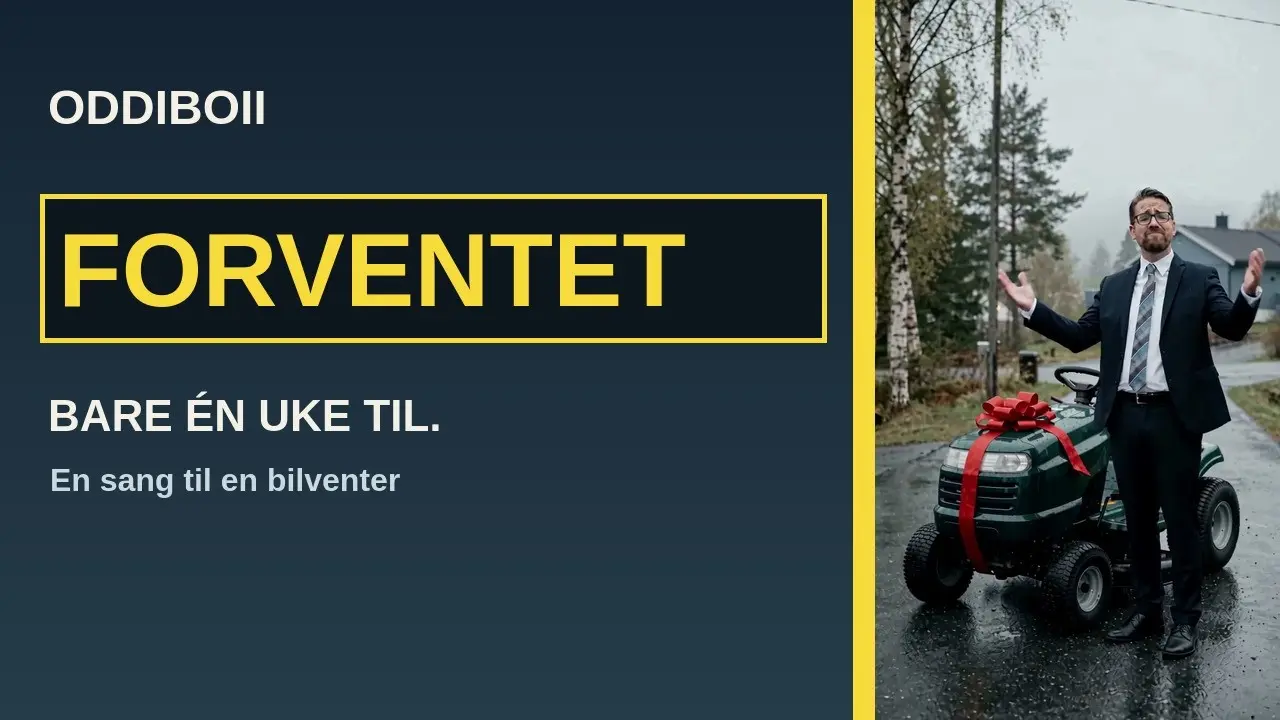
His colleagues at the police station welcomed him with a party song. Three typewritten pages signed R.H. survive in the family archive. The song contains jabs between colleagues, small-town humor, stories about people who had left, and a friendly warning that whatever happened at the party should preferably remain there. The new chief had come from “the smiling South” to the valley of mountains and waterfalls.
I used AI to give the song music and images. A typewritten text can lie silent in a folder for more than 70 years. Then it gains melody and rhythm, and the people behind the official titles become audible again. The song does not document major decisions. It documents atmosphere, humor, and the way colleagues received a person. Those are often exactly the sources that make a biography live.
The war years are the part of Kristoffer’s life that still requires the most work. The family archive points toward April 9, 1940, service at Kristiansand Fortress, work with price and rationing matters, later police service, escape to Sweden, and an appointment as captain from the Royal Norwegian Navy’s high command in London in December 1944. Eli’s account, the diary from 1941 to 1950, certificates, and newspaper clippings all provide important leads.
The timeline is unfinished. Routes, dates, units, and events must be compared with military archives and contemporary records before they can be told as a continuous wartime history. Leaving this open is a strength. The family archive has given me a research project with concrete points of reference, not a finished heroic tale.
After the war, Kristoffer appears in local matters involving police work, vehicle inspections, liquor licensing, hunting and fishing, animal welfare, and civil defense. That was the range of a police chief’s office in a smaller place. Law and order were not only about drama. They were everyday disputes, rules, safety, and administration.
For me, a line runs from Eiler’s court records to Kristoffer’s police station. Both worked inside public systems where power had to meet documentation. But Eli reminds me that the system is never the whole person. The State Calendar can confirm the appointment. The party song can show the colleagues. The daughter can remember her father.
Elizar Saxlund chose to warn people
Kristoffer married Marie Henrikke Saxlund. Her father, Niels Evensen Saxlund, had served as chief of police in Tromsø from 1909 to 1917. The family later lived with ties to Larvik. Niels, his son-in-law Kristoffer, and his son Elizar form a clear succession of lawyers and police officers in the family, but Elizar’s story asks the hardest question.
Elizar Aage Saxlund was Marie Henrikke’s brother and therefore an uncle in my grandmother’s family. He worked as a police prosecutor and second-in-command at Drammen police station during parts of the German occupation. Local wartime research documents that he warned his Jewish neighbor Ester Becker about the planned arrests in November 1942. After arrested Jewish people were brought to the police station, he argued for their release because there was no legal basis for holding them and because he understood the danger into which they might be sent.
The family has preserved a story with a specific number of people he is said to have saved. The exact number and the final outcomes remain a research trail. What can be told on firmer ground is the warning and his attempt to have detained people released.
His life also included a period of membership in Nasjonal Samling, Norway’s fascist party, during the occupation. The material says he was a member from 1940 to 1942 and resigned before the action against the Jews. That complicates the picture: A person can make choices that point in different directions, and history becomes less truthful if its contradictions are polished away.
This is exactly where my sense of justice becomes strongest. What does a person inside a system do when the system demands something fundamentally wrong? Elizar knew the police from within. In November 1942, he used his position to warn people and argue against the arrests. At the same time, the research must be able to examine the whole life, including the membership that makes the picture more difficult.
I want to know more. Police archives, witness testimony, and local historical research may show who was warned, who was released, and what consequences his actions had. Until then, I will let the documented courage and the open questions stand beside each other.
Erik Magnus Carlén followed chemistry from Mölndal to Rjukan and France
Rjukan brought the Hoel and Carlén stories together geographically before the families met through my grandmother Berit Hoel and grandfather Jan Arnljot Carlén. On the Hoel side, Kristoffer arrived as chief of police. On the Carlén side, Erik Magnus Carlén had already spent much of his life inside the industrial system that built the town.
Erik Magnus was born in Mölndal on June 8, 1886. The family archive describes a boy who left home as a teenager and took an unusual route into chemistry and industry. The road did not run directly from a classroom to a finished title. It led out into the world.
From around 1903 to 1910, he lived in the United States. He worked, attended evening classes, and gained technical knowledge through a combination of practice and teaching. Among the workplaces named in the family archive is Cos Cob Power Station in Connecticut, where he worked as a machinist.
That is a story I find easy to recognize. I am self-taught in IT. Expertise does not always arrive in the order suggested by a diploma. Sometimes the problem comes first, then the work, then the need to understand more. Evening school alongside a job says a great deal about the determination to build knowledge while life is already underway.
In the autumn of 1912, Erik Magnus started at Norsk Hydro in Rjukan as a laboratory assistant in the experimental department. Rjukan was then in the middle of the fierce industrialization that used hydropower to build a chemical industry. The town, the factories, and working life grew together. For a man with experience of machines, power, and chemistry, it was a place where practical knowledge could have great reach.
In January 1914, he became works manager for acid concentration. The position placed him in production, where chemical processes had to function reliably, safely, and at scale. A laboratory can prove that a process works. A factory has to make it work again and again, with raw materials, equipment, people, and deviations as part of everyday life.
In 1916, Erik Magnus went to France to help build Fabrique Nitratière de Soulom in the Hautes-Pyrénées. He remained there until 1925. His family lived with him, and the children attended school in Argelès-Gazost. The industrial journey therefore also became a family story about language, school, and a life far from Mölndal and Rjukan.
Nine years is more than a brief assignment. It is a substantial part of an adult life and of the children’s upbringing. Certificates, speeches, and company documents in the family archive provide the outlines: Technical knowledge from Hydro’s environment was used in construction and operations in France, while the family established an everyday life around the work.
They returned to Rjukan in 1925. Erik Magnus also completed an assignment for Hydro in Switzerland in 1928 and later became factory manager for ammonia synthesis. By the time he retired in 1953, he had worked for approximately 41 years within the Hydro system.
That long career contains far more than the label “a Hydro man.” He was the teenager who went out into the world, the worker and student in the United States, the machinist, laboratory assistant, works manager, family man in France, and factory manager back in Rjukan. Chemistry tied the life together across countries.
The details of positions, stays abroad, and proposed improvements rely heavily on documentation in the family archive. I want to compare them with Hydro’s personnel archives, pension records, and French sources from Soulom. The family archive already provides a coherent professional journey, preserved in working-life documents rather than oral memory alone.
Rjukan thus became a crossroads before the families knew it was one. Erik Magnus had built a long life in industry. Kristoffer arrived as chief of police in 1951. Later, Berit Hoel married Jan Arnljot Carlén. The police chief’s family and the Carlén family did not first meet in my database. They met in a town that had already gathered their stories.
Jan Arnljot Carlén remained curious throughout his life
My maternal grandfather Jan Arnljot Carlén was born in 1934 and died in 2022. He was a senior teacher at Haugaland upper secondary school. Teaching fits a family history full of people who measured, documented, and tried to explain, but Jan Arnljot had interests that take him beyond his job title.
He was deeply interested in aquarium fish. He wrote about reproduction and breeding, received awards, and became an established name in the aquarium community. Keeping fish at that level requires more than filling a glass box with water. Water quality, temperature, feed, species, behavior, and breeding must be observed over time. Small changes can have large consequences.
That is curiosity in practice. You watch, try, learn, and share what you discover with other people. The teacher and the aquarium enthusiast are therefore not two entirely different people. Both are about understanding a system well enough to help something develop.
Gaming later became an important interest. Jan Arnljot played Doom, Quake, and Assassin’s Creed well into his eighties. The image makes me smile, but I like what it says about him. New media and new worlds were not reserved for the young. He kept exploring.
Curiosity runs like a thread through many of the stories that have caught my attention. In Eiler, it became constructions. In Hjalmar and Oskar, it became instruments and measurements. In Carl, it became school health. In Erik Magnus, it became technical knowledge built through work and evening classes. In Jan Arnljot, it became teaching, aquarium fish, and computer games.
I have his photographs on DVDs. They are going to be digitized and added to the system. That may sound less romantic than a handwritten letter, but digital memories are fragile too. A DVD can become unreadable. A format can disappear. A folder can be left without a name. History can be lost just as effectively in a dead file format as in a box on its way to the garbage.
Gustav Johan Carlén wrote the history others rarely preserved
Gustav Johan Carlén occupies a very different position in the same maternal family from the professors, the trading house, and the offices of police chief. He came from Sweden and had a Romani/Traveller background. The family history and documents speak of poverty, work from a young age, and discrimination. According to family history, he worked as a herder, begged for food, and was subjected to derogatory language about Travellers.
He later worked in the Norwegian paper industry, including at Korndal and Hunsfos in Vennesla. The family archive also connects him with work at Vigelands Brug and shows how he gained knowledge in an industrial environment. He received Norwegian citizenship in October 1913 and died in Vennesla on December 9, 1937.
It is a life shaped by migration and labor. He moved from Sweden to Norway, found a place in factory industry, and wrote alongside the work. The poems show that labor was not merely an entry in a census. It was body, toil, hunger, rank, and dignity.
He also wrote about nature, faith, and hope. His voice is vulnerable in places, sharp in others, and surprisingly bright in the midst of hardship. The title Lys på veien – Light on the Road – came from that. The light is not simply pleasant decoration. It is something a person chooses to hold on to when the surrounding world provides good reasons to do the opposite.
Romani and Traveller history in the Nordic countries is full of official descriptions, control, discrimination, and attempts to force people into frames made by others. Gustav Johan’s poems are valuable because they allow a Traveller man to express his experiences himself. He becomes the subject of his own history.
When Lillian found the texts beneath the wig, she therefore found more than family papers. She found a rare first-person trace. If the box had been thrown away, the loss would have been greater than the family losing a few poems. A voice from a life and a group so often spoken about from the outside would have fallen silent again.
Lillian and I edited and published the material. The work involved deciphering, sorting, checking, and making many choices about how to present the originals. AI made it possible to handle the material more quickly and recognize patterns in the texts, but responsibility for what we published remained with us.
I later gave the poems new forms through music and video. More than 30 songs let rhythm, rhyme, and imagery meet people who might never open a collection of poems by an unknown factory worker.
The technology did not take over the history. The originals are still there. The book preserves the words in a lasting form. The songs and videos open more doors into them. To me, that is a good use of AI: making material searchable, understandable, and accessible without erasing the person who created it.
Gustav Johan also brings together several questions that run through the project. Who gets to appear in the history books? Who is reduced to a category in a register? Which papers does a family decide are worth preserving? And how much can one patient sister rescue by looking beneath a wig?
When I first saw the family tree, Gustav Johan was one person among hundreds. After the poems, he became a person I could hear. That is the difference this entire project is about.
Eli is the bond between the archive and the family
My great-aunt Eli appears in almost all the most important connections. That is because she is more than a source of individual facts. She carries the relationships between the people.
A public register can show that Kristoffer Hoel was chief of police. Eli can make him her father. The family archive can hold a framed patent description left by Jens. Eli can deliver the line that makes us remember both the ten children and why the memorial stone was raised. A family tree can show the line from Kielland to Boye. Eli can point to the candlesticks and tell the story that traveled with them.
She can correct errors too. It is easy to become too confident when two names and two dates seem to fit. A living source may explain that the people have been confused, that a nickname conceals an official name, or that an object came from a different branch than the note claims. Oral history must be checked like other sources, but it can ask questions that the documents never knew they ought to answer.
At Ullevål, her role becomes even clearer. Eli has macular degeneration and uses eye drops for glaucoma. Her father also had glaucoma. She moves through the ophthalmology environment around Hjalmar Schiøtz Road, carrying the family story about the bust and knowledge of the relative who developed the tonometer.
The archive gives me the instrument from 1905. Medical history explains why intraocular pressure matters. The art register gives me the bronze bust from 1948. The map gives me the road. Eli connects every part to a living person in 2026.
That is why I want to listen now. I can always improve a search function later. I can scan a document again. But a turn of phrase, the pronunciation of a name, or the explanation of why two candlesticks matter may disappear when the last person who remembers it is gone.
What I recognize is a question, not an answer
When I began, I was looking for relatives. In time, I found mirrors as well.
I found Eiler, who worked with law and justice while drawing, building, and designing. I found Hjalmar and Oskar, who made curvature, pressure, gravity, and geomagnetism measurable. I found Carl, who applied systematic work to children’s nutrition and health. I found Kitty, who insisted on the life of an artist and joined the struggle for women’s rights. I found police officers who stood within systems, and Elizar, who at a decisive moment tried to help people the system had turned against.
I found Erik Magnus, who built expertise through work and evening classes and followed the chemical industry across national borders. I found Jan Arnljot, who continued learning, teaching, keeping aquarium fish, and playing computer games into his eighties. I found Gustav Johan, who wrote in his own voice in a society that gave him little reason to believe anybody would preserve it.
On my father’s side, I found the farms and the long continuity of western Norway. The practical and grounded life is there in the map: work that had to be done, places that had to be kept running, and families moving between farms and communities along the fjords. That side reminds me that history does not need a bronze bust to be real.
I grow curious about where my own combination of a sense of justice, system-building, need for documentation, and inventive urge comes from. I see an echo of Eiler when I cannot leave an impractical system alone. I recognize the pleasure of making something searchable and measurable in the Schiøtz brothers. Gustav Johan’s experiences make the question of who gets to define a person more personal.
Heinrich’s privilege and Hjalmar’s decision to forgo a patent also give me two different stories about power and access. One used a royal monopoly to finance a necessary light. The other allowed a medical instrument to spread without patent control. History rarely delivers a neat political lesson. It gives us concrete choices, consequences, and good reasons to ask whom a system is for.
There is no tidy mechanism that turns these interests into a measurable inheritance. I am the one who selected the stories, and I see them through my own experiences. Another descendant might have been drawn most strongly to the music, teaching, art, farming, or the courage required to move.
Even so, the recognition does something to me. It places my interests inside a longer conversation. I do not feel controlled by those who came before me. I gain more people to think alongside.
The map and the history books meet in the database
My system is full of things I do not yet know. My father’s side must go farther into local histories, land registers, probate records, and parish books. The candlesticks need a documented provenance. The Caspar Boye/Borring trail needs a solid Kielland source. Kristoffer Hoel’s war years need a finished timeline. Elizar Saxlund’s actions require further research. Erik Magnus Carlén’s professional journey must be compared with the Hydro archives.
That makes me more excited, not less. Every open trail is a door, as long as I mark it as open.
Genealogy with AI made it possible for me to handle more material, see more connections, and ask better questions. MyHeritage gave me the beginning. The family archive gave me the documents no online service had. Eli gave me the memories. The database made everything searchable. But the history only appeared when the people began to step out of the search results.
On my father’s side, the family is written into the map. On my mother’s side, it is written into the history books. One side shows me places that still bear the names. The other shows how strongly public office, education, wealth, institutions, and published work affect who remains visible to posterity. And within my mother’s side are also Gustav Johan’s poems, a reminder that a factory worker can write himself into history if somebody preserves the papers.
Between the map and the history books stand the boxes in the garage. They remind me that history is not preserved only by museums, hospitals, archives, and encyclopedias. Sometimes it is preserved by a sister who lifts a wig before her brother manages to throw the whole thing away.
I am not merely building a database about those who lived before me. I am trying to give those who come after me more than names and dates. They should get the farms, the light on Kvitsøy, Eiler’s nearly three decades around Karmsund, the wooden vehicle in the museum collection, Kitty’s Jæren landscapes, the Schiøtz instruments, the white surgical coats, the Oslo Breakfast, the song from the police station, the journey to Soulom, the computer games on my grandfather’s screen, and the poems from the box.
They should get the questions too. That matters. A family history does not become more credible when every gap is painted over.
Then the family becomes more than a tree. They become people again.
Sources and further reading
This article draws on institutional sources, the family archive, the family’s genealogy, and oral information from Eli Margrethe Hoel. Family traditions and open research trails are identified as such in the text.
- Norwegian Coastal Administration: The history of the Coastal Administration
- Norwegian Coastal Administration: National conservation plan for maritime infrastructure
- Norwegian Coastal Administration: Management plan for Kvitsøy lighthouse station
- Norwegian Lighthouse Association: Was von Fyhren nobility?
- Norwegian Artists’ Dictionary: Eiler Hagerup Schiøtz
- Norwegian Biographical Dictionary: Hjalmar Schiøtz
- Great Norwegian Encyclopedia: Hjalmar Schiøtz
- Journal of the Norwegian Medical Association: Hjalmar Schiøtz and his tonometer
- Smithsonian Institution: Javal-Schiøtz ophthalmometer
- Great Norwegian Encyclopedia: Oskar Emil Schiøtz
- Great Norwegian Encyclopedia: Carl Schiøtz
- Oslo School Museum: The school breakfast
- National Library of Norway: The Oslo Breakfast
- Great Norwegian Encyclopedia: Gabriel Schanche Kielland
- Norwegian Artists’ Dictionary: Carl Paulsen
- Project Runeberg: 1959 Norwegian State Calendar, Rjukan police district
- Great Norwegian Encyclopedia: Rjukan
- The family archives of Gustav Johan Carlén, Erik Magnus Carlén, Jens Kristoffersen Hoel, and Kristoffer Hoel
- Oral family history from Eli Margrethe Hoel
Frequently asked questions
How did AI help with this genealogy project?
AI helped me decipher handwriting, organize documents, compare name variants, build timelines, and find connections across the material. I also used it while building my own SQLite and FTS5 system. It did not replace sources or judgment: uncertain claims remain marked as open research trails.
Why did I build my own family history database?
MyHeritage gave me useful matches and a starting point, but I wanted to search stories, places, documents, relationships, and source status together. My own system holds about 390 people, 91 families, and documented lines spanning 12 generations back to 1618.
What does “the family is in the map” mean?
On my father’s side, farm and place names such as Bauge, Baugstø, Skromme, Jegteberg, and Lothe preserve family history across western Norway. Those lives are often visible through land, parish, probate, and local records rather than biographies or institutional histories.
Which parts of the family history are still uncertain?
Several trails remain open, including parts of my father’s line, the provenance of Eli’s candlesticks, Kristoffer Hoel’s complete wartime timeline, the precise outcome of Elizar Saxlund’s actions, and parts of Erik Magnus Carlén’s work history. I would rather mark a gap than paint over it.