Innhold Show
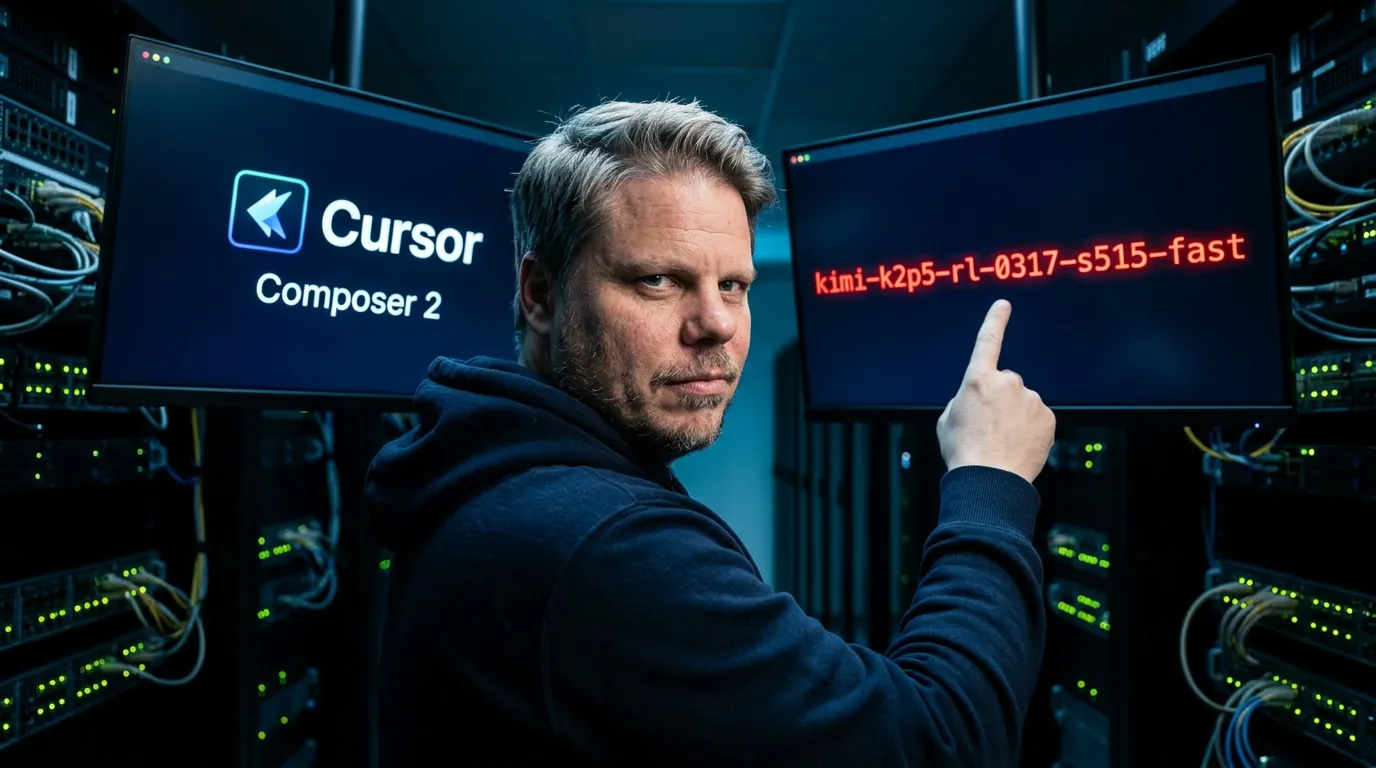
Cursor launched Composer 2 on March 19, 2026, positioning it as its own model with better coding performance from continued pre-training and reinforcement learning. The problem was that the model ID, kimi-k2p5-rl-0317-s515-fast, revealed what was under the hood: Kimi K2.5 from China’s Moonshot AI. Cursor had not mentioned that at all.
Moonshot AI was not pleased. Yulun Du, the company’s head of pre-training, said the tokenizers matched and that Cursor had neither paid nor obtained permission for the use. Kimi K2.5 was released under a modified MIT license with a specific clause: companies above the stated user or revenue thresholds must display “Kimi K2.5” prominently in their product. Cursor, valued at $29.3 billion, had not done so.
So this was the situation on March 20, 2026: one of the world’s fastest-growing AI companies used a Chinese open-weight model as its foundation, called the result its own and somehow forgot to tell anyone. That is the short version. Here is what actually happened.
What is Kimi K2.5, and what does it do well?
Moonshot AI released Kimi K2.5 in January 2026. I covered the model when it launched, and it is technically impressive. It uses a Mixture-of-Experts architecture with 1 trillion total parameters while activating only 32 billion for each request. It was trained on 15 trillion tokens combining text and visual data, making it natively multimodal.
It also keeps up with the leading models on coding benchmarks. Moonshot reported a score of 50.2% on Humanity’s Last Exam. Its Agent Swarm technology can coordinate as many as 100 specialized AI agents in parallel and, according to Moonshot, cut execution time by a factor of 4.5. It offers all of that at a substantially lower cost than many competitors.
In other words, it is not hard to see why Cursor found the model attractive. Kimi K2.5 is genuinely good, and its weights are open. Someone downloaded it, sharpened it for coding with further reinforcement learning, and packaged the result as Composer 2. There is nothing inherently wrong with building on an open model. That is the point. But Moonshot AI attached a condition to the license.

What does the license require, and did Cursor breach it?
Kimi K2.5 is distributed under a modified MIT license. It is broadly permissive: you can use the model, modify it and build products on top of it. One clause stands out, however. Commercial products with substantial usage or revenue must display “Kimi K2.5” prominently in the product.
Cursor was hardly an unknown startup. The company had been valued at $29.3 billion, and its user base was growing quickly. It was difficult to argue that Cursor did not qualify as a commercial product with substantial usage or revenue. Yet its March 19 announcement discussed continued pre-training and reinforcement learning repeatedly. Kimi K2.5? Not a word.
Du said the tokenizers matched and publicly stated that Cursor had neither paid Moonshot nor asked for permission. Moonshot’s accusation remained unanswered when the story was published on March 20, 2026.
Is this part of a wider pattern in AI?
The Hacker News discussion around the case was worth reading. One commenter put it bluntly: the IDE is based on VS Code, and the company is built around packaging and reselling open source. That is not necessarily criticism. It is a business model. Combined with a lack of transparency about which models actually run under the hood, however, it starts to look rather ugly.
Open models exist so people can use them. Moonshot AI chose to release Kimi K2.5 openly when it could have kept the model closed. But “open” does not mean “without conditions,” and licenses exist for a reason. When a company with a multibillion-dollar valuation takes a model, specializes it and sells the result without crediting the people who built the foundation, I see two serious problems.
First, it breaches the attribution requirement described in the license. Second, it damages trust in open models as a business model. If large companies repeatedly take open models and resell the results without giving credit, fewer developers will choose to release their models openly. You do not preserve an open ecosystem by pretending its foundations appeared by magic.

What did this mean for Cursor users?
For anyone using Cursor every day, the practical question was simple: was Composer 2 a good model? Based on what was known about Kimi K2.5, the answer was probably yes. Reinforcement learning focused specifically on coding was a sensible strategy, and the foundation model was solid.
But there was something deeply uncomfortable about paying for a tool that was not transparent about what ran under the hood. That mattered especially when users had legitimate questions about Chinese models and data processing. Not because Kimi K2.5 was automatically dangerous, but because paying customers deserved to know what they were actually using. It was a matter of respect for the people paying the bill.
This was also not the first time Cursor had appeared in the news over questionable practices. The fast-growing company moved quickly – and sometimes, apparently, too quickly to check every detail in a license. Users did not need a vague promise. They needed Cursor to identify the foundation model clearly and explain how it handled both the license and customer data.
What could happen next?
Cursor had two obvious ways out. It could confirm its use of Kimi K2.5, add the required attribution and potentially pay whatever Moonshot believed it was owed. Or it could dispute the accusation and argue that its reinforcement-learning work had changed the model enough for Composer 2 to count as something new.
The second route looked legally difficult. The license language focused on commercial products above its usage or revenue thresholds, not only products running an entirely unchanged model. A version refined with reinforcement learning but built on Kimi K2.5 was still built on Kimi K2.5.
Moonshot AI chose to make the dispute public, which was unusual in an industry where conflicts like this are often handled quietly. That signaled that the company was serious. It also drew attention to a problem that was probably much broader than this one case: large companies building on open models without giving anything back, whether money or credit.
I am generally skeptical of Chinese models, but skepticism about the technology is one thing. Using it while pretending it does not exist is something else entirely. That is disrespectful to the people doing the actual research, and the industry should take it seriously. Cursor owed Moonshot and its own users a clear answer.
Frequently asked questions
Was Cursor Composer 2 based on Kimi K2.5?
The model ID kimi-k2p5-rl-0317-s515-fast pointed directly to Kimi K2.5, and Moonshot’s Yulun Du said the tokenizers matched. The evidence indicated that Composer 2 used Kimi K2.5 as its foundation and added coding-focused reinforcement learning.
Why did Kimi K2.5 require attribution?
Kimi K2.5 used a modified MIT license. It permitted use and modification, but required commercial products above specified usage or revenue thresholds to display the Kimi K2.5 name prominently. Moonshot alleged that Cursor had not met that condition.
Did Moonshot AI give Cursor permission?
Moonshot’s Yulun Du said publicly that Cursor had neither paid nor asked for permission. When the story was published on March 20, 2026, Cursor had not publicly responded to that accusation.
Was Composer 2 still useful for coding?
Probably. Kimi K2.5 was a strong foundation, and coding-focused reinforcement learning was a sensible way to specialize it. The dispute was not proof that Composer 2 performed poorly. It was about attribution, licensing and whether paying users were told what model they were using.