Innhold Show
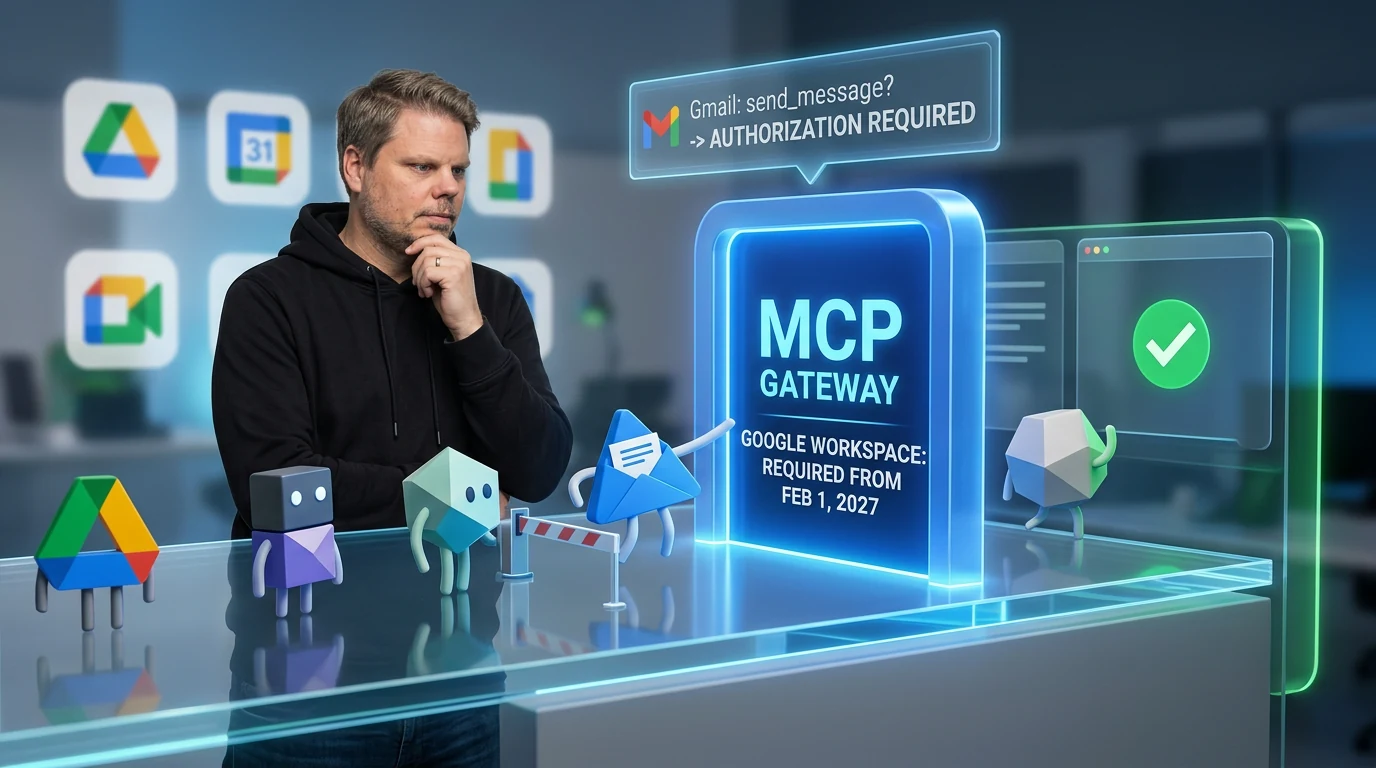
Google is making MCP the main gateway between AI agents and Google Workspace from February 1, 2027. If you build an agent that reads Gmail, works in Drive or updates Calendar, you will have to use Google’s Workspace MCP servers or the Workspace command-line interface. That brings new security gates, new quotas and, eventually, a new bill for anyone who needs more than the standard tier.
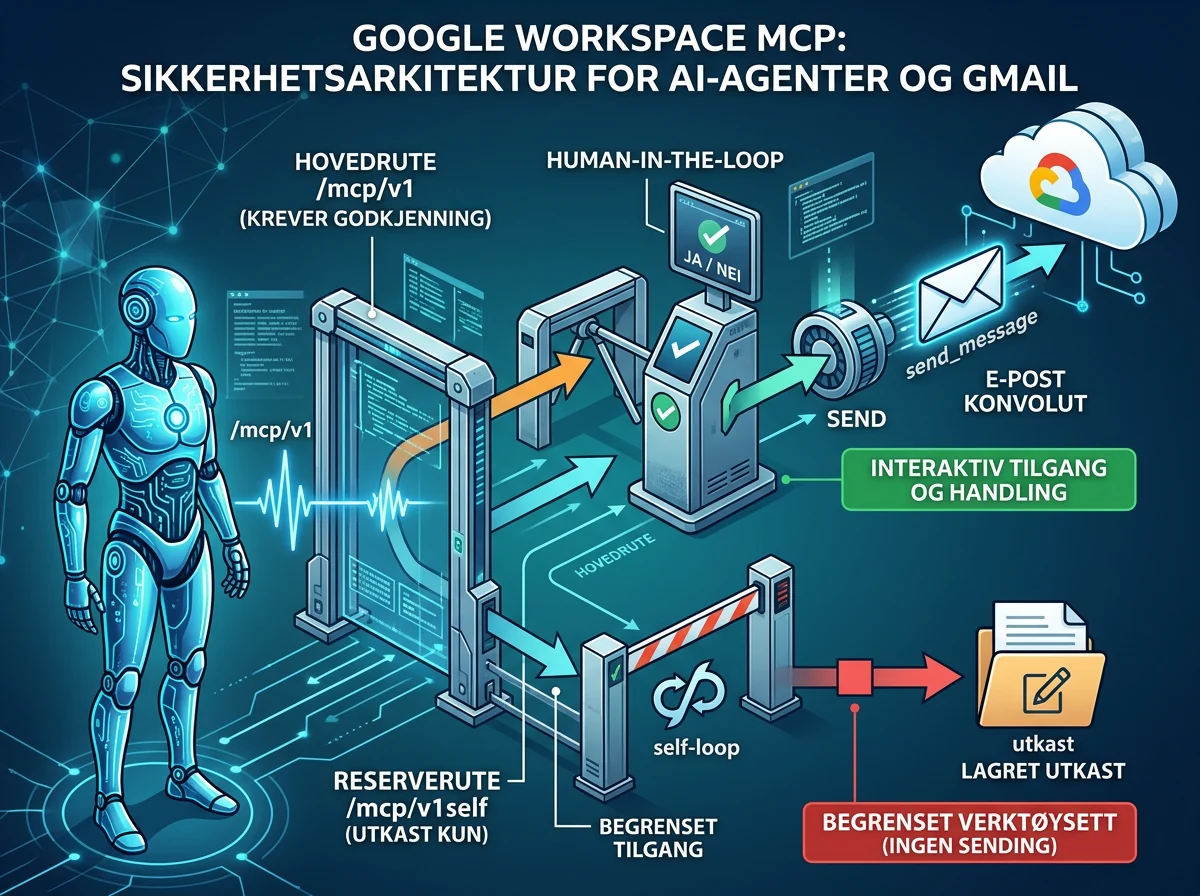
The most eye-catching claim around the launch was that the Gmail server cannot send email. Google’s documentation now says otherwise. The public Gmail MCP server includes a send_message tool, but only on the primary /mcp/v1 endpoint. The MCP client must support Google’s interactive approval flow before a sensitive action can be completed.
That distinction matters. Gmail is not missing the ability to send. The limited fallback endpoint, /mcp/v1self, omits sending because it is intended for clients that cannot handle this kind of interactive approval. The central story is Google’s decision to standardize how agents gain access, how people approve sensitive actions, how much an app may use and who controls the gateway.
What is Google changing for AI agents?
From February 1, 2027, Google will require AI agents and similar access tools to use the Google Workspace MCP servers or Workspace CLI when retrieving Workspace data. Direct use of the REST APIs for agentic workloads will be held to Standard Tier quotas regardless of the tier otherwise selected for the project. Google’s timeline and quota guide sets out the dates and says the new Workspace AI Tools Addendum takes effect on the same day.
MCP is a common language between an AI client and the tools it can use. Instead of every agent integration inventing its own interpretation of the Gmail, Drive and Calendar APIs, Google provides tools with defined names, arguments, results and approval requirements. That can make integrations more consistent. It also gives Google one place to enforce the rules.
Google has generally available MCP servers for Gmail, Calendar, Drive, Docs, Sheets, Slides, Chat and Tasks. People API also appears in the combined tool reference, while some other services remain in Developer Preview. This may save substantial integration work for a small internal agent. For an established service already using REST directly, it is a migration with real architectural consequences.
The security argument is easy to understand. An OAuth token proves that an app has access, but it does not necessarily prove that the user intended an agent to perform this particular action at this particular moment. An email, document or web page may also contain instructions designed to manipulate the agent. Putting policy, logging and approval in the request path is better than hoping the system prompt will sort everything out.
Can Gmail MCP actually send email?
Yes. Google’s current tool reference lists 30 Gmail tools on /mcp/v1 and 25 on /mcp/v1self. The send_message tool immediately sends a new email from the user’s Gmail account and is available on the primary endpoint. forward is also restricted to that endpoint, while tools including create_draft and update_draft are available on both. The difference is documented in Google’s combined reference for Workspace MCP tools.
This is not an arbitrary product limitation. The primary /mcp/v1 endpoint is designed for MCP clients that support form elicitation, meaning the server can ask the client to present an approval form to the user in the middle of a tool call. The /mcp/v1self endpoint is the fallback for clients that do not support that flow. It omits tools that always require interactive approval under the standard policies.
Two developers can therefore connect to the same Gmail MCP server and see different capabilities. A client using https://gmailmcp.googleapis.com/mcp/v1 with form-elicitation support can gain access to sending with human approval. A client using https://gmailmcp.googleapis.com/mcp/v1self gets a safer but narrower toolset without send_message.
This also explains why an agent may be able to create a draft while being unable to send it. That is not evidence that the entire Gmail server lacks sending. It means the client, endpoint or policy in use does not allow that action. Google’s documentation even warns that models may choose create_draft on their own because they incorrectly assume that sending happens without control.
How does approval work before an action?
On the primary endpoint, the server pauses a sensitive tool call and returns a request for user input. The client shows what the agent intends to do, the user approves or rejects it, and the client then sends the same tool call again with the response and a state value from the server. Only then is the action performed. Google’s technical guide describes the process in seven steps.
That makes sense for email, sharing, deletion and other actions with consequences outside the agent’s conversation. I use agents extensively in my daily work, and the transition from suggesting an action to actually performing it is exactly where an integration must be precise. An agent that writes a good reply has not automatically received a blank check to send it to a customer.
The approval flow does not solve the entire security problem. A user may approve an action without realizing that the agent was influenced by content it had just read. A model can also select the wrong tool or enter the wrong recipient. The client must therefore show the specific action, target and relevant data – not merely a vague button marked “Allow.”
Google also recommends instructing the agent to use the tool that actually matches the user’s intent. If an action is rejected, the agent should stop and respect the decision rather than trying an alternative write operation. That sounds obvious. My experience with agents is that obvious rules should be built into the control flow, not left to the model’s mood that day.
How much does Google Workspace MCP cost?
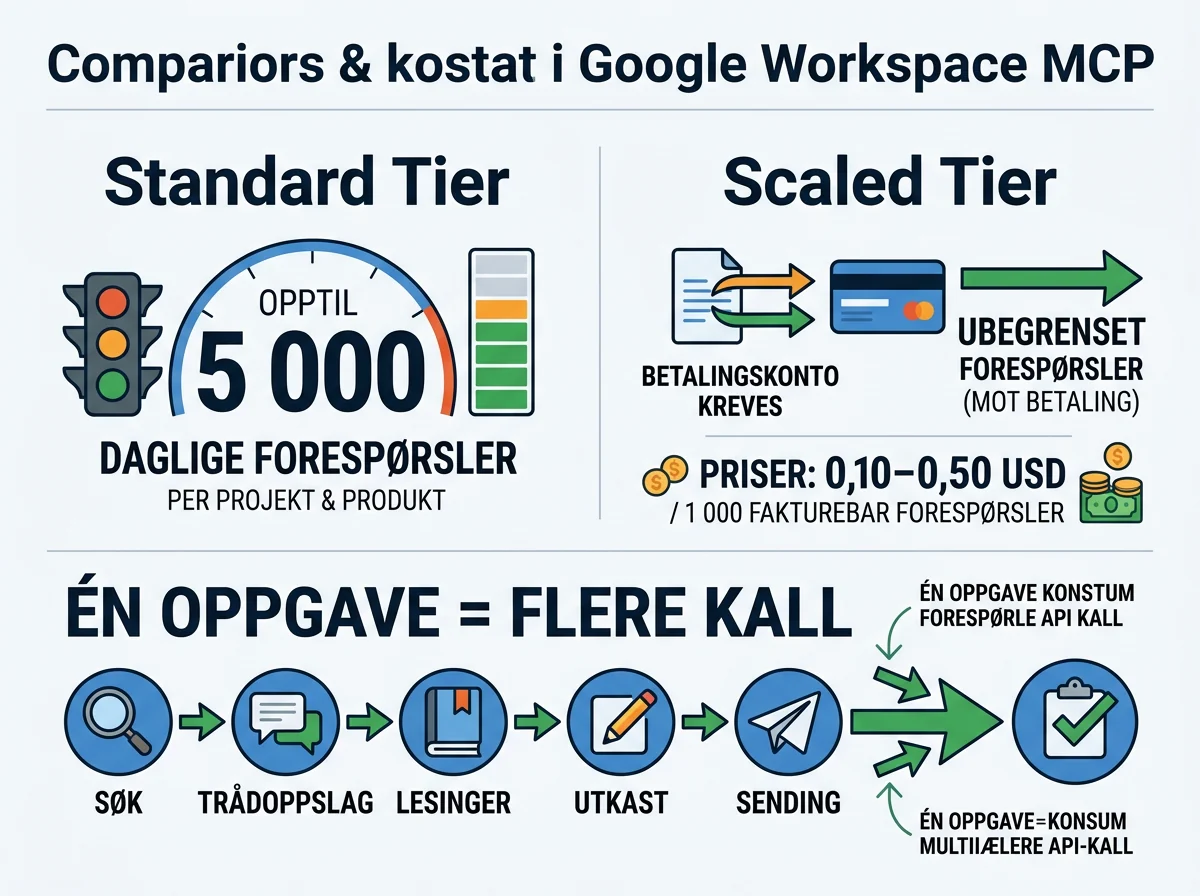
Standard Tier provides up to 5,000 MCP requests per day, per project and per product, without requiring a billing account. Some compound tools count as multiple requests because they perform several underlying API calls. In other words, 5,000 tool calls do not necessarily equal 5,000 quota units.
A project that needs higher MCP quotas must move in full to Scaled Tier and link a billing account. Enrollment does not automatically increase the limits; the developer must still request a quota increase. From April 1, 2027, successful calls to the Gmail, Calendar and Drive servers on Scaled Tier will be charged from the first request. Standard Tier remains free within its limits.
Google’s pricing page divides operations into four groups. The prices are $0.10, $0.20, $0.25 and $0.50 per 1,000 billable requests, depending on the weight of the operation. Actual cost depends on the tools used and the number of quota units each call consumes.
A basic email send falls into the Medium group, while thread retrieval and search are Premium operations. That matters because agent work often involves several searches and reads before one final action. The send call itself is unlikely to dominate the workflow. Cost should be measured per completed task, not per tidy demo of a single tool call.
Is this only about security, or also platform control?
It is both. Google has good reasons to demand clearer controls when AI can act on email, files and calendars at machine speed. A standardized layer for approval, data governance and logging is more robust than hundreds of integrations all inventing their own security model.
At the same time, Google is moving agent traffic into a gateway that it owns, measures and prices. Google defines the tool surface, decides which actions require approval, calculates the quotas and determines which projects may scale. When direct REST use by agents is held to Standard Tier and higher MCP quotas require Scaled Tier, this is a business model as well as a security model.
That does not automatically make the solution bad. But developers should be honest about the dependency. An agent built directly around Google’s tool names, approval protocol and quota model is not simply using “standard MCP.” It is tied to Google’s interpretation of MCP and Google’s continuing product decisions. Less integration work for the developer also means placing more of the architecture in the supplier’s hands.
This matters especially to smaller providers. Large companies can build support for form elicitation, administrator controls, audit logs and changes to the toolset. A small developer must solve the same requirements before February 1 if the agent needs to go beyond the standard limits or uses Workspace data in ways covered by the new terms. The security benefit is real, but the friction is not distributed equally.
What should developers do before February 1, 2027?
Start by finding every place where a model, agent or agent platform reaches Gmail, Drive, Calendar or another Workspace service. Separate these workflows from ordinary deterministic integrations. A scheduled synchronization job does not automatically become an AI agent merely because it runs in the same project.
Then choose the right access path. If the agent must send email or perform another action that requires interactive approval, the client needs to support /mcp/v1 and form elicitation. If it uses /mcp/v1self, you must accept the narrower toolset. Do not base a product promise on a capability you saw in the full reference without checking which endpoint the client actually uses.
Create a separate OAuth client for the agent function where required, enable the AI-powered agent designation and test approval, rejection and cancellation. Log the action the agent requested, what the user saw and what was ultimately performed. A user must be able to say no once without the model attempting a creative detour.
Measure quota usage on real tasks as well. One agent run may perform several searches, retrieve a thread, read attachments, update a draft and finally send. The useful unit is therefore cost and request count per completed work task. If you exceed 5,000 daily requests per project and product, Scaled Tier, the quota increase and the associated costs need to be in the plan before April.
I would not wait until the end of January. Google’s gateway is becoming a mandatory part of the architecture, and the difference between the two endpoints is not cosmetic. It decides which actions the agent can actually perform. Gmail can send email through MCP. The question is whether your client can handle the control Google requires before it is allowed to do so.
Frequently asked questions
Will every app have to use Google Workspace MCP in 2027?
No. The requirement covers AI agents and similar access tools that retrieve data from Google Workspace. Ordinary deterministic apps and integrations are not automatically included. Developers should still review the terms and classify each workflow before February 1, 2027.
Why is send_message missing from /mcp/v1self?
/mcp/v1self is a limited fallback endpoint for clients without full form-elicitation support. It omits tools that always require interactive approval under the standard policy. Use the primary /mcp/v1 endpoint when the client can display and return Google’s approval form.
Is Google Workspace MCP free?
Standard Tier is free and includes up to 5,000 daily requests per project and product. Higher MCP quotas require Scaled Tier. From April 1, 2027, successful Gmail, Calendar and Drive calls on Scaled Tier are billed from the first request.
Can an agent bypass MCP and keep using the Gmail REST API?
Direct REST calls for agentic use will be limited to Standard Tier from February 1, 2027, regardless of the project’s selected tier. Google’s new addendum also requires MCP or Workspace CLI for the relevant agent access, so REST is not a valid route around the scaling rules.