Innhold Show
DeepSeek is reportedly closing a funding round worth about $15 billion, one of the largest ever in China, just two days after the US ordered federal agencies to remove the company’s technology.
That is enough money to build data centers, develop new models, and compete much more aggressively with American AI companies. But the round has so far been reported by news organizations citing anonymous sources. DeepSeek, Tencent, and battery giant CATL have not publicly confirmed the final amount, and the terms could still change.
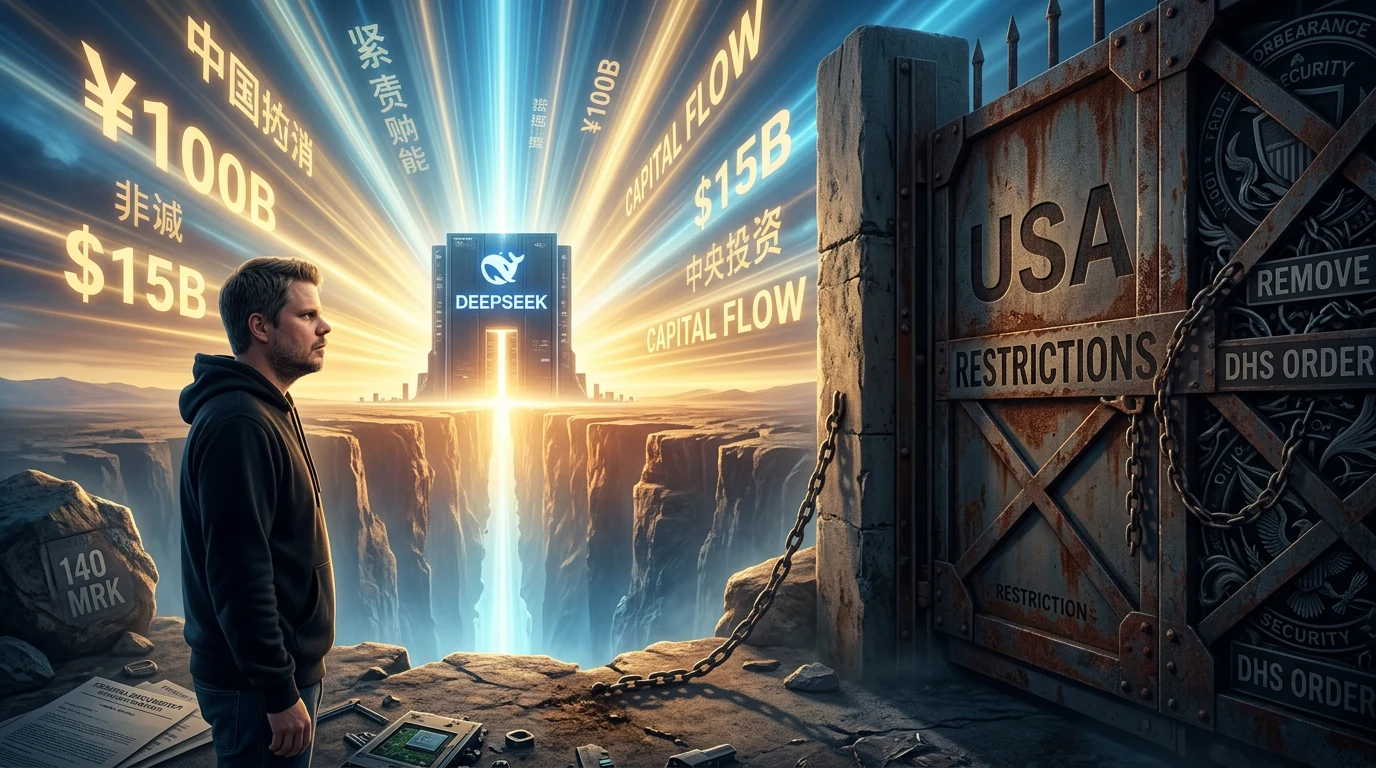
The contrast is hard to miss. Washington can force DeepSeek out of federal IT systems. It cannot order the company out of existence, make Chinese capital disappear, or stop the rest of the world from taking an interest in affordable open-weight models. National barriers are getting higher while the AI race attracts even more money.
What do we know about the DeepSeek funding round?
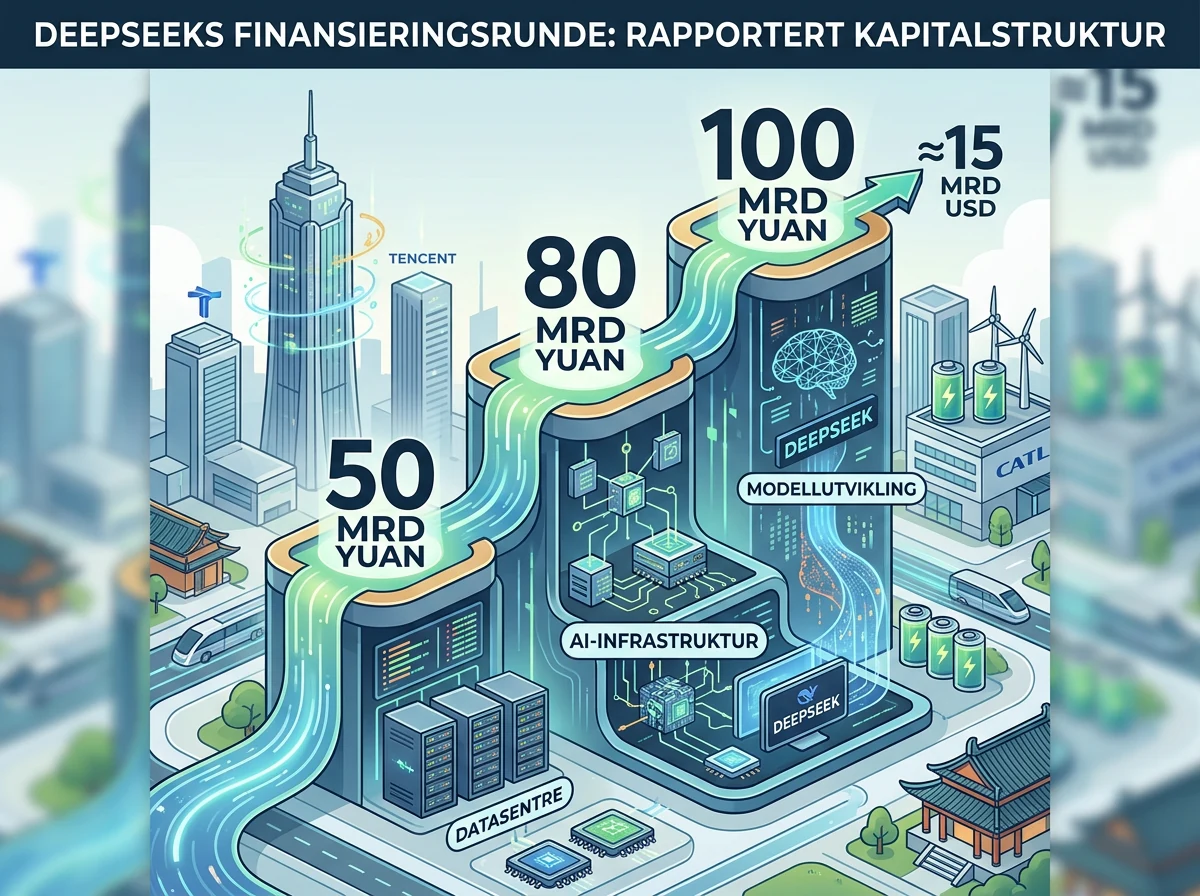
DeepSeek is reportedly close to completing a funding round of roughly RMB 100 billion, or about $15 billion. Bloomberg reported on October 22 that the company had raised its target at least twice, first from RMB 50 billion to RMB 80 billion and then to about RMB 100 billion.
Tencent, the company behind WeChat, and Chinese battery manufacturer CATL are said to be among the largest investors. TechCrunch described it as one of China’s largest funding rounds, while also noting that DeepSeek did not respond to a request for comment.
That qualification matters. Reuters was told that the financing was expected to close within days, but that the financial details were not yet set in stone. The claim is not that $15 billion has been publicly confirmed in DeepSeek’s bank account. Bloomberg broke the story, and Reuters followed with anonymous sources of its own. Both described a round of roughly RMB 100 billion, with Tencent and CATL among the largest investors.
The reported amount is twice the original RMB 50 billion target. That says something about the appetite surrounding DeepSeek. The company is moving from funding through founder Liang Wenfeng’s hedge fund, High-Flyer, toward backing from some of China’s most powerful technology and industrial companies.
Why does DeepSeek need so much capital?
DeepSeek needs capital for AI infrastructure, data centers, and further development of open-weight models. Training and serving models at global scale is expensive, even for a company that became famous by challenging the assumption that only the largest American budgets could produce competitive AI.
The company raised more than $7 billion in June at a valuation above $50 billion. That round had an unusual structure: investors put capital into a limited partnership controlled by Liang Wenfeng, and the shares came with a five-year lockup. Reuters could not independently verify those details at the time, but reported that the arrangement was designed to preserve the founder’s control.
The new round would not be a routine top-up. At around $15 billion, it would be more than twice the size of the June financing by itself. The money could reduce DeepSeek’s dependence on High-Flyer’s balance sheet and let the company expand infrastructure faster, even as US export restrictions make the most advanced American chips harder to obtain.
DeepSeek is already much more than one well-known chatbot. Its model family continues to expand across long context, faster inference, and lower resource use. More capital could accelerate those releases while giving the company greater control over the physical infrastructure behind them.
What has the US actually restricted?
The US action applies to civilian federal agencies. It is not a nationwide ban on private Americans using DeepSeek. The order stops new federal procurement of DeepSeek products and requires the technology to be removed from civilian federal IT systems. It also covers affiliates and third-party products built with DeepSeek implementations.
The Department of Homeland Security published the order in the Federal Register on October 20, 2026. It cites federal supply-chain risk and concern that information from US government users could become accessible to Chinese authorities. An earlier December 2025 decision covered national security systems, while the new order brings many more civilian agencies under the restrictions.
It is perfectly reasonable for government systems holding sensitive data to impose hard requirements on suppliers and data handling. But this order goes beyond blocking DeepSeek’s own cloud service. Once third-party products built with DeepSeek technology must also be removed, the inventory job becomes much broader. Agencies can seek exceptions, but exclusion is the default.
And here comes the bureaucratic catch. Writing “DeepSeek” on a blocklist is easy. Deciding whether a local model, a fine-tune, or one component inside a larger system counts as a DeepSeek implementation is rather less elegant. Large vendors have lawyers and dedicated compliance departments. Small developers and subcontractors get the bill for proving that every part of the chain is acceptable.
Will the US order make DeepSeek weaker?
In the short term, DeepSeek loses access to a large and prestigious customer group in the United States. The order may also influence American companies that do not want the risk of using technology the federal government has labeled a security concern. That is a real commercial disadvantage.
At the same time, the funding round shows the limited reach of a national procurement ban. If the round closes at RMB 100 billion, DeepSeek will have about $15 billion to spend in China and other markets. Tencent can bring distribution and a vast software ecosystem. CATL comes from the industrial and energy side, which matters more with every new data center consuming enormous amounts of power and physical infrastructure.
The result may be two increasingly separate AI ecosystems. The US is trying to keep Chinese technology out of its own systems while restricting access to advanced chips. Chinese investors are answering with more capital for domestic companies, domestic infrastructure, and models that can be deployed outside American cloud services.
That can become a self-reinforcing cycle. The harder it is for Chinese companies to buy American technology, the stronger the incentive becomes to develop domestic chips, toolchains, and model platforms. The more money moves into a separate Chinese ecosystem, the less influence Washington has over how the technology is developed and used beyond the United States.
None of this means DeepSeek has won. The company still faces hardware constraints, serious security questions, and American competitors with enormous access to capital. But $15 billion is enough to stop any serious observer from dismissing DeepSeek as a short-lived Chinese sensation.

What does this mean for developers and businesses?
For developers, the funding means DeepSeek will probably have more capacity to release, operate, and improve models. That matters even to people who never send a single byte to DeepSeek’s own servers. Open-weight models can appear through cloud providers, in local deployments, and as the foundation for new fine-tunes.
Open weights do not remove risk by themselves. You need to distinguish between running a model locally and using a vendor-controlled cloud service. Local deployment can reduce data sharing with the model provider, but licensing, supply chain, model provenance, updates, and your own security requirements still need proper review.
Companies supplying the US federal government now have a specific job: map where DeepSeek technology appears directly or indirectly in their products. The order covers third-party products built with DeepSeek implementations, so searching for an app icon on a laptop will not do. Model servers, API routing, embedded components, and vendor dependencies all belong in the inventory.
For everyone else, it is too early to treat the US order as a universal verdict. Security requirements should follow the data, the use case, and the threat model. A system holding federal secrets is not the same thing as a local model summarizing public documentation. The same logo does not create the same risk.
The AI race is becoming more expensive and more national
The DeepSeek round is first and foremost a demonstration of financial weight. The company that became the symbol of efficient Chinese models challenging US giants in 2025 is about to gain a budget that even the largest technology companies must take seriously. It could mean more infrastructure, more open-weight models, and a faster path toward an eventual public offering.
It also shows how little government barriers can achieve on their own. The US can protect its systems and choose its own suppliers. That is not the same as stopping technological competition. When one door closes in Washington and $15 billion opens others in China, it becomes difficult to pretend that the competition can simply be administered away.
I remain skeptical of Chinese models when data handling, control, and political influence are unclear. But skepticism is not the same as underestimating the opponent. DeepSeek has money, industrial backers, and a model strategy reaching far beyond China. That is why this round matters more than yet another large check in the AI industry.
Frequently asked questions
Has DeepSeek confirmed the $15 billion funding round?
No. Bloomberg, Reuters, and TechCrunch reported the amount based on anonymous sources. DeepSeek and the named major investors had not publicly confirmed the final total, and the terms could still change when the reports were published.
Is DeepSeek banned for everyone in the United States?
No. The order applies to civilian federal procurement and IT systems. It also requires agencies to remove third-party products built with DeepSeek implementations. It is not a general nationwide ban on private use.
Who is reportedly investing in DeepSeek?
Tencent and Chinese battery manufacturer CATL are reportedly among the largest investors. The final investor list and allocation have not been publicly confirmed, so the names should still be treated as reported information.
Why does the funding matter outside China?
A $15 billion round could fund larger data centers, more model development, and broader distribution of open-weight models. That affects cloud providers, local deployments, and international AI competition even where DeepSeek’s own service is restricted.