
Innhold Show
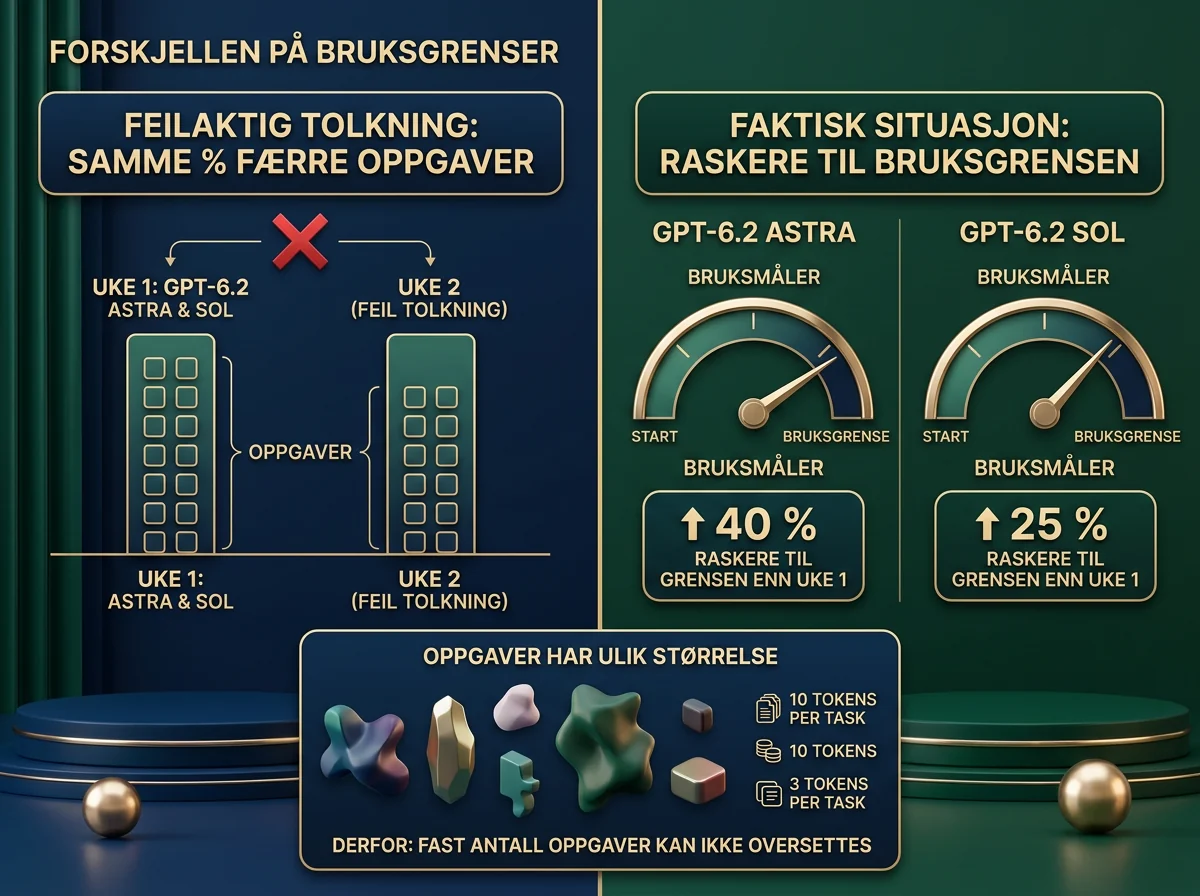
If you use GPT-6.2 Astra or Sol in Codex and ChatGPT Work, the same included allowance now gets you less work than it did during launch week. OpenAI has fixed what it calls a billing error. After the correction, users hit the limit 40% faster with Astra and 25% faster with Sol than they did the week before.
That does not mean the subscription price has increased, and it does not automatically mean 40% or 25% fewer completed tasks. Different tasks can consume wildly different amounts of the allowance. The practical effect is still straightforward: if you repeat the same work with the same settings, your included usage runs out faster than it did immediately after launch.
OpenAI says GPT-6.2 usage was accidentally undercounted for most users at launch. As compensation, the company is giving Go, Plus, Pro and Business users one stored full reset. That is a decent gesture. It does not replace clear numbers showing what customers can actually expect their subscription to cover.
What changed in the GPT-6.2 usage limits?
OpenAI changed how much GPT-6.2 Astra and GPT-6.2 Sol consume from the included allowance in Codex and ChatGPT Work. In the November 26 announcement, Tibo Sottiaux, who works on Codex and ChatGPT at OpenAI, said a launch bug had given both models an unintended usage discount. That bug has now been fixed.
Sottiaux compared the corrected system with the previous week and said users will now reach their limits 40% faster with GPT-6.2 Astra and 25% faster with GPT-6.2 Sol. Other models were not affected, and OpenAI says it will not retroactively charge users for the difference. “Faster to the limit” is not the same thing as a published table of messages, agent jobs or tokens per subscription.
OpenAI’s own documentation explains why a fixed task count would be misleading. Usage in Work and Codex varies by model, task size, input and output, reasoning level and speed setting. A small code edit and a long agent run across an entire repository can therefore place very different loads on the same plan.
A billing fix that feels like a cut
From OpenAI’s perspective, this is a correction to faulty metering, not a price increase or a formal downgrade of the plans. From the user’s perspective, that distinction becomes rather academic. If identical work consumed less of the allowance last week and consumes more this week, the value of the included usage has fallen compared with the product customers met at launch.
The wording still matters because it prevents a different mistake. We cannot claim that OpenAI removed 40% of all Astra tasks or 25% of all Sol tasks. Reaching a limit 40% faster does not automatically translate into 40% fewer deliverables, especially when every task can consume a different amount. OpenAI has not published the underlying calculation behind those percentages either.
What OpenAI has documented is serious enough without exaggeration. GPT-6.2 launched with incorrect usage metering. The error favored customers, and fixing it means paying users now hit their limits sooner. When included usage is a central part of what the customer is buying, a change this large deserves more explanation than two percentages and a notice that the meter now works as intended.
The launch promise makes this more awkward
Efficiency was a major part of OpenAI’s message when it introduced the models. In the GPT-6.2 Astra and Sol launch announcement, the company said both models delivered better results on demanding tasks with fewer output tokens, allowing users to get more done within their usage limits.
OpenAI said Astra used 22% fewer output tokens than GPT-6 Astra in its own GDPval v2 evaluation. The promise for Sol was even more direct: the new model was supposed to be more efficient than GPT-6.1 Sol and allow users to complete more tasks on the same paid plan. That may still be true when the new models are compared with their predecessors, even after the billing correction. The new usage percentages do not prove it either way.
Two different comparisons are at work here. The launch material compares the models’ technical efficiency with older models. The correction compares how quickly GPT-6.2 users reach their limits now with how the faulty meter behaved the week before. A model using fewer output tokens does not necessarily mean the subscription system deducts allowance in the same proportion.
The result looks a little absurd to an ordinary customer: the model is promoted as more efficient, yet that same model now eats more of the plan’s allowance than it did at launch. Both statements can be technically true. OpenAI should still understand that customers judge the product by what they can complete, not by how elegantly its internal systems distinguish model cost, token efficiency and subscription usage.
Who is affected?
The change applies to GPT-6.2 Astra and GPT-6.2 Sol usage deducted from the included allowance in Codex and ChatGPT Work. The two products share a usage structure, while model access and limits depend on the plan, workspace and settings. Regular Chat has its own model choices and limits, so it should not automatically be folded into this specific change.
GPT-6.2 Astra is aimed at the heaviest coding, analysis and professional tasks, while GPT-6.2 Sol is positioned as the more efficient model for everyday work. This matters most to people who run substantial agent jobs rather than a handful of short prompts. Capacity and usage limits are no longer a footnote when the work itself depends on an agent remaining available long enough to finish.
API usage also needs to be separated from the subscription allowance. If you sign into Codex with a ChatGPT subscription, you use the plan’s included quota. If you use your own API key, usage is billed separately at the published token rates. OpenAI lists GPT-6.2 Astra at $8 per million input tokens and $40 per million output tokens. GPT-6.2 Sol is listed at $2 and $10 respectively. This correction concerns included subscription usage, not a change to those published API prices.
The stored reset only helps once
As compensation for the transition, Sottiaux announced one stored full reset for Go, Plus, Pro and Business users. A reset can refill the relevant usage windows when the user chooses to activate it. It sits on the account until it is used or expires, rather than automatically wiping the meter when the announcement goes live.
OpenAI’s guidance on one-time resets says the terms, expiration date and limits restored can vary by offer. Check Settings > Usage before activating yours. If plenty of allowance remains, using the reset immediately may waste part of its value. If both a shorter usage window and the weekly limit are exhausted, it can be much more useful.
This is compensation for the changeover, not a permanent expansion of the plan. Once that single reset has been used, GPT-6.2 continues at the corrected rate. Anyone planning long-running agent jobs needs to budget for the new reality rather than treating the reset as a recurring part of monthly capacity.
How I would allocate GPT-6.2 usage
Start with your own usage page instead of trying to reverse-engineer task counts from the percentages. Open Settings > Usage and check both your remaining allowance and the next reset time. Some plans use more than one usage window, so spare capacity in one window does not necessarily mean every relevant limit is still open.
Use Astra when a task genuinely needs the strongest model. Complex failures spanning several services, difficult architecture decisions and work across large collections of source material can justify the higher consumption. Routine edits, summaries and tightly scoped jobs should go to Sol or a lighter model when the quality is sufficient. That is ordinary cost control in agentic work, not evidence that Astra has become useless.
If predictable capacity matters to your workflow, avoid putting every job on one model and one subscription. I use agents in my daily work, and their value depends on getting the whole task completed, not winning an imaginary benchmark halfway through it. Model routing is now part of capacity planning: reserve the expensive model for the point where its extra capability changes the result.
Most importantly, do not read this correction as proof that GPT-6.2 suddenly became 40% or 25% worse. Model quality and quota consumption are different things. The news is that OpenAI changed the meter to what it says was the intended rate. That makes included capacity more expensive in practice than launch week led customers to believe.
OpenAI needs to make usage limits easier to understand
Variable usage limits are understandable when jobs range from one short message to an agent run lasting hours. The problem begins when customers have no clear unit they can plan around. “40% faster” tells us the change is substantial, but not whether a particular workflow falls from ten jobs to seven, from five to three or to something else entirely.
That is why OpenAI should show more than a percentage and a progress bar. Historical consumption by model, an estimated charge before an expensive job and a clear log showing what deducted allowance would make these subscriptions far easier to manage. That visibility is particularly important for small businesses and professional users putting real work into Codex and Work.
GPT-6.2 may well be better and more efficient than the models it replaces. But a launch error that taught customers to expect more work from their subscription does not become irrelevant because OpenAI calls the correction billing. The same work now consumes more of the allowance than it did the week before. That is the practical truth users have to plan around.
Frequently asked questions
Did OpenAI reduce the number of GPT-6.2 tasks included in subscriptions?
OpenAI has not published a fixed task count. It says a launch bug undercounted GPT-6.2 usage. After the fix, users reach the limit 40% faster with Astra and 25% faster with Sol than they did the previous week.
Does the GPT-6.2 change affect both Codex and ChatGPT Work?
Yes. The announcement concerns GPT-6.2 usage charged against the shared usage structure in Codex and ChatGPT Work. Regular Chat has separate model choices and limits. API use with your own key is also billed separately from the subscription allowance.
How do I use OpenAI’s free full reset?
Check Settings > Usage in your account. OpenAI announced one stored full reset for Go, Plus, Pro and Business users. Confirm which limits it restores and whether it has an expiration date before using it, especially if you still have substantial allowance left.
Should I stop using GPT-6.2 Astra?
Not necessarily. Use Astra for work that genuinely needs the strongest model, and choose Sol or a lighter model for more limited tasks. Watch your actual consumption because task size, reasoning level and speed settings all affect how quickly the allowance disappears.