
Innhold Show
A UFC fan built a machine-learning model that reached 71.6% accuracy on historical test data – and uses AI to explain why it picked each winner. The project surfaced on Reddit and attracted plenty of attention in the machine-learning community. I think it is a great example of what a curious hobbyist can accomplish with the right toolbox.
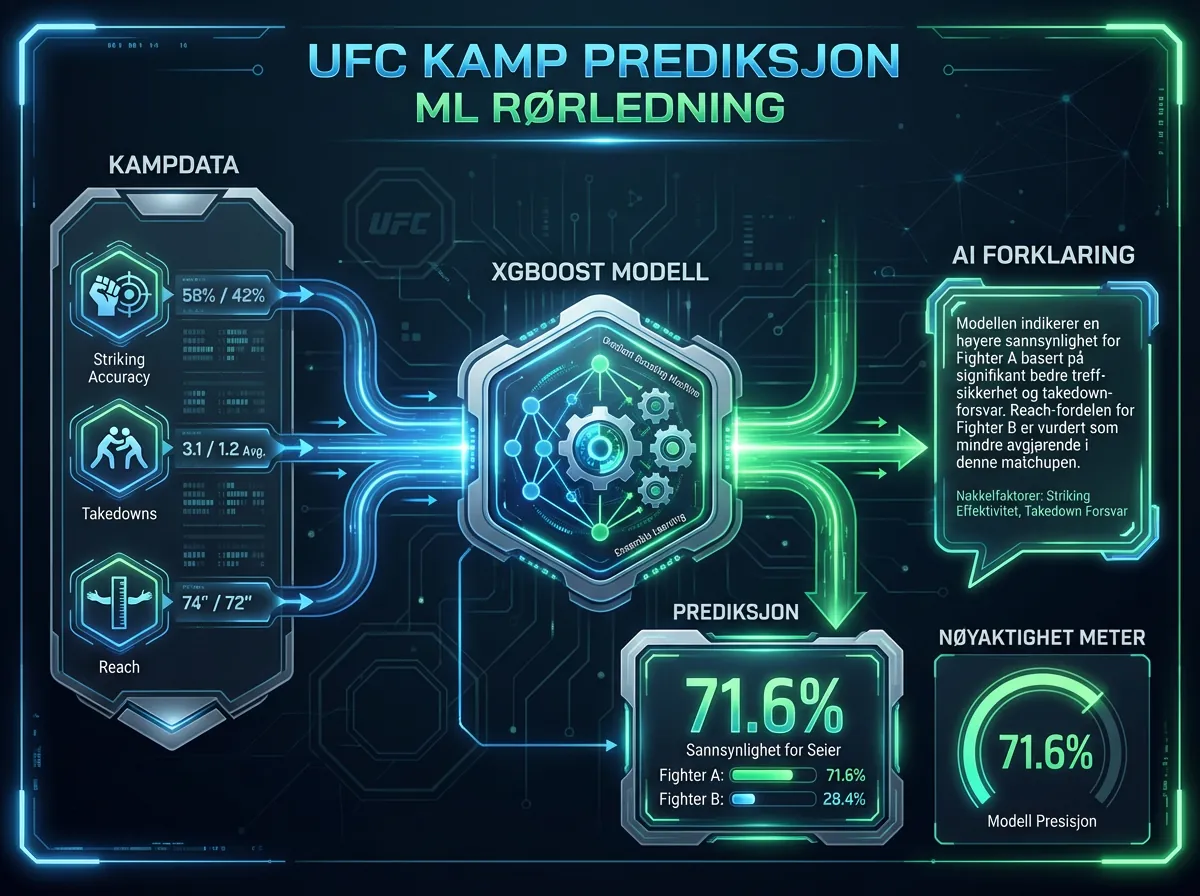
The model is built with XGBoost – a classic, battle-tested gradient boosting algorithm – and combines fight statistics with an AI-powered explanation engine. It is not just a black box that says, “Fighter A wins.” It also tells you why the model reached that conclusion.
For UFC predictions, 71.6% on a historical test set is genuinely good. Combat sports are notoriously unpredictable – a fighter can dominate four rounds and lose to a single punch in the fifth. Reaching that result suggests that the data really does contain patterns worth capturing.
Why does XGBoost fit UFC prediction?
XGBoost, short for eXtreme Gradient Boosting, is one of the most widely used machine-learning algorithms for structured data – the rows and columns you would find in a table. It won literally hundreds of Kaggle competitions after it arrived, and many large companies still use it in production.
That makes it a natural choice for UFC prediction. The inputs are structured: win rate, knockdowns, submission attempts, reach, age, and winning or losing streaks. No images and no video – just numbers and statistics. XGBoost eats that kind of data for breakfast.
The especially interesting part is that the developer adjusted the algorithm to account for the fight’s weight class. Each UFC division has a dominant style – lighter fighters are often faster and more focused on striking, while heavyweights are more oriented toward knockouts. The model gives a small advantage to fighters whose style matches the dominant style in their division. It is an elegant way to handle biological and stylistic variation.
How does the AI explanation work?
This is where the project separates itself from most academic UFC prediction projects. Instead of returning only a probability, the app uses an AI model to generate a natural-language explanation of the prediction.
Imagine asking, “Who wins between Fighter A and Fighter B?” Instead of receiving only “Fighter A: 67%,” you get something along the lines of: “Fighter A has better striking accuracy over the last five fights, while Fighter B has lost three of four fights against southpaws. That stylistic difference gives Fighter A a clear advantage.”
This is a good example of explainable AI – a branch of machine learning that aims to make a model’s decisions understandable to people, not merely accurate. I think commercial products give us far too little of this. Most AI tools provide an answer. This project provides the answer and the reasoning.
Technically, the app combines two systems: the XGBoost prediction model and an LLM that receives the model’s output data as context. The LLM translates numbers and feature importance values into something a person can actually understand and use.
Inside the machine-learning pipeline
For readers interested in the technical side, the core is an XGBoost binary classifier using binary:logistic as its objective. In other words, it predicts whether Fighter A wins (1) or loses (0). The classification itself is standard. The feature-engineering work is where the project gets interesting.
Typical features in models like this include:
- Striking statistics: Significant strikes landed per minute, striking accuracy, and defensive rate
- Grappling statistics: Takedown accuracy, submission attempts, and ground control time
- Fight history: Winning streaks, losses against specific styles, and form across the last five fights
- Physical attributes: Reach, height, age, and weight class
- Stylistic matching: An adjustment for the dominant fighting style in each division
The weight-class adjustment is a clever addition. Rather than treating every division the same way, the developer analyzed which fighting style statistically dominates each one and incorporated that information as a feature. It is not a huge change on its own, but domain knowledge like this is often what separates a 65% model from a 71% model.
What is 71.6% accuracy really worth?
Let us bring the number back down to earth. An accuracy of 71.6% may not sound impressive beside AI systems that play chess or Go at near-perfect levels. Combat sports are fundamentally different.
A Kaggle notebook explores decision trees, XGBoost, and LightGBM for UFC prediction. Against that broader field of practical experiments, a hobbyist reaching 71.6% in historical testing with a solid XGBoost implementation is seriously impressive.
It is important, however, to understand what the 71.6% measures. The model was trained and tested on historical fights. Predicting genuinely future fights is harder because fighters have private training camps, undisclosed injuries, and psychological factors that historical statistics cannot fully capture. A 71.6% result on the test set is a strong signal, but the model still needs to prove itself over time against real future bouts.
What can you learn from this project?
What fascinates me most is the method: one person with a genuine interest in a field such as MMA, some spare time, and accessible tools such as XGBoost, Python, and an LLM API can build a working product with real value. No company. No team. No investors.
This is the pattern for practical AI learning in 2026. Pick a field you genuinely care about, find public data, and build something concrete. You will learn ten times more than you would from taking an online course.
XGBoost is free and open source, and historical UFC fight data is available from UFCStats.com. Add an LLM API for the explanation layer, and the essential pieces are accessible to an individual developer. The infrastructure for a project like this can be built over a weekend.
I use Claude Code for a great deal of my development work, and it is fascinating to see how the toolbox available to one person with an idea has exploded over the last two or three years. Five years ago, projects like this would have required a small team and months of work.
Is this the beginning of something bigger?
UFC is an interesting test case because the sport is already so data-driven. UFCStats.com has fight statistics stretching back to the early days of the UFC, and the organization makes its numbers available in a way that sports such as football do not always match.
The model also points toward something much bigger than UFC. Explainable AI combined with domain-specific prediction is one of the most useful AI architectures you can build. The same approach can be applied to medical diagnosis, legal risk assessment, financial analysis, and any other field where “why” matters as much as “what.”
Models that return a probability with no context are difficult to trust. Models that say, “Here is the answer, and here is why” give people something they can actually use. UFC prediction is a fun, low-risk arena for experimenting with that pattern. What do you think – is this an approach we will see much more often?
The project was not released as open source, at least not at the time of the original Reddit thread, but the approach was documented well enough for people who wanted to build something similar. One GitHub repository combining XGBoost and Elo ratings was a practical starting point at the time, but that repository is no longer available. The UFC prediction notebook on Kaggle remains a usable starting point.
Frequently asked questions
Is 71.6% accuracy good for predicting UFC fights?
Yes, it is a strong historical test result for an unpredictable sport. The important limitation is that the figure comes from a test set of past fights. It should not be treated as guaranteed accuracy on future UFC events until the model has been validated prospectively.
Why use XGBoost instead of a neural network?
XGBoost is particularly effective with structured, tabular data such as fighter age, reach, striking statistics, takedown accuracy, and recent form. UFC prediction is therefore a natural fit, and good feature engineering can matter more than choosing a more fashionable model.
Does the LLM make the fight prediction?
No. XGBoost produces the prediction from fight data. The LLM receives the model’s output and feature information as context, then turns those numbers into a natural-language explanation. The two components have separate jobs.
Can I build a similar UFC prediction model?
Yes. XGBoost and Python are free, historical UFC statistics are publicly available, and the existing GitHub and Kaggle projects provide useful starting points. The difficult part is not only training a classifier, but choosing meaningful features and validating the result against fights the model did not train on.