Innhold Show
Norway was left off the new US country list for advanced AI chips. But the US AI rules can still affect Norwegian data centers if they provide large amounts of computing power to Chinese companies or other entities covered by US export restrictions.
Earlier on November 16, Digi and the Norwegian news agency NTB reported that Norway was among seven countries that could end up on a new US control list. That report concerned a proposal that was still being developed. Later the same day, the US Bureau of Industry and Security, or BIS, published the actual interim final rule.
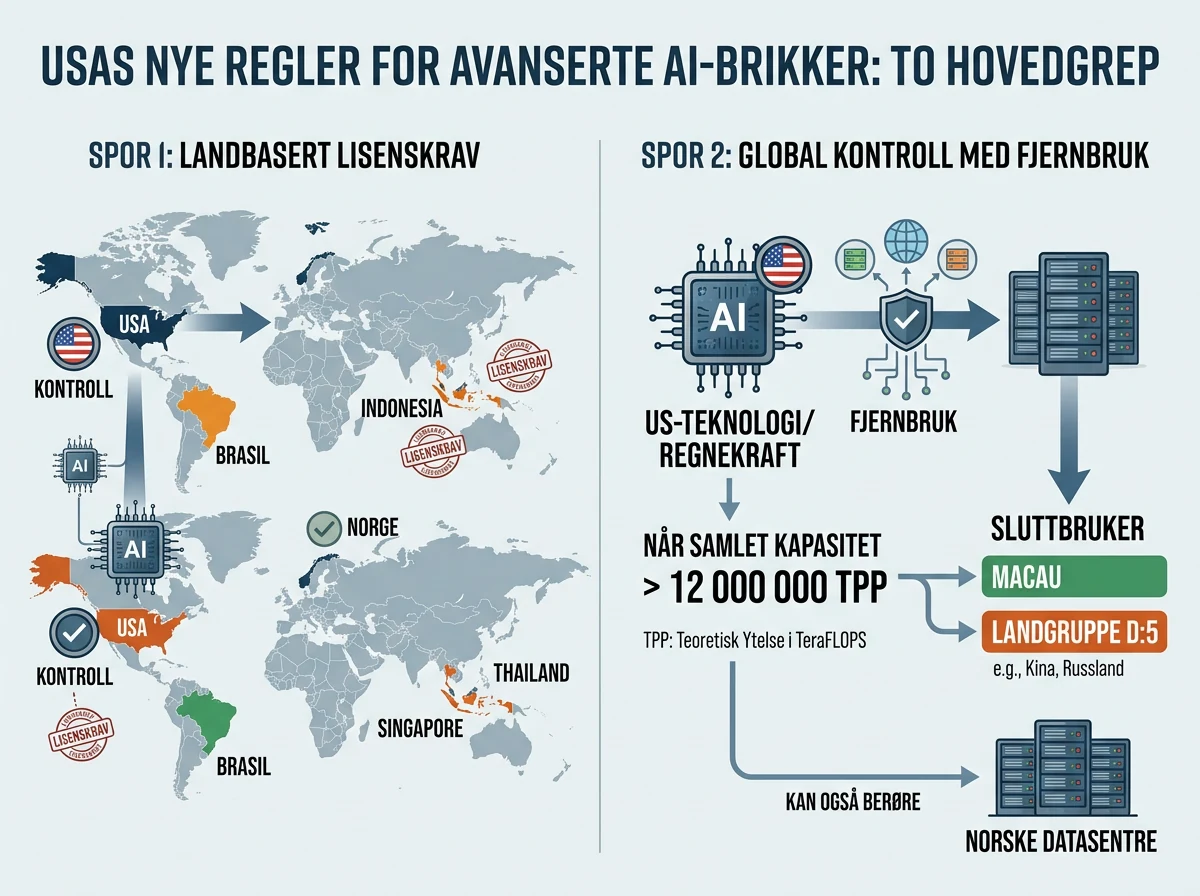
Norway is not on it. That matters, because the difference between an early proposal and a published rule is not a footnote. Indonesia, Malaysia, Singapore, Brazil and Thailand received the new country-based license requirement. Norway and South Africa, which appeared in the earlier reporting, were omitted. At the same time, the United States introduced broader controls on remote access to advanced computing power from data centers in every country. Norway is out of one list, but not necessarily out of the story.
What did the United States actually decide?
The United States introduced two main measures. The first is a license requirement for exports of advanced AI chips to five named countries. The second is a worldwide rule restricting data centers from supplying large amounts of that computing power to companies in Macau or countries in the US D:5 country group. BIS says the rule is intended to prevent restricted entities from bypassing controls by renting remote capacity in a third country.
The logic is straightforward. A ban on directly exporting the most powerful chips to China does little if a Chinese company can rent the same computing power from a data center elsewhere. The chip never enters China, but its capacity can still be reached over the internet. The new rule therefore tries to control both where the hardware is shipped and who ultimately uses it.
The published rule applies to advanced chips and servers covered by specific US export classifications. For remote access, the control is triggered above an aggregate threshold of 12,000,000 TPP, a technical measure of total processing performance. The threshold can apply to one data center or to several digitally interconnected facilities that share capacity and operate as a combined resource.
Why was Norway left off the final country list?
The public rule does not explain why Norway and South Africa disappeared between the early reporting and the published text. It only establishes that the country-based license requirement applies to Indonesia, Malaysia, Singapore, Brazil and Thailand. BIS describes those five as presenting an elevated risk that advanced chips could be diverted to entities the United States wants to keep away from them.
It would therefore go too far to claim that the Norwegian government negotiated its way out, that US officials made a mistake, or that Norwegian data centers have been cleared of every risk. None of those conclusions is supported by the public material. What we know is more limited: Norway appeared on the reported seven-country list, but not on the official five-country list published by BIS.
This is also why fresh regulatory news must be read with the date and document status in view. A proposal can move markets and generate headlines before the final comma is in place. For Norwegian data centers, investors and customers, the published text matters more than reports about what might be coming.
Can the US AI rules still affect Norwegian data centers?
Yes. The new rule includes an end-use control for data centers regardless of where they are located. If a party knows that advanced US computing resources will provide more than 12,000,000 aggregate TPP to a company headquartered in Macau or a D:5 country, or whose ultimate parent is headquartered there, a US license is required.
This is not limited to the customer named on the invoice. The 132-page BIS rule requires extensive customer screening, including checks on direct and indirect ownership and control. It explicitly aims to prevent an apparently harmless intermediary from being used to train models for a covered entity. A data center may therefore need to understand the customer, its parent company and the real use of the capacity.
There is a narrow exception for commercial recommendation systems, such as ranking products or content based on user behavior. It does not cover systems that generate new text, images, audio, video or software. A service does not automatically qualify for the exception merely because it combines recommendations with generative AI.
For Norwegian operators, “Norway is not on the list” is not the same as “US rules do not apply here.” The United States is using its control over American chip technology to set conditions far beyond its own borders. If a data center is packed with US technology, Washington effectively has a hand on part of its rulebook too.
Who gets the easiest route through the rules?
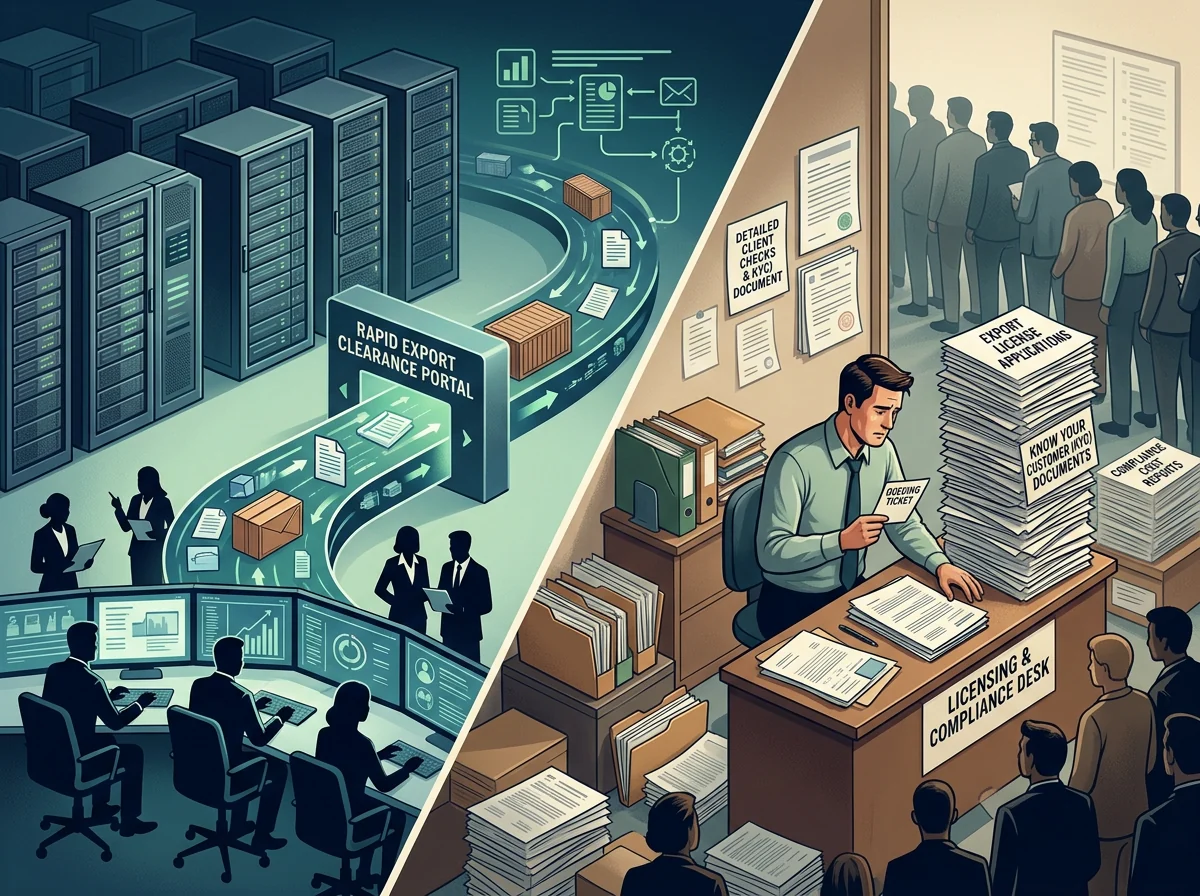
Here is the catch. In the five named countries, exports to companies headquartered in the United States, or whose ultimate parent is headquartered there, can avoid the new country-based license requirement if the reporting conditions are met. Local operators and other foreign companies face case-by-case license reviews.
It is not difficult to see who is best equipped to deal with that system. The largest US cloud providers have lawyers, compliance departments and direct lines to regulators. A smaller independent data center operator has to spend time and money on applications, customer screening and continuous documentation. The giants walk through the gate with a reporting form. The small operator gets a ticket and joins the queue.
The United States justifies the distinction through diversion risk and national security. Circumvention is a real problem when an export ban can be bypassed with an internet connection. But the security argument does not erase the effect on competition: expensive compliance often becomes an advantage for companies that are already dominant. Who really benefits from that part of the arrangement? Certainly not the small challenger.
What does this mean for Norway’s AI infrastructure?
In the short term, the most important news is that Norway avoided the special country-based license requirement for exports and reexports of the covered chips to Norway. Norwegian data center projects therefore do not face the same direct disadvantage as projects in the five named countries. One concrete source of uncertainty around planned deliveries and investments has been reduced.
Over the longer term, the case shows how dependent Norwegian AI infrastructure is on decisions made elsewhere. Norway has a cold climate, abundant power and strong conditions for data centers. Yet the most sought-after AI chips and much of the software stack are controlled by US companies. Geography can determine access to AI features for ordinary users, and now the same mechanism is visible at the infrastructure level.
A Norwegian facility should therefore calculate more than electricity prices, cooling and grid capacity. Its customer base, ownership structures, contracts, remote use and the supplier’s export conditions have become part of the technical risk. That sounds dull until a planned chip delivery or a major customer agreement suddenly depends on a US licensing decision.
Norwegian companies buying computing capacity should also ask where that capacity is physically located, who owns and controls the facility, and which countries’ rules can change access. AI use is already widespread in Norway, and Norwegian businesses are moving from experimentation into practical adoption. Computing power cannot be treated as an unlimited commodity that will always remain available on the same terms.
What should Norwegian operators watch now?
First, data center operators and major buyers should read the published rule, not just the first media report. Norway is outside the special five-country group, but the global end-use control and customer-screening requirements may still be relevant. Any legal assessment must be tied to the specific chips, capacity, customer and use.
Second, contracts should establish who is responsible for end-customer screening, reporting and the consequences of a license requirement. Discovering that division of responsibility after capacity has been resold through several intermediaries is a terrible plan. Operators should also be able to document how interconnected facilities share resources, because the rule can aggregate digitally connected data centers.
Finally, Norwegian projects should treat political supplier risk as an operational risk. That does not mean everyone should rip out US technology or pretend a Norwegian alternative can be conjured up overnight. It means budgets, delivery schedules and customer contracts should withstand rule changes in Washington. Norway fell off the country list this time. It may be on the next one.
I do not buy the idea that another layer of US approval automatically produces an elegant solution. But the early headline that Norway had been hit did not match the final outcome either. The useful verdict is precise: Norway escaped the special country requirement, while US control over who can use American AI computing power now reaches into data centers around the world. That is better news for Norway than first feared, but it is no free pass.
Frequently asked questions
Is Norway covered by the new US license list for AI chips?
No. The published rule names Indonesia, Malaysia, Singapore, Brazil and Thailand. Norway appeared in an earlier report about seven possible countries, but BIS did not include it in the special country-based license requirement published on November 16, 2026.
Can US AI export rules still apply to a Norwegian data center?
Yes. The rule contains a worldwide end-use control for data centers supplying large amounts of advanced US computing power to companies in Macau or US country group D:5. Whether a Norwegian facility is covered depends on the chips, capacity, customer, ownership and actual use.
What is the 12,000,000 TPP threshold?
It is the aggregate processing-performance threshold used in the new remote-access rule. The capacity can sit in one data center or be distributed across several digitally interconnected facilities. The license test combines that performance measure with the identity and location of the entity receiving access.
What should Norwegian buyers ask a computing provider?
Ask where the capacity is located, who owns and controls the data center, which chips are used, whether capacity is shared across connected facilities, and who handles export-control and end-customer checks. Those details can affect availability, delivery time and contractual risk.