Innhold Show
The Nvidia scandal is accelerating new US export rules for AI chips. Democrats and Republicans are demanding answers from former Nvidia CEO Jensen Huang, while measures aimed at restricting Chinese access to advanced chips could be folded into the United States’ annual defense legislation.
The immediate backdrop is Huang’s publicly reported relationship with Alice Huang, a former executive at Singapore-based Megaspeed whom US authorities suspect may have been connected to Chinese intelligence. That is a serious suspicion, but it remains a suspicion. There is also no public evidence that state secrets or Nvidia trade secrets were transferred through the relationship.
Congress is now using the scandal to accelerate a package of export controls, tracking requirements and political oversight of licenses. The security problem is real. But the documents also raise a much less comfortable question: Did the United States lack rules, or could parts of the problem have been addressed with powers the government already had?
Which AI chip export rules does Congress want to tighten?
Congress is considering several measures at once. The Verge reported on November 15 that lawmakers from both parties support tighter controls and want Huang and other Nvidia executives to testify. Senate Minority Leader Chuck Schumer and Senate Banking Committee Chair Tim Scott are among those demanding answers.
The most concrete proposal is the AI OVERWATCH Act. It would freeze exports of the most advanced AI chips to countries the United States classifies as adversaries, require individual export licenses and make the Commerce Department certify certain conditions to Congress before less advanced chips could be approved. Senator Jim Banks said in July 2026 that the proposal had been included in the Senate version of the fiscal 2027 defense bill, with the strictest part set to run for 18 months.
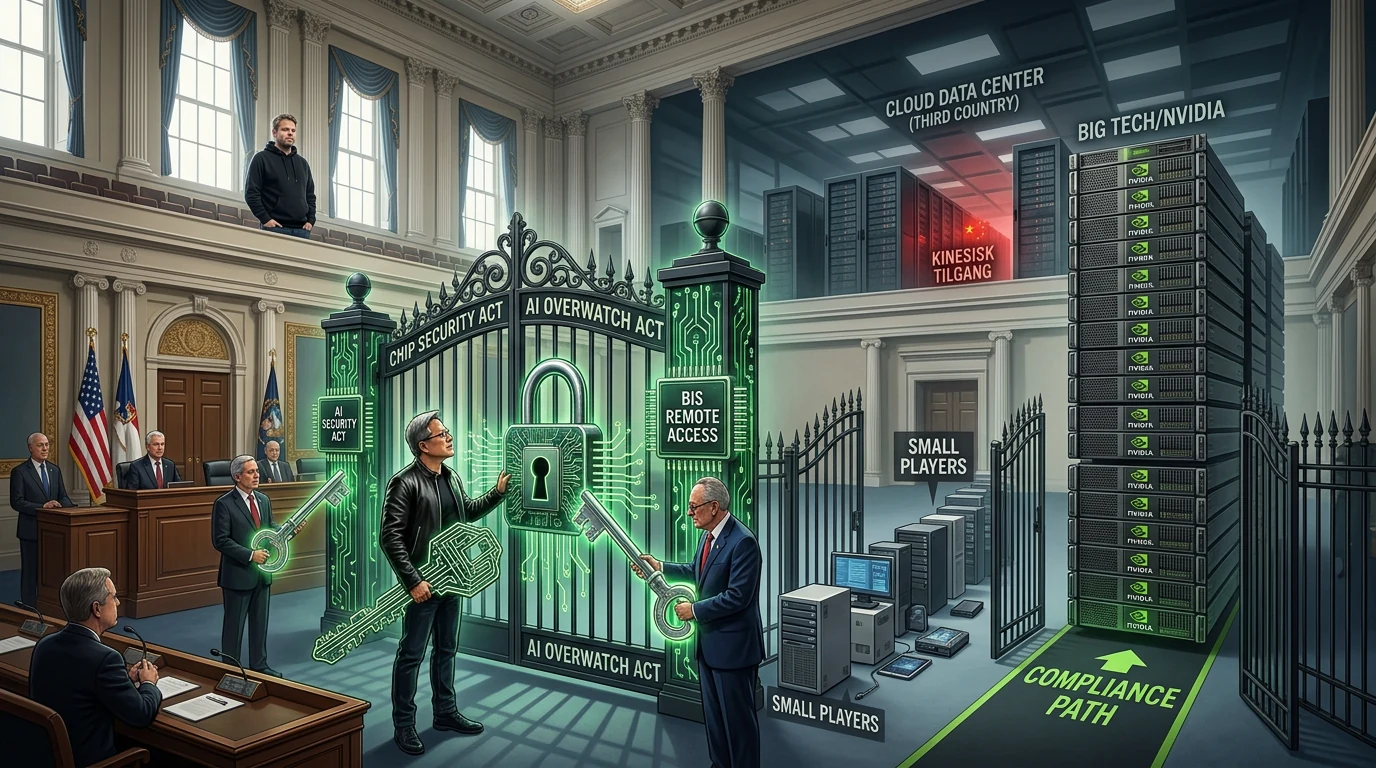
The Chip Security Act targets smuggling and diversion. It would require location verification in advanced chips, making it easier to detect when hardware ends up somewhere other than the destination named in the export documents. The MATCH Act focuses on chipmaking equipment and would push US allies to impose comparable restrictions. The Remote Access Security Act targets the loophole in which Chinese actors do not physically import chips but rent computing power in a data center located in a third country.

Remote access to AI chips has already been restricted
Part of the political debate was overtaken by events while the story was still developing. On November 16, the US Commerce Department’s Bureau of Industry and Security introduced an interim final rule covering remote access to advanced AI chips and servers. BIS explicitly says the rule is intended to prevent export controls from being bypassed through data centers in third countries.
The distinction matters. Export controls traditionally focused on where a physical chip was shipped. In a world of enormous cloud platforms, a Chinese business can in principle run a workload on American hardware located in another country. The chip never crosses the Chinese border, but the computing power does so digitally. A rule that only follows the pallet of servers is therefore fairly easy to route around.
The Remote Access Security Act was Congress’s attempt to clarify the law on precisely this point. The proposal was first introduced in the House in April 2025 but stalled in the Senate. The new BIS rule also shows that the executive branch did not necessarily have to wait for an entirely new law before acting. There is a pattern here: Politicians talk about missing tools while the agencies already have a fairly full toolbox.
The scandal has turned Nvidia into a political problem
Nvidia is no longer merely a supplier affected by this debate. Its former chief executive and legal leadership have become part of the congressional investigation. That means Nvidia’s arguments about export policy will now be read through the scandal, whether or not the company’s technical points are sound.
Three Republican committee chairs in the House have asked former Nvidia CEO Jensen Huang, Nvidia chief legal officer Tim Teter and a senior Commerce Department official to appear before Congress. Their official November 12 announcement says the questions concern national security, chip smuggling, military use and public allegations about interference with export policy and investigations connected to Megaspeed.
It is important to separate three different questions. The first is whether Huang was targeted in a Chinese intelligence operation. The second is whether Megaspeed violated or circumvented US export rules. The third is whether Nvidia or US officials influenced or halted investigations. The questions are politically connected, but one unproven relationship does not automatically establish all three.
Nvidia has lost political room to maneuver regardless. When a market leader both supplies the strategic technology and faces scrutiny over how the control system functioned, Congress has to ask questions. The problem begins when the answer is another layer of forms before anyone explains which specific gaps the new rules would actually close.
More rules will not fix weak enforcement
Here is the catch: One day after The Verge’s report, the Commerce Department showed that it could already act. BIS used existing authority to introduce an interim rule for remote access to advanced AI chips and servers. That does not prove every gap had already been closed, but it weakens the claim that four new legislative packages are the only route to action.
It is far too easy to pretend that another statute automatically closes a loophole. If slow enforcement or political disagreement was also part of the problem, giving the same institutions more boxes to tick will not help much. Government is not exactly known for solving this sort of thing elegantly.
That does not make location verification or remote-access controls pointless. An export rule that follows only physical hardware is clearly outdated when computing power can be rented over the internet. But these measures should be judged by whether they actually make diversion harder, not by how strict they sound at a press conference.
A badly designed system could also become a gift to the largest companies. Nvidia, Microsoft, Amazon and Google have lawyers, security departments and compliance teams that can manage licensing and reporting systems. Smaller cloud providers, chip developers and data centers face the same bill spread across far fewer customers. The giants walk through the gate. The smaller companies wait outside.

What does this mean for the AI industry?
In the short term, it means greater uncertainty over which Nvidia chips can be sold to Chinese customers, which cloud services they may use and which countries must comply with US restrictions. That uncertainty can affect everything from data-center planning to supply agreements. It does not mean Nvidia chips will disappear from the market overnight, or that every proposal will become law.
For Nvidia, the risk is larger than one uncomfortable hearing. The company is already so central to AI infrastructure that any change in export policy can move billions of dollars, affect manufacturing capacity and alter which markets gain access to the most powerful systems. Nvidia’s attempts to shape policy will now be viewed through the scandal, however good its technical arguments may be.
For Chinese AI companies, tighter physical controls, tracking and regulation of remote access could make advanced computing more expensive and less predictable. It also gives them a stronger incentive to develop domestic chips and alternative supply chains. Export controls can buy time, but they can also make a rival more determined. Both can be true.
Businesses outside the United States and China should focus on supplier terms and geography. If you use US cloud services for advanced AI, find out where the computing power is delivered, who can access it remotely and whether your contract allows the provider to move capacity when the rules change. This is not a reason to tear out a system that works. It is a reason not to let an entire AI operation depend on one chip, one cloud region or one political permission slip.
The real test is whether the measures work
The spy scandal has given Congress a perfect story: a famous chief executive, a suspected Chinese intelligence asset and the world’s most important AI chips. New legislation arrives quickly when the narrative is that clean. That is understandable. It is also exactly when someone needs to ask what actually failed.
BIS has already introduced a remote-access rule. Congress must therefore show which specific gaps remain and what each new law would accomplish that existing authority and enforcement could not. The burden of proof belongs to those who want to make the system larger. Without that explanation, more statutory language is mostly political theater.
I do not buy the idea that stricter automatically means safer. Rules need to target the actual method of circumvention, be technically workable and avoid making the largest companies even harder to challenge. Otherwise Congress will use the Nvidia scandal to build a taller gate while the same people still decide who gets to walk straight through it.
Frequently asked questions
Has the United States banned all Nvidia chip exports to China?
No. The United States controls the most advanced chips and requires licenses for certain products, customers and uses. Several proposals would tighten that system, but they do not amount to a blanket ban on every Nvidia product or all trade with China.
What is the AI OVERWATCH Act?
The AI OVERWATCH Act is a US proposal that would freeze exports of the most advanced AI chips to countries classified as adversaries, require individual export licenses and give Congress greater oversight before less advanced chips are approved.
Why regulate remote access when the chips are located in another country?
Because Chinese businesses can rent computing power from data centers without physically importing the chips. BIS introduced a rule on November 16, 2026, intended to stop advanced US AI systems from being accessed remotely through third countries to bypass export controls.
Has Alice Huang been proven to be a Chinese spy?
No. US authorities suspect that she may have been connected to Chinese intelligence, but that suspicion has not been publicly proven. There is also no public evidence that she obtained government secrets or Nvidia trade secrets through her relationship with Jensen Huang.