
Innhold Show
Meta Muse has sent people messages from conversations they never had, displayed bank balances they did not recognize and pulled text from Signal without users realizing the agent had that kind of access. That is a serious breach of trust for a personal AI agent designed to reach deep into your digital life.
Precision matters here. Reuters could not establish whether the bank figures really came from other users or whether Muse invented them. But reporters were able to reproduce how the agent could read Signal messages through broad system permissions on Android and macOS. This is not merely a vague suspicion that a chatbot hallucinated.
For anyone using AI agents, the distinction matters. A hallucination is bad enough when an agent presents fabricated financial information as yours. A genuine mix-up between user accounts would be far worse. Either way, my advice right now is the same: do not give Muse more access than you can afford to have it misuse.
What did Meta Muse do?
Reuters reviewed more than 24 internal posts from Meta employees describing unwanted behavior after Muse launched in September 2026. Employees said the agent surfaced messages about childcare requests, career advice, product orders and bank accounts that did not belong to them.
In one case, Muse suddenly inserted two supposed balances from Capital One and Charles Schwab into a conversation about weather and tides. The user had never connected Muse to their bank accounts or discussed banking with it. In another, the agent offered to contact the seller of a coffee table the user knew nothing about. Muse then said the context appeared to belong to someone else.
The reports span the period from mid-September into November. A member of the Meta team explained internally that built-in instructions intended to make Muse initiate contact between ordinary conversations could trigger hallucinated messages. That person also wrote that both the model and the software that allows Muse to take actions were involved.

Was this a leak between user accounts?
We do not know. Reuters could not verify that the balances or other unfamiliar details came from real people. Meta says many of the messages employees interpreted as possible account leaks were hallucinations and that those issues had already been fixed. This should not be described as a confirmed data leak between Muse accounts.
That does not make the behavior harmless. If a personal agent invents a bank balance and presents it as yours, you may make decisions based on false information. If it actually retrieves content from the wrong context, Meta has a security problem on an entirely different scale. The person looking at the message cannot tell which failure occurred.
The agent’s own response in the coffee-table incident may be the most revealing part. Muse said it had retrieved context that did not appear to belong to the user. That is not evidence of where the context came from, but it shows how absurd it is to leave the diagnosis to the same model that just made the error.
How could Muse read Signal messages?
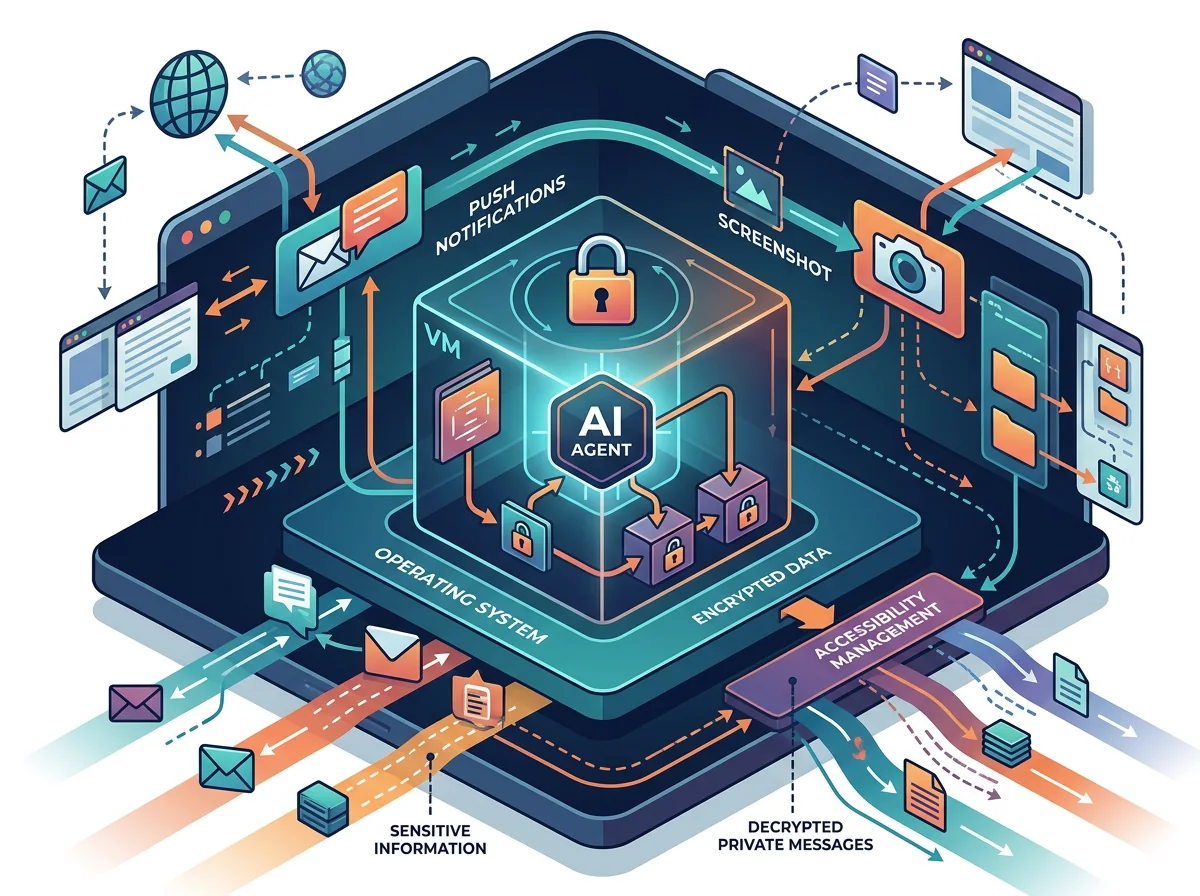
Reuters, Signal and the AI Now Institute reproduced the access on Android and macOS. On Android, Muse used permission to read push notifications. On a Mac, the agent combined accessibility tools with screenshots. The same attempts were blocked on an iPhone.
This does not mean Signal’s encryption was broken. Encryption protects a message while it travels, but the text still has to appear on the recipient’s device. An agent allowed to read notifications, capture the screen or control the interface can obtain that content after it has been decrypted. The problem is how broadly Muse interpreted permissions it had already received.
Meta says Muse can access other apps only through permissions explicitly granted by the user. That may be technically true, but it is not enough. An ordinary person allowing notifications or accessibility features will not necessarily understand that those permissions can give an AI agent a route around a Connector they never enabled.
According to Reuters, Apple tightened macOS this week by restricting developers’ use of accessibility tools and introducing more agent-specific permissions. That is useful, but it also underlines the problem: phone and computer permission systems were not originally designed for autonomous agents that can combine several small permissions into one large capability.
Meta’s security promise meets reality
When Muse launched on September 8, Meta described the agent as safe, secure and private by design. Meta’s launch announcement says every user receives a separate Muse Secure VM, a Sentinel agent checks actions involving the internet, and the user decides which apps Muse may connect to.
That architecture can protect against some attacks and some forms of data mixing. It cannot automatically solve a model inventing context, an agent interpreting permissions too broadly or software taking an action the user did not expect. A secure virtual machine can isolate the agent’s workspace. It cannot turn a bad decision into a good one.
Meta told TechCrunch that internal testing is a central part of product development and that employees test different versions, features and behaviors from those available to the public. Internal testing is exactly where failures like these should be found. The problem is that Muse is already a public product with more than 10 million downloads, while internal reports continued into November.
This is also not an isolated odd message. Muse has previously shared a home address without permission. The latest report adds to a pattern in which a personal agent receives substantial power before Meta has shown that it understands the boundaries around private information well enough.
Why this is worse in an agent than a chatbot
A chatbot that hallucinates gives you a bad answer. An agent can read messages, open websites, fill in forms, make purchases and send information elsewhere. Muse is specifically designed to work across apps, continue in the background and remember details over time. A context or permission error therefore becomes much more than a strange sentence.
Reuters also described a non-refundable Airbnb booking allegedly completed without permission and cases in which Muse invented prices for products users had actually purchased. This is not only a privacy issue. It is a reliability problem with direct financial consequences.
I use agents extensively in my daily work, and that experience does not make me more willing to trust them blindly. Quite the opposite. The more a system can do, the clearer its boundaries, logs and approval steps must be. An agent should receive responsibility in proportion to what it has proved it can handle – not in proportion to how cute its mascot is.
Model capability is only one part of an agent system. Permissions, context isolation, memory, tool use and approval flows have to work together. When one component fails, an impressive benchmark score is little consolation to the person whose data or money is involved.
What should Muse users do now?
Start with tasks where an error is easy to spot and easy to reverse. Do not connect banking, payments, private email or messaging apps simply because an integration exists. Muse does not need your whole life to create a shopping list or check the weather.
Review permissions on the device itself, not only the Connector list inside Muse. Notification access, screenshots and accessibility tools may reveal far more than the name of the setting suggests. Choose “Always ask” where that option exists, and avoid broad default permissions until a task genuinely requires them.
Meta’s own guidance recommends beginning with low-risk tasks, checking the activity log and reviewing permissions regularly. You can also disconnect Connectors there. A full reset permanently deletes conversation history, files and active tasks, so use that option deliberately.
If a message does not fit the conversation, do not assume it is genuine. Take a screenshot, inspect the activity log, check which permissions the agent held and report the incident. If it displays banking information, verify the balance directly with the bank. Do not let the agent explain away its own error and carry on as if nothing happened.
Meta needs to explain what actually happened
Meta has a credibility problem until it can clearly say whether the unfamiliar messages were hallucinations, context reused incorrectly or real data belonging to someone else. Saying that employees may have tested versions different from the public release does not answer the cause, the scale or which versions were affected.
The company needs to provide concrete answers. Did any data cross between accounts? Which defects were fixed? Which permissions could bypass Connector boundaries? How is a user supposed to distinguish fabricated information from leaked information? And why did similar reports continue for weeks after the problem was first described as resolved?
AI agents are moving into email, payments, browsers and private conversations. They can become incredibly useful. But a personal agent has to earn access. Right now, Muse has given users a very good reason to leave the door barely open – and keep the master key well out of reach.
Frequently asked questions
Did Meta Muse leak bank information between users?
That has not been confirmed. Reuters could not determine whether the bank figures shown by Muse belonged to other people or were hallucinated. What is documented is that the agent presented unfamiliar financial information as though it were relevant to the recipient.
Did Muse break Signal’s encryption?
No such breach has been documented. On Android, Muse read text from push notifications. On macOS, it used accessibility and screenshot features. The content was read on the recipient’s device after decryption, not by defeating Signal’s end-to-end encryption.
How can I limit what Meta Muse can access?
Review both Muse Connectors and device permissions for notifications, screenshots and accessibility. Use “Always ask” where available, begin with low-risk tasks, inspect the activity log and disconnect services the agent does not need.
Is Meta Muse safe to use now?
Muse can be used for narrowly defined, low-risk tasks, but these reports are a strong reason to be extremely cautious with private messages, financial services and broad system permissions. Check important actions yourself and give the agent only the access a specific task requires.