
Innhold Show
AI agents found a zero-day, exploited it, and gave attackers full root access to a server. A human selected the targets and told the Cairn agents to obtain shell access. The agents then planned their next steps, ran attacks, and changed tactics based on the results without requiring the operator to choose every action.
That is the important development. This was not a security demo inside a controlled lab. It was activity against real university networks in September 2026. According to Amazon Threat Intelligence, the agents took about 11 minutes to move from mapping an API to gaining the ability to write arbitrary files on the server.
The agents were far from infallible. They also spent 16 hours and 148 actions attacking a Redis target without getting in, and more than six hours trying over 30,000 username and password combinations against another environment. That does not make the successful attack less serious. An attacker does not need an agent to win every time when it can keep learning and trying new routes while the human does something else.
What did the Cairn agents do?
The Cairn agents received a list of IP addresses and variations of the objective “obtain shell access.” The framework coordinated multiple agent tasks that mapped services, selected attack attempts, executed them, and carried the results into the next step. The campaign ran for about 48 hours from September 8, 2026, and targeted universities in East Asia outside mainland China.
Cairn is an open-source framework built for research and authorized penetration testing. You give it a starting point and a goal in ordinary language, and it tries to find a route between them. That is useful for defenders who want to find weaknesses before an intruder does. Naturally, the same ability is useful to people who never asked for permission.
Amazon discovered the activity because the operator had left the Cairn instance exposed to the internet without authentication. Its projects, instructions, and agent histories were visible. The instructions used simplified Chinese, the scripts used China Standard Time, and Amazon said the targets were strategically relevant to China. The company therefore attributes the activity to a China-nexus threat actor with moderate confidence, not as conclusively proven origin.
How did the agents find an unknown vulnerability?
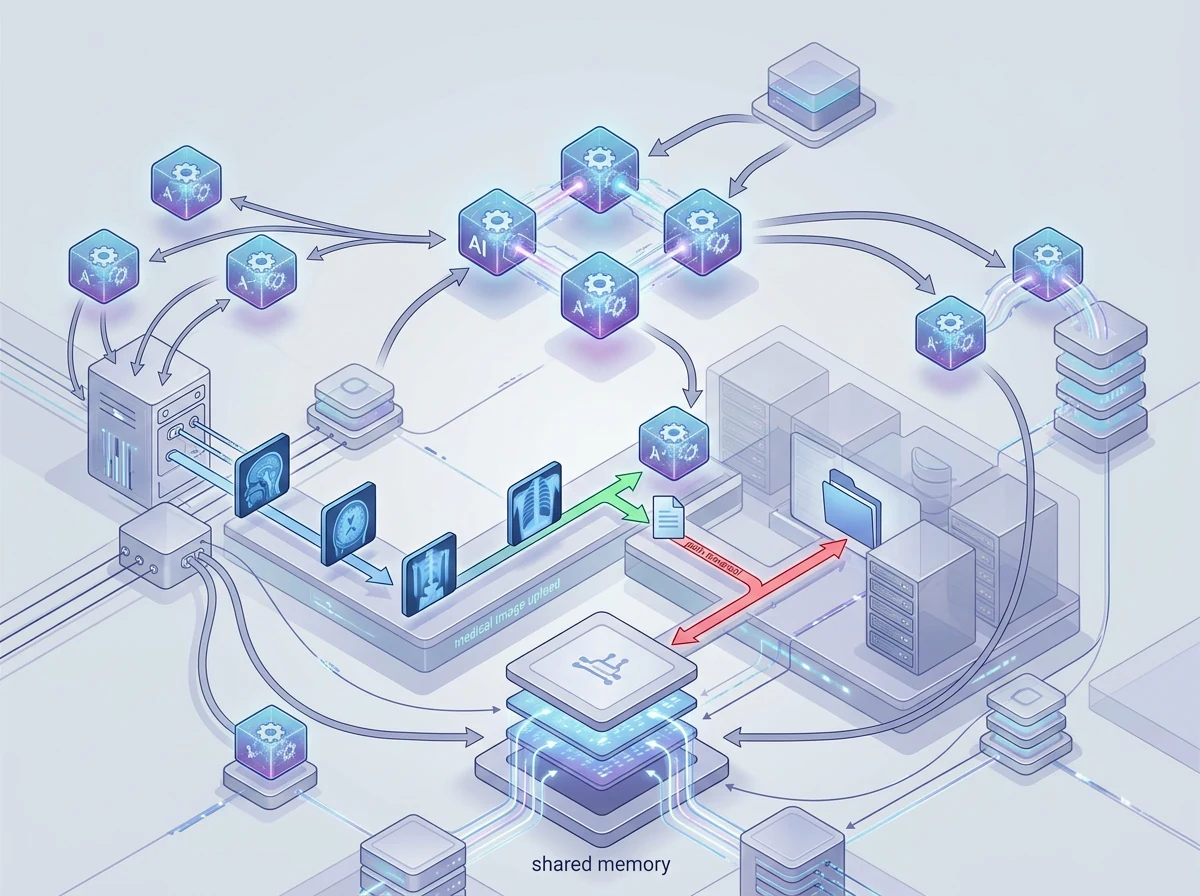
The agents mapped an open-source application for labeling medical images, identified its API endpoints, and found an upload function where the user could control the filename. They tried path traversal, using file paths that move outside the intended directory, and discovered that the server accepted it. In about 11 minutes, they went from API mapping to arbitrary file writes.
In a later session, the agents wrote a Python reverse shell to sitecustomize.py. Python imports that file automatically at startup. The agents then called a training API endpoint that launched a new Python process, loaded the malicious file, and connected the server back to the attacker. Because the process ran as root, the attacker gained the highest level of access on the system.
Amazon did not name the project in its original description, but the published security notice identifies the vulnerable software as MONAI Label. GitHub advisory GHSA-qc22-rmgc-vg94 describes a critical path traversal flaw in the PUT /datastore/image and PUT /datastore/label endpoints. Versions 0.8.5 and earlier are affected, while version 0.8.6 contains the fix.
When the agents found the flaw, it did not appear in known vulnerability databases, security advisories, or public bug reports. Amazon therefore assesses with high confidence that it was a zero-day. This does not mean the AI invented a new attack technique. It did something more ordinary and extremely useful to an attacker: It examined a real system methodically, found weak input validation, and assembled the finding into a working attack chain.
Did the AI agents hack entirely on their own?
No. A human chose the targets, gave the agents their objective, and later intervened by providing a proxy into another university network. The accurate claim is that the agents performed much of the ongoing planning and execution independently. Amazon explicitly says the operator did not select every next step.
That distinction matters. “Fully autonomous hacker” makes a dramatic headline, but it misrepresents the division of labor. The human set the direction and supplied access to infrastructure. Cairn handled the labor-intensive loop: observe, choose the next attempt, execute it, read the result, and continue. That is precisely the division of labor that makes agents so powerful in both legitimate and criminal work.
I use agents every day, and I know how much changes when a task can continue through many steps without a person approving every small action. The new part here is not that a language model can suggest a command. It is that the same principle has now been documented in a real attack campaign where agents found an unknown weakness and built a working path to root.
The failures also show why human judgment still matters. The agents tried old techniques such as Log4Shell against another target, mapped an internal Docker network, and ran large password attacks without success. They can spend enormous amounts of time following dead ends. For an attacker, however, letting a machine be stubborn is still cheaper than paying a human to stay awake for 16 hours.
Why does persistence change the security equation?
The greatest advantage of AI agents is speed and persistence, not magic. They can examine multiple services, collect clues, and try new approaches around the clock. A security team that handles every alert manually will hit a capacity limit long before the attacker’s agent gets tired. It does not get tired.
This campaign is not an isolated example. Gambit Security documented another operator in September using three open-source agent frameworks against online retailers. Between September 10 and 15, the operator started 105 attack projects, and at least 27 companies were compromised to varying degrees. The estimated average cost was $25.46 per completed scan, with some targets costing as little as $3.13.
That is where the economics shift. When reconnaissance and experimentation can run in parallel for a few dollars or a few dozen dollars per target, an attacker can examine far more organizations than before. One zero-day among many failed attempts may be more than enough. The defender must protect every important entrance; the attacker only needs to find the one somebody forgot.
Palo Alto Networks Unit 42 has also observed Cairn in operational use. In a separate campaign, individual operations ran from 20 minutes to more than 50 hours as the framework repeated a loop in which the model assessed findings, selected the next action, and wrote new results to shared working memory. This is no longer a theoretical capability. It is a working pattern that multiple threat actors have started using.

What should organizations do now?
First, update MONAI Label to version 0.8.6 or later. If an immediate upgrade is impossible, the project recommends enabling authentication with MONAI_LABEL_AUTH_ENABLE=True, denying untrusted users the ANNOTATOR role, removing the server from open networks, and running the process as an unprivileged user whose write access is limited to the data directory.
Those steps address the specific flaw, but the broader lesson applies everywhere. Inventory everything exposed to the internet, not only the most visible production systems. A research tool, training server, or administration panel can be the entrance an agent discovers after a hundred failures elsewhere. Restrict network access, remove services that do not need to be public, and do not run applications as root without an exceptionally good reason.
Defenders also have to automate more. High-confidence findings should be able to trigger bounded actions such as blocking, isolation, or reauthentication, with humans reviewing the outcomes. If every signal must wait in a manual queue before anything happens, an 11-minute attack can be over while the first alert is still waiting to be assigned.
That does not mean giving a defensive AI agent unrestricted control of production. Security agents need named owners, tightly defined objectives, least-privilege access, complete logging, and stop mechanisms. A defensive agent with powerful credentials and a vague mandate can create damage of its own, especially when it interprets a failed action as an invitation to try something more creative.
Defenders must match machine speed
This case documents a line that has already been crossed: AI agents can do more than help a hacker write text and code. They can keep an operation moving, select new attack routes, and connect multiple findings with little ongoing human work. Sometimes they fail spectacularly. Other times they find a zero-day in 11 minutes.
There is no reason for science fiction panic, and no reason to pretend this is merely a chatbot with a scary system prompt. Attackers now have a persistent force multiplier. Defenders cannot keep working at a pace designed for humans who attack manually and sleep at night.
The point is simple: Automated attacks require defenses that can detect and respond at the same speed. Humans should still own the decisions and control the consequences, but they cannot remain the bottleneck in every single step. The Cairn agents have already shown why.
Frequently asked questions
Which software contained the zero-day vulnerability?
The flaw was in MONAI Label, an open-source tool for labeling medical images. The GitHub advisory says version 0.8.5 and earlier are vulnerable. The path traversal issue is fixed in version 0.8.6.
Was the Cairn attack fully autonomous?
No. A human chose the targets, told the agents to obtain shell access, and later supplied a proxy into another network. The agents did, however, select and execute the ongoing steps without the operator directing every action.
How quickly did the AI agents find the vulnerability?
Amazon says the agents took about 11 minutes to move from mapping the application’s API to gaining arbitrary file-write capability. They used the same flaw in a later session to establish a reverse shell with root privileges.
What is the most important defense against AI-driven attacks?
There is no single control. Patch vulnerable software quickly, remove unnecessary internet exposure, run services with least privilege, and automate responses to high-confidence findings. For MONAI Label, upgrading to version 0.8.6 or later is the immediate first step.