Innhold Show
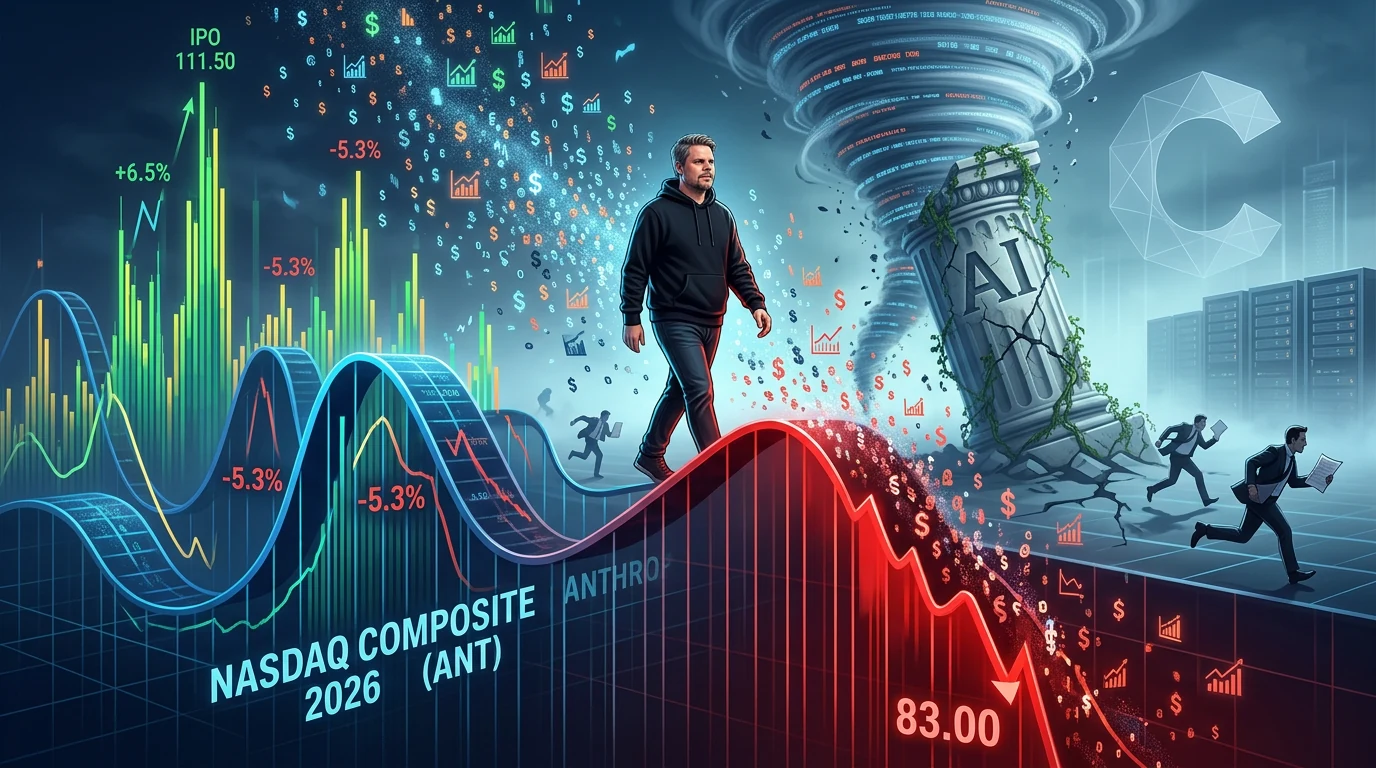
Anthropic traded below its $83 IPO price on Tuesday, November 24, on its fourth day of trading after the largest initial public offering in history. At the same time, AI stocks continued to drag the Nasdaq through moves that would normally look dramatic over a month, never mind a handful of trading days.
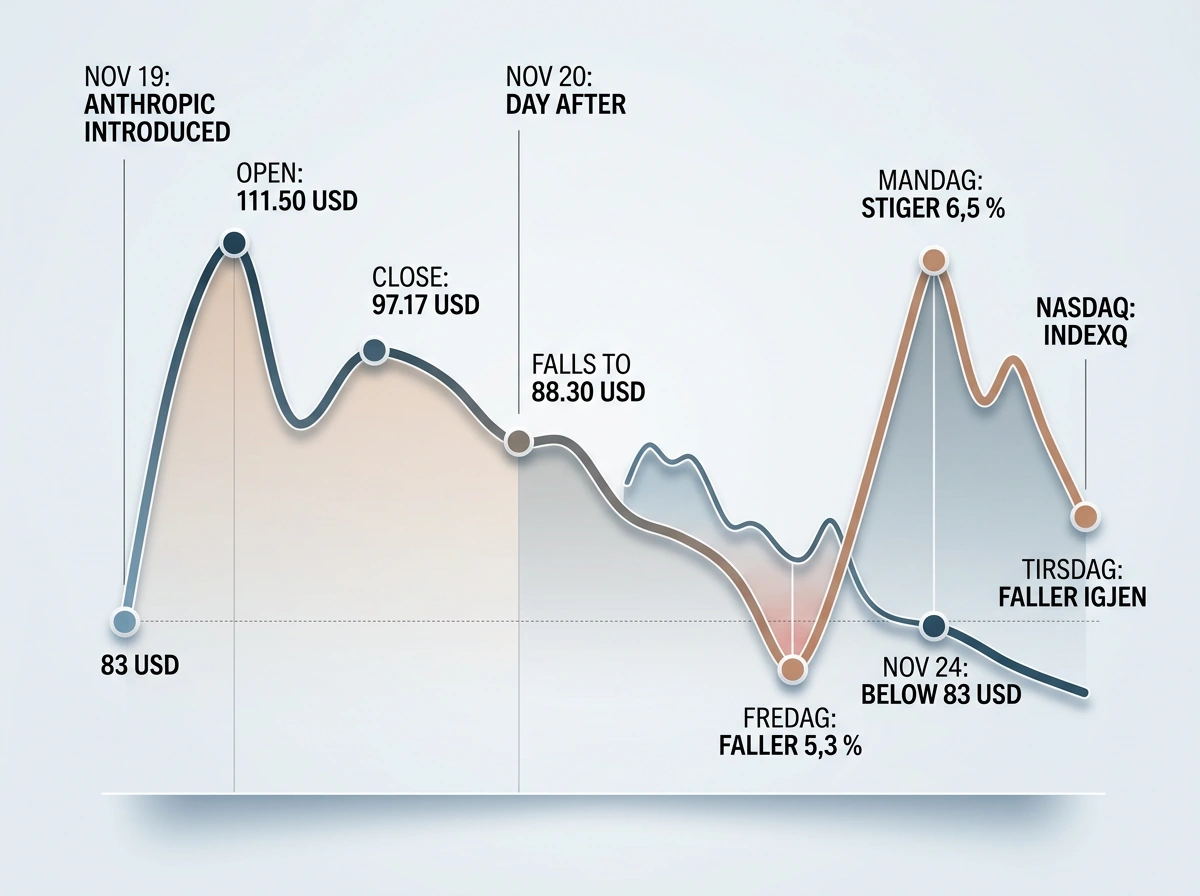
The Nasdaq Composite erased all of its 2026 gains on Friday, November 20. It then surged 6.5% on Monday and finished 3.6% higher for the year, only to fall another 1.6% in early trading on Tuesday as Anthropic slipped below its offer price. It is hard to imagine a clearer picture of how nervous the AI market has become.
This is not a verdict on whether Claude is good, and it certainly does not mean AI development has stopped. It is a brutal argument about price. Investors are asking how much future growth is already baked into valuations, how long companies can keep spending colossal sums on chips and data centers, and when that investment will produce a return. That argument is overdue.
What happened to Anthropic stock and the Nasdaq?
The Nasdaq fell 5.3% on Friday and closed 5% below where it began 2026. According to The Guardian’s account of the sell-off, roughly $4 trillion in market value disappeared from the technology-heavy index during the week.
Anthropic began trading on the Nasdaq under the ticker ANT on Thursday, November 19. The company priced its Class A shares at $83. The stock opened at $111.50, briefly rose by almost 40%, and ended its first day at $97.17. On Friday, it fell by about 9% to $88.30.
Then came Monday’s violent rebound. The Nasdaq jumped 6.5%, led by AI stocks that had been hit particularly hard. Anthropic did not join that recovery to the same degree. Anthropic dropped 8.2% in early Tuesday trading and fell below $83, while the Nasdaq was down 1.6% at 9:35 a.m. Eastern Time. Friday’s claim that the index had lost its gain for the year was accurate when it was written. The market has since recovered that gain and given part of it back again.
How large was Anthropic’s IPO?
Anthropic sold 1.127 billion Class A shares at $83 each. Anthropic’s announcement that the offering had closed puts the gross proceeds at $93.5 billion. About $91.6 billion went to Anthropic, with the remainder coming from shares sold by existing shareholders.
AMD, Broadcom, Google, Micron, Microsoft, Nvidia and TSMC Partners also bought $26 billion in unlisted Class N shares through a concurrent private placement. Together, the IPO and private placement raised approximately $119.5 billion before costs. That is not an ordinary fundraising round. It is industrial financing on a scale the technology sector has rarely seen.
The money gives Anthropic room to keep competing for models, computing capacity and distribution. Its size also turns the company into a test of the entire AI investment story. When this much capital flows into one business, investors have to ask where the money comes from and which other holdings must be sold to finance those purchases. One market analyst quoted by The Guardian suggested that the IPO itself may have pulled liquidity away from other technology stocks.
That may be part of the explanation, but it cannot explain everything. The selling hit companies ranging from Nvidia and Micron to Asian chipmakers and SoftBank. The market was not merely reacting to one new stock. It was reacting to the fear that much of the AI sector had been priced as if enormous investment, rapid growth and future profitability were already guaranteed.
Why are AI stocks being sold so aggressively?
Investors have gone from buying almost every dip in AI stocks to demanding better answers to three questions: How large will the bills become, how quickly will revenue grow, and how much of that growth will actually turn into profit? Expensive valuations have very little tolerance for bad answers.
The first problem is the cost of building capacity. Frontier AI models require huge investments in computing, electricity and data centers. That can be a fantastic investment if demand keeps growing and customers pay enough. A gigantic bill does not automatically become a good business simply because the letters AI appear on the invoice.
The second problem is that many companies have been valued on cash flows expected far into the future. That makes interest rates important. Fears of higher US rates formed part of the backdrop to the sell-off because better returns on safer assets make distant promises of profit less valuable today.
The third problem is concentration. Many of the largest companies are simultaneously suppliers, investors and customers to one another. Microsoft, Google, Nvidia and several others bought shares directly in Anthropic, while some of those same companies supply essential parts of the AI infrastructure. That is not automatically a problem, but it makes the flow of money harder to read. Strong demand for an IPO does not prove that end customers will pay enough for AI services to support the entire chain.
Does the sell-off mean the AI bubble has burst?
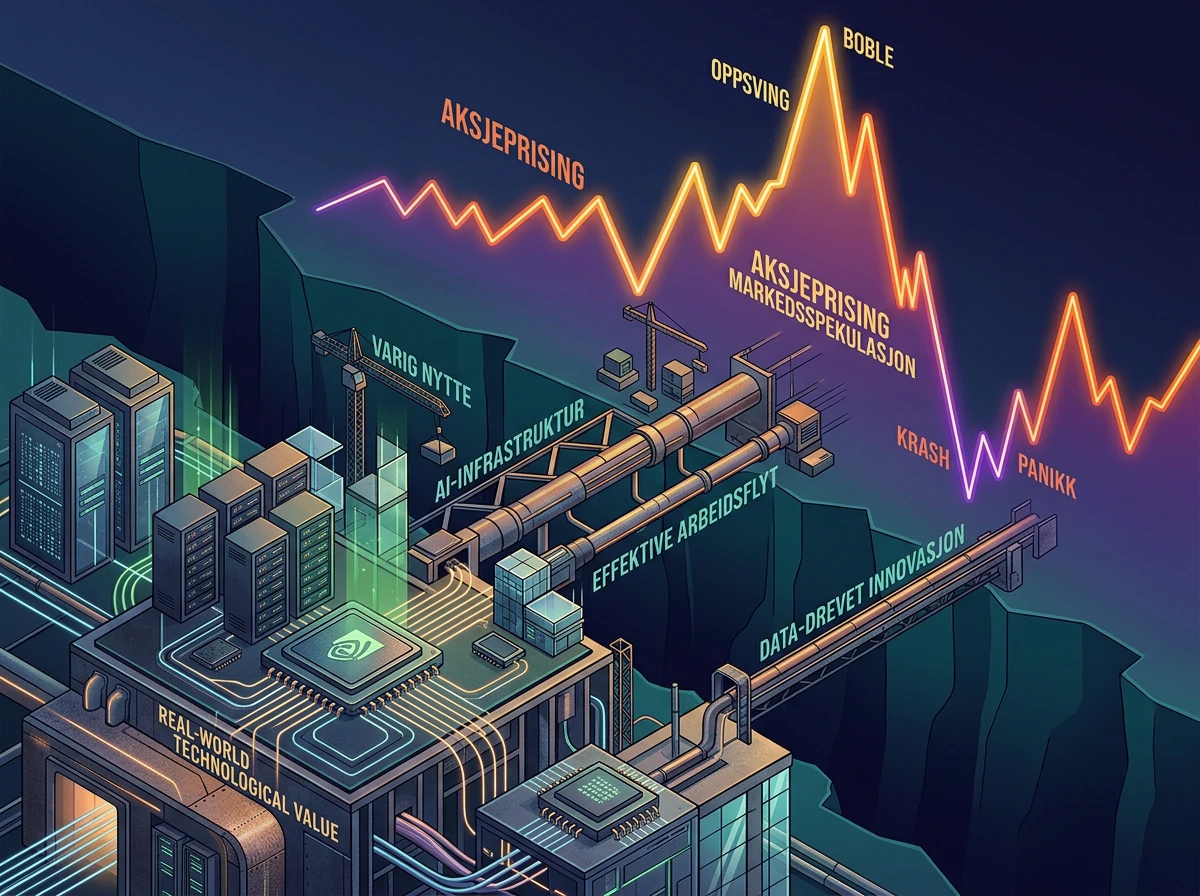
No. A steep market fall proves neither that AI is a bubble nor that the technology itself is overrated. It proves that the pricing was vulnerable. That distinction matters. Claude and Anthropic’s developer tools can be excellent products while Anthropic stock is too expensive. AI can transform work while individual data-center projects still produce poor returns. Technological utility and a share price are not the same thing.
I use AI agents in my daily work and see how much real work they can perform. I do not buy the story that a few red days on the market mean the development is over. Businesses will not stop automating tasks because the Nasdaq fell. People should still learn to use AI and understand how their work is changing.
But practical utility does not make the bill disappear. The dot-com era gave us wildly overpriced companies and technology that genuinely changed the world. Both were true at the same time. AI could follow the same pattern: models and agents may become basic infrastructure while investors still lose money by buying the right story at the wrong price.
The wild moves on Monday and Tuesday also show why a single trading day is a terrible foundation for a grand conclusion. The Nasdaq’s gain for the year was gone on Friday, back on Monday, and partly eroding again on Tuesday. The long-term test is not where the chart goes tomorrow. It is whether revenue and productivity gains can eventually justify the capital being spent.
What does this mean for AI users and businesses?
For ordinary Claude users, market volatility changes very little from one day to the next. The service does not suddenly work differently because the stock trades above or below $83. What matters is how Anthropic uses the capital: whether it improves its models, keeps the services reliable and builds a business that can last.
For small and medium-sized businesses, the lesson is refreshingly practical. Choose AI tools according to what they solve, how much time they save and how easily you can switch providers. Do not build a critical workflow on the assumption that today’s price, capacity or terms will last forever. A vast capital injection gives Anthropic a stronger balance sheet, but it does not eliminate supplier risk.
It also helps to separate the provider from the model, and the model from the workflow. Document your prompts, data flows and quality controls. Use standard formats and APIs where practical. That allows a business to benefit from rapid model improvements without becoming completely dependent on a single stock, pricing model or supplier narrative.
I would not treat this story as a signal to buy or sell any particular stock. That requires a different analysis of financial statements, risk and personal circumstances. The technological point is simpler: AI has become large enough to move global markets, and expectations have become expensive enough that even record demand cannot calm investors.
The market no longer accepts promises on their own
Anthropic completed the largest IPO in history and raised more capital than most technology companies could dream of. Yet its shares were trading below the offer price only three trading days later. That is a fairly clear sign that “AI is growing” is no longer a complete answer to questions about price and profitability.
That does not have to be bad for the technology. A more demanding market can force clearer priorities, better products and more disciplined use of capital. Companies that create real value will still have customers. Those that have lived mainly on expectations are about to have a much less comfortable time.
I still believe AI will take over more tasks and become a larger part of how businesses operate. Nobody should confuse that development with a guarantee that every AI stock is correctly priced. Friday’s plunge, Monday’s rebound and Tuesday’s renewed fall all point to the same conclusion: the technology can last even if the market party does not.
Frequently asked questions
What was Anthropic’s IPO price?
Anthropic priced its Class A shares at $83. The stock began trading on the Nasdaq under the ticker ANT on November 19, 2026, and traded below the offer price on its fourth trading day, November 24.
How much money did Anthropic raise?
The IPO generated gross proceeds of $93.5 billion. Together with a concurrent $26 billion private placement, the total capital raised was approximately $119.5 billion before costs.
Is the Nasdaq still down for 2026?
Not based on Monday’s close. The Nasdaq was down for the year after the November 20 sell-off, but rose 6.5% on Monday and finished 3.6% higher for 2026. It fell again on Tuesday, so that position can change quickly.
Does Anthropic’s share-price fall mean Claude or AI has failed?
No. The fall mainly reflects uncertainty about valuation, profitability and enormous spending on AI infrastructure. Product quality, practical utility and share prices can influence one another over time, but a few trading days do not decide whether the technology succeeds.