Innhold Show
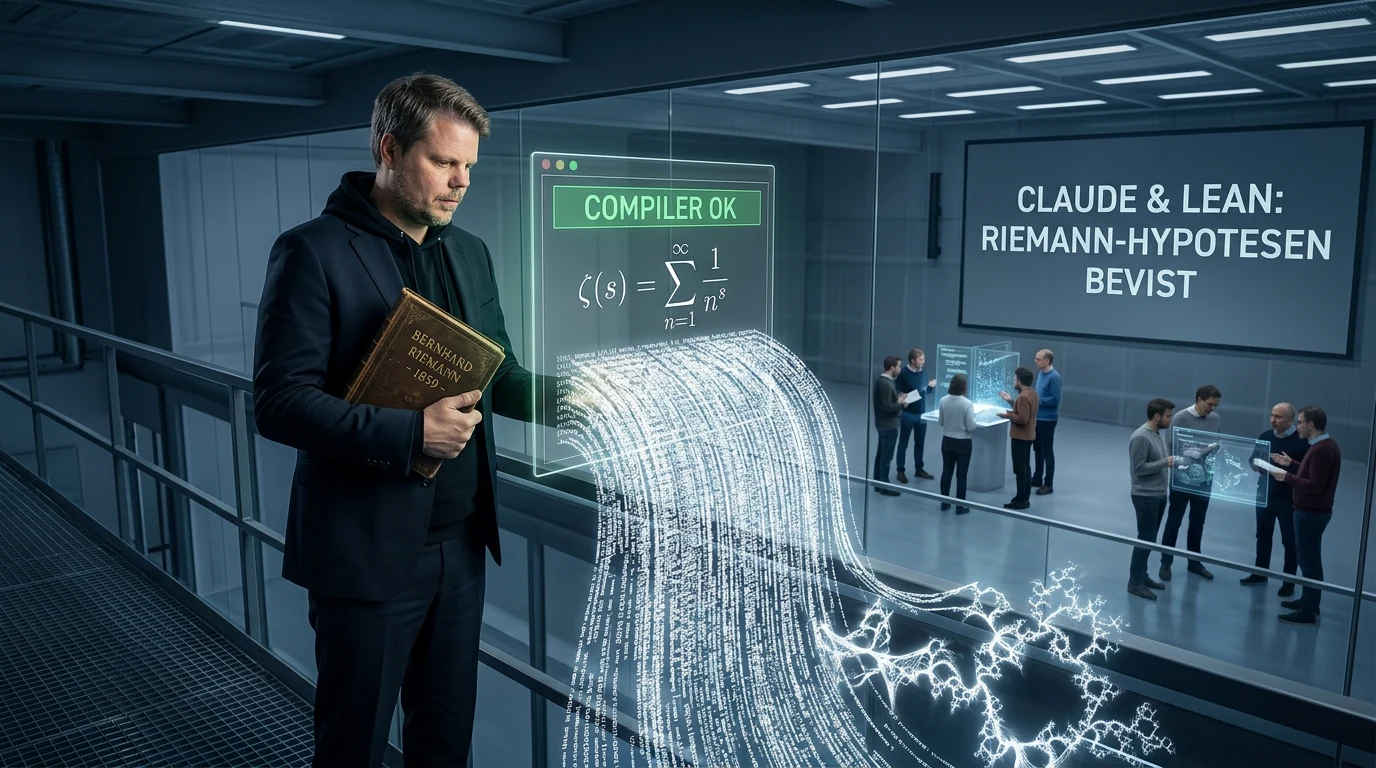
The Riemann hypothesis has stood unsolved since 1859. Now a 17-million-line, AI-assisted Lean proof has passed extensive formal verification. The Lean and Mathlib communities say they have full confidence in the result, while the Clay Mathematics Institute still lists the problem as unsolved. This is a mathematical milestone – and a striking picture of what research can become when humans, AI and formal proof tools work together.
This is not simply a language model giving a confident answer to an impossible question. The proof has been published as roughly 17 million lines of Lean code. Independent experts have checked that the code compiles, that it proves the correct formulation of the Riemann hypothesis, and that the proof object is accepted by several different verification systems.
There is not yet a finished, human-readable mathematical paper explaining the entire argument. The machine has checked that the proof holds inside the formal system. The next job is to understand the ideas, simplify them and turn them into mathematics that humans can learn from. That distinction matters, but it does not make the achievement smaller. If anything, it shows how dramatically the relationship between discovery, verification and understanding is changing.
What has actually been proved?
The Riemann hypothesis says that every non-trivial zero of the Riemann zeta function has a real part of 1/2. Bernhard Riemann formulated the hypothesis in 1859, and it concerns the hidden structure behind the distribution of prime numbers. The Clay Mathematics Institute says the first 10 trillion relevant solutions have been checked, but a final solution must apply to all of them.
In his own account of the work, mathematician Levent Alpöge says that he and Claude have found a proof of the Riemann hypothesis. He says the method also proves the generalized Riemann hypothesis for Dirichlet L-functions, a stronger family of statements that extends the central idea to more mathematical functions.
Alpöge describes a process in which he guided the project toward the right mathematical setting, while Claude gradually found and connected more of the technical pieces. He is candid about the argument being enormous, about parts of the mathematics that he does not yet fully understand himself, and about the much shorter explanations that will probably follow. An early text version reportedly ran beyond 250,000 pages. Asking for the short version is rather optimistic.
The crucial point is that the result does not rest on Alpöge’s conviction alone. The proof is expressed in Lean, a programming language and proof assistant that represents mathematical statements and proof steps formally. A small verification program can therefore check whether every step follows from the rules and previous results.
How strong is the Lean verification?
On November 21, the Lean and Mathlib communities published a joint statement certifying both the proposition and the proof. The statement is supported by Lean FRO and the Mathlib Initiative. They say directly that they have full confidence in the correctness of Alpöge’s proof of the Riemann hypothesis.
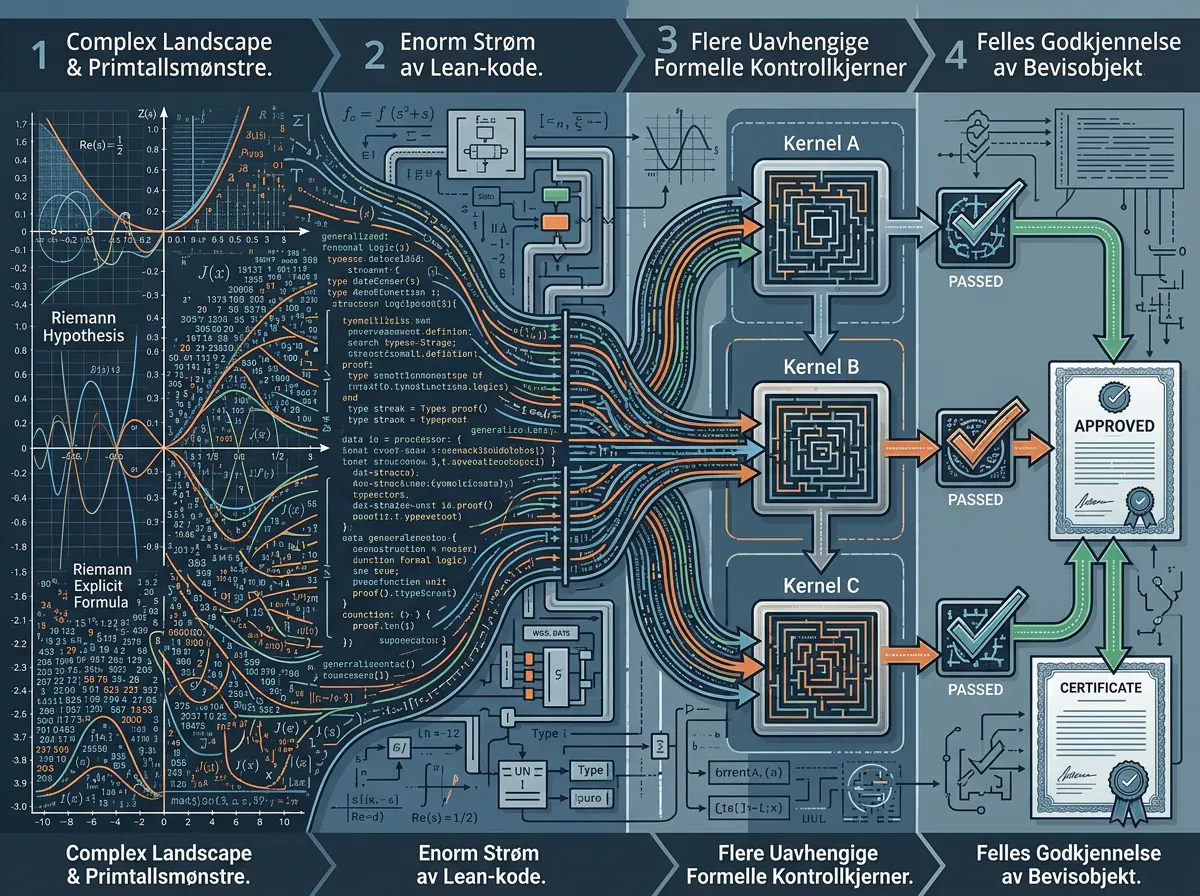
The verification had four important parts. First, the reviewers confirmed that Mathlib’s formal definition really does express the Riemann hypothesis. Several dozen people then compiled the codebase and obtained the same raw proof file. Two independent comparison tools confirmed that Alpöge’s theorem was exactly the same proposition as the isolated Mathlib formulation.
Finally, the proof object was checked by Lean’s official kernel and several other verification programs, including con-leche and con-ron. Some of those checkers were written in other programming languages. The point of this round was to rule out an easy shortcut, a hidden assumption or a defect in a single tool.
That is a substantial update from the first news reports, which reasonably described the result as a claim that still needed scrutiny. Saying merely that “the code compiles” would also be too weak. The community checked both what the code proves and whether independent checkers accept the proof. It is difficult to get much closer to mathematical certainty without understanding the entire argument yourself.
Does this mean the problem is officially solved?
Mathematically, this is now far stronger than an ordinary claim about a possible proof. The formal verification says that the correct proposition follows from the permitted axioms and the Mathlib library. However, the Clay Mathematics Institute still lists the Riemann hypothesis as unsolved and has a separate process for evaluating a solution to a Millennium Prize Problem.
Under Clay’s official rules, a proposed solution must be published in a qualifying outlet, at least two years must pass after publication, and the result must achieve general acceptance in the global mathematics community. The prize is $1 million. So there will be no quick payout, no matter how many verification programs nod approvingly.
That waiting period is not evidence that the Lean verification lacks value. Clay evaluates more than whether a formal term has the correct type. The institute must determine whether the solution meets the official problem statement and has become an accepted part of mathematics. Researchers need time to study the result, explain its ideas and discover what else follows from it.
This is also why the human-readable version matters so much. A correct proof can settle whether the hypothesis is true. A good explanation can also reveal why it is true, which techniques made the breakthrough possible and which other problems those ideas might unlock. Mathematics is more than a green light from a compiler.
What did Claude contribute?
Alpöge’s account gives Claude a much larger role than ordinary writing assistance. He describes finding the broad direction himself and guiding the work into an analogous setting where two ideas could be combined. Near the finish line, Claude reportedly moved ahead with technical suggestions and connections spanning a remarkable number of mathematical fields.
That does not mean a random user could type “prove the Riemann hypothesis” and collect the answer five minutes later. Alpöge is an accomplished mathematician who has thought about the problem since childhood. He could choose a direction, recognize promising ideas and judge how the pieces fit together. The AI system contributed breadth, stamina and technical capacity at a pace that one person would struggle to match.
This is where the real news value lies. AI did not remove the human from the research. It changed what one qualified researcher could explore and assemble. Human judgment, a model able to work across an enormous body of mathematics, and a formal system that refuses to accept cheating make a far more interesting combination than the old argument about whether a chatbot “understands” in the same way humans do.
The weight of the final result matters too. This is not a benchmark or a promising demonstration. It is a formally verified proof of a problem that has shaped parts of mathematics for 167 years. For anyone used to working with AI agents, the lesson is wonderfully concrete: broad exploration becomes vastly more valuable when the final output must pass an unforgiving verification layer.
What happened to the competing human proof?
A human-written draft proof of the generalized Riemann hypothesis appeared on the same day. Stanford mathematician Ravi Vakil published work by Alessandro Maria Masullo and stressed that it had been produced without AI. Masullo had reportedly spent 12 years on the project, and the plan had been to allow a long period of review and refinement before publication.
The first announcement made the two efforts sound like an almost perfect story: AI and a human reaching the finish line together. But a November 22 update from Vakil says several people had reported issues in Masullo’s draft, identified with help from different AI models. Those issues must be resolved before the mathematical community can accept the proof. Vakil also makes clear that he is not claiming the overall strategy is necessarily wrong.
That makes the contrast even more revealing. The AI-assisted proof arrived as an unmanageable volume of formal code, but it survived extensive machine verification. The human-written proof was easier to read as mathematics, yet quickly attracted objections that still need answers. This is not a contest in which “the human lost.” It shows why both comprehensible explanation and formal verification matter.
AI appears on both sides as well. Claude contributed to the formal proof, while other models helped mathematicians identify possible problems in the human draft. That is probably a more realistic picture of future research than a solitary supermodel replacing an entire university overnight.
Why this is a turning point for AI and research
The Riemann hypothesis was not chosen to give AI a neat public-relations moment. It has influenced number theory for more than a century and connects to an enormous body of other results. When AI-assisted work appears to solve it with a proof accepted by independent checkers, the boundary of what AI can contribute to research moves.
The most striking fact is not that Claude can produce millions of lines. AI can produce a lot of text and code – anyone who has let an agent run for too long already knows that. What matters is that the output can be bound to a system in which every claim must survive ruthless formal checking. The model’s ability to explore broadly becomes much more useful when nobody has to accept its final result on trust.
The challenge now is to extract human insight from a machine proof too large for anyone to read. Alpöge says he wants to understand the argument better, simplify it and communicate it. That work is not decoration after the “real” job is done. It is the next phase of the research.
My conclusion is unavoidable: this is a breakthrough. Not because AI woke up and became a mathematician on its own, but because an outstanding mathematician could use Claude to go further and faster than he could alone, while Lean gave the result a verification mechanism strong enough to survive far more than ordinary launch hype. The Riemann hypothesis has waited since 1859. A proof arriving as 17 million lines of code before it arrives as a book humans can understand is, in its own strange way, very 2026.
Frequently asked questions
Has the Riemann hypothesis finally been solved?
The AI-assisted Lean proof has been certified by the Lean and Mathlib communities, which say the proposition and proof are correct. The Clay Mathematics Institute still has a separate process requiring qualifying publication, at least two years of scrutiny and general acceptance by the mathematics community.
Did Claude prove the Riemann hypothesis by itself?
No. Mathematician Levent Alpöge directed the work, found the broad route and evaluated the ideas. According to his account, Claude contributed heavily with technical suggestions and connections near the finish line. The result is best described as human-AI collaboration verified in Lean.
What is Lean in mathematics?
Lean is a programming language and proof assistant for formal mathematics. Definitions and proofs are expressed as code, and a small verification kernel checks that every step follows the rules. This allows enormous proofs to be checked without relying on the author’s authority.
What happened to the human-written GRH proof?
Alessandro Maria Masullo’s human-written draft appeared on the same day, but several researchers quickly reported issues that still need to be resolved. That does not necessarily make the whole strategy wrong, but the proof has not been accepted.