
Innhold Show
Frostbite is a new CPU architecture that AI agents explored, designed and verified across the entire chip stack – from the programming model and instruction set to RTL and final physical layout. In its technical introduction to Frostbite, Architect Labs describes a workflow that moves from programs and formal specifications to measurable hardware.
The reported results are striking, but this is not a finished processor you can buy. Frostbite is currently a pre-silicon design on a 7 nm process, and the comparison is against an unnamed modern dual-issue, in-order CPU core. Architect Labs says broader testing against larger out-of-order processors and established benchmark suites such as SPEC and PARSEC will come later.
Even with those limits, this is wild. The strongest result is the connected workflow: the agent system moved between software, architecture, physical constraints and formal verification, discarded ideas that failed and retained 37 of 58 proposed changes. That kind of closed loop is what makes agents far more interesting than a language model that merely produces a plausible answer.
What is the Frostbite CPU architecture?
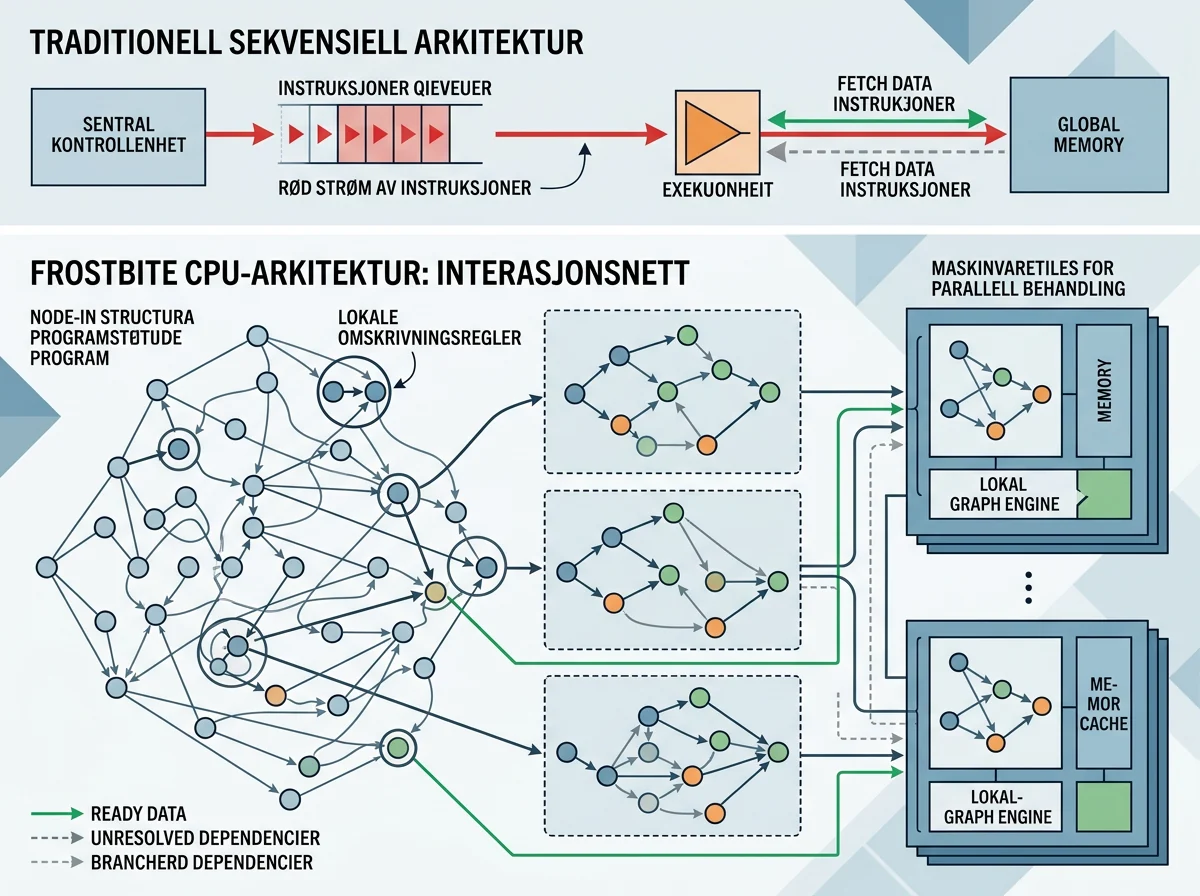
Frostbite is an experimental general-purpose CPU architecture built around interaction nets, a computational model that Yves Lafont formalized in 1990. Instead of shared mutable state, a program is organized as a graph in which local pairs of nodes are rewritten. Every value has one owner, dependencies are explicit and independent work can, in principle, run in parallel.
A conventional CPU spends substantial hardware and energy fetching instructions, predicting branches, rediscovering dependencies and keeping several cache levels coherent. Frostbite tries to move more of that knowledge into the programming model itself. Programs are written in the Vine programming language, which has Rust-like syntax, and compiled into an intermediate representation called Ivy that preserves the interaction net structure.
That does not make every program magically parallel. A computation with a long and unavoidable dependency chain remains sequential. The advantage appears when a program contains independent work that this representation can preserve and the hardware can distribute without threads, locks or a heavy central scheduler.
How did AI agents design a CPU?
Architect Labs used agent swarms to explore the architecture, compiler, instruction set, microarchitecture, RTL, verification and finally the GDS layout as one connected process. The agents began with 10 workloads available during the search, while another 15 were held back for the final evaluation. The system could optimize for concrete requirements without seeing the entire test set in advance.
The first architecture proposal became a 141-page document, but it was deleted after the first RTL iteration exposed how far some estimates were from physical reality. The early Python models were retired later, once Arcmodel and the RTL had been aligned and the ASL contracts could become the source of truth. That detail matters. The system did not cling to a well-written plan after hardware evidence proved its estimates wrong.
This resembles what I value in good agent systems: they need room to try, measure, fail and correct themselves inside strict gates. Daily work with agents teaches you quickly that many parallel suggestions are not the same thing as progress. What matters is whether the system has a hard mechanism for killing bad ideas before they become foundations for more work.
During the Frostbite program, swarms proposed revisions in parallel worktrees. Every change was checked against the contracts, modeled in the system simulator, implemented in RTL and measured for performance and power. Four searches and a final ablation round tried 58 ideas and kept 37. That measurable selection is much more convincing than a polished screenshot of a model saying its solution looks correct.
Formal contracts keep the agents honest
The center of the workflow is Architect Specification Language, or ASL, an internal specification language that can describe everything from memory ordering and coherence to pipelines and arbitration. ASL can be translated into several machine-checkable forms, including the Lean 4 theorem prover. By the end of the project, the Frostbite specification lowered to more than 800,000 lines of Lean.
A large number of Lean lines does not automatically prove that a manufactured chip will be perfect. Formal verification proves properties relative to the specification and assumptions supplied to it. An incomplete contract can still produce an inadequate result. But a machine-checkable contract makes mistakes much harder to hide behind fluid language and persuasive AI prose.
The ASL contract served as the common source of truth for the ISA, system model, design and verification. Architect Labs says this prevented large classes of bugs, silly mistakes and reward-hacking behavior in the agent swarms. The lesson travels well beyond chip design: when AI gets more responsibility, it needs more than better prompts. It needs controls that can reject an answer even when the answer looks impressive.
That is the part I find most convincing. Agent count is cheap theater if the workers can quietly validate one another’s mistakes. A system becomes useful when the specification, tests and physical measurements can say no. Frostbite did not remove human choices or engineering constraints. It gave the agents a much larger design space and surrounded that freedom with machinery capable of rejecting bad work.
What did the agent system discover?
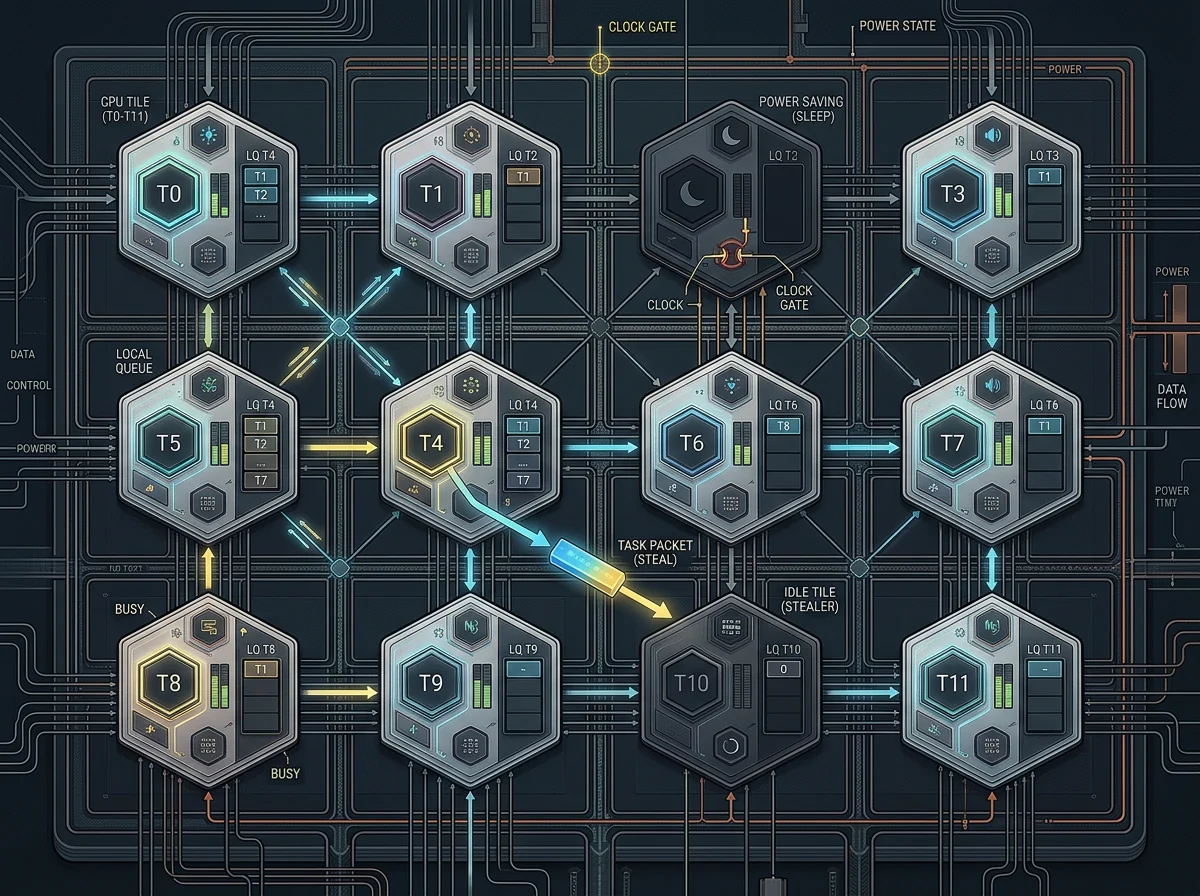
One feature highlighted by Architect Labs is distributed work stealing without a central scheduler. Each tile first runs its own work. If it is empty, it can pull a task from a neighboring tile with work to spare. If no task is available, the tile can become inactive and save power. The company says this specific behavior emerged through optimization and was not specified by a human.
The compiler divides code into short sections that can run once their inputs are ready. When a branch or loop creates an unknown number of parallel tasks, the continuation is parked locally while new tasks enter a hardware queue. Idle neighboring tiles can pull those tasks, and return packets wake the continuation when the final piece has completed. It is an elegant way to make dynamic parallelism a property of both the program model and the hardware.
Another example is extremely fine-grained clock gating. The agent system found changes in the hardware and modified the software runtime to exploit them at the same time. Architect Labs says that cross-stack optimization was completed in a matter of hours. This is where the workflow gets teeth: a conventional, divided chip-development process makes it expensive and slow to revise the architecture, runtime and physical design together.
This is also where the claim of AI as an inventor becomes most interesting. Individual mechanisms can have historical relatives, and interaction nets have existed for more than 35 years. The novelty is the combination. The agent system explored how the model could become a concrete instruction set, microarchitecture, runtime and physical design, then measured the pieces as one system.
How strong are the Frostbite results?
Frostbite was synthesized for a 7 nm process and reached 800 MHz at synthesis and 500 MHz in the final GDS. A cluster with four tiles and four L3 nodes measured 0.792 mm², compared with 0.895 mm² for the reference core on the same process. Across all 25 workloads, Architect Labs reports 4.59x the performance per watt. These are the company’s own pre-silicon results, not independent measurements from manufactured Frostbite silicon.
The advantage remained on the 15 workloads hidden during the architecture search, although it was smaller than on the tasks available for optimization. Frostbite reached a reported 6.02x geometric mean on the 10 search workloads and 3.83x on the held-out set. That is exactly why the held-out evaluation matters, and why the architecture still needs testing across a much broader range of software.
The workloads ranged from matrix operations and convolution to JSON parsing, Huffman coding, k-d trees and LZ4 decompression. That provides more breadth than one carefully selected demo. At the same time, 25 tasks are still a limited basis for calling Frostbite a practical replacement for today’s general-purpose processors.
The comparison target is the biggest limitation. The TCPU is a silicon-proven, dual-issue, in-order core that Architect Labs does not name for legal reasons. That is not the same as defeating a wide modern out-of-order CPU in ordinary applications. The figures also come from pre-silicon models and physical design, not measurements from a fabricated Frostbite chip.
What must happen before Frostbite is a breakthrough?
Frostbite needs independent scrutiny, broader benchmark suites and preferably physical silicon. Architect Labs plans comparisons against larger out-of-order CPUs, multicore configurations and established suites such as SPEC and PARSEC. The company also plans to release the RTL and ISA, build an FPGA-hosted playground and develop a preliminary operating system.
Those will be the decisive checkpoints. Public RTL and an open ISA would let other engineers inspect what the agent system actually produced. An FPGA version could give developers practical experience with the compiler and runtime. A fabricated chip could show how well the power and performance estimates survive contact with real silicon.
The software ecosystem is at least as difficult as the core itself. Vine looks familiar on the surface, but Frostbite relies on a different computational model from the software and toolchains surrounding today’s CPUs. A strong architecture without a compiler, debugger, operating system and useful software can remain an impressive research demonstration that never leaves the laboratory.
I am not declaring a winner of the CPU market on the strength of one company’s pre-silicon numbers. But I am not dismissing this as another AI demo either. Frostbite shows a credible direction in which agent systems can explore technical design spaces that humans rarely have the time or money to investigate, while formal contracts and physical measurements keep the search grounded. If the next rounds of testing hold up, this is big.
Frequently asked questions
Can you buy a Frostbite CPU?
No. Frostbite is currently a pre-silicon design with a completed GDS layout for a 7 nm process. Architect Labs plans an FPGA-hosted playground and says it will release the RTL and ISA, but it has not announced a commercial processor or measurements from fabricated Frostbite silicon.
Did AI create Frostbite without humans?
No, not in the sense of working without human goals or constraints. Humans selected the problem, workloads and control framework. Architect Labs says its AI agents explored and iterated on the compiler, ISA, architecture, RTL, verification and GDS, with some features emerging without a human specifying them directly.
Is Frostbite faster than the best CPUs available today?
That has not been demonstrated. Architect Labs compared performance per watt with an unnamed dual-issue, in-order core across 25 selected workloads. It was not a direct comparison with today’s widest out-of-order processors running broad, standard application suites.
Why does Frostbite use interaction nets?
Interaction nets make ownership and dependencies explicit, allowing independent local operations to run in any order. Frostbite tries to turn that structure into automatic parallelism, local storage and less dependence on heavy cache coherence and centralized scheduling.