Innhold Show
If you follow open coding models, GLM-5.4 is worth watching for one very specific reason: Z.ai lets the same 28 layers work through the problem twice. This is the company’s first Loop Transformer, designed to add computational depth without increasing the parameter count at the same rate.
GLM-5.4 is available to GLM Coding Plan subscribers and can also be used in ZCode and Z.ai Chat. It adds vision, targets coding and more complex visual tasks, and gives users with weekly limits 50 percent more quota than GLM-5.3. Public API access is still marked as coming soon, while the model weights are supposed to follow after additional safety work.
The architecture is the exciting part. The performance claims are still vendor claims. Z.ai has not yet published GLM-5.4 results on the usual benchmarks, and there are no open weights or API prices to inspect. I am not going to crown anything after a few polished demos. But the idea behind this model points toward an important direction for large AI models.
What is GLM-5.4?
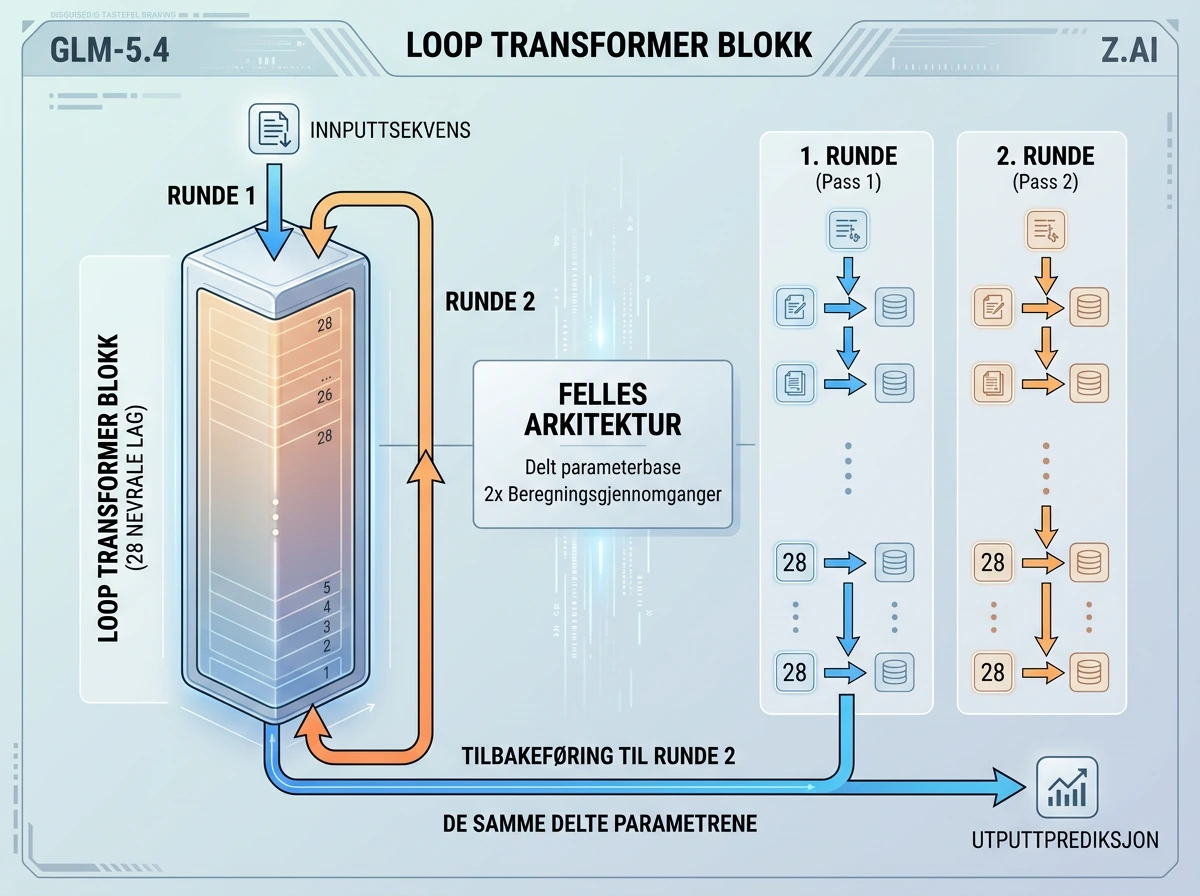
GLM-5.4 is Z.ai’s new flagship model for coding, vision and agentic work. According to Z.ai’s November 23, 2026 launch announcement, it is the company’s first flagship built as a Loop Transformer. The model sends its representation through one shared block of 28 layers twice instead of running every layer only once.
In a conventional Transformer, the signal moves through a sequence of layers once during each forward pass. GLM-5.4 feeds the representation through the same layers again. That gives the model more computational steps for processing the task without requiring Z.ai to add a second, separate copy of every layer.
Think of it as asking the same expert team to review a case a second time with its notes from the first pass, rather than hiring another full team. That does not guarantee a better answer, but it creates room for another round of refinement without duplicating the entire parameter set.
Z.ai claims that GLM-5.4 reaches an intelligence level comparable to models with 2 to 3 trillion parameters. That is a comparison of capabilities, not a claim that GLM-5.4 itself contains that many parameters. The statement needs to keep its vendor label until open weights, fuller technical details and independent measurements are available.
Why run the same layers more than once?
The point is to spend more computation on reasoning without growing the model at the same pace. Additional unique parameters can give a model more capacity to store knowledge, but tasks that require several stages of evaluation may also benefit from greater computational depth. The loop architecture tries to gain some of that depth by reusing layers.
Z.ai first trained smaller 30-billion-parameter models to study the effect. With roughly 10 percent more training compute, the company says looping produced its largest gains in mathematics, scientific reasoning and long-context tasks. On some evaluations, the answers also became 10 to 14 percent shorter. More internal processing does not necessarily mean burying the user under a longer response.
There is a catch. Z.ai says loop models trained from scratch still trail conventional models when both receive the same amount of training compute. GLM-5.4 therefore starts from a pretrained GLM-5 base and receives additional training. This is not evidence that repeated layers have replaced conventional scaling. It is an attempt to combine the two approaches.
How does Z.ai control the memory cost?
Running a large model block twice is not free. GLM-5.4 uses three techniques to limit the added cost: gates that control how much each pass writes back to the residual stream, a hybrid KV cache, and reuse of the indices selected by sparse attention. The last technique means the model does not have to calculate the entire attention pattern again during the second pass.
The hybrid KV cache matters especially with long context. According to TestingCatalog’s account of the launch, the additional pass requires one sliding-window cache rather than another full cache covering the entire context. Without that optimization, the theoretical gain could easily be swallowed by higher memory use and slower inference.
Z.ai has not released enough detail for outsiders to verify the complete calculation. The weights are not available yet. Still, the architecture description shows that the company has thought about deployment rather than stopping at a neat research diagram. Looping has to work during real inference if it is going to become more than a technical curiosity.
What do vision and Generalized Coding mean?
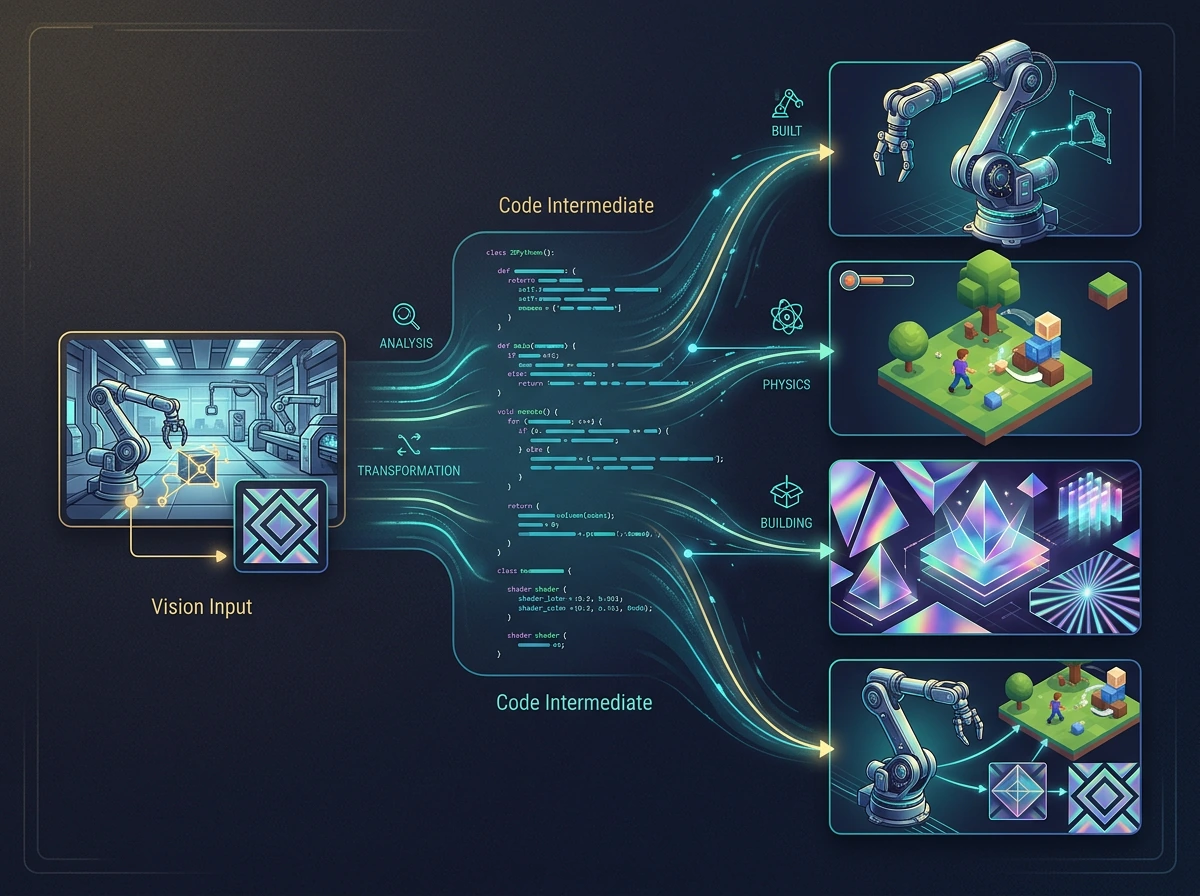
GLM-5.4 adds vision and is supposed to use code as a working tool far beyond conventional software development. Z.ai calls this direction Generalized Coding: the model can interpret a visual goal, write code that creates or changes the result, inspect the output and continue working. Code becomes an intermediate tool for solving a wider class of tasks.
The company’s demonstrations include a music video, a six-axis robot arm modeled in FreeCAD, a complete game with physics and combat systems, and an interactive 3D scene built with mathematical geometry and GLSL shaders. They show the breadth Z.ai is aiming for. They do not show how reliable the model will be when an ordinary user asks it to maintain a large project for several hours.
That distinction matters enormously with agents. Producing one impressive demo is one job. Understanding an existing codebase, retaining requirements, using tools correctly, noticing mistakes and finishing without breaking anything is another. For me, the second part decides whether a coding model becomes a useful working tool or remains a capable chatbot with spectacular screenshots.
What do we know about speed and limitations?
TestingCatalog reports speeds of up to 200 tokens per second outside peak demand and 70 to 80 tokens per second during peak periods. Those numbers describe the hosted service, not what a future local release might achieve on a particular machine. They also say nothing about how often the model stalls, uses the wrong tool or loses track of a long agent run.
Z.ai points to a more interesting weakness itself: the model can become stuck in extremely long “marathon thoughts.” The company says the additional reflection and self-correction improve accuracy, but for a coding agent, prolonged thinking can also mean more waiting and higher cost. More compute is useful only when it buys a better result.
Z.ai also launched GLM-5.4 without publishing results on the usual benchmarks. A company representative said those results would come later. I prefer practical agent runs to a wall of benchmark scores anyway, but their absence means the sweeping comparisons with much larger models cannot yet be independently checked.
When will the API and open weights arrive?
GLM-5.4 can be used now through GLM Coding Plan, ZCode and Z.ai Chat. In Claude Code, the model name is listed as glm-5.4[1m], while other supported tools use glm-5.4. Existing subscribers who have weekly limits receive 50 percent more GLM-5.4 quota than they had for GLM-5.3.
The public model API is marked as coming soon. Z.ai says access will open after a safety evaluation, but it has not supplied a firm date or price. Developers who need standard usage-based API access, cost figures or a stable production contract do not yet have enough information to plan around the model.
The weights are also due to open after safety hardening is complete. That is welcome, but future open weights are not the same thing as open weights today. The license, files, hardware requirements and final model specifications all need to exist before anyone can judge how practical GLM-5.4 will be outside Z.ai’s own service.
Is this a real architectural shift?
Yes, in the limited but meaningful sense that Z.ai has moved looped layers from smaller experiments into a flagship model. The company also says it intends to scale both loop depth and model size, and it is already promising a substantially larger model. GLM-5.4 is not an argument that the parameter race is over. It is an attempt to use computation more intelligently between each new round of larger models.
I find that direction more exciting than another model name accompanied by a claim of a few percentage points on a benchmark. If the same layers can perform more useful evaluation without making memory requirements explode, the approach could improve hosted models and, eventually, open-weight releases. Fixed two-pass processing may still be a fairly blunt instrument. A simple task might need one pass, while a difficult one could benefit from several.
GLM-5.4 does not yet prove that repeated layers lead to better real-world agent runs. It does make the idea concrete in a model that people can actually use. That is enough to make the launch architecturally significant, but not enough to make the model a proven winner.
Who should pay attention to GLM-5.4?
Developers who already pay for GLM Coding Plan can try the model now. I would pay particular attention to long agent tasks, vision work and how often “marathon thinking” produces a better result rather than merely adding delay. I have not tested GLM-5.4 myself, so I will not pretend to know how stable it remains after several hours of work.
Anyone waiting for API access, OpenRouter availability or local weights should wait for the actual deliverables. I am a big fan of APIs and open models, but “coming soon” cannot be inserted into a production plan. The useful questions are still unanswered: What will the API cost? Which license will cover the weights? What hardware will they require? And does the model remain dependable across long, tool-heavy agent runs?
My preliminary verdict is simple: GLM-5.4 is architecturally more interesting than an ordinary point release, but it is too early to call it a new open favorite. API pricing, published weights and independent agent tests will tell us whether two trips through the same layers also deliver twice the practical value. Until then, the Loop Transformer idea is the story, and the vendor superlatives can wait for verification.
Frequently asked questions
Can I use GLM-5.4 now?
Yes. GLM-5.4 is available through GLM Coding Plan, ZCode and Z.ai Chat. Standard public API access is still marked as coming soon. The model name is glm-5.4[1m] in Claude Code and glm-5.4 in other supported tools.
Is GLM-5.4 an open-weight model?
Not yet. Z.ai says it will release the model weights after the necessary safety hardening is complete, but it has not announced a date or license. Until the files are actually published, GLM-5.4 should be described as a model with promised open weights.
What is a Loop Transformer?
A Loop Transformer runs a shared block of layers more than once. GLM-5.4 sends its representation through the same 28 layers in two passes. The goal is to increase computational depth and improve reasoning without adding a separate copy of every parameter for each pass.
Does GLM-5.4 support images?
Yes. GLM-5.4 includes vision and can use visual information in coding and design tasks. Z.ai demonstrates games, video, 3D graphics and CAD work, but there is not yet enough independent evidence to judge how stable its vision capabilities remain during long agent workflows.