Innhold Show
If you want to run text, vision, video, and audio AI locally, Liquid AI LFM3 is a model family worth watching. Six models in roughly the 2-billion-parameter class cover different jobs without forcing you to load one enormous general-purpose model.
That practical idea is what makes this release exciting. LFM3-1.7B is a text model, while separate variants handle vision, audio, multiple modalities together, and fast structured decisions. They all grow from the same compact base model, and Liquid AI says each one can be fine-tuned on a single GPU.
This is a source-based news article, not my own test. Most of the performance figures come from Liquid AI and should be read as the vendor’s measurements. Even with that caveat, I like the direction: smaller models designed for specific jobs can be far more useful locally than a larger model trying to be the best at everything.
What is Liquid AI LFM3?
Liquid AI LFM3 is a family of six open-weight models for text, images, video, audio, and structured decisions. According to Liquid AI’s October 27, 2026 announcement, every model is derived from LFM3-1.7B-Base and sits in roughly the 2B class.
The family includes LFM3-1.7B for text, LFM3-VL-2B for text, images, and video, LFM3-Audio-2B for text and audio, and LFM3-Omni-2B, which combines text, images, video, and audio. The other two are d1-2B and d1-Omni-2B, decision models built to return fast structured answers with probabilities rather than another little essay.
You are not supposed to load all six for every task. Pick the model that fits the job. A local document assistant may need only the text model, while a system that has to understand an image and a spoken request may call for Omni. That makes more sense than paying the memory and power bill for capabilities your application never uses.
Six models, six different jobs
The six variants share a technical foundation, but they are not six labels pasted onto the same model. Liquid AI’s technical overview on Hugging Face shows separate inputs, outputs, and encoders adapted to each job.
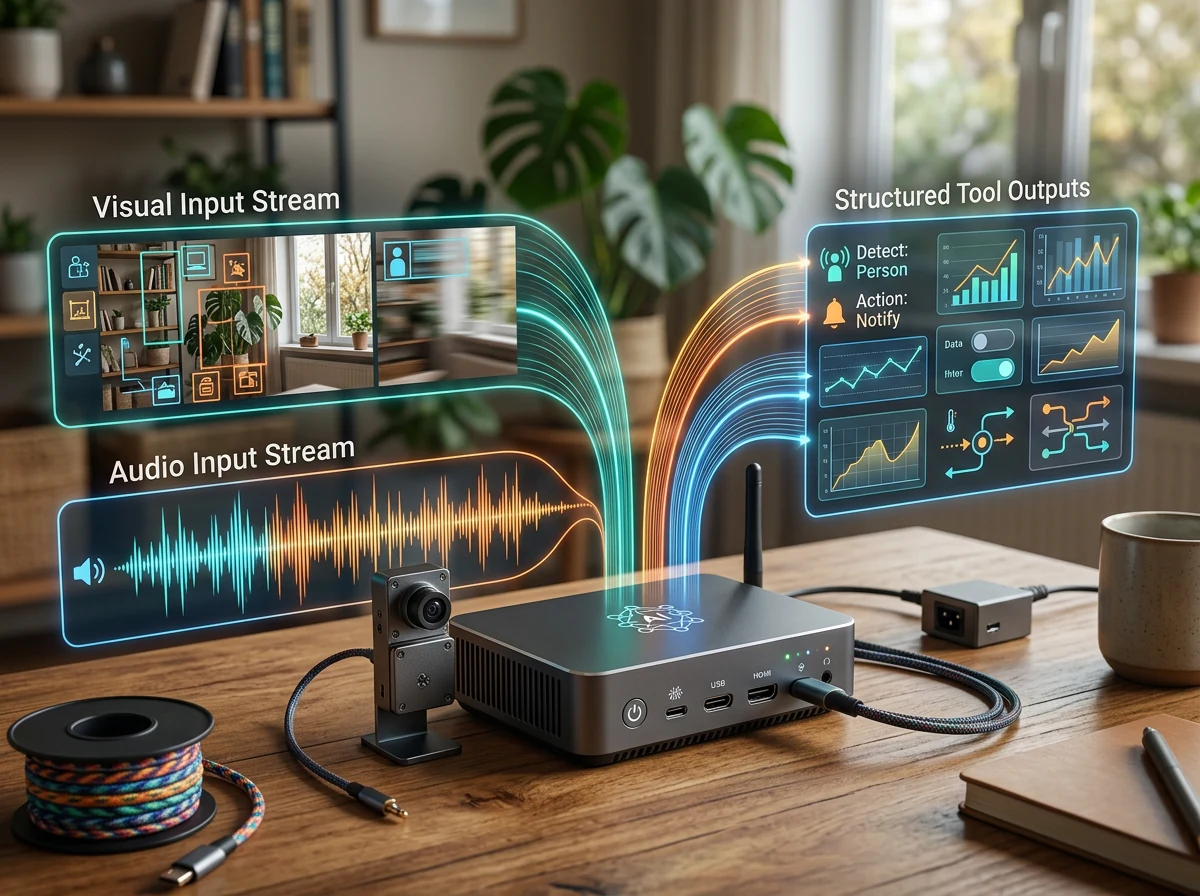
LFM3-VL-2B accepts text, images, and video and responds with text. LFM3-Audio-2B can take text or audio and produce text, speech, or both. LFM3-Omni-2B brings vision and hearing into one model, so it can answer a spoken question about an image or process a video together with its soundtrack.
The decision models are a slightly different kind of tool. You can give d1-2B an invoice, screenshot, or video clip along with several questions. In one pass, it can answer those questions, point to objects, extract values, estimate a numeric range, and attach probabilities to its answers. That may suit sorting, quality control, and document workflows better than a model determined to write prose every time.

How small is LFM3-1.7B in practice?
LFM3-1.7B has 1.73 billion parameters and a 256K-token context window. The official model card says a 4-bit version needs about 1 GB of memory. The model can run through Transformers, vLLM, SGLang, and compatible llama.cpp setups, among other options.
About 1 GB for the quantized text model is small enough to make laptops and phones realistic targets. That does not mean the entire workload will always use exactly 1 GB. Long context, the KV cache, the inference engine, and the rest of the application also need memory. A 256K context window is maximum capacity, not a free default setting.
This is where size matters more than a random top score on a benchmark. A model that fits on the device, starts quickly, and can keep doing one bounded job in the background may be more valuable than a smarter model you can only afford to call occasionally. The useful question is not whether 1.7B can beat everything. It is whether it is capable enough for the exact local job you need done.
How does the tri-hybrid architecture work?
Tri-hybrid means LFM3-1.7B distributes its work across three types of layers: 13 gated short-convolution layers, five sliding-window attention layers, and six global attention layers. That makes 24 layers in the base model, according to Liquid AI’s technical presentation.
The convolution layers handle much of the local processing efficiently. Sliding-window attention looks at a limited window of 256 tokens, while global attention can connect information across longer distances. The idea is to spend the more expensive global attention where it helps instead of paying the same computational cost in every layer.
Liquid AI also added per-head attention gating, partial RoPE, and normalization before and after the blocks. The company says its architecture search covered 14 combinations of devices and inference engines, from a Raspberry Pi 5 and phones to GPUs and the Qualcomm Hexagon NPU. That is much more relevant to local deployment than a model optimized mainly for one large server.
The text model is built for local agents
LFM3-1.7B has been post-trained for tool calls, structured output, and agent frameworks. Liquid AI highlights tasks such as sorting email, managing a calendar, retrieving information, and selecting the right tool from a large collection. It also supports deferred tool definitions, so an application does not have to cram its entire tool catalog into the prompt in advance.
That fits small persistent agents doing one clearly defined job locally. When every call does not pass through a paid cloud service, several background processes can work without turning every tiny step into a new API charge. Data can also remain on the device when the complete workflow truly runs there.
But small is still small. The model card explicitly says LFM3-1.7B is not recommended for agentic coding or complicated multi-step reasoning. Liquid AI recommends search or RAG for knowledge-intensive tasks. I would treat it as a specialist and tool user, not a local replacement for the largest reasoning models.
Vision and audio are more than accessories
LFM3-VL-2B uses a new 164-million-parameter vision encoder. Liquid AI claims it needs three times less compute than the SigLIP2 encoder in earlier LFM models. For video, two sampled frames are merged into one temporal unit, halving the visual sequence length before further processing.
The audio side adds both a causal audio encoder and LiquidCodec for generated speech. The company reports time to first token as low as 50 milliseconds for audio input and speech decoding at about 87 times real time on one CPU thread of an Apple M4 Max. Those are vendor measurements on specific hardware, not a promise that every machine will produce the same speed.
LFM3-Omni-2B may therefore be the most exciting variant. A compact model that can see, listen, answer with speech, and issue structured tool calls opens the door to local assistants on hardware that will never run a giant model. However, the available documentation does not support a judgment about Norwegian speech, dialects, interruptions, or noisy environments. The release lists 18 audio languages, and Norwegian is not among them. That is an unknown, not a negative test result.
Open-weight does not mean no conditions
All LFM3 models are available as open weights in Liquid AI’s LFM3 collection on Hugging Face. The collection includes the base, text, vision, audio, omni, and decision models, with several formats for local inference. You can download, inspect, and fine-tune them.
\nIf you would rather try the models before setting up local inference, Liquid AI says LFM3 is also available through the Liquid API and launch partners including OpenRouter. That gives developers a practical way to test the right specialist first, then decide whether local deployment is worth the setup.
\n\n\n\nOpen-weight does not mean everything has been released under a completely permissive open source license. The model cards use the LFM Open License v1.0. If you plan to put one of these models into a product or commercial service, read the actual terms for your use case instead of assuming that open weights means you can do whatever you like.
There is no reason to download every variant simply because it exists. Choose the text model for text and tool calls, VL for images and video, Audio for audio, and Omni only when the task genuinely needs those modalities together. The specialization is the whole point.
What do Liquid AI’s own measurements show?
Liquid AI says LFM3-1.7B uses 35 percent fewer parameters than LFM2.5-2.6B while outperforming its predecessor in the company’s evaluations. With 8K tokens in context, it is said to be about 25 percent faster per parameter than LFM2-1.2B on the tested edge devices.
For vision, the company reports that LFM3-VL-2B raises the average score across 62 evaluations from 57.6 to 71.4 compared with LFM2.5-VL-3B. That sounds impressive, but a broad average hides which tasks fit the model and which do not. The concrete limitations in a model card are often more useful than a victory lap around one aggregate score.
I would not pick a model from a results chart alone. Start with the modality, license, formats available for your hardware, and whether the task requires precise knowledge or long reasoning. If you need much more local capability, compare models in another size class instead of pretending 1.7B and 30B are the same kind of tool.
The practical value of LFM3
LFM3 follows a direction I like: build one small foundation, create clear specialists, and make them available on hardware people actually own. It is not as easy to market as one model that supposedly does everything, but it is often a better recipe when the software needs to be fast, private, and inexpensive to run.
The text model could be useful for local tool calls and structured tasks. The vision and decision models may fit documents, screenshots, inspection, and sorting. Audio and Omni point toward local voice interfaces, but the sources do not document Norwegian quality and nobody should pretend otherwise.
LFM3 is new, and its most tempting performance claims come from the company itself. Treat the family as a promising set of building blocks, not six proven winners. Still, a text model with 256K context at roughly 1 GB in 4-bit, plus separate 2B models for vision, audio, and decisions, is more than a cosmetic update. Local multimodal AI has simply become easier to fit onto real devices.
Frequently asked questions
Can Liquid AI LFM3 run on a regular laptop?
Yes, especially the text model. Its official model card says LFM3-1.7B needs about 1 GB of memory in 4-bit, although the inference engine, context, KV cache, and application require additional memory. The multimodal variants have different requirements.
Is LFM3 free and fully open source?
The model weights can be downloaded from Hugging Face under the LFM Open License v1.0. Open-weight is more accurate than calling the release completely permissive open source. Read the license terms before commercial use, redistribution, or integration into a product.
Which LFM3 model should I choose?
Choose LFM3-1.7B for text and tool calls, VL-2B for images and video, Audio-2B for audio, Omni-2B when vision and audio must work together, and the d1 variants for fast structured decisions with probabilities.
Does LFM3 support Norwegian speech?
Norwegian is not among the 18 audio languages listed in the release material. The sources also do not document Norwegian pronunciation, dialect understanding, interruptions, or noisy conditions. There is therefore no basis for either a positive or negative judgment of its Norwegian speech quality.