Innhold Show
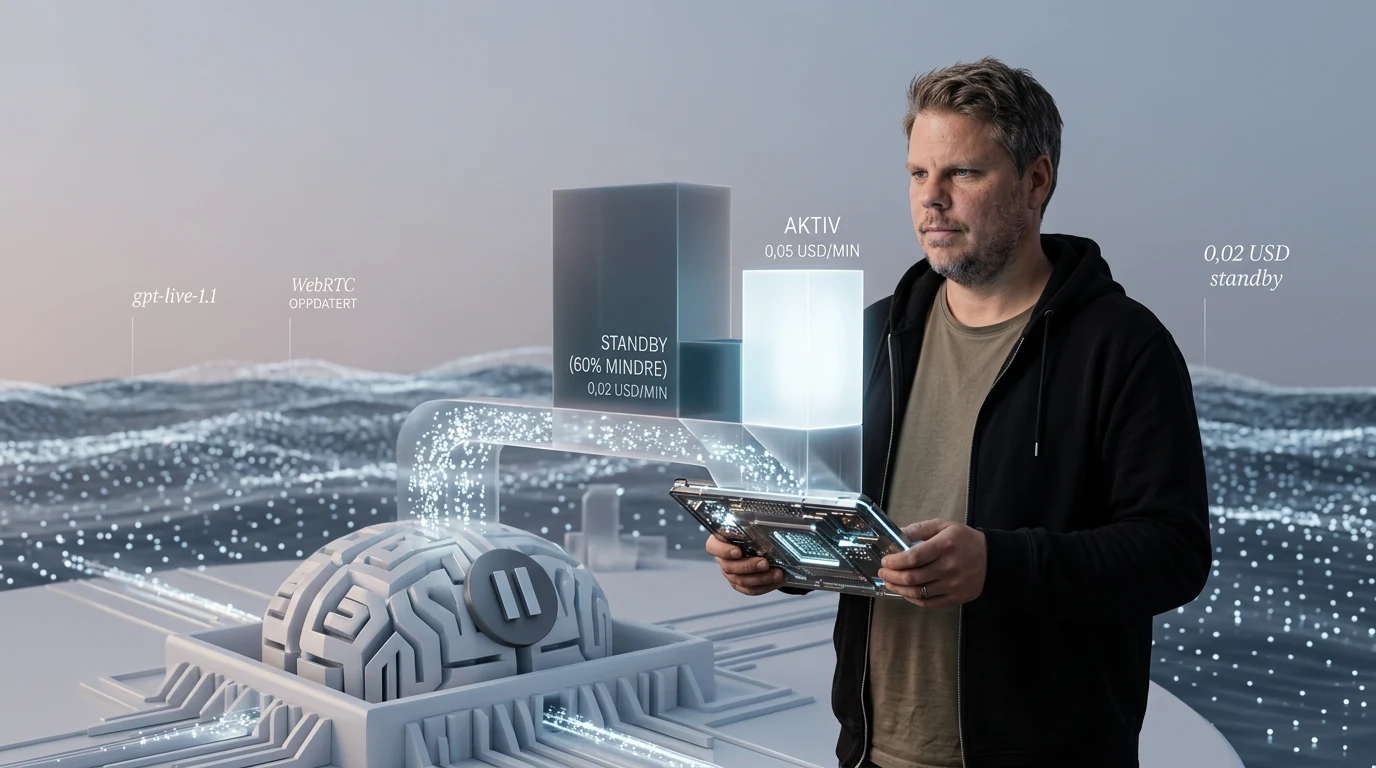
OpenAI has released GPT-Live-1.1, while a new standby mode cuts the price of idle time in GPT-Live sessions by 60 percent. Standby keeps the WebRTC connection open but pauses inference when nobody is speaking. The price then drops from $0.05 to $0.02 per minute.
Those numbers may look tiny in isolation. Across long customer-service calls, meetings, driving sessions or support conversations, however, silence becomes a real operating cost. An agent that must remain available for an hour should not have to burn full inference money while someone searches for an order number.
GPT-Live-1.1 also promises more accurate transcription, more consistent voices and accents across languages, and better handling of letters and numbers than GPT-Live-1. Those improvements sound useful, but OpenAI has not published comparative benchmark figures for them. The benefit we can quantify today is standby: paying less while the voice agent waits.
What is GPT-Live-1.1?
GPT-Live-1.1 is OpenAI’s full-duplex model for live voice conversations. It accepts audio and text, returns audio and text, supports streaming and function calling, and costs $0.05 per active minute according to the official model page. The API model ID is gpt-live-1.1.
Full duplex means the conversation does not have to follow the rigid pattern of “you speak, the machine waits, the machine answers.” The model can deal with interruptions and overlapping speech more like a real conversation. It can also hand reasoning or tool work to a backend model without breaking the live audio flow.
That makes it relevant to customer service, phone systems, bookings, training and assistants designed to stay available over time. GPT-Live-1.1 does not turn a voice interface into a complete agent by itself, but it can remain the conversational layer while other models, databases and services do the work behind it.
How does the new standby mode work?
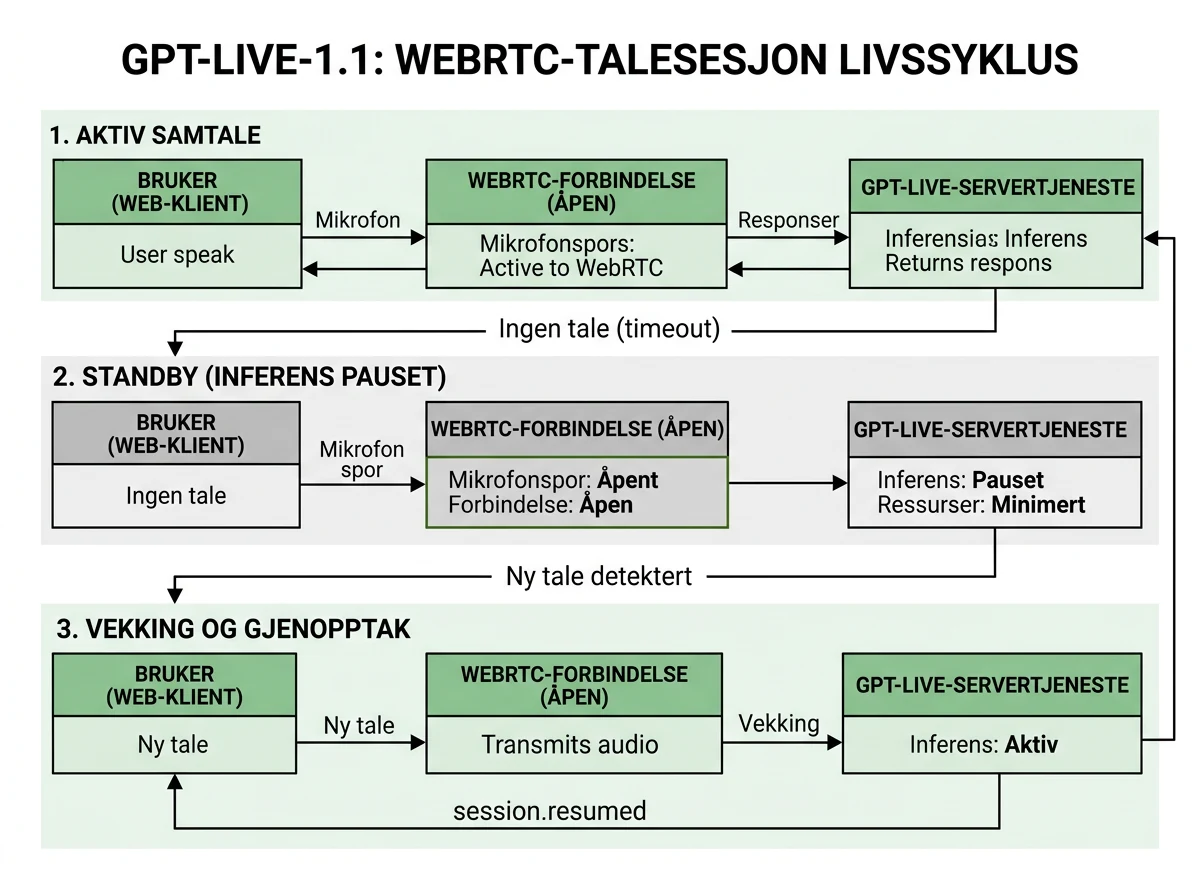
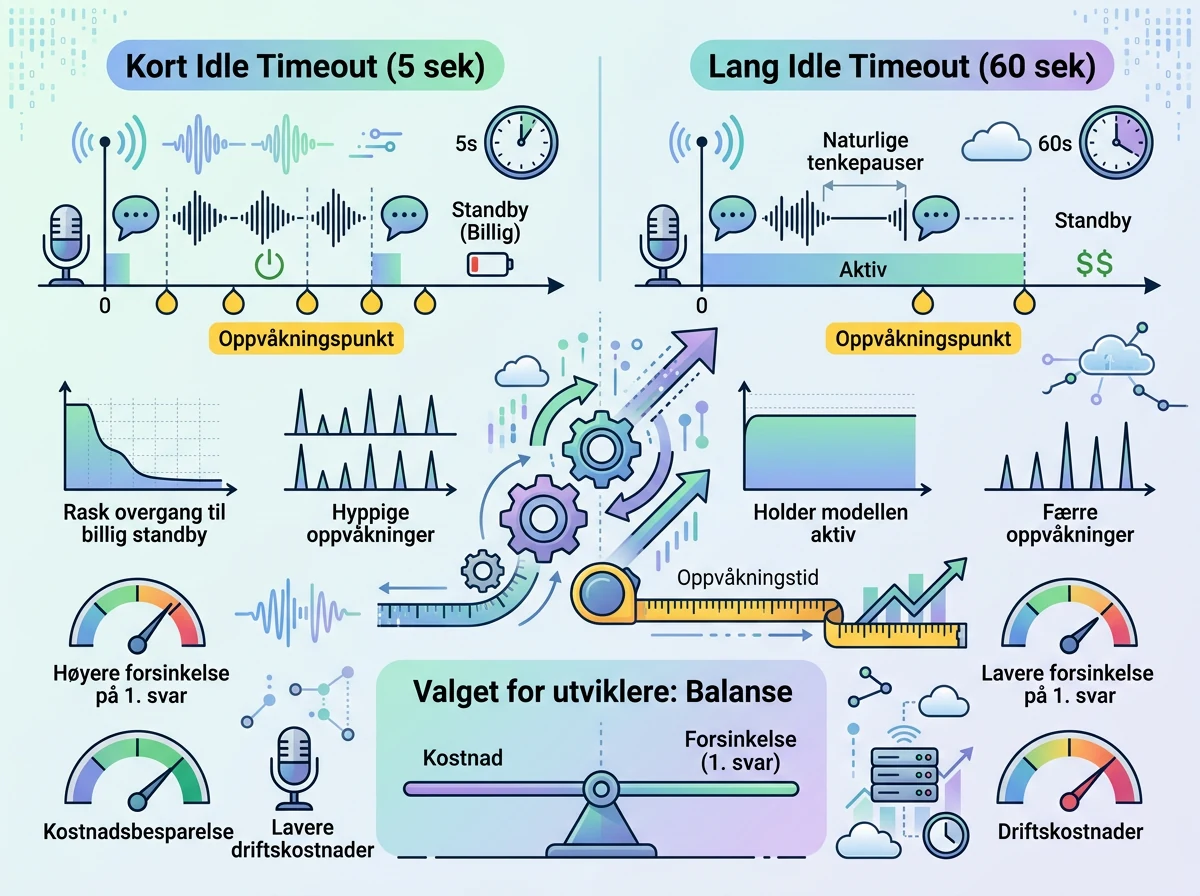
Standby leaves a WebRTC session connected while inference is paused. Set session.wake_policy.type to speech, then choose a session.idle_timeout_s value from 5 to 60 seconds. When speech returns, the model wakes and continues with the same session ID and conversation history.
OpenAI’s idle-session documentation says the microphone track must remain active during standby. The server emits session.paused when inference stops and session.resumed when the model is ready again. Those events give the application something concrete to display, log and measure.
Muting the microphone is not the same thing. OpenAI explicitly notes that a muted microphone leaves the session active. To receive standby pricing, the session must enter the documented paused state rather than merely stop sending useful sound.
For a very long gap, closing the session and creating a new one later may still be cheaper. Standby is for pauses where the connection should remain ready to wake on speech. A car assistant, a meeting-room agent or an ongoing support call fits that pattern far better than a service that may not be used again until tomorrow.
How much does a GPT-Live-1.1 voice agent cost?
An active GPT-Live audio session costs $0.05 per minute, or $3 per hour. Standby costs $0.02 per minute, or $1.20 per hour if the entire hour is spent paused. That is a 60 percent reduction for the minutes in which inference is actually paused.
A real conversation will normally move between the two states. Ten active minutes and 50 standby minutes cost $1.50 for the Live session: $0.50 for active time and $1 for standby. Keeping the same session active for the full hour would cost $3. The more time the agent must remain available without speaking, the more the difference matters.
Backend models and tools are billed separately. If the voice agent sends a difficult request to a text model, searches a database or calls an external service, those costs still apply. The $0.02 figure is not the total price of a finished agent. It is the price of waiting voice time while inference is paused.
I like the architecture behind this. A fast conversational model can stay close to the user while specialist models and tools handle the tasks they are better suited to perform. Standby makes that architecture easier to justify when availability matters but continuous inference does not.
OpenAI’s quality claims are not measured results
OpenAI says GPT-Live-1.1 transcribes speech more accurately, maintains accents and voices more consistently between languages, handles details such as letters and numbers better, and completes tasks more reliably. The launch announcement lists those four improvements but provides no comparable scores.
I therefore cannot say how large the jump from GPT-Live-1 really is. It could be a noticeable production improvement, or it could be a collection of smaller refinements that become visible only in particular languages and conversation types. OpenAI says the model has powered voice in ChatGPT Plus and Pro since October 15, but that is not a substitute for measurements on the workflow you plan to deploy.
Nor does a general claim about multilingual consistency prove performance in any particular language. A language listing or an English benchmark would not document pronunciation, dialect recognition, interruptions, noisy audio or transcription quality in Norwegian. I have not tested GPT-Live-1.1 myself, and the available material contains no dedicated Norwegian evaluation. Its Norwegian quality is therefore unknown, not good and not bad.
MarkTechPost also points out that OpenAI presents the quality gains without published benchmark results. That does not make the claims worthless. It does mean they should remain vendor claims until independent testing or measurements from a real deployment can confirm them.
Standby also has a latency cost
The lower price is not technically free. OpenAI warns that the first response after a short utterance can take longer when a session wakes from standby. The effect depends on the product: a small delay may be harmless in one support call and painfully obvious in a conversation where the user expects an instant reply.
The 5-to-60-second idle timeout is therefore a product decision, not merely a cost setting. Five seconds sends the agent into its cheaper state quickly but creates more wake-ups. Sixty seconds carries the active price through ordinary thinking pauses but avoids waking the model as often. There is no universal correct value. The right setting follows the actual rhythm of the conversations.
The client should also wait for session.resumed before assuming inference is ready. A polished microphone button means very little if the user begins speaking while the application loses the first words. In production, I would measure how often standby activates, time to resume, lost or repeated utterances, and cost per completed task.
Who benefits most from the upgrade?
Standby delivers the most value when a voice agent spends substantial time waiting but must keep the connection open. Customer service while someone searches for an order number, an assistant following a long work session, and voice control in a car are obvious cases. A short call filled with continuous speech has much less idle time to make cheaper.
You do not need to switch models to use standby if you already run GPT-Live-1. OpenAI makes the feature available to both GPT-Live-1 and GPT-Live-1.1. That distinction matters: the price benefit comes from the session configuration, while the model change supplies the claimed improvements in transcription, consistency and task completion.
It also gives developers a cleaner test plan. First enable standby on the existing model and measure cost, pause frequency and wake-up latency. Then create separate sessions with gpt-live-1.1 and compare transcription, instruction following and task completion. The model cannot be changed during an existing session, so the comparison must use separate runs.
A voice agent that is cheaper to keep available is easier to defend in products where much of the session is perfectly ordinary human silence. That is a modest-sounding change with a very practical effect. It removes waste without forcing developers to discard the connection and conversation context every time someone stops talking.
My verdict on GPT-Live-1.1
Standby is a sensible, concrete improvement. Nobody wants to pay full inference rates while a model listens to someone rummaging around for a customer number. Keeping the connection and history while lowering the rate to $0.02 per minute solves a real operational problem without making the developer tear down the session at every pause.
I am more cautious about the quality claims. Better transcription and more reliable handling of letters and numbers could matter enormously in customer service, bookings and identity checks. Without published comparative figures, and without relevant evidence for Norwegian, we do not yet know how much better GPT-Live-1.1 actually is.
The next step for developers is straightforward: enable standby where open WebRTC sessions contain real silence, then measure the savings against wake-up latency. Evaluate the model upgrade separately with representative conversations, languages, number sequences and tool calls. The price advantage is documented. The rest still has to prove itself in use.
Frequently asked questions
Is GPT-Live-1.1 available in the OpenAI API?
Yes. The model is available in the Live API under the model ID gpt-live-1.1. It supports audio and text input and output, streaming and function calling. It does not support image or video input, structured outputs or fine-tuning.
How much can standby save during a voice session?
Standby costs $0.02 per minute compared with $0.05 while active, so paused minutes cost 60 percent less. A full hour would cost $1.20 in standby rather than $3 at the active rate, excluding backend models, tools and external services.
Does standby work with the older GPT-Live-1 model?
Yes. Standby is available for both GPT-Live-1 and GPT-Live-1.1. It requires a WebRTC session, an idle timeout from 5 to 60 seconds and an active microphone track while inference is paused.
Has GPT-Live-1.1 been proven to work well in Norwegian?
No specific Norwegian result has been published. OpenAI says transcription and multilingual voice consistency have improved, but those claims do not measure Norwegian pronunciation, dialects, noise or interruptions. This article is source-based, not my own Norwegian voice test.