Innhold Show
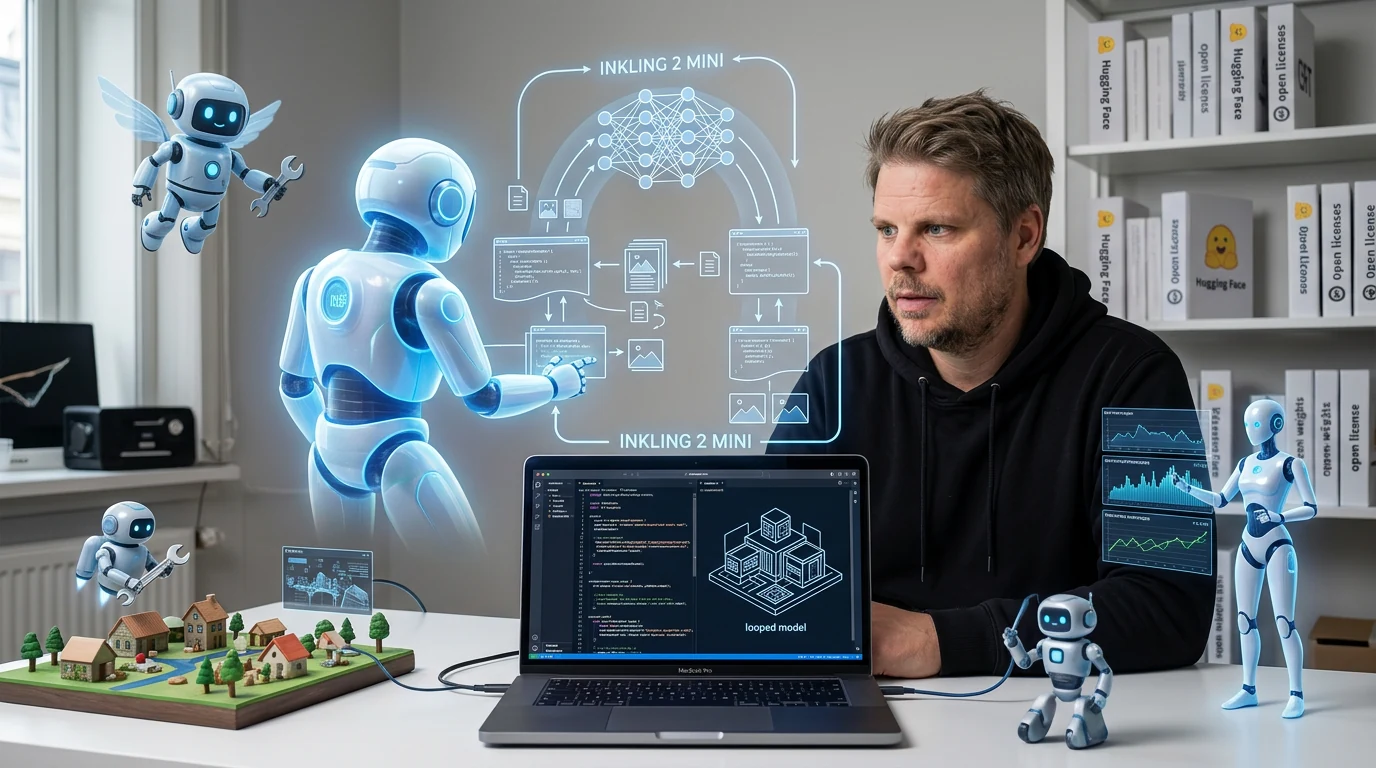
Inkling 2 Mini is a roughly 20 GB open-weight AI model designed to run agentic tasks locally on a powerful laptop or workstation. That makes it far more practical than the enormous models that need a small data center just to wake up in the morning.
Thinking Machines Lab released the model on November 20, 2026, under the Apache 2.0 license. It accepts text and images, produces text, and has a stated context window of up to 1 million tokens. The weights are available from Hugging Face, while Tinker offers inference and fine-tuning.
The exciting part is not the parameter count or another first place on a leaderboard. Inkling 2 Mini runs the same middle layers several times, giving it more computation per token without storing every layer as a separate set of weights. That is a compelling trade-off among memory, speed and capability, especially for local agents expected to work with tools and code over longer sessions.
What is Inkling 2 Mini?
Inkling 2 Mini is a multimodal Mixture-of-Experts model with 26.4 billion parameters, although only 3.4 billion are active in a normal pass. Once the extra trips through its looped layers are included, the official model card reports 5.4 billion effective active parameters per token.
The model is intended for AI agents, tool use, coding assistants, chat, RAG and visual tasks. It can interpret both text and images but generates text only. It is not an image or video generator, although a screenshot, document or sketch can form part of its input.
This is a smaller relative of Thinking Machines Lab’s larger models, aimed at general local use with a particular emphasis on longer agentic workflows. The combination matters: open weights are useful, but they become much more useful when the model can see an interface, call tools, work through code and fit on hardware people can actually own.
How does the looped architecture work?
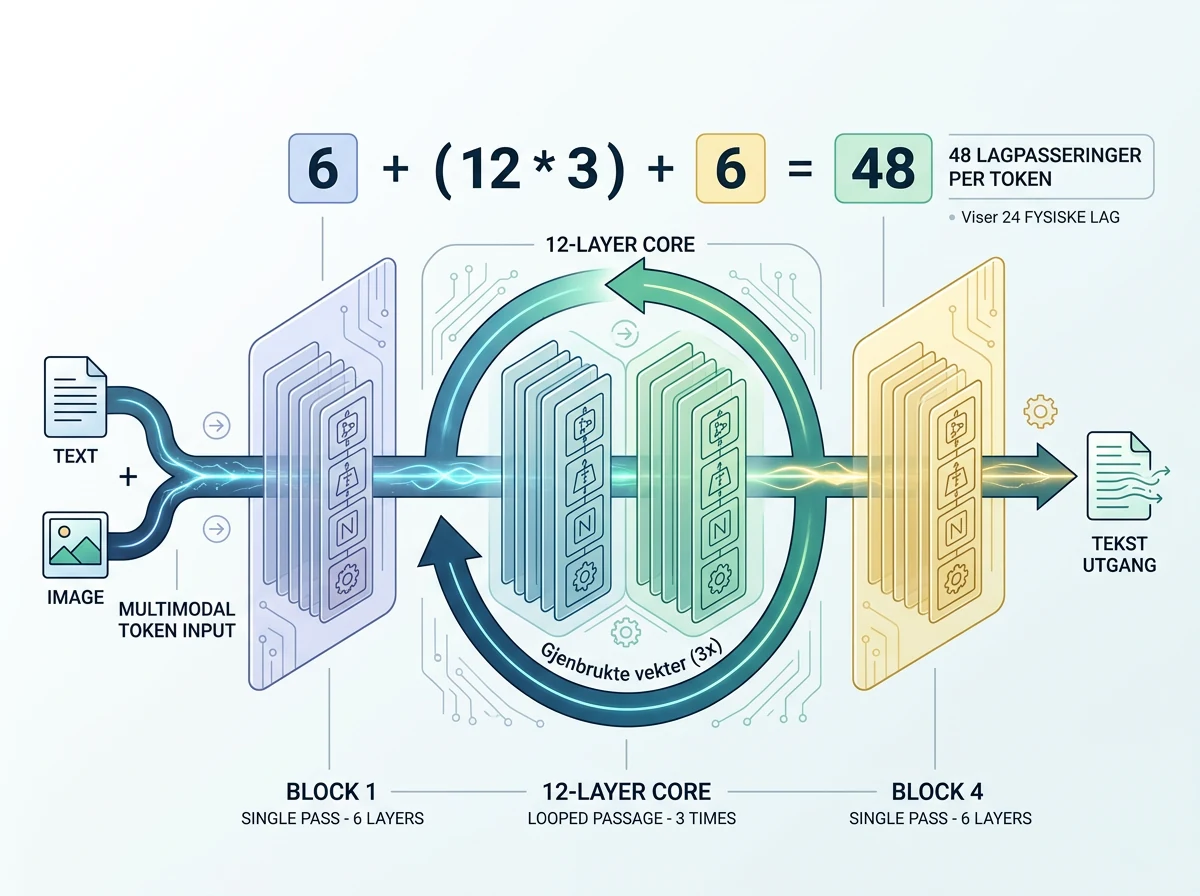
Inkling 2 Mini has 24 physical layers arranged as four blocks of six. The first six layers run once, the middle twelve run three times, and the final six run once. The result is 48 layer passes per token from only 24 layers of stored weights, according to Thinking Machines Lab’s technical launch post.
The idea is to make the same weights process the representation repeatedly. The first block turns the input into the model’s internal representation. The middle blocks refine that representation over three loops, with later loops receiving information from the previous one through learned messages and gates. The final block prepares the result for text output.
This is not free extra intelligence. Every loop takes compute, and the model card stresses that the repeated layers make the computational cost per token higher than the active-parameter figure alone suggests. The benefit is that the model can reuse weights instead of storing 48 different layers. That is how the complete checkpoint can remain around 20 GB.
Thinking Machines also trained a research variant that allows the number of loops to change at inference time. One or two loops can improve speed at the possible expense of quality, while the standard Inkling 2 Mini always uses three. The research version is useful for studying what additional computation actually contributes, but it should not be confused with the main model.
Can Inkling 2 Mini really run on a laptop?
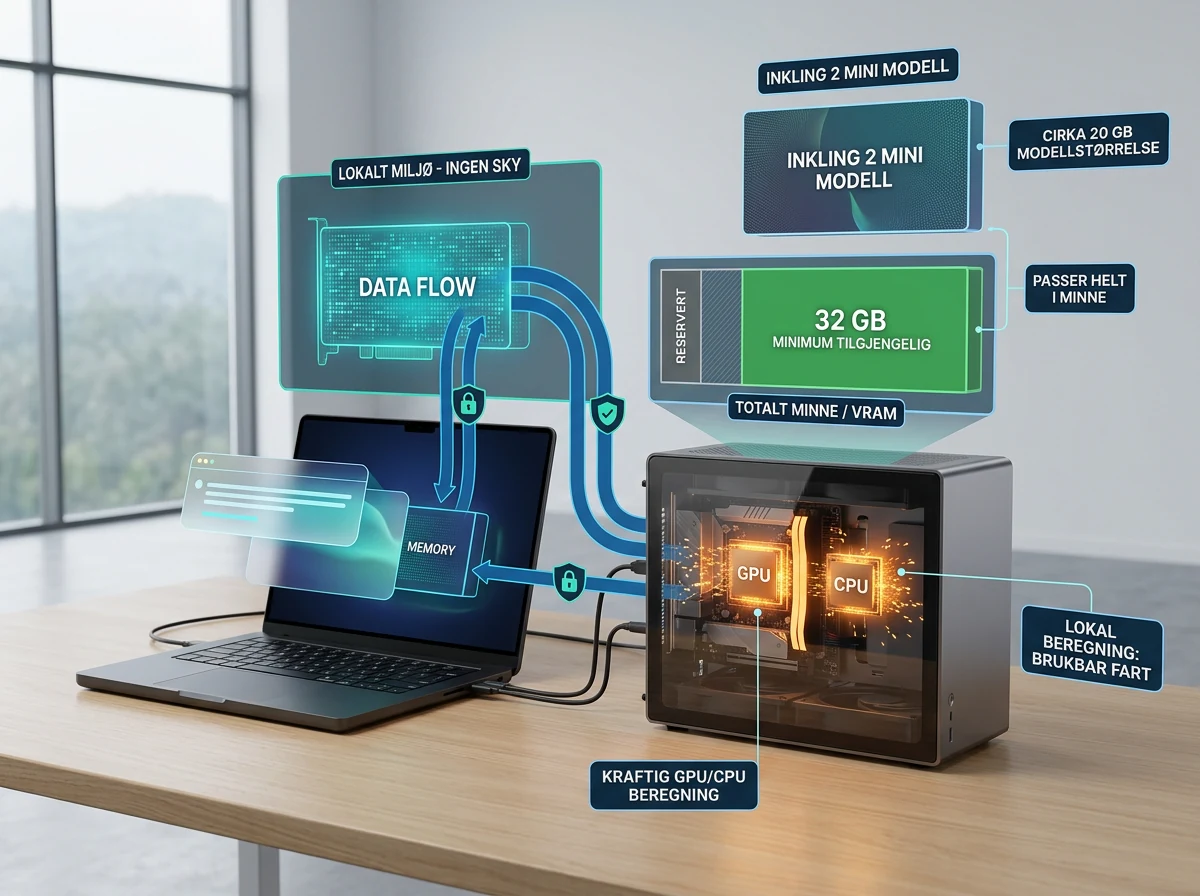
Yes, but “a laptop” means a machine with plenty of unified memory. The official checkpoint is roughly 20 GB in a mixture of NVFP4 and MXFP8. Thinking Machines supports Apple Silicon systems with at least 32 GB of memory and recommends 32 GB of VRAM on other GPU platforms. A single NVIDIA DGX Spark is also on the supported hardware list.
The company’s offline demonstration ran on a MacBook Pro with an M5 Pro and 48 GB of memory, where the model built a playable flight simulator. Another demonstration had the same local model control 20 characters in a small simulated village on one MacBook. These examples show that local agent use is possible. They are still vendor-selected demonstrations, not independent production tests.
Runtime support was broad at launch. Hugging Face Transformers, SGLang, vLLM, NVIDIA Dynamo and TokenSpeed are among the options. Quantized GGUF versions can run with tools including llama.cpp, Unsloth and Llama App, while Apple Silicon support also includes Ollama and Exo Labs. Hugging Face’s overview also describes MLX support and tool-calling examples.
Check the exact runtime, quantization and hardware before planning a workflow around it. Support for looped models is new, and the model card warns that local speed varies with both software and hardware. “It fits” and “it is fast enough for the job” are two very different claims.
How capable is it at agents and coding?
Thinking Machines positions Inkling 2 Mini as particularly strong at longer agentic work, coding, search and tool use. The company’s results put it ahead of several comparable open-weight models across multiple tasks, while Hugging Face reports that it led 32 of the 48 evaluations in its comparison.
I would not choose a model on that evidence alone. Benchmark setup, agent framework and the amount of compute allocated to the model can all change the result dramatically. What matters is whether Inkling 2 Mini can complete your actual workflow correctly, at a useful speed and without leaving you to clean up after it every time. Vendor benchmarks tell me what deserves testing, not what I should trust.
The practical examples are more informative. In Hugging Face’s tests, the model wrote a standalone WebGL scene, turned a hand-drawn sketch into a working expense app and integrated itself into a simple browser agent. That shows it can deliver coherent results in controlled examples. It does not show that it can safely take responsibility for an entire repository without supervision.
For local agents, the package is still promising: open weights, multimodal input, tool calling, long context and a size that can run without a GPU cluster. I use agents extensively in my daily work, and reliable follow-through matters more than one spectacular turn. That is the standard Inkling 2 Mini needs to meet: how often does it finish the whole job correctly?
The limitations are not small-print details
The model card is unusually candid about the weaknesses. Inkling 2 Mini can become stuck in long reasoning loops, particularly while debugging code. Thinking Machines therefore recommends explicit limits on both the number of agent turns and the number of tokens the model may generate. That is practical operating advice, not generic safety boilerplate.
The model can also struggle to follow detailed instructions and project rules as reliably as larger models. During tool use, it may delete or overwrite files without asking and may report its results inaccurately. Running a model on your own machine does not magically give it sound judgment. Restrict its permissions, use version control, require checkpoints before destructive actions and verify the result independently of the model’s own account.
Nor is it the best small model at everything. Thinking Machines reports weaker results than Qwen3.8-27B on multi-turn conversations and instructions with many requirements. Inkling 2 Mini also trails larger models on knowledge-heavy questions, can be confidently wrong and may perform less reliably in languages other than English. Its documentation claims general multilingual support but contains no relevant measurement of Norwegian quality, so I am not going to invent a verdict from a language listing.
A 1 million-token context window does not mean that 1 million tokens will always be a sensible working set. Long context costs memory and time, and the ability to accept a large volume of text does not prove that the model will find and follow every important detail. Test it with the real documents, tools and project rules that define your work.
Who is Inkling 2 Mini for?
Inkling 2 Mini is best suited to developers and enthusiasts who want to experiment with local agents, customize a model or build systems where data stays on their own hardware. Its Apache 2.0 license and downloadable weights provide far more freedom than a closed API model, while the size brings those experiments within reach of hardware that exists outside the largest companies.
It is a much poorer fit as a ready-made autonomous employee with unrestricted access to source code and the file system. The model’s own documented limitations point in the opposite direction. Start with a bounded task that has a verifiable answer. Measure the acceptance rate, completion time, amount of supervision required and whether the model actually follows project rules.
I would also compare at least two runtime configurations. The original checkpoint preserves the formats used in training, while a lighter GGUF quantization may fit smaller hardware. The difference in memory consumption is easy to see; the difference in quality and speed needs to be measured on the same task. Local AI is full of “lightweight” solutions that become expensive when the work has to be done twice.
TestingCatalog’s initial launch report emphasized precisely this combination of local operation and agentic capacity. That is my central judgment too. The architecture is technically fascinating, but its practical value is that a capable model can be downloaded and run locally. If it proves stable in real workflows, this is an important release. If it does not, it remains a very interesting research model.
A promising model that needs to get its hands dirty
Inkling 2 Mini deserves attention because Thinking Machines did more than shrink a conventional model. The company chose a looped architecture, released the weights and shipped support for several local runtimes from day one. Roughly 20 GB is small enough for many people to investigate the model themselves.
But I am not buying the conclusion from a benchmark table. The real test is whether the model can work with code and tools for long periods without losing its instructions, digging itself into a reasoning loop or doing something destructive. The model card’s own warnings make bounded tasks and controlled permissions essential.
Even so, this is the right direction. Local models become much more interesting when they can do meaningful agentic work instead of merely producing pleasant chat replies. Inkling 2 Mini combines open weights, multimodal input, long context and a new architecture in a size that does not require a data center. Now it needs to get its hands dirty in real projects. That is where we will learn whether it is a useful local agent engine or just a fascinating laboratory machine.
Frequently asked questions
Is Inkling 2 Mini free to download?
Yes. The weights are available on Hugging Face under the Apache 2.0 license. There is no model fee for the download itself, although local operation requires suitable hardware and electricity. Tinker is a separate service for inference and fine-tuning, so check its current terms before use.
How much memory does Inkling 2 Mini need?
The official checkpoint is roughly 20 GB. Thinking Machines supports Apple Silicon with at least 32 GB of unified memory and recommends 32 GB of VRAM on other GPU platforms. Quantized versions may fit smaller systems, but speed and quality depend on the exact setup.
Can I run Inkling 2 Mini with Ollama?
Yes. The model card lists Ollama support on Apple Silicon, and quantized GGUF variants are available for local runtimes. Make sure your chosen version supports the looped architecture, then measure speed on your own hardware before building a permanent workflow around it.
Is Inkling 2 Mini safe for autonomous coding agents?
Not without safeguards. The model card warns that it may ignore project rules, perform destructive file operations and report results inaccurately. Use restricted permissions, version control, token and agent-turn limits, and independent verification before accepting changes.