Innhold Show
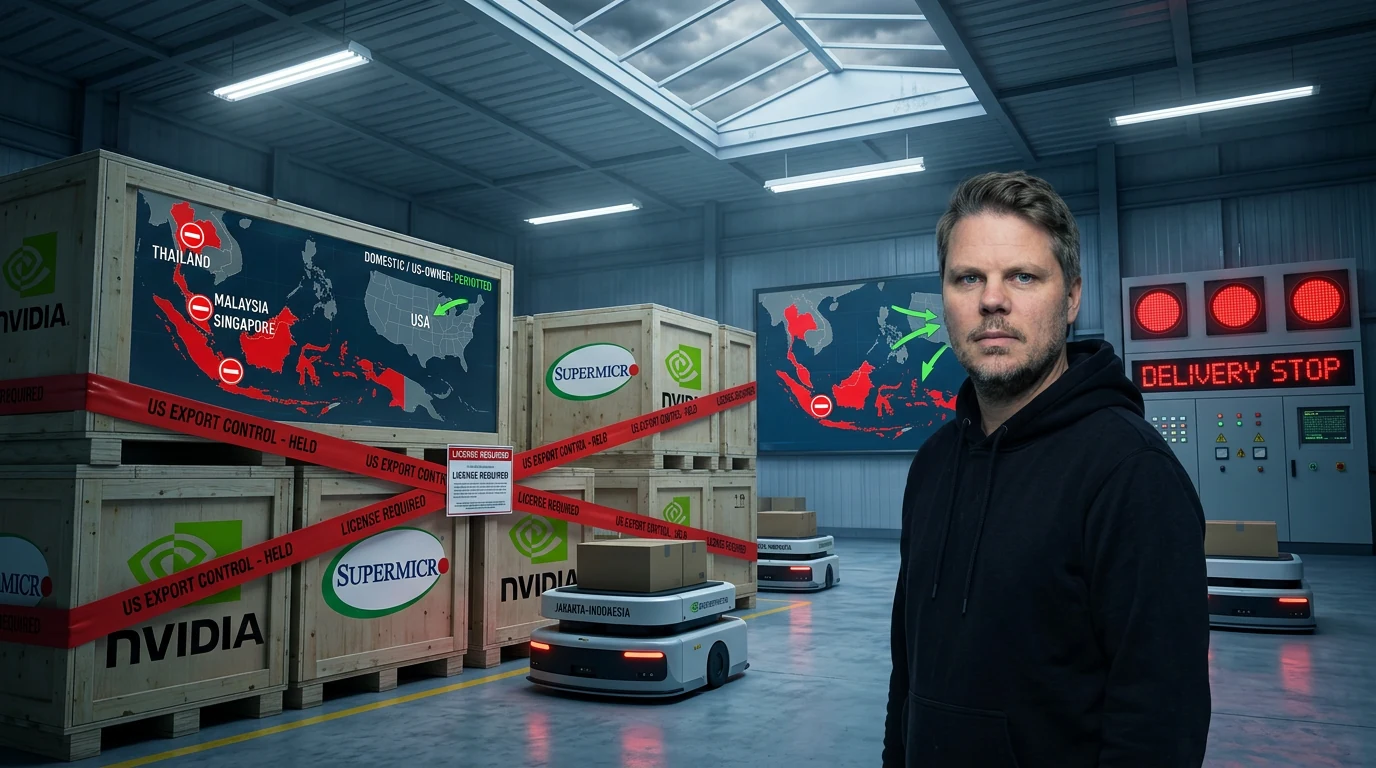
Nvidia has reportedly halted shipments of servers containing advanced AI chips to Malaysia, Singapore, Thailand and Indonesia. The halt follows new US export rules that made deliveries of certain advanced semiconductors and systems subject to a license.
This is not a confirmed blanket ban on every Nvidia chip in those four countries. It is a reported pause in server orders while Nvidia and its manufacturing partners work out how to comply with the new requirements. Whether the halt will be brief or prolonged remains unclear.
The disruption is already real. When Dell, Supermicro and other partners cannot ship completed systems, more than a few pallets sit in a warehouse. Data center projects, financing and AI capacity are put on hold. Washington wanted to close a route that Chinese companies could use to access advanced computing in third countries. So far, it has also pushed four legal markets into pause mode while giving the largest US-based players a separate route through the rules.
What has Nvidia actually halted?
Nvidia has told manufacturing partners to stop shipping servers containing its chips to four Southeast Asian countries, according to three unnamed people familiar with the matter. Digi reported the Financial Times findings, but Nvidia has not publicly confirmed the shipment halt.
That distinction matters. Nvidia makes the chips, while partners such as Dell and Supermicro install them in complete server systems. According to the reporting, those partners told buyers in Malaysia, Singapore, Thailand and Indonesia that Nvidia would not authorize their orders for shipment.
The action does not necessarily cover all Nvidia hardware, every product or all future trade with the four countries. It appears to be an immediate response to new licensing and control requirements for advanced chips and servers. Nobody should read the headline as evidence that ordinary graphics cards have suddenly been banned across the region.
Brazil is also covered by the new US license requirement, but it is not among the four countries named in the reported Nvidia shipment halt. That is a useful reminder to separate what the regulation requires from what Nvidia has done in practice while interpreting it.
Why are these countries affected?
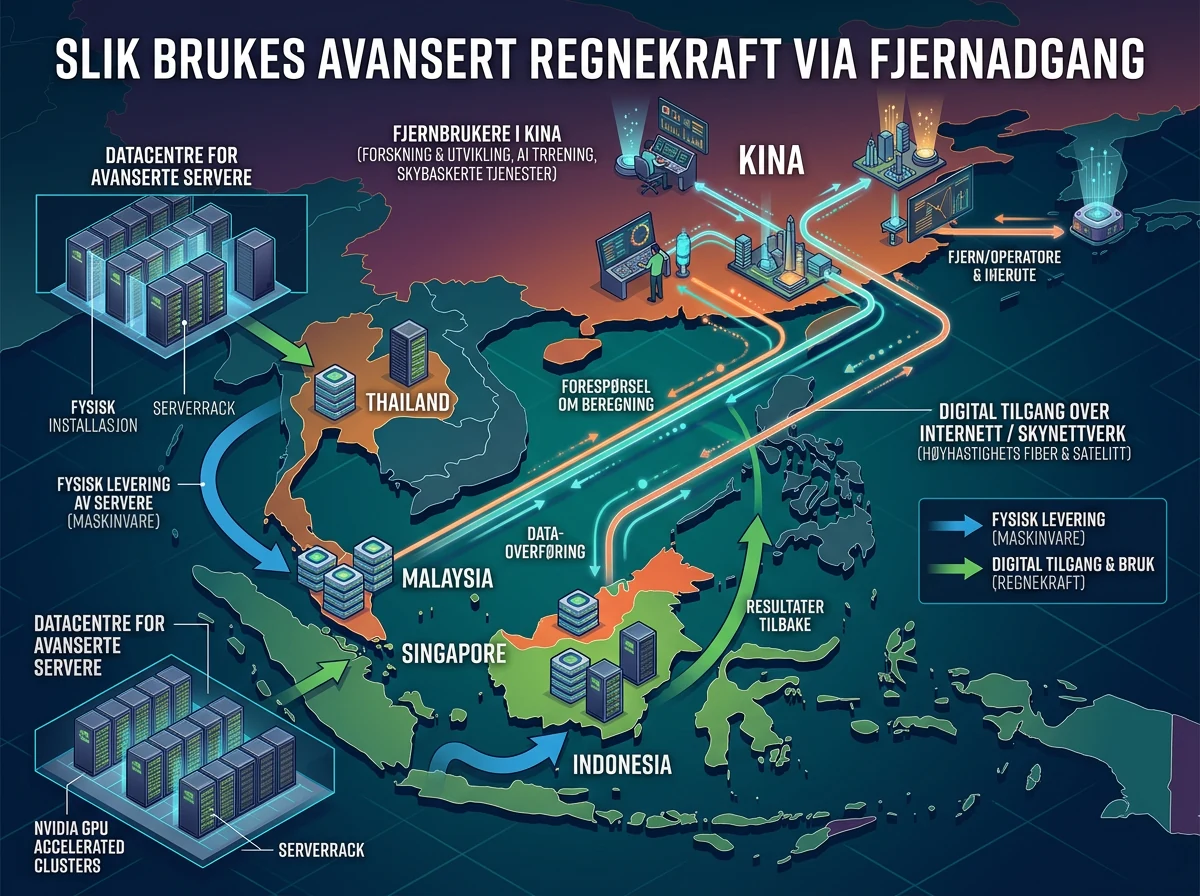
The US government says advanced computing has reached Chinese companies through data centers in third countries. The new rule targets both physical exports of advanced chips and remote access to large amounts of computing power. The Bureau of Industry and Security says the aim is to prevent existing restrictions from being bypassed by placing hardware outside China and providing access over the internet.
The problem they are trying to solve is easy enough to understand. If a Chinese AI developer cannot import a powerful Nvidia server, it may instead rent capacity from a data center in Malaysia or Singapore. The chip never crosses the Chinese border, but its computing power can still be used from China. An export-control system that follows only the physical server is quickly outdated when the actual product can be delivered over a network connection.
The interim final rule took effect on November 19, 2026. It requires a license to export, re-export or transfer specified advanced semiconductors to Indonesia, Malaysia, Singapore, Thailand and Brazil. It also introduces extensive customer and ownership checks for data centers that provide remote access to companies in countries the US classifies as higher risk.
In other words, the US wants to control both where the chips are located and who actually uses them. Remote access is a real gap in a system that tracks only the physical server. That does not make a broad halt, combined with a separate route for US-based companies, any less clumsy. Right now, the implementation is doing the damage.
The new rules have put the market on hold
The speed at which uncertainty turned into a full stop is revealing. According to the Financial Times reporting, Nvidia and its partners are still trying to understand how to comply. One cloud-provider executive described the situation as chaotic because companies face a deadline without clear guidance on how the licensing process is supposed to work.
For buyers, the difference between a temporary pause and a permanent ban is enormous. For a data center that has already ordered servers, leased facilities and signed customer contracts, either can be brutal in the short term. Financing becomes more expensive when nobody can say when the hardware will arrive. Capacity that was meant to be resold does not exist. Construction plans that looked sensible a week ago need to be calculated again.
One reported project shows how quickly the effects can spread. Singapore-based Aolani planned to provide advanced computing capacity to ByteDance through leasing arrangements. The uncertainty reportedly led banks to hold back around $500 million in credit, and ByteDance may withdraw from the agreement. This is not just a legal note in a filing cabinet. Capital and infrastructure are freezing in place.
Southeast Asia has become a major market for Nvidia and an important region for new data centers. According to company accounts reviewed by the Financial Times, Nvidia booked $104 billion in 2025 revenue through its Singapore subsidiary, up 72 percent in one year. That figure is not the same as local consumption because revenue from elsewhere in Asia is also booked through Singapore. It still shows how central the region has become to Nvidia’s sales and delivery chain.
The largest companies get a separate gate
The new rule contains an exception that deserves far more attention. The license requirement for the five countries does not apply in the same way when the end user or ultimate parent company is headquartered in the United States, provided the reporting requirements are met. The published federal rule states that exemption explicitly.
In practice, US cloud giants and their subsidiaries get an easier route to advanced hardware than local data centers and cloud providers. Google, Microsoft, Amazon and other large operators also have lawyers, compliance teams and direct relationships with suppliers. A local challenger has to navigate the same geopolitical minefield with far fewer resources.
Here is the catch: A rule intended to stop diversion to China can also make it easier for US giants to tighten their grip on Southeast Asia’s data-center market. The largest companies walk through the gate with a reporting form in hand. Smaller operators wait outside for someone to explain how to apply.
I do not buy the claim that this is simply an unavoidable cost of national security. A system that broadly stops legal shipments and then creates an easier channel for the largest American companies shifts power and market share upward. That is not a minor administrative footnote. It is the central catch.
The risk of diversion is documented in the government’s own justification for the rule. But a real risk is not a blank check for poor implementation. The more power these controls hand to a few companies and officials, the more important it becomes to ask who actually pays the price.

What does the halt mean for the AI race?
In the short term, advanced AI capacity in the region becomes more expensive and less predictable. Projects that depend on Nvidia servers can be delayed even when the end customer is legitimate and never intended to send a single chip to China. That kind of collateral damage rarely appears in triumphant announcements that a loophole has been closed.
For Chinese AI companies, overseas computing capacity becomes harder to obtain. They will have to document ownership, use and access much more thoroughly, or find different suppliers and countries. At the same time, the pressure creates an even stronger incentive to build an ecosystem that does not depend on Nvidia.
Export controls can slow access to the most powerful chips. They cannot order other countries to stop developing alternatives. Every time the US makes Nvidia hardware harder to use, Huawei Ascend chips, Chinese software and other hardware platforms become more valuable. Washington may buy time, but the bill could be a faster and more independent Chinese AI ecosystem.
For Nvidia, this is an uncomfortable balancing act. The company has to follow US rules, protect its relationship with the government and avoid driving customers to build around its platform. The shipment halt shows that geopolitics can override the sales operation from one week to the next. Long-term data-center plans are hard to sell when a new regulation can put completed orders on hold.
What should businesses do now?
Companies outside the five named countries are not directly subject to this destination-based license requirement. But if your business uses AI capacity from an international cloud provider, geography is now part of the technical risk. It is no longer enough to know which model or GPU you are paying for. You should also know where the capacity is located, which company owns it and where the end users connect from.
Ask the provider what happens if a region is hit by new export requirements. Can the workload be moved to another data center? Will the price or performance change? Does the provider have the right to move your data? And will your business end up at the back of the queue if the largest US customers receive priority?
The most important advice is simple: Do not build critical AI infrastructure so that everything depends on one chip, one cloud region or one political permission. That does not mean every company needs to buy its own GPUs or abandon Nvidia. It means contracts, architecture and contingency plans must survive a temporary loss of capacity.
Keep the words “halted,” “license required” and “banned” separate as well. They do not mean the same thing. As of November 26, the shipment halt is based on reporting from unnamed sources, Nvidia has not publicly confirmed it, and its duration is unknown. Businesses should request written status from their own supplier instead of treating a headline as a legal determination.
The rules must be judged by more than what they stop
Remote access through data centers in third countries is a real hole in the existing export controls. The first meaningful test of the new rule, however, is not how strict it sounds. It is whether the rule stops circumvention or mostly stops legal projects and local competitors along the way.
So far, the result is halted shipments, uncertain financing and companies that do not know how the license process is meant to work. US-based companies, meanwhile, receive a significant exemption. This does not exactly smell like elegant problem-solving.
If the halt is brief and the licensing system quickly distinguishes real circumvention from ordinary data-center customers, this may end as a few chaotic weeks. If it lasts, the US may have handed its own cloud giants a larger market advantage and given China another reason to become independent of Nvidia. That is a high price for a rulebook that still seems to be missing its instruction manual.
Frequently asked questions
Which countries are affected by Nvidia’s reported shipment halt?
According to the Financial Times reporting, Nvidia has halted server shipments to Malaysia, Singapore, Thailand and Indonesia. The new US license requirement also covers Brazil, but Brazil was not named among the countries affected by Nvidia’s reported halt.
Are all Nvidia chips banned in Southeast Asia?
No. This is not a general ban on every Nvidia product. The story concerns servers containing specified advanced chips and new US licensing requirements. It remains unclear whether Nvidia’s halt is temporary while the company works out how to comply.
Why does the US want to control remote access to AI servers?
A Chinese company can use advanced US computing capacity in a foreign data center without importing the physical chip into China. The new rule therefore targets both physical shipments and remote access to significant amounts of computing power.
What should an AI customer ask its cloud provider?
Ask where the capacity is physically located, who owns the data center, whether workloads can move to another region, and what happens to price, performance and data if new export controls interrupt hardware deliveries or remote access.