Innhold Show
Active Memory in Muse and Meta AI is meant to reduce how often you have to repeat important information from earlier conversations. The new specialized models also get Active Focus, which is designed to keep an agent moving when a task runs into an obstacle.
Meta announced the rollout on November 6, 2026. The company is using Muse Wonder to train specialized versions of the existing models behind Muse and Meta AI. That distinction matters: Meta is not necessarily giving everyone access to Muse Wonder itself. It is moving some of Wonder’s capabilities into services people already use.
This may sound like a minor model update, but memory and the ability to hold on to a goal are the foundations of a useful AI agent. An agent that forgets the premise or gives up at the first error message is still little more than a talkative intern. Meta now says Muse uses critical context correctly in 90 percent of tasks, up from 76 percent.
What has Meta actually rolled out?
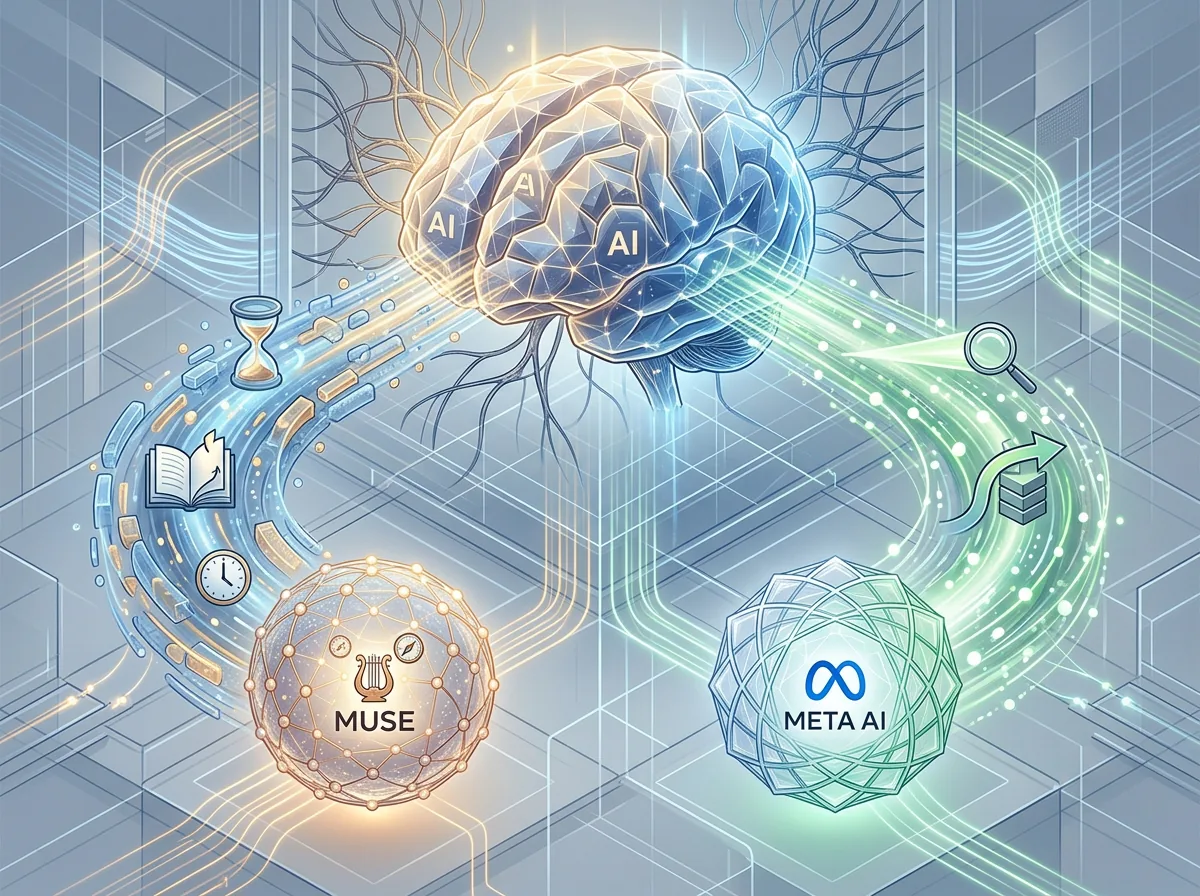
Meta is rolling out new specialized versions of the models that power Muse and Meta AI. Trained using Muse Wonder, they gain two capabilities first introduced with the Wonder family: Active Memory for relevant long-term memory and Active Focus for more persistent task completion.
TestingCatalog reported on the rollout on November 9, three days after Meta’s announcement. Meta has not published separate model names, model sizes or a detailed schedule for when every account will receive the change. “Rolling out” should therefore be read literally. It does not mean that everyone will see the new capabilities at the same time.
The update follows the October introduction of the Muse Wonder series, which Meta described as its most capable models for agentic tasks. Active Memory and Active Focus were two of its headline capabilities. Meta is now using Wonder as a training foundation for more specialized models, with the aim of spreading some of those capabilities to more users without claiming that everyone is running Muse Wonder itself.
What does Active Memory do?
Active Memory is designed to distinguish information that only matters right now from details that remain useful later. The models are trained to reason about time, recognize when earlier information becomes relevant again and leave stale details behind. The point is not to remember everything. It is to remember the right things.
That distinction matters far more than an ever-larger context window. If you plan a project across several conversations, an old deadline may have been replaced, a supplier may have dropped out and a budget may have changed. A good agent has to understand which information still applies. Retrieving everything indiscriminately is just a more sophisticated way to make a mess.
In Meta’s own Active Memory evaluation, the new Muse model used critical context correctly in 90 percent of tasks. The previous model managed 76 percent. The error rate therefore fell from 24 to 10 percent, which explains Meta’s claim of a 2.4 times reduction in forgetting critical information. That is a clear improvement in the company’s test, but Meta has not published the number of tasks, a full evaluation protocol or results from an independent assessment.
Meta says the same work should make Meta AI better at breaking complex problems into steps, asking sharper follow-up questions and keeping up when the user changes direction midway through a conversation. The company has not provided equivalent percentage results for Meta AI, however. The specific measurements in the announcement apply to Muse.
What does Active Focus do?
Active Focus is meant to keep Muse aimed at the goal when something unexpected happens. Meta says the models were trained on bottlenecks drawn from real-world tasks so they can try harder, recover, find another route or ask for clarification instead of stopping at the first obstacle.
It is easy to underestimate how important this is. Many agent demos look wonderful as long as the website, file or API behaves exactly as expected. Reality rarely does. A button moves, a field is missing, a login expires or a condition changes. The agent then needs to understand that the method failed without losing sight of the goal.
Meta reports a 67 percent improvement in completing everyday tasks when unexpected problems arise. It does not give the absolute scores before and after, so the figure does not reveal what proportion of tasks the model actually completed. A 67 percent improvement may be impressive, but it is harder to judge without the starting point, sample and test setup.
The specialized models are also supposed to handle multiple tasks more effectively, decide when to work independently and recognize when they should collaborate directly with the user. Meta also says they can absorb new instructions and clarifications in the middle of a task without losing the thread. Those transitions are precisely what separate an agent from a conventional chatbot with a long system prompt.

How large is the improvement in practice?
Meta’s figures point in the right direction: critical context is used correctly in 90 percent of tasks, up from 76 percent, while the Personal Superintelligence Index rises from 38 to 47 percent. The company also claims a 67 percent improvement in completion when an everyday task encounters an unexpected obstacle.
The memory evaluation is the most tangible result because Meta gives both the old and new values. The jump from 76 to 90 percent is 14 percentage points. That is not the same as a 14 percent relative improvement, and it certainly does not mean the model remembers 90 percent of everything a user has ever said. The measurement covers tasks that require the model to use critical context in Meta’s own evaluation setup.
The Personal Superintelligence Index is also Meta’s own index. It indicates that the company sees a substantial improvement, but the name is larger than the documentation accompanying this brief announcement. I would treat the numbers as a signal of direction, not a final verdict on quality. Independent evaluations and ordinary use over time will have to show whether the difference is noticeable outside Meta’s scenarios.
There is also no evidence here measuring Norwegian language performance, Norwegian dialects or Norwegian speech. This is a source-based report, not my own test. It tells us something about Meta’s measured context use and task completion in Muse, but it does not support a claim that the model has become better in Norwegian.
Why is Meta using specialized models?
Meta describes the specialized models as a way to bring selected Muse Wonder capabilities into Muse and Meta AI. The stated goal is to give more people access to better memory, planning and the ability to recover when something goes wrong.
This looks like a practical division of labor: Wonder provides the training foundation, while more targeted models do the work inside the product. Meta does not disclose the training method, the size of the new models, the compute they require or whether they are cheaper and faster to run. It is therefore too early to label this as distillation or any other specific technical recipe. What the company confirms is that the models were trained using Muse Wonder.
For the user, the model name matters less than the behavior. Muse is moving from an assistant that responds to one message at a time toward an agent that can pursue goals over time. That fits Meta’s broader plan to turn Muse into a more active operating partner for small businesses. Memory and persistence are not decoration on the box at that point. They are requirements for the service to be useful at all.
What should you look for when the update arrives?
First, watch whether you need to repeat fewer premises in longer conversations. A genuine improvement should be visible when old information becomes relevant again, when an earlier decision has been replaced and when you change a condition midway through the work. The model should retrieve what still applies without dragging stale details along with it.
Next, pay attention to what Muse does when a plan breaks. Does it try a sensible alternative, or merely repeat the same mistake in different words? Does it ask for help when a decision genuinely requires you, or continue on its own without adequate control? Active Focus is only useful when persistence is paired with judgment.
Do not give an upgraded memory feature more access than the task requires. Long-term memory can be extremely useful, but you should still think carefully about the personal information, customer data and business details you put into a cloud service. Meta’s short launch article explains the intended model behavior, but it does not provide a complete account of storage, deletion or the controls users receive over memory.
I find this direction far more useful than yet another launch built around topping a narrow benchmark. If Meta has genuinely reduced critical forgetting and made the agent better at navigating obstacles, people may notice the improvement in ordinary work. But vendor figures are the start of an evaluation, not the end.
Meta has chosen a sensible path: take the most useful capabilities from Muse Wonder and distribute them through specialized models in Muse and Meta AI. Now comes the part that is always hardest – proving that the memory can keep real conversations straight and that the focus survives when reality refuses to follow the demo.
Frequently asked questions
Are the new models the same as Muse Wonder?
No. Meta describes them as specialized versions of the existing models behind Muse and Meta AI, trained using Muse Wonder. They receive some Wonder capabilities, but Meta does not say that every user is now running the frontier model itself.
When will everyone get Active Memory and Active Focus?
The rollout began on November 6, 2026, but Meta has not published a detailed schedule by country, platform or account. The change may therefore appear gradually, and the absence of a visible model name is not enough to determine which model is running.
Does Active Memory store everything I write to Meta AI?
Meta says the models are trained to distinguish temporary information from lasting and stale details. Its brief announcement does not fully explain storage, deletion or user controls. Check the current privacy and memory settings before sharing sensitive personal or business data.
Is Meta AI documented as better in Norwegian after this update?
No, not in the material Meta has published about this rollout. The figures cover critical context and task completion in Muse. They do not document Norwegian pronunciation, dialect comprehension, speech performance or general Norwegian-language quality.