Innhold Show
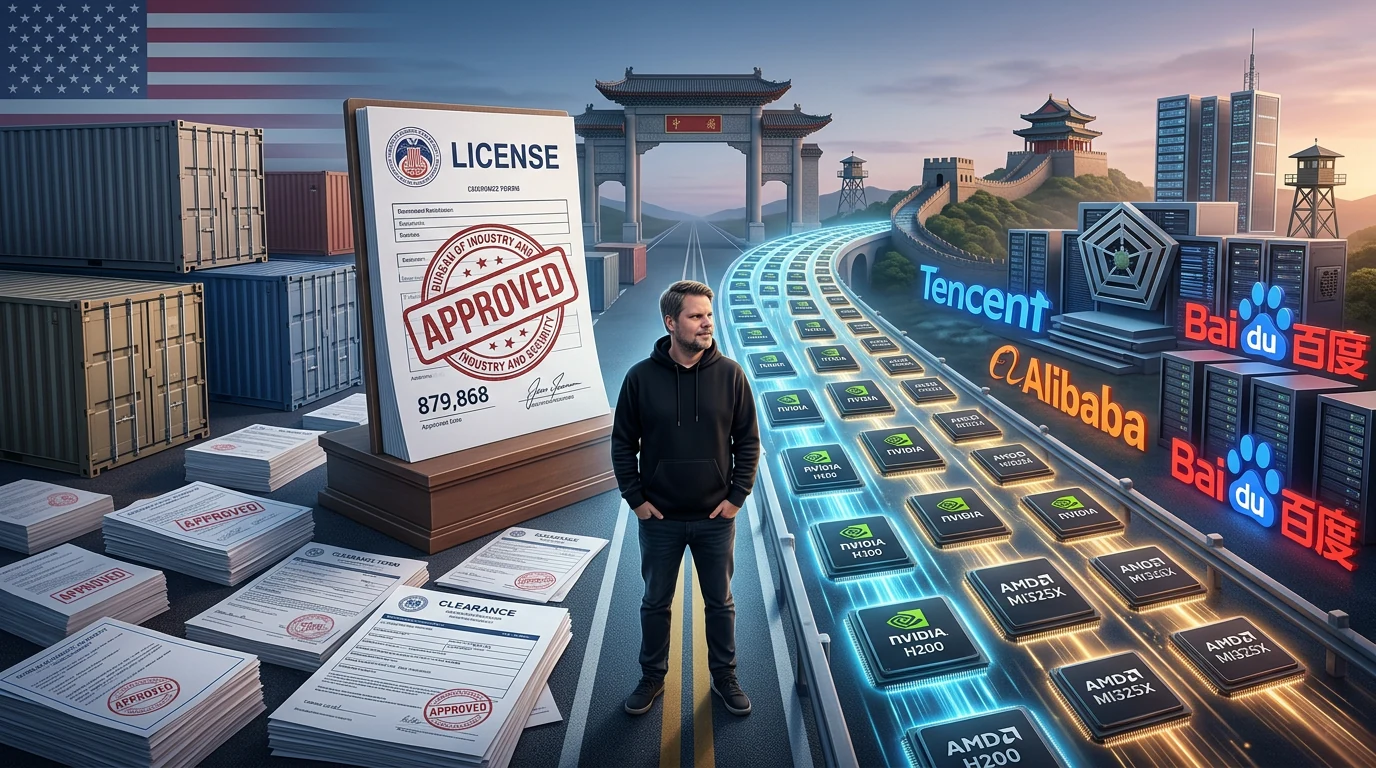
The US approved export licenses covering 879,868 advanced AI chips for China in just under six months. More than 30% of the approved chips were intended for companies on the Pentagon’s list of Chinese military companies. That is a rather large gap between the tough public rhetoric and what the system actually allowed.
The figures come from licensing records released by the US House Foreign Affairs Committee on November 19, 2026. The applications covered Nvidia H200 chips and comparable AMD products, including the MI325X. Companies had applied to sell more than 3.4 million chips to China, and the Commerce Department’s Bureau of Industry and Security, or BIS, had approved 21 applications.
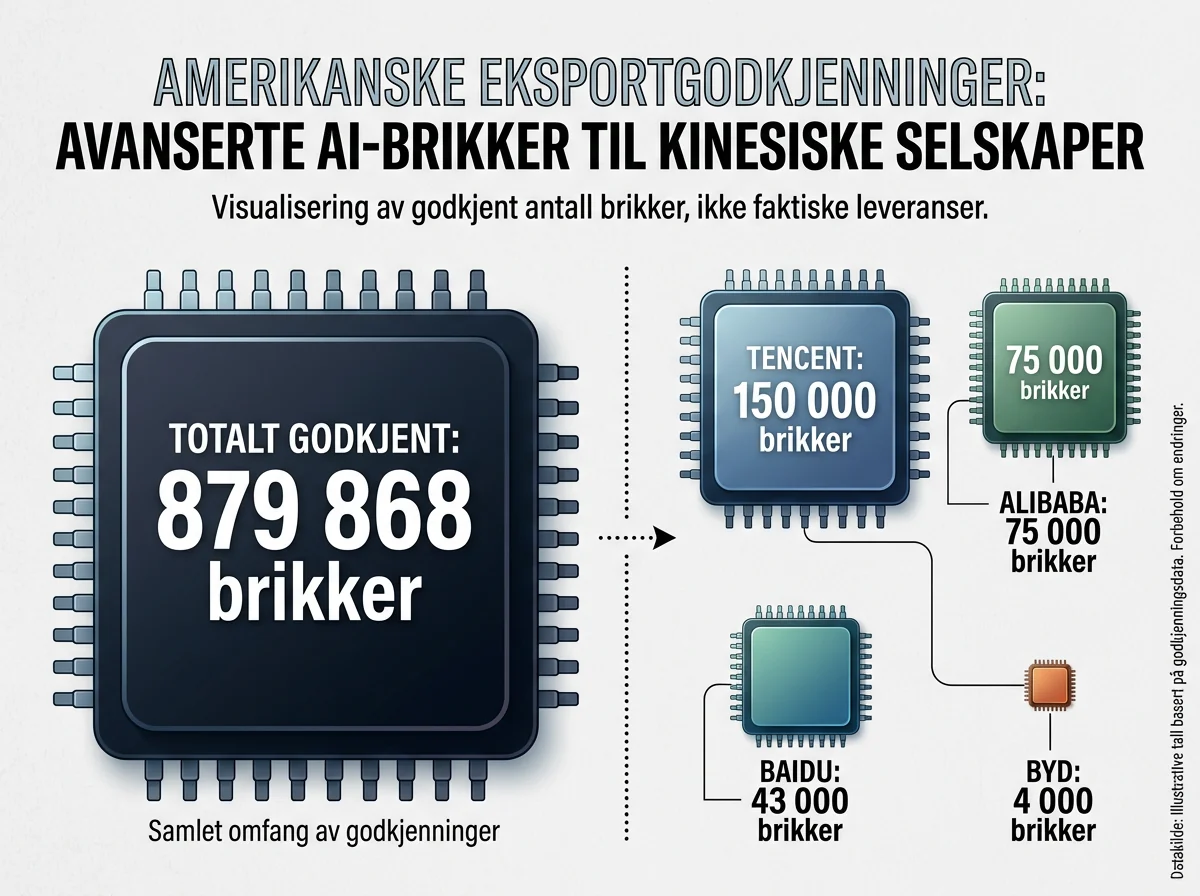
One crucial qualification belongs right at the top: An approved export license is not the same as a completed delivery. The documents show how many chips the US government allowed exporters to sell, not that all 879,868 reached Chinese customers. Even so, the scale shows how wide the gate was opened, including for companies the US government itself associates with China’s military.
What did the US approve?
The Commerce Department approved license applications covering a total of 879,868 Nvidia and AMD chips for Chinese companies between December 2025 and May 11, 2026. The House Foreign Affairs Committee’s release says these approvals came from applications covering more than 3.4 million chips.
The approved amounts included 150,000 chips for Tencent, 75,000 for Alibaba, 43,000 for Baidu and 4,000 for BYD. All four appear on the Pentagon’s list of companies allegedly linked to China’s military. That does not mean every chip was ordered for a military project. It does make one question unavoidable: What is the point of such a list if it has no clear consequences when advanced AI capacity is being exported?
The committee also says the applications involved potential intermediaries it describes as fronts for chip smuggling. That is the committee’s characterization, not a court finding that those companies smuggled these particular shipments. But when both end users and intermediaries raise these kinds of questions, saying the paperwork was processed correctly is not much of an answer.
Approved does not mean delivered
The documents do not prove that 879,868 chips were shipped to China. Reuters reported that it remained unclear how many approvals became actual deliveries. When Reuters examined the issue in May, around 10 companies had been approved to buy H200 chips, but no deliveries had been confirmed at that point.
In a July hearing, BIS chief Jeffrey Kessler said shipments had begun, but that there were very few of them. Later information indicated that several large Chinese internet companies had received roughly 10,000 H200 chips each. Nvidia has since said it stopped H200 shipments to China, even though it had obtained some licenses.
This distinction is essential. “The US approved sales” is supported by the documents. “The US delivered nearly 900,000 chips” is not. The licensing data shows the government’s willingness to permit the trade and its potential scale. Customs records, order confirmations and receiving data would be needed to document the actual flow of hardware.
At the same time, dismissing the story because every chip cannot be traced as delivered would miss the point. A license is the government’s yes. When that yes covers hundreds of thousands of advanced chips for companies on its own risk list, it tells us plenty about how permissive the export policy actually was.
Why were H200 and MI325X chips allowed?
The Trump administration changed course after tighter rules had restricted Chinese access to advanced chips. In January 2026, BIS announced that applications involving Nvidia H200, AMD MI325X and comparable products would be reviewed case by case when specified security conditions were met.
Exporters had to show, among other things, that the sales would not reduce global production capacity available to US customers. Chinese buyers were expected to have export-control and customer-screening procedures, while the products had to undergo independent testing in the US to verify performance and security. The idea was to permit controlled sales without surrendering the entire technological lead.
There is an economic and strategic argument for that approach. US chipmakers earn revenue, keep customers and can finance further development. China remains dependent on US technology rather than gaining even more incentive to accelerate domestic alternatives. That is not an entirely foolish calculation.
But the calculation becomes difficult to defend when customer screening produces major approvals for companies another arm of the same government has already placed on a military list. At that point, “controlled sales” starts to look like two government databases that are not on speaking terms. The state is not exactly famous for handling these things elegantly, and this time the confusion concerns computing power with both civilian and military uses.
How much AI capacity is 879,868 chips?
Nearly 880,000 advanced accelerators could equip a substantial number of data centers, but the total cannot be translated directly into one enormous AI cluster. The licenses covered several customers, different chips and deliveries that could have been spread over time. Power, networking, cooling, servers and software also determine how much useful performance customers can extract from the hardware.
The scale still matters. Modern AI models are trained and run on large clusters of these accelerators. They support far more than chatbots, including image analysis, simulation, autonomous systems, intelligence work and software development. That dual-use potential is precisely why chip controls have become a central part of the technology contest between the US and China.
Alibaba alone applied for roughly 950,000 chips and received approval for 75,000. Tencent was approved for twice as many. The figures show both the extraordinary level of Chinese demand and the leverage Washington still has because Nvidia and AMD supply technology Chinese companies want.
That leverage will not necessarily last forever. The more difficult and unpredictable access becomes, the stronger China’s incentive to build a complete domestic chip industry. Export controls can slow a competitor, but they can also make it harder to keep that competitor dependent on US suppliers. Washington is trying to manage that tradeoff through a licensing system.

The Pentagon list makes the story much sharper
Alibaba, Tencent, Baidu and BYD appear on the Pentagon’s list because the Defense Department says they have ties to China’s military sector. Being listed is not proof that these particular approved chips were intended for military use. That boundary matters. Overstating the evidence only makes a serious story less credible.
But the list exists because the US government considers those ties relevant to national security. It is therefore strange to watch the Commerce Department approve advanced AI hardware on this scale at the same time. Either the risk is serious enough to affect licensing decisions, or the government needs to explain why the companies were nevertheless considered acceptable customers.
This is where the issue stops being a routine trade story. The US wants to preserve a technological lead, limit Chinese military capacity and allow its own companies to profit from the Chinese market. Those three goals cannot always be maximized together. When licenses cover 879,868 chips, revenue and controlled trade have plainly received substantial weight in the decision.
The answer is not automatically another layer of rules. More forms and new oversight bodies do not necessarily make policy more coherent. The government first needs to explain the objective, follow its own risk assessments and show what was actually delivered. Otherwise, the military list risks becoming little more than an impressive-looking political signal.
What should the industry watch next?
First, watch the actual shipments. Licenses show the maximum approved quantity, while delivery data shows how much computing capacity Chinese companies really received. Nvidia and AMD disclosures, public hearings and documented export records matter more here than the largest number in a headline.
Second, watch which customers receive new licenses and whether the Pentagon’s list has any practical effect. If the same companies continue to receive major approvals, the list is more political theater than effective control. If licenses are withdrawn or tightened, the effects could quickly reach both Chinese AI plans and the revenue of US chipmakers.
Third, watch the specific chip models. Nvidia has said H200 shipments to China have stopped, but both the rules and the products covered can change. A broad statement about “AI chips” is not enough. The models named in future licenses and the conditions attached to them will show what the policy means in practice.
My judgment is straightforward: These documents expose an export-control system that promises strategic precision but granted remarkably broad permissions to the very companies it was supposed to examine with extra care. They do not prove that every chip was delivered or used by the military. They do prove that the gate was much wider open than the public rhetoric suggested.
Frequently asked questions
How many AI chips did the US approve for sale to China?
The US approved export licenses covering 879,868 advanced Nvidia and AMD AI chips between December 2025 and May 11, 2026. Companies had applied to sell more than 3.4 million chips. The figure covers approved licenses, not confirmed deliveries.
Which Chinese companies received approvals?
The named recipients included Tencent with 150,000 chips, Alibaba with 75,000, Baidu with 43,000 and BYD with 4,000. All four appear on the Pentagon’s list of companies allegedly connected to China’s military.
Were all 879,868 chips delivered to China?
No. The available documents do not establish that. An export license permits a sale but does not prove the hardware was shipped or received. US officials said shipments had begun, although the number in the initial period was very small.
Which AI chips were covered by the export licenses?
The disclosed applications covered Nvidia H200 and comparable AMD products, including the MI325X. These are advanced accelerators used to train and run AI models. They have major civilian uses, but the same computing capacity can also support military and security applications.