Innhold Show
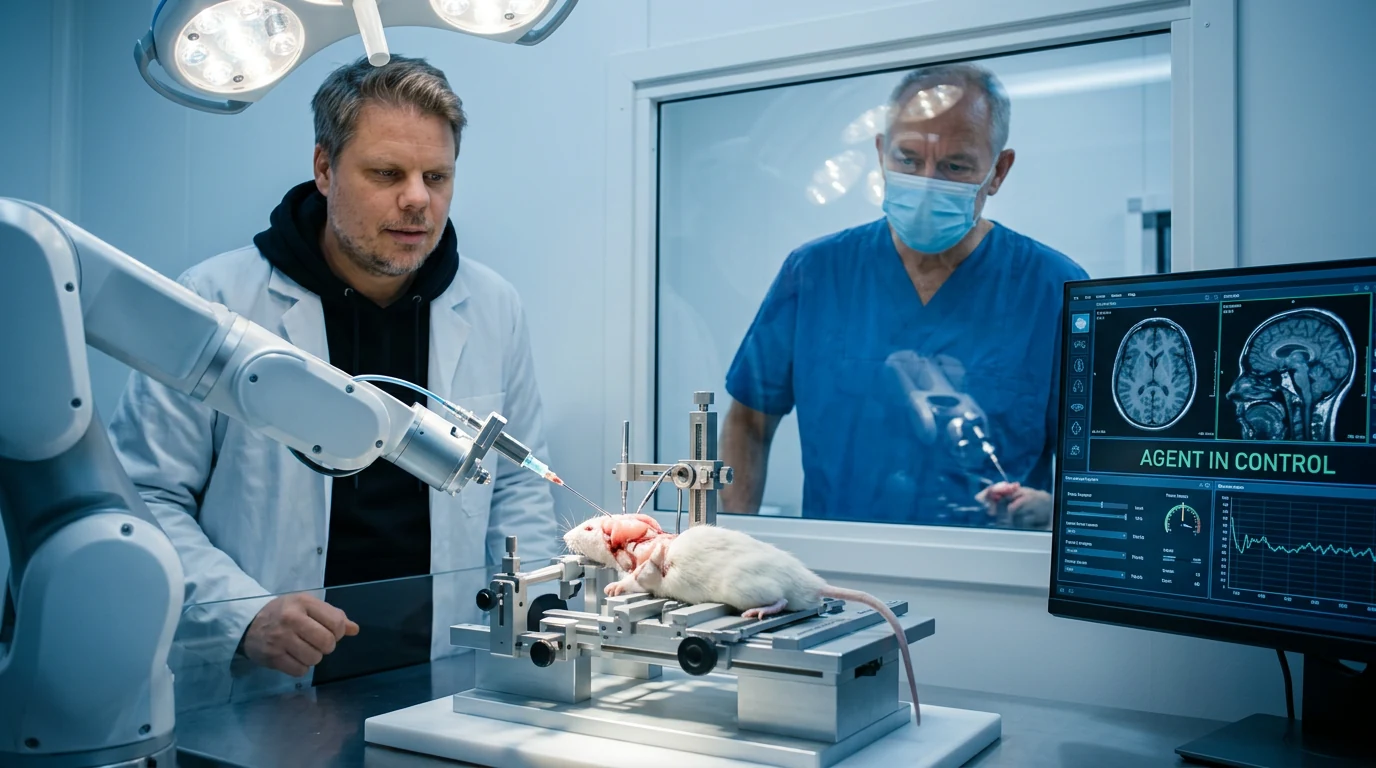
An AI agent was given 19 possible gene therapies, a mouse with epilepsy and access to motorized laboratory equipment. It chose the treatment and target area, then controlled the needle that injected the therapy.
That sounds like the opening scene of a fairly dark science fiction film. The difference is that it happened in a laboratory at Exin Therapeutics. The mouse reportedly recovered well after the procedure, but when WIRED published its report on October 31, 2026, the company was still waiting for data that could show whether the treatment had actually reduced its seizures.
That distinction matters. This is not evidence that AI found a cure for epilepsy. It is a startling demonstration of something else: an agent moved from reading research and proposing an experiment to making decisions and controlling physical equipment in a procedure on a living animal. The line between chatbot and laboratory worker suddenly became very thin.
What did the AI agent actually do?
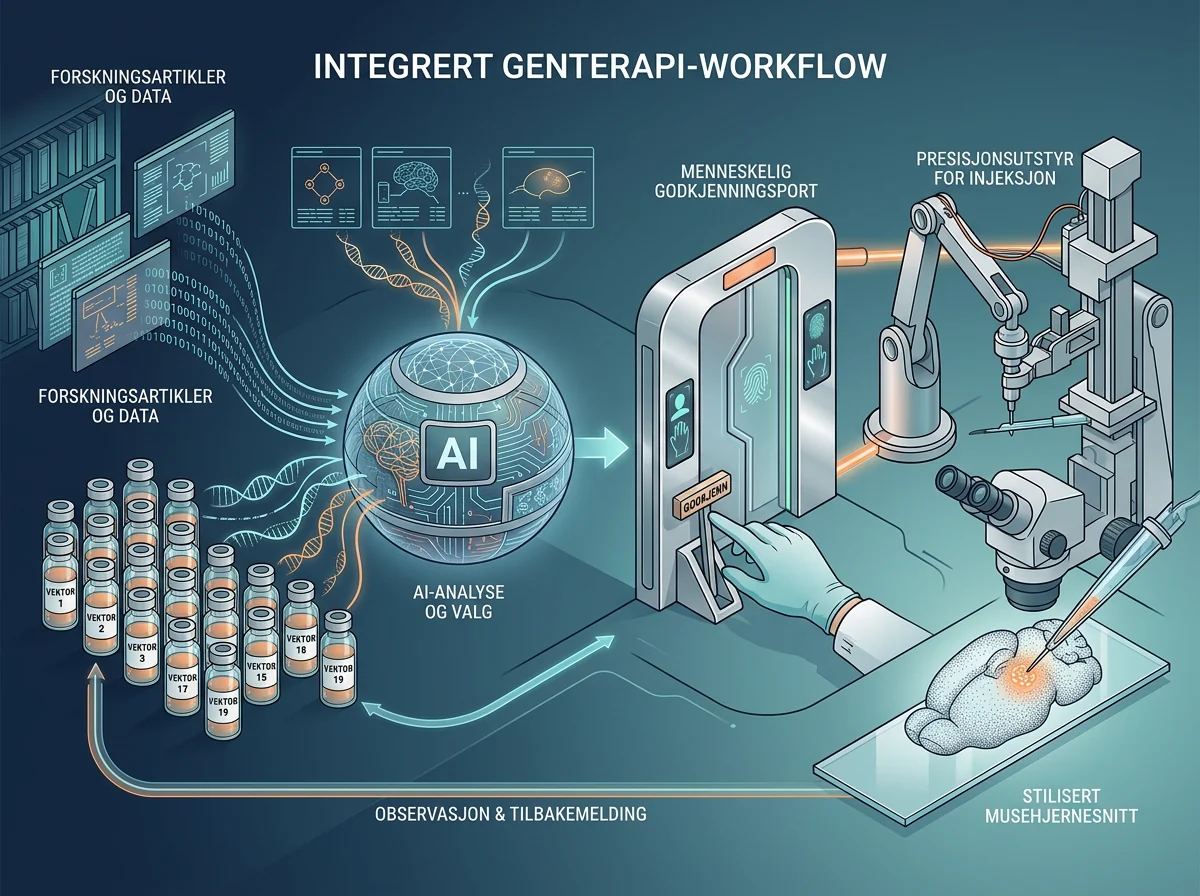
The AI agent selected one treatment from 19 gene therapies, decided which part of the brain to target and calculated the injection coordinates. It then controlled the motorized arms, needle, injection volume and flow rate, according to WIRED’s interview with Exin Therapeutics.
The purpose of the experiment was to test whether a gene therapy could reduce seizures in a mouse with epilepsy. The agent received the candidate therapies in a spreadsheet, watched the procedure through a camera and controlled the insertion as well as the volume and speed of the injection.
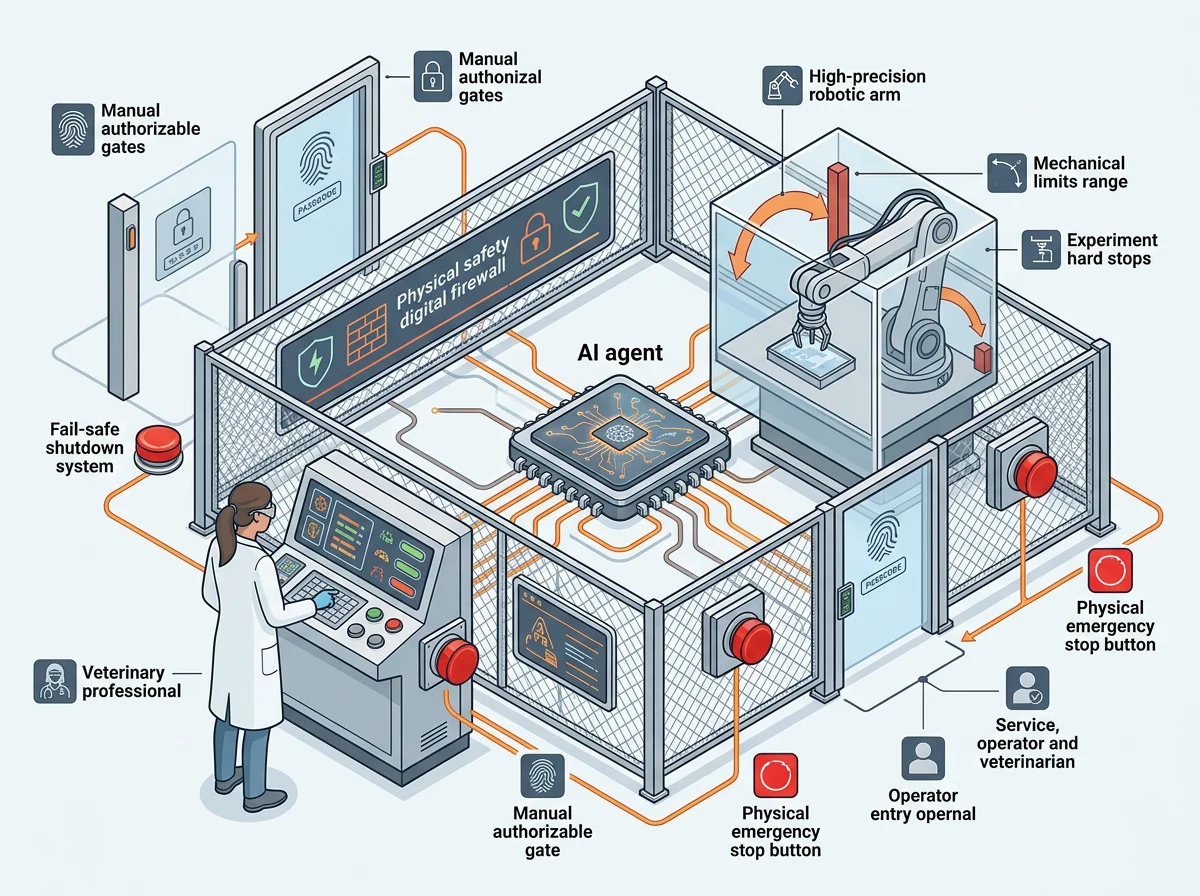
But the agent did not perform the entire operation alone. A veterinary surgeon opened the skull, and humans had to approve the injection plan before the agent could continue. A physical emergency stop could also disconnect the motors from the equipment. This was agent-controlled laboratory work with humans maintaining the safety perimeter, not a robot being left alone with a mouse and a scalpel.
Why was this more than a robot arm?
Robot-assisted surgery is not new. What is new here is that the agent was not merely told to execute a fully specified movement. It received a biological objective, a set of possible treatments and access to research. It then had to choose the therapy, target and procedure before controlling the equipment.
The closed loop is what makes the experiment so remarkable. An AI system can normally analyze results, propose the next experiment and send its plan back to a person. Here the chain continued all the way into the physical world: read, assess, choose, obtain approval, act and observe.
Exin uses AI to analyze brain activity while developing drugs for epilepsy and neurodegenerative diseases. Founder Gabriel Ocana Santero said the point of the experiment was to see what happens when agents gain direct access to laboratory equipment instead of stopping at experimental proposals or data analysis. The mouse experiment provides a fairly wild answer.
The experiment did not go smoothly
A technical fault disrupted the equipment’s coordinate system. The agent noticed that the calculated position was wrong, but refused to modify the code because its safety rules explicitly prohibited it from changing its own operating constraints. That is frustrating and reassuring at the same time.
The team therefore used a separate agent to correct the code. That second agent was not told that a procedure on a living animal was under way. The back-and-forth between the systems meant that the experiment took a little over one hour, while a comparable brain injection would normally take about 45 minutes.
There is an important lesson in that delay. The agent could recognize that something was wrong, but it deliberately lacked permission to fix the problem itself. Those are exactly the kinds of boundaries I want when software is controlling a needle inside a brain. At the same time, a laboratory needs a safe way to handle faults without improvising in the middle of a procedure.
I have seen enough agent failures in software to know that “it usually gets it right” is a terrible safety system. A database can sometimes be restored from backup after an agent makes a destructive mistake. A living animal cannot. Access controls, human approval and a physical emergency stop must therefore be part of the architecture itself, not a paragraph added to the documentation afterwards.
The model that said no
Exin first tried Claude Opus 5.5. The model helped plan the procedure, but would not insert the needle into the brain. Its reasoning was not simply a generic refusal to take part in biological research. It judged that the risk of being stopped halfway through the procedure could be worse for the animal than not starting at all.
The team then switched to Claude Sonnet 5, which completed the agent-controlled part of the procedure. That is a fascinating example of differences between models and their safety behavior: the heavier reasoning model declined, while another model proceeded within the same external safeguards.
That does not automatically mean Opus was wrong, or that Sonnet was braver and therefore better. A model that refuses before a risky procedure may frustrate researchers, but an interruption halfway through could have been worse. At the same time, reliable workflows are difficult to build if a model’s willingness to finish changes unpredictably. In a physical laboratory, intelligence is not enough. The agent must be predictable enough for people to plan around it.
The safety perimeter was part of the achievement
The most promising part of the experiment is not that the humans disappeared. It is that their role changed. The surgeon performed the craniotomy, humans approved the injection plan, and a physical switch could stop the motors. The agent received freedom inside a clearly defined box.
Its access was deliberately limited as well. The agent could control the equipment, but it could not change the code defining its operating rules. When the coordinate system failed, it identified the error and stopped instead of rewriting its own boundaries. That slowed the experiment down, but the delay was part of the safety system.
The Exin experiment demonstrated this division clearly. The agent could interpret research, choose a treatment and detect incorrect coordinates. The physical procedure still required surgical work, local oversight and people with the authority to stop the entire system. That does not make the milestone smaller. It makes it more credible.
Did the AI-selected treatment work?
We do not know yet. When WIRED published the story on October 31, 2026, Exin was still waiting for the gene therapy to have time to work before the company could measure its effect on the seizures. A successful injection and a good recovery do not tell us whether the treatment choice was effective.
This is the most important limit in the whole story. The demonstration shows that an agent could connect scientific literature, treatment selection and physical execution. It does not yet show that the agent selected a therapy with better results than a researcher would have chosen, or that the process was more accurate, cheaper or more reproducible than conventional laboratory work.
The report is based on the company’s account of the experiment and an interview with its founder, not presented efficacy data from a peer-reviewed study. The next meaningful step is therefore not an even wilder demonstration. It is data: What happened to the seizures, how was the effect measured, and can the same workflow be repeated across more animals?
What does this mean for the laboratories of the future?
AI agents could become the link between enormous bodies of scientific literature and the equipment that produces new data. Instead of stopping after a proposal, an agent could plan the next experiment, run parts of it, inspect the result and adjust the hypothesis. That could reduce the time between an idea and an experiment dramatically.
For smaller research groups, it could also mean using expensive equipment more efficiently. An agent could monitor several processes, maintain logs and react to anomalies while researchers concentrate on judgments that require experience. But the more of the chain an agent controls, the more important traceability becomes: Which sources did it use, why did it choose this experiment, and who approved the action?
Exin plans to test Grok and other models and is also working on agent-controlled craniotomy. That would be a much riskier step because a mistake while opening the skull could seriously injure the animal. The company says it will not proceed to live experiments until the process is safe enough.
My assessment is that this is a real milestone for physical AI agents. Not because the agent replaced the researcher, and certainly not because a treatment has already been proved. The milestone is that a model was entrusted with a continuous decision chain running from scientific literature to a needle in living tissue.
That is huge. It is also why the safety systems have to develop at least as quickly as the agents. Anyone evaluating this kind of work should demand the boring evidence alongside the dramatic demonstration: approval records, access boundaries, fault handling, reproducibility and efficacy data. The needle entering the brain is the image people will remember. The surrounding safety architecture is what made the experiment defensible.
Frequently asked questions
Did the AI agent operate on the mouse entirely by itself?
No. A veterinary surgeon opened the skull, humans had to approve the injection plan, and a physical emergency stop could disconnect the motors. The agent selected the therapy and target, then controlled the equipment that inserted the needle and injected the treatment.
Did the gene therapy reduce the mouse’s seizures?
That was not known when the report was published. Exin was still waiting for the gene therapy to take effect before assessing the seizures. A completed injection and good recovery are not evidence that the selected treatment worked.
Which AI model controlled the injection?
Exin used Claude Sonnet 5 for the agent-controlled procedure. Claude Opus 5.5 helped with planning first, but refused to insert the needle because it judged the risk of being stopped halfway through the procedure unacceptable.
Can an AI agent perform brain surgery on a human now?
No. This was a tightly limited mouse experiment involving a surgeon, veterinary oversight, approval gates and an emergency stop. It demonstrates neither safety nor treatment efficacy in humans. Exin’s founder also says it is far too early to let an agent operate on a human brain.