Innhold Show
Can AI replace dentists? Not all at once, but the building blocks of an AI dentist are arriving piece by piece: image analysis, digital design, machine production and robot-guided treatment. Once those parts begin to connect, the question sounds a lot less like science fiction.
My partner put me on this trail. We were talking about AI and jobs, and my head was full of photographers, office work and tedious tasks on a screen. She pointed to dentistry: images, analysis, impressions and precise physical work. That was a good question. In fact, it was a much better question than another round of wondering whether a chatbot can write an email.
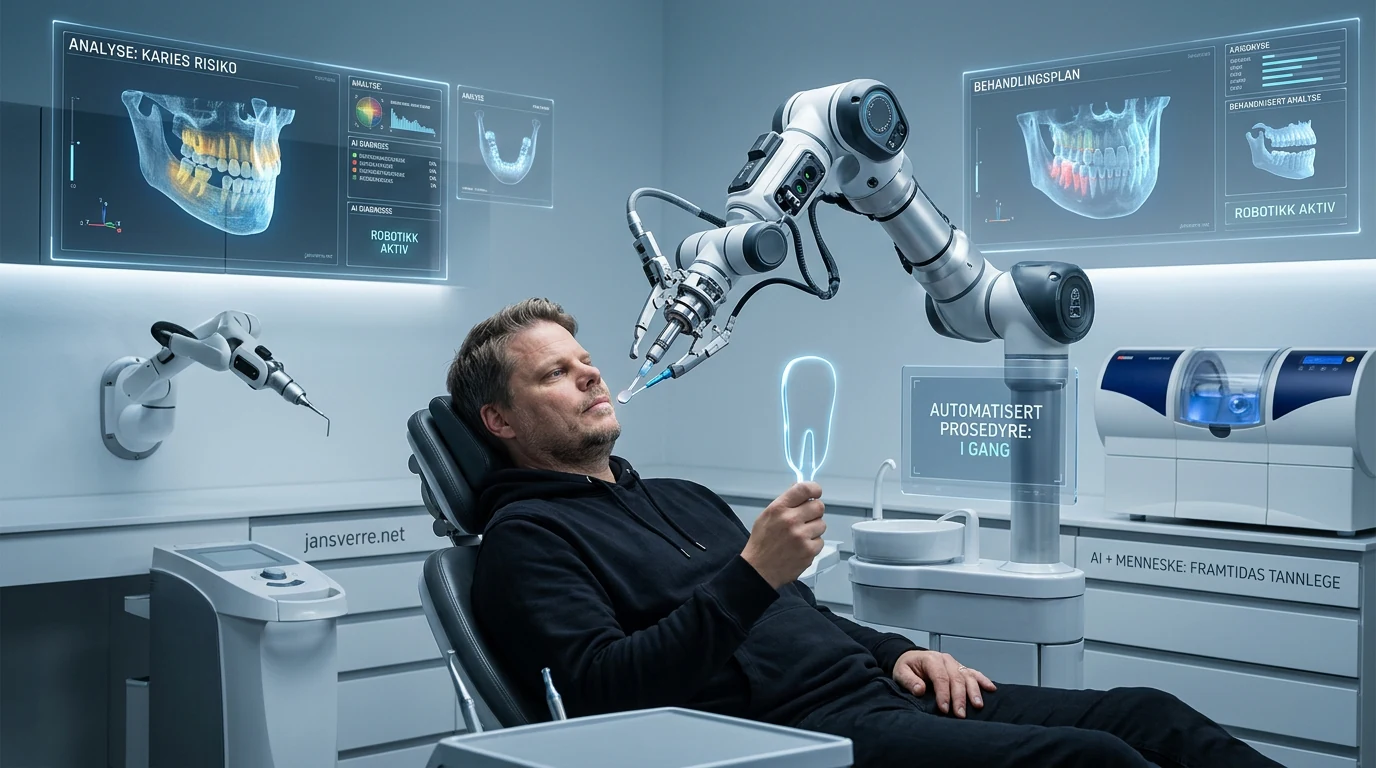
Imagine sitting in a chair that maps your teeth, proposes a plan and carries out a limited procedure with robotic precision. People would still be there to assess uncertainty, handle complications and help when you are frightened. That complete machine does not exist as a ready-to-use dental clinic today. The pieces, though? Several are already at work, and one manufacturer has reported an automated procedure on a human.
Which parts of an AI dentist already exist?
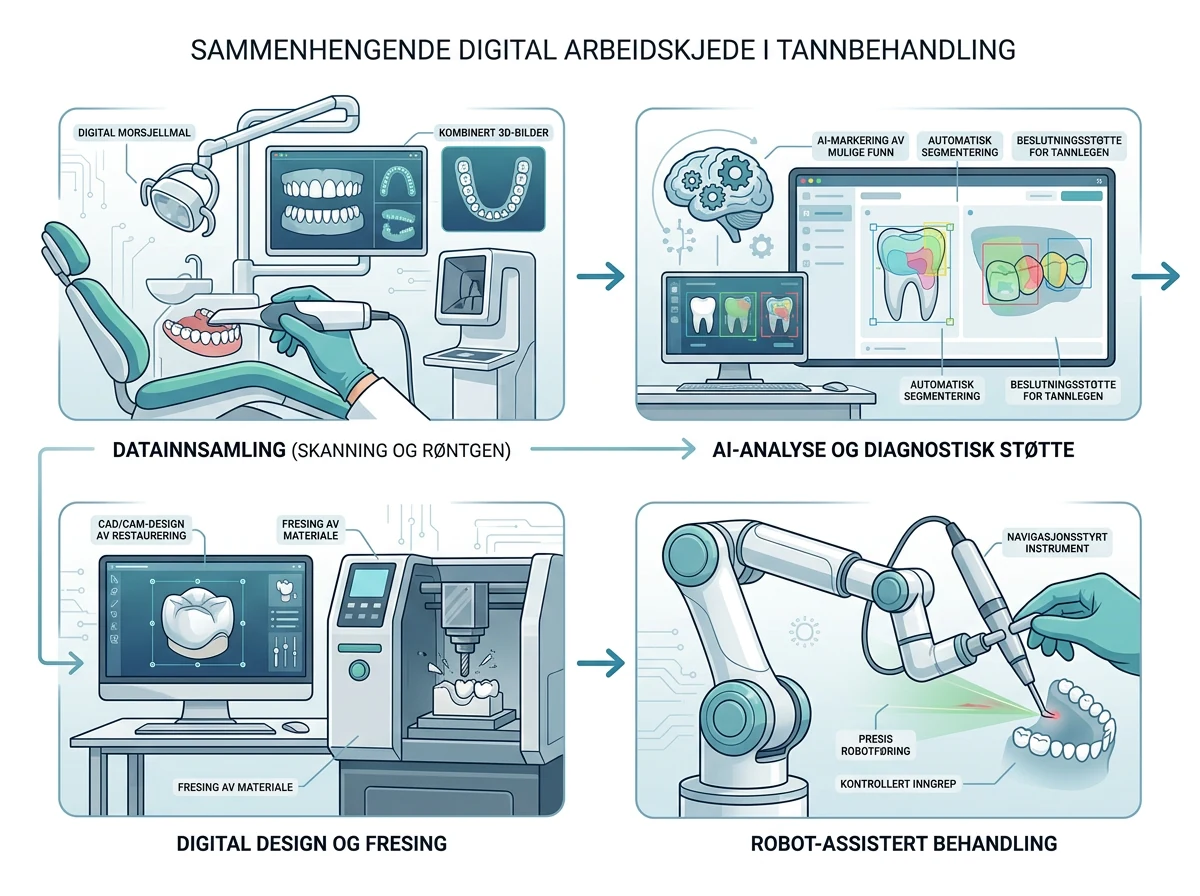
AI can already analyze dental images and flag possible findings, while digital systems can scan, design and mill restorations. That is not an independent dentist. It does show, however, that the workflow can be divided into tasks that software and machines can take over or substantially change.
Videa Dental Assist appears in the US public medical-device database as software that analyzes intraoral X-rays. It can mark suspected findings, previous treatments and anatomy for the professional examining the image. This is clinical decision support, not a machine that diagnoses you, chooses a treatment and sends the dentist home.
Further along the chain, digital impressions and machine production are already established. The CEREC workflow covers scanning a tooth, designing a restoration digitally and producing it in a milling machine before clinical finishing. That is a long way from the old idea that everything must be shaped by hand. A machine that mills a crown is still not a robot that decides whether you need it, prepares the tooth and fits the crown.
The combination is what excites me. When a camera can map, software can propose, production equipment can make and a robot can move an instrument precisely, a much larger share of the workflow starts to look automatable. None of those components has to be a complete dentist on its own for the profession to change.
Dental robots are already in the treatment room
A dental robot can already help a clinician follow a planned position, angle and depth during implant surgery. Neocis is explicit that its Yomi system is controlled by the clinician. Robotic guidance limits deviations from the plan, but the machine is not an autonomous dentist.
The FDA documentation for Yomi S describes CT-based planning, physical guidance and tracking that can compensate for patient movement. Its documented use is limited to implant surgery. It is not evidence that robots can now drill, clean and repair anything they find in your mouth. It does show that precise physical work inside the body is no longer a boundary robotics must remain outside.
That matters because this is physical AI, not another answer appearing in a chat window. A machine must interpret visual data, follow a plan and act precisely in a physical world that can move. Dentistry is regulated, sensitive and far less forgiving than a tidy laboratory demonstration, but the basic ingredients are becoming real.
What do we know about robotic treatment on a human?
On July 30, 2024, Perceptive announced that it had completed a fully automated dental procedure on a human. That is an important milestone, but it is the company’s own announcement, not a large independent clinical trial.
The announcement describes an automated restorative procedure. Perceptive uses optical coherence tomography, or OCT, to build detailed 3D images, plan the work and guide the robotic procedure. That is precisely the chain my partner prompted me to imagine: mapping, planning and physical execution in one system.
Now for the necessary precision. Perceptive still labels the technology a prototype and says it has not received US 510(k) clearance for commercial use. Its goal of completing a restorative visit in 15 minutes is based on internal preclinical testing, not verified US patient trials. This is promising development, not an appointment you can book next week.
What does clinical research say about autonomous robots?
A randomized study of 40 implant patients found that an autonomous robot achieved better angular accuracy than dynamic navigation, but no statistically significant improvement in linear accuracy. The robotic operations took longer, while early implant success and reported postoperative outcomes were comparable.
The study was published online on August 20, 2025. It matters because it moves the discussion from a manufacturer’s demonstration to a controlled human comparison. It still involved selected implant patients, not an autonomous clinic accepting anyone and fixing everything from plaque to a broken molar.
I find that result more interesting than a glossy claim that the robot was simply “best.” It was more precise on one measure, similar on others and slower during the operation. That is what real technological development looks like. Some abilities arrive early; speed, workflow and practical operation have to mature later.
Cleaning is being investigated too. In 2022, the University of Pennsylvania described magnetically controlled microrobotic structures that removed biofilm from dental models and extracted human teeth in laboratory experiments. The US National Institute of Dental and Craniofacial Research described it as a concept that might later be adapted for people. It is a laboratory result, not a robotic cleaning you can order from your dentist. Still, it adds another possible piece to the puzzle.
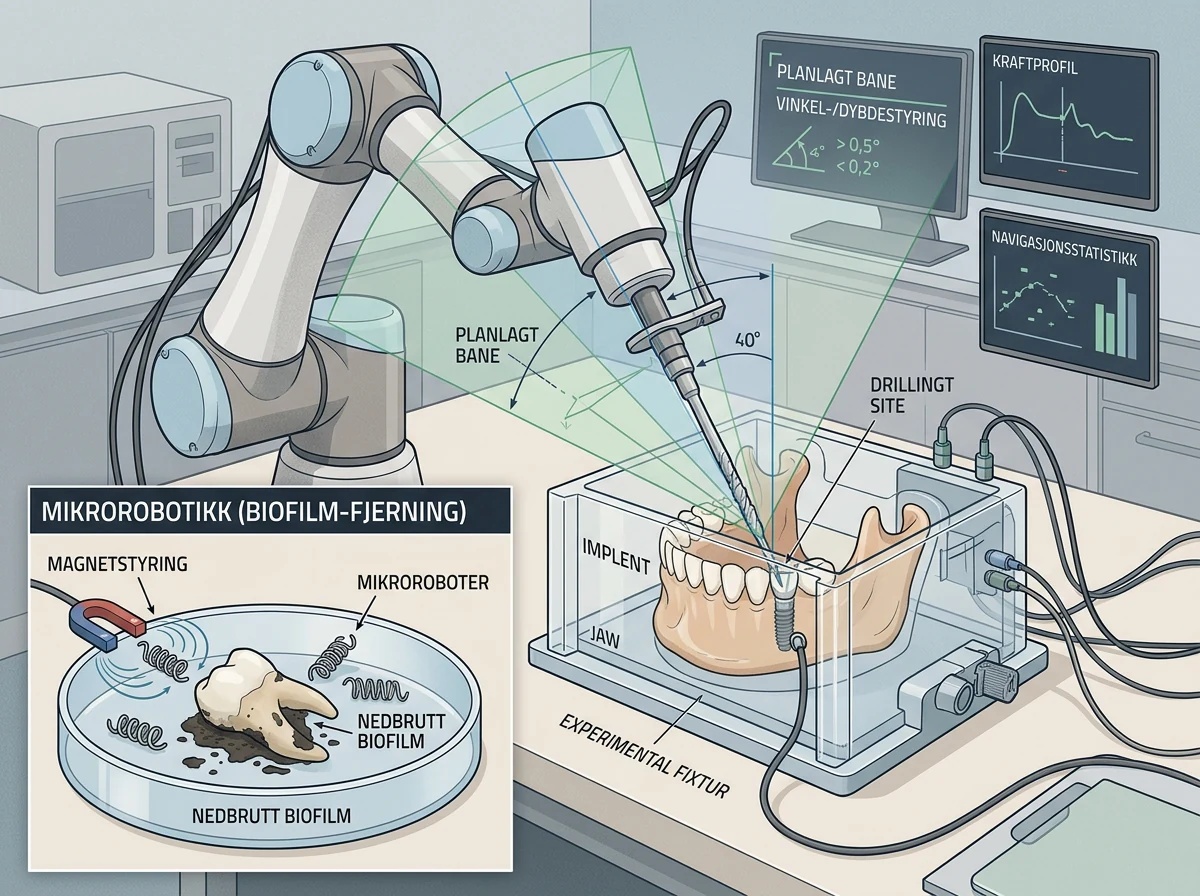
Why is an accurate dental image not enough?
An accurate image does not automatically tell anyone what should be done. Mapping, choosing a treatment and physically carrying it out are three different tasks. No sensible dental machine should simply find every deviation and drill it away. Thankfully.
NIDCR explains that early tooth decay can be stopped or reversed before a cavity forms. The American Dental Association describes risk assessment and a mix of preventive, non-operative and operative approaches. A system therefore needs more than pattern recognition. It must know when treatment is warranted, which option fits and when uncertainty must go to a person.
This is why the division of labor interests me more than the cartoon version where the dentist simply disappears. AI may be good at finding patterns, and a robot can be extremely precise within a fixed plan. Patients do not always fit the plan. Bodies move, previous dental work varies, and complications have an annoying habit of appearing exactly when a demonstration would prefer them not to.
Can a robot know when treatment hurts?
Sensors can provide useful signals, but they cannot automatically tell a robot that a patient is in pain. The US National Institutes of Health describes pain as personal and says a person’s own account remains the best measure.
Heart rate can be one signal, but it is not a pain detector. A 2023 study protocol on heart-rate monitoring in non-verbal patients stresses that heart rate is not specific to pain. Fear and other conditions can change it too. This was also a protocol for planned research, not finished evidence that a dental robot understands pain.
In a future treatment chair, sensors, clear communication and a physical stop control could absolutely matter. People are needed for far more than holding your hand, though. They assess consent, uncertainty, deviations and complications. Care matters, especially when someone is frightened, but professional judgment is not decoration around the robot.
Will AI make dental care cheaper?
Automation could increase capacity and reduce the manual work required for a limited procedure. That could push costs down. We do not yet know how much patients would save or how staffing would change, whether in Norway or elsewhere.
Machines are not free. They must be bought and maintained, staff must learn to use them, and the systems must be integrated and supervised. A robot that saves a clinician time might allow more treatments each day, but the economics depend on far more than the speed of the instrument itself. I still hope lower cost becomes one of the major gains. Dental care is something an enormous number of people need, and the bill hurts.
For jobs, it makes more sense to examine tasks than titles. Image review, standardized planning, production and parts of the precision work can move to software and machines. Dentists may gain capacity, but they may also lose tasks that currently occupy much of the working day. If this technology becomes reliable and practical, I do not believe the ending will be “everything stays the same, with a little AI on the side.” The division of labor could change substantially.
The complete AI dentist is still missing
There is no finished chair that maps, diagnoses, numbs, cleans, drills, fills and follows up without a dentist. There is also no credible date for when such a system might become commonplace. I have not tested any of these systems myself.
Even so, the direction is hard to miss. AI examines images. Digital systems shape restorations. Robots guide instruments and have carried out limited procedures. Clinical studies have tested autonomous precision on people. Every piece has clear limitations, but together they point toward something much bigger.
So can AI replace dentists? Not in one dramatic leap that suddenly makes every dentist redundant. But AI and robotics can take more of the tasks, change the economics and move the human role toward judgment, exceptions, complications and reassurance. My partner was right: this question deserves far more attention. The robots have already started.
Frequently asked questions
Is there a fully autonomous AI dentist today?
No. AI image analysis, digital production systems, robotic assistance and prototypes for limited procedures all exist. There is no complete machine that can examine a patient, choose the appropriate treatment and perform every routine dental procedure without a dentist.
Has a dental robot treated a human?
Perceptive announced in July 2024 that it had completed a fully automated restorative procedure on a human. The technology is still described as a prototype, and a manufacturer’s milestone announcement is not the same as a large, independent clinical trial.
Will AI replace dentists?
AI and robots can take over or change several limited tasks, but the evidence does not show that the entire profession will disappear. Assessing uncertainty, consent, complications and patient safety remain essential human responsibilities, even if the division of work changes substantially.
Can dental robots make treatment painless?
That has not been demonstrated. Precise robotic guidance may help, but pain is personal, and heart rate can change because of fear and other factors. Sensors and stop controls may be useful, but they do not prove that a robot understands pain or can guarantee painless treatment.