Innhold Show
If a municipality wants to know what its residents think, it needs to ask the residents – not a language model. Yet a Norwegian municipality reportedly asked a large language model to play 200 different residents and answer questions about local policy. If the account is accurate, this is a useful experiment with a dangerous temptation: AI can help staff find questions they have missed, but it cannot tell them what students, nurses or pensioners actually think.
Asking a language model to pretend to be the public is not public participation. It is synthetic brainstorming. That distinction is not academic. The moment those outputs enter a workshop, recommendation or decision paper, plausible sentences can start being treated as though they represent real people.
The evidence behind the dramatic headline is also thin. The source is an opinion article in the Norwegian trade publication Kommunal Rapport. The municipality is not named, the system has not been demonstrated, and there is no published methodology or decision to examine. We do not know whether this was a loose demonstration, an internal ideation tool or something that genuinely influenced a municipal plan. It is serious enough to demand answers. It is not enough to prove that Norwegian municipalities are already using legally high-risk AI in this way.
What did the municipality reportedly do?
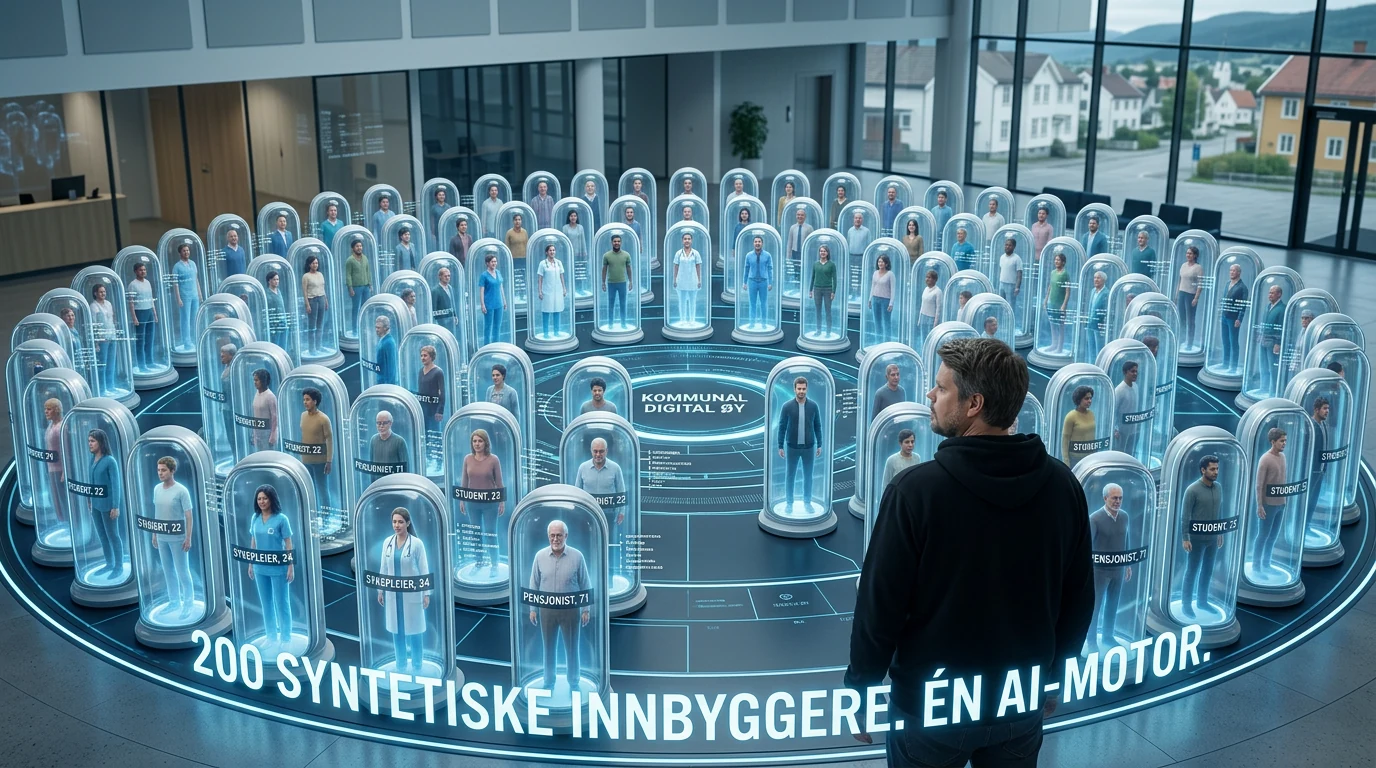
The opinion article in Kommunal Rapport describes an unnamed chief municipal executive talking about a digital “island” populated by AI agents. The municipality reportedly prompted a large language model to act as 200 different residents so staff could discuss current issues with them.
The examples are specific. The model could be told to answer as a student who wanted to live in shared accommodation as cheaply as possible, a burned-out nurse or a pensioner living alone. Staff could then ask what that constructed person thought about housing near natural areas, AI glasses at work, parking spaces, cycle lanes or bus fares.
That is not inherently pointless as a creative exercise. A language model can quickly suggest objections, needs and possible consequences that a working group should investigate. The problem begins when the municipality moves from “Which questions should we ask?” to “What does this group think?” The first is brainstorming. The second requires real people, a proper sample and a method that can withstand public scrutiny.
Why can AI not represent the residents?
A language model generates likely text from patterns in its training data and the context it receives. It has not worked a night shift in a nursing home, waited for the last bus or tried to pay rent on a student budget. When it plays a role, it produces a plausible answer. Plausible is not the same as true or representative.
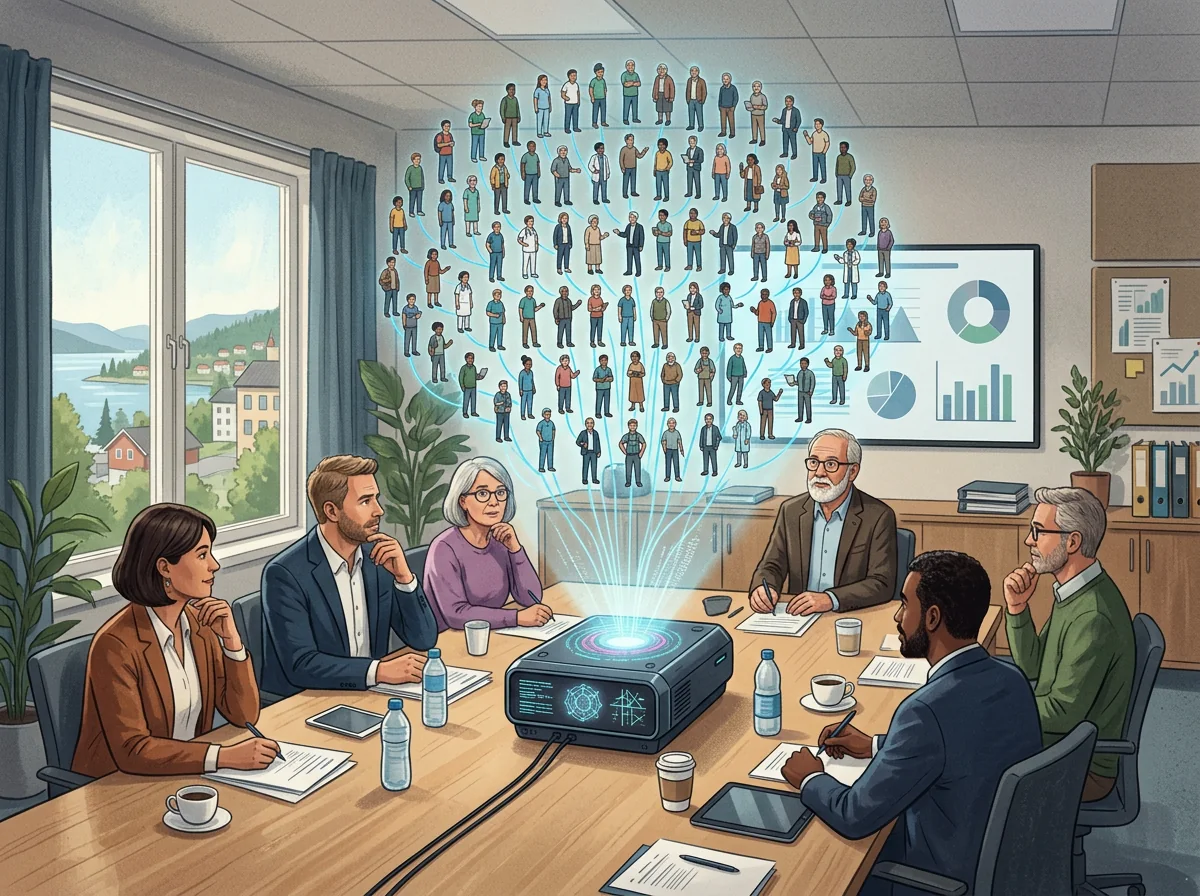
There is no natural law saying that “200 people” produces 200 independent perspectives either. If every persona comes from the same model, the same instructions and the same run, they can share the same biases and assumptions. The municipality does not get a sample of its population. It gets 200 variations from one statistical engine, shaped by whoever wrote the prompt.
The person defining the roles also decides a great deal before the model produces a word. Why is the nurse described as burned out? Why is the student concerned about cheap housing but not public transport or accessibility? Which groups are missing entirely? Those choices are not neutral, even when they are made with good intentions.
This matters even more in the public sector because a polished document can acquire authority simply by existing. First the AI outputs appear in a workshop. Then the workshop is summarized. Eventually a decision paper may say that “resident perspectives were considered.” By then, the distance between what the municipality actually did and what the paperwork appears to claim has become dangerously large.
Is this legally high-risk AI?
It may be risky use of AI, but the source does not establish that this particular system is legally classified as high-risk. The EU AI Act classifies specific systems according to their intended purpose and use. Its high-risk categories include certain systems used in education, employment, access to essential public services, law enforcement, migration and the administration of justice. Municipal AI is not automatically high-risk simply because a municipality uses it.
The intended use and real effect are crucial. A tool that generates possible questions for a workshop is not necessarily high-risk under the Act. A system that influences whether someone receives an essential public benefit, or contributes to a decision with serious consequences for a person’s rights, may be a very different matter. We know too little about the unnamed digital island to classify it confidently.
The timeline matters as well. On August 4, 2026, the Norwegian government said it intended to present Norway’s AI legislation to Parliament in spring 2027. At the same time, it said that the rules for high-risk systems had been postponed until December 2, 2027 and August 2, 2028, depending on the type of system. Existing obligations covering privacy, public administration and other areas still apply. This is not a free-for-all, but it is inaccurate to write as if every new high-risk requirement already governs Norwegian municipalities.
Two things can be true at once. Replacing residents with simulated roles is a bad idea even without a new EU label. And a dramatic legal label does not become accurate merely because the practice deserves criticism. I do not need more bureaucracy to state the obvious: a municipality must talk to the people who have to live with its decisions.

What does documented municipal AI use look like?
Other Norwegian municipal AI projects are documented far more thoroughly. The municipalities of Kongsvinger, Stange and Ringsaker worked with Norway’s data protection authority, Datatilsynet, to examine an AI note-taking assistant for child welfare services. The tool records conversations, transcribes them and produces a draft meeting summary. That is sensitive use with obvious risks, but it also has a concrete purpose that can be examined.
Datatilsynet’s regulatory sandbox report discusses the legal basis, data minimization, deletion and information for families. It recommends deleting the audio as soon as the transcript is ready and deleting the transcript once the final meeting record has been completed. Families should receive clear information about what data is processed and how, and the municipalities need a procedure for handling objections.
The report also addresses a very real danger. If families lose trust in the service and withhold important information, the tool may undermine the purpose it was meant to serve. Datatilsynet is equally clear that its sandbox advice is not a formal approval or binding decision. That caveat matters, because transparency is valuable only when the public can see both what was assessed and what was not.
This is what a serious public discussion about AI should look like. Not because the answer must always be no, but because the municipality explains what the system does, which data it uses, who is affected and where the boundaries lie. Residents, employees and elected representatives can then criticize actual choices. An anonymous story about an island with 200 digital people offers none of that.
How should municipalities use AI personas?
The first rule should be simple: AI personas must never be described as residents, user representatives or public participation. Mark the material as synthetic brainstorming every time it is displayed, exported or quoted. If an AI output influences a decision paper, the paper should say where it came from, which model and prompt were used, and how its claims were checked.
The second rule is to put AI on the correct side of the question. Ask the model which groups the municipality may have forgotten, which counterarguments deserve investigation or which questions should be raised at a meeting. Then go out and ask the real people. AI can improve the preparation. It cannot replace the conversation.
The third rule is for residents and elected representatives: ask for disclosure. Ask whether synthetic personas, summaries or recommendations were used. Request the actual prompt, the model version, the raw outputs and the assessment explaining how the material affected the case. If the municipality cannot show that record, the AI material should not carry weight in the decision.
Municipalities also need to stop hiding experiments behind words such as “innovation” and “insight.” Trying new tools is allowed. So is discovering that an experiment was bad. But when public decisions are affected, residents must be able to distinguish between reactions invented by a model and views expressed by people who actually live there.
The missing transparency is the real warning
The claim about 200 digital residents is striking, but most of the information needed to assess it is missing. Which municipality was it? Which model did it use? Was this a demonstration or established practice? Did the answers enter an official decision paper? Were residents told? Without those answers, even the criticism rests on a weaker foundation than it should.
Kommunal Rapport has published a relevant warning, not proof of a nationwide high-risk practice. That distinction must not become an excuse for the municipality in the story. Quite the opposite. If a municipality really allowed AI characters to stand in for residents in a political process, it should be willing to expose the method, use and consequences to full daylight.
AI can be an excellent tool for exploring possibilities. But a language model cannot vote, does not pay municipal fees and will not have to live with the decision afterward. By all means, ask AI which questions you should raise. Then ask the residents for the answers.
Frequently asked questions
Can a municipality use AI to simulate groups of residents?
Yes, as clearly labeled brainstorming, simulations can generate hypotheses and possible questions. They must not be presented as representative evidence or replace surveys, public consultations and conversations with actual residents. The municipality should document the use, prompt and limitations.
Is all municipal use of AI classified as high-risk?
No. The EU AI Act considers a system’s intended purpose and effect. Specific uses can be high-risk, including some that influence access to essential public services. An ordinary writing assistant or a brainstorming exercise is not automatically high-risk.
How can residents find out whether AI influenced a municipal decision?
Ask whether AI-generated analysis, personas or summaries were included in the decision process. Request the prompt, model version, raw outputs and the municipality’s review. The public should be able to distinguish synthetic material from views submitted by real residents.
When will the high-risk AI rules apply in Norway?
The Norwegian government intends to present its AI legislation in spring 2027. The specific EU rules for different high-risk systems have been postponed until December 2, 2027 and August 2, 2028. Existing rules, including privacy and public-administration law, still apply.