
Innhold Show
SpaceX Starmind has received FCC approval for a planned constellation of up to 1 million AI satellites. It is the first time the agency has authorized an entire constellation of orbital data centers. That makes the decision a genuine milestone, but the million-satellite figure is a ceiling in an authorization, not a fleet waiting on the launchpad.
The FCC has opened the door. A government stamp does not build satellites, manufacture AI chips or prove that the economics work. SpaceX must place at least one Starmind satellite into operation by 2033 and meet the 1 million satellite milestone by 2040. Now the difficult part begins.
That distinction matters because a number this large can easily swallow the rest of the story. SpaceX has secured permission to pursue an extraordinary piece of infrastructure. It has not demonstrated the full system in orbit, and it has not shown that a million units will be necessary, affordable or technically practical. The authorization is the starting gun, not the finish line.
What did the FCC approve for SpaceX Starmind?
The FCC announced the approval on November 25, 2026. It covers a non-geostationary constellation of up to 1 million satellites carrying AI compute hardware as part of SpaceX’s Starmind initiative. According to the announcement, this is the first U.S. authorization for a complete constellation of data centers in space.
The words “up to” are doing a great deal of work. SpaceX is allowed to build toward that maximum, but the decision does not say that 1 million satellites have already been manufactured, ordered or scheduled for launch. It does not certify Starmind as an economical way to deliver AI compute either. The FCC has authorized the company to try.
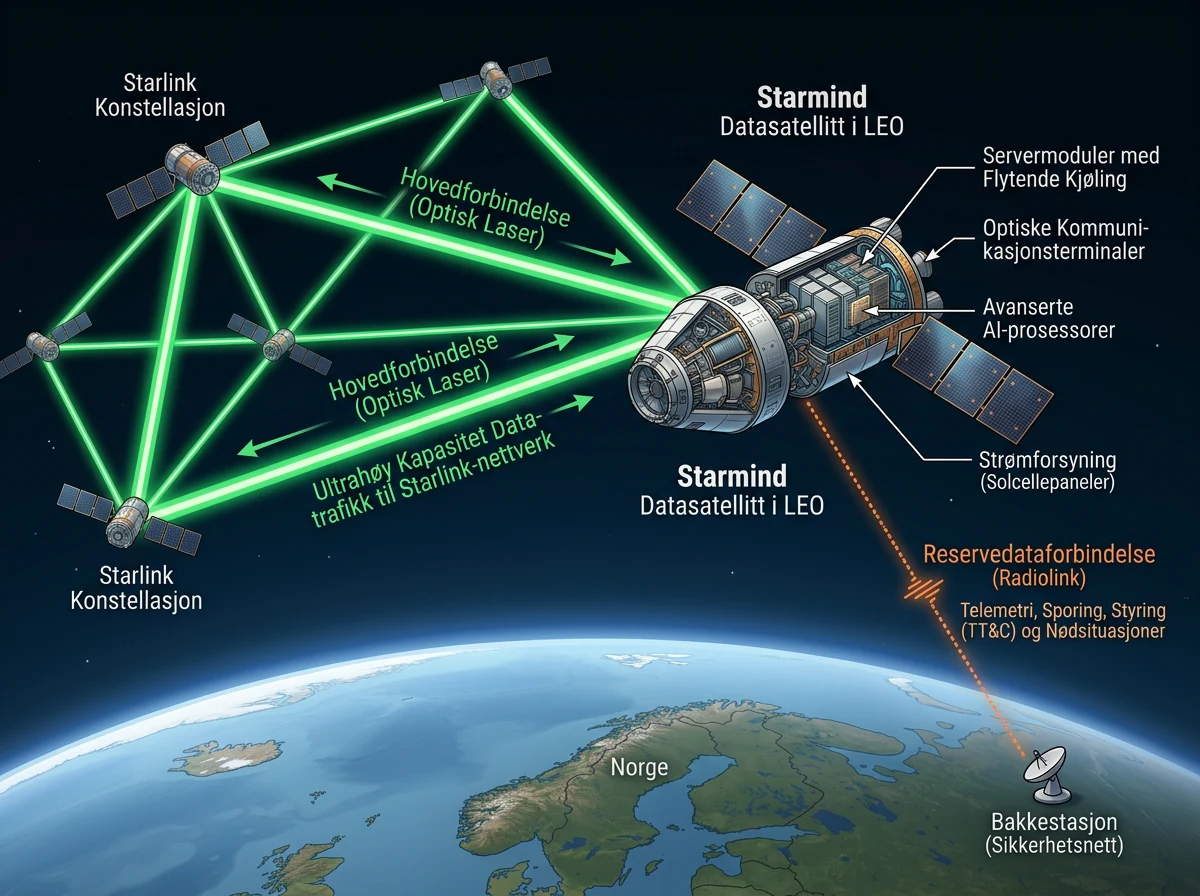
The legal scope is also more specific than the headlines make it sound. The FCC order authorizes radiofrequency links for backup and emergency telemetry, tracking and command. SpaceX says the constellation will primarily communicate through optical links. In other words, the regulator is handling the communications authority needed to operate the system, not declaring the entire engineering and business case solved.
How is Starmind supposed to work?
SpaceX describes Starmind as a way to capture solar energy in space and use it to power AI compute for work performed on behalf of users on Earth. Data would move through high-speed optical links between Starmind and Starlink. The company also plans to manufacture the chips for these satellites at its forthcoming Terafab facility.
The architecture explains why SpaceX is a serious participant in this race. It is trying to control several parts of the chain at once: launches, the satellite network, optical communications and eventually chip production. Every layer it can supply itself removes one external dependency from an already absurdly complicated system.
That does not make the project easy. A useful orbital data center has to do far more than place a chip in sunlight. It needs reliable power, communications, thermal management, launch capacity, maintenance and a disposal plan. Starmind may benefit from SpaceX’s existing infrastructure, but the complete operating system still has to prove itself in orbit.
The connection to Starlink is especially important. A compute satellite is only useful if data can move to and from it quickly and reliably. SpaceX is not proposing a collection of isolated machines circling Earth. It is proposing another layer in a network it already operates, with optical links doing most of the heavy lifting and radio available for limited backup and emergency control.
One million satellites is a limit, not a delivery
The first deadline is the one worth watching in the short term: SpaceX must have at least one Starmind satellite operating by 2033. The company then has until 2040 to reach the 1 million satellite milestone. The approval therefore gives Starmind a timetable, but it does not prove that SpaceX will complete every step.
The order is conditional rather than a blank check. The FCC granted the application in part and deferred part of it. In particular, the agency postponed SpaceX’s request for flexibility to move retired satellites operating above 600 kilometers into other Earth orbits or heliocentric orbits. The FCC said SpaceX had not provided enough information about those alternative disposal methods.
That is a practical limit, not a footnote to wave away. A constellation with a maximum size of 1 million satellites cannot treat end-of-life operations as an afterthought. SpaceX will need another application and sufficient justification before using a disposal method other than atmospheric re-entry for the relevant satellites.
The order also requires reporting on deployed satellites, re-entries and conjunction events. None of this guarantees that a million-satellite system will be safe or successful, but it does show why “approved” should not be read as “unrestricted.” SpaceX has an authorization with milestones and conditions, and its performance will generate evidence that a press release cannot.
So the sentence “SpaceX will launch 1 million satellites” is too certain. The company has permission for up to 1 million and a path extending to 2040. That is a massive difference. The first operational system will tell us far more than the largest number in the paperwork.
SpaceX is not alone in pursuing orbital AI data centers
Google and Blue Origin are also working on compute infrastructure in space. Google launched an AI server satellite for Project Suncatcher in October 2026, while Blue Origin is scheduled to conduct the project’s first dedicated heavy-lift mission in 2029. The race is already under way.
SpaceX now has the first FCC authorization for a full constellation of this kind. That is a concrete lead in the paperwork, but paperwork is only the starting line. The real advantage appears when SpaceX places a working satellite in orbit, connects it to Starlink and demonstrates useful compute under actual operating conditions.
This is also why the Starmind decision matters beyond SpaceX. Once one full constellation receives authorization, the idea no longer sits entirely in the category of corporate ambition. There is now a regulatory path that competitors can study, challenge and try to follow.
The competition should help separate engineering from theater. A company can promise solar-powered compute in space, but the meaningful comparisons will be much less glamorous: How much useful work does each satellite deliver? How reliable are the links? How quickly can hardware be deployed and replaced? What does the full service cost compared with a terrestrial data center? Those answers will decide the market, not the size of an approved constellation.
What does the approval change today?
For ordinary AI users and small businesses, the answer is simple: nothing immediate. Starmind is not a service you can buy, and an FCC authorization will not make a chatbot faster tomorrow. The news value is that orbital AI infrastructure has moved from an application to an authorized construction and deployment program.
That is still a major step. Infrastructure projects often spend years as presentations, partnerships and confident promises. Regulatory approval does not complete the project, but it removes one obvious reason it could remain stuck on paper. SpaceX can now be judged against an actual authorization and its deadlines.
I would follow four things from here: the first Starmind satellite, the optical connection to Starlink, real chip production at Terafab and the pace of deployment toward 2040. These are the points where the plan starts turning into evidence. Each one tests a different part of the story, from basic hardware to communications and industrial scale.
If SpaceX delivers on those points, Starmind could mark the beginning of a new kind of AI infrastructure. If it does not, the FCC will be left with an impressively large number in a document. The approval is big. But it is the starting gun, not the finish line.
Frequently asked questions
Has SpaceX already launched 1 million Starmind satellites?
No. The FCC has authorized a planned constellation of up to 1 million satellites. SpaceX must place at least one Starmind satellite into operation by 2033, so the million figure describes the permitted maximum and later milestone, not a fleet already in orbit.
When does SpaceX have to complete the Starmind constellation?
The FCC authorization requires SpaceX to reach the 1 million satellite milestone by 2040. That is a deadline attached to the authorization, not a guarantee that the entire fleet will be manufactured, launched or commercially successful.
How will Starmind send data back to Earth?
SpaceX says Starmind will primarily use high-speed optical links that can connect with Starlink. The FCC also authorized specified radiofrequency links for backup and emergency telemetry, tracking and command if the optical network is unavailable.
What part of SpaceX’s request did the FCC defer?
The FCC deferred a request concerning alternative disposal orbits for satellites operating above 600 kilometers. SpaceX had not provided enough information, so it must submit another application before using disposal methods other than atmospheric re-entry for those satellites.