Innhold Show
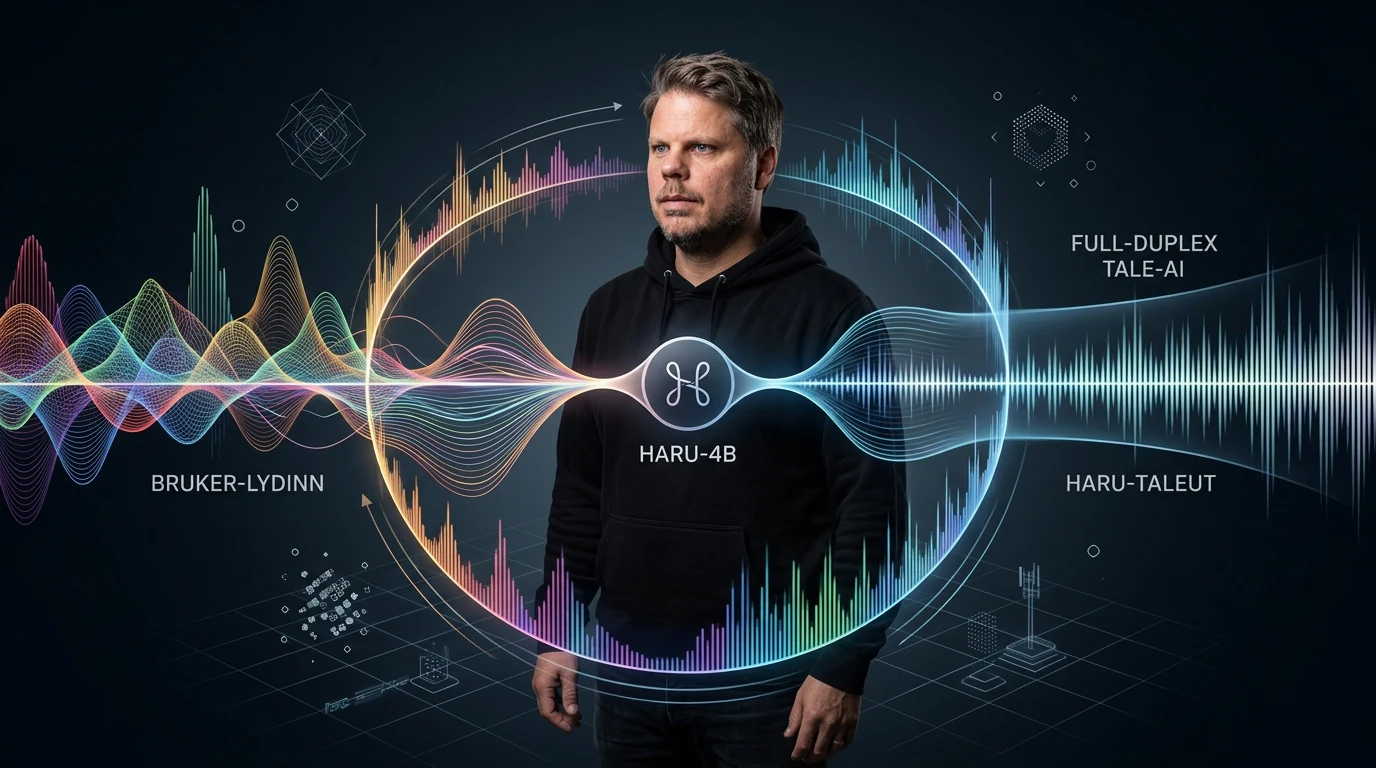
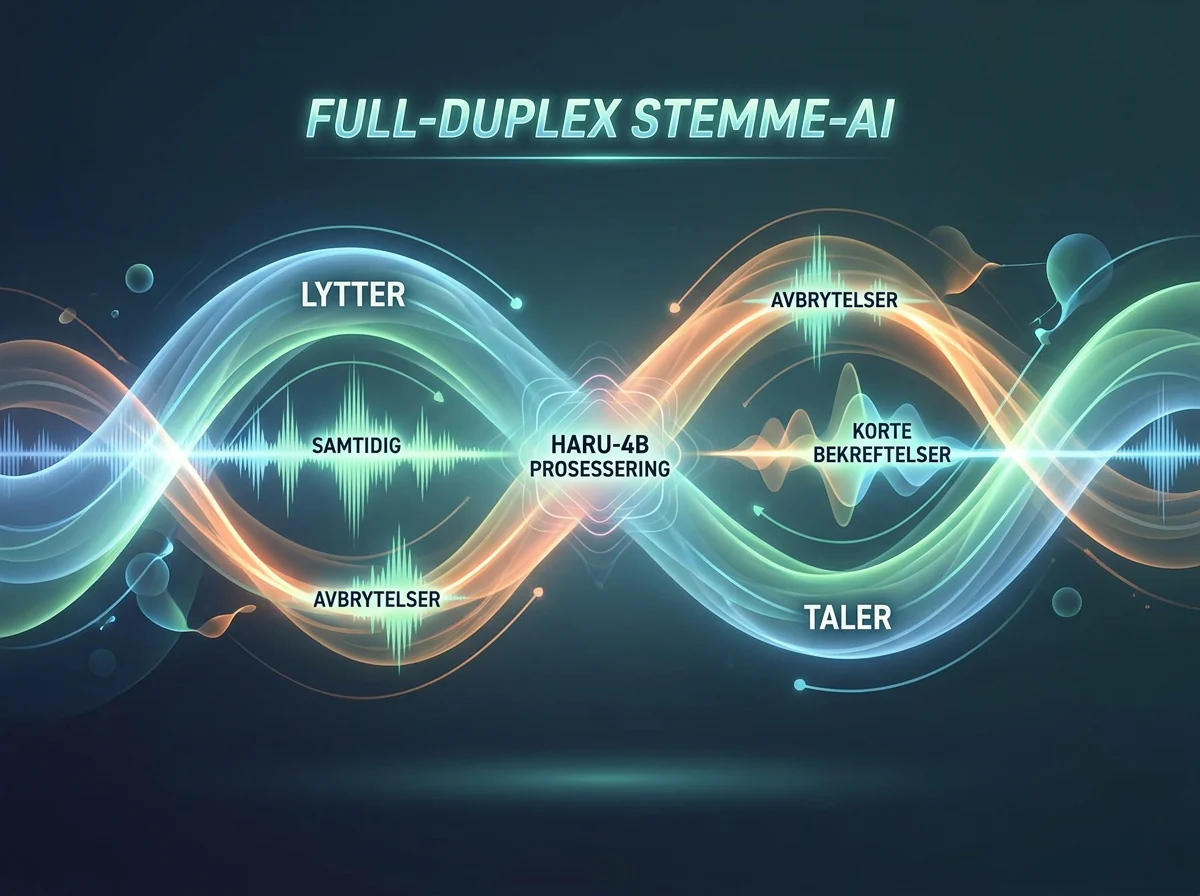
Haru-4B can listen and speak at the same time, giving voice AI the foundation for a much more natural conversational rhythm. It does not have to treat every exchange like a rigid relay race where the human finishes, the machine thinks and the answer only begins afterward. Listening and speaking can overlap.
That opens the door to small, human signals during a conversation. A voice agent could, in principle, say a quick “mm-hmm” without ceasing to listen, or notice that the user is interrupting while it is still talking. Haru-4B is not a finished consumer service. It is a foundation model and a collection of open building blocks that developers can take further.
That is exactly why I find this release interesting. Higurashi has built simultaneous audio into a model based on Qwen3.5-4B, published the weights and inference code, and provided several ways to run it. The important distinction is that natural flow does not make an assistant intelligent or reliable. Haru-4B may sound more conversational without knowing what is true or following difficult instructions correctly.
What is Haru-4B?
Haru-4B is a speech-to-speech foundation model that receives and produces speech as simultaneous streams. Higurashi introduced the model on November 13, 2026, describing it as a full-duplex model built on Qwen3.5-4B.
Full-duplex is the key term. People do not always wait politely for the other person to deliver a perfectly finished paragraph. We acknowledge, hesitate, prepare to speak and interrupt. A voice agent that has to switch between a pure listening mode and a pure speaking mode easily acquires the awkward rhythm of a walkie-talkie.
Haru instead handles incoming user speech, its own outgoing speech and text as synchronized streams in one language model. The audio stream updates 7.5 times per second, or roughly every 133 milliseconds. That number describes the duration of each audio frame, not the total time the system needs to understand you and respond. It is a small distinction on paper and an important one in practice.
The model uses VibeVoice for audio representation and a lightweight MeanFlow component to produce audio in a single sampling step. The useful point is not the name of every component. It is that listening, language processing and speech generation are part of one continuous process rather than a chain that transcribes an entire utterance, waits for a complete text response and only then starts separate speech synthesis.
Why does simultaneous listening and speaking matter?
Simultaneous listening and speaking means a voice agent can keep following the conversation while it responds. That provides the technical basis for handling interruptions, short acknowledgements and changing turns without resetting the exchange every time. These are examples of what full-duplex makes possible, not results from my own test.
The difference matters most when a conversation stops following a script. You might begin correcting an answer before the agent finishes, or the agent might give a brief signal that it is still following a longer explanation. That kind of timing does not make the model more knowledgeable, but it can make the interface feel less mechanical.
Voice is already a useful interface for AI tools. Haru-4B tackles a deeper part of that experience: the model itself keeps incoming and outgoing audio active together. That could matter for conversational characters, language practice and future voice interfaces, but those are potential applications. They are not finished Haru products available as subscriptions today.
The exciting part is not that a machine can read an answer aloud. Plenty of systems can already do that. The value is an open model designed for the rhythm of conversation, including moments when both parties speak. If developers can make that behavior stable through further training and integration, voice agents may begin to feel less like forms with microphones.
What is open, and what can developers build?
Higurashi has released the Haru-4B model weights and inference code under Apache 2.0. The project’s GitHub README describes a PyTorch implementation with a web demo, an MLX implementation with a native Apple Silicon app, and vLLM-Omni integration for server deployments.
That makes Haru relevant both for local experimentation and as the foundation for a service operated by the developer. Running it locally also gives developers more control over the model, audio pipeline and adaptations than a closed voice API would. Open weights do not make the hardware or operation free, however, and they do not mean every part of the training process has already been published.
Higurashi has released the weights and code needed for inference. The complete training dataset and training code are not included. The developer says a more detailed technical report and training code are planned. This is a meaningful open release that people can run and build upon, but not a complete record of every step used to create the model.
Developers can define the character with a structured text card and provide a voice through a reference clip. The README calls for one clean recording with a single speaker, lasting between 3 seconds and 3 minutes. The user must have the right to use that voice, and the model does not ship with voice clips. This is a sensible building block: personality and voice can be adapted without pretending that one default voice fits every product.
It also underlines an important distinction in voice AI. The voice, its delivery and the conversational system are separate parts of the problem. Haru-4B is primarily about the third part. Its defining feature is that both sides of the conversation can produce audio at the same time.
Can Haru-4B run locally?
Yes, Haru-4B can run locally. The model card and README specify an Nvidia GPU with roughly 12 GB of memory for the documented PyTorch setup. That is the developer’s approximate requirement for this implementation, not a universal threshold for every machine, software stack or future quantization.
Apple Silicon has a separate route through MLX and a native app. Higurashi reports roughly 65 milliseconds in one measurement on a MacBook Pro with an M1 Max, int8 weights and specialized Metal kernels. The measurement includes audio encoding, the language model, audio decoding, and wired microphone and headphone I/O. It excludes audio framing, which can add up to 133 milliseconds.
It would therefore be wrong to reduce that result to “Haru responds in 65 milliseconds.” This is a specific measurement on a specific setup with a defined scope. On an Nvidia B300, the developer reports around 15 milliseconds for audio encoding, decoding and one model step, which is another scope entirely. The figures show that real-time performance is a serious design goal, not that every user will get identical latency.
Audio hardware matters as well. The README recommends a wired microphone and headphones and says Bluetooth can add 100 milliseconds or more. It is easy to blame the model when the delay actually comes from the entire chain: microphone, audio interface, framing, model and playback. Voice systems do not live inside a benchmark vacuum.
Does Haru-4B work in Norwegian?
There is no documentation showing how well Haru-4B understands or speaks Norwegian. Higurashi’s technical presentation says it was trained on more than 40 million hours of real speech across over 160 languages, but Norwegian is not among the nine primary languages the developer highlights.
Those nine languages are English, Spanish, Portuguese, German, French, Chinese, Japanese, Russian and Korean. Norwegian may be present somewhere in a large multilingual dataset, but that does not demonstrate good pronunciation, dialect comprehension or reliable handling of interruptions. It does not prove that Norwegian cannot work either. The honest answer is that the quality has not been properly established.
Higurashi says the training data contains neither language-model-generated conversations nor TTS-synthesized speech. A later training stage uses more than 13 million hours of separated conversational audio, with examples lasting up to 60 minutes. Those 60 minutes describe the length of training examples, not a promised conversation limit for a finished product.
I have not tested or listened to Haru-4B, so I do not have a personal assessment of its Norwegian quality. Anyone building a Norwegian service on Haru would need to measure Norwegian speech, real dialects, noise and interruptions in that specific implementation.
What can the foundation model not do yet?
Haru-4B is a pretrained foundation model for research, not a finished assistant. The model card explicitly says it is not a reliable source of factual information and does not follow instructions like an assistant model that has been trained for that purpose. Natural timing and a convincing voice can make a wrong answer sound more persuasive. They do not make it correct.
That is the model’s most important limitation, but it is not an argument against the project. A foundation model is intended to be adapted. Developers building customer support, education or a conversational character still need to add knowledge, instruction tuning, safeguards, tool use and control around the speech system itself.
The training audio also contains noise and errors introduced while separating speakers, especially during overlapping speech. Higurashi identifies better adaptation with genuine two-channel conversations, larger models and real-time video as future work. Real-time video is therefore a plan, not a hidden Haru-4B capability.
Local operation needs one more qualification. You can run the model on your own hardware, but the README includes an optional sharing feature that routes traffic through Gradio servers. A local model does not automatically mean that every possible configuration keeps all audio local. Developers still need to know which features are enabled and where the data actually travels.
Why Haru-4B is worth watching
Haru-4B represents a direction I want to see more of: advanced voice technology that does not only arrive wrapped inside a closed API. The documented local setup requires roughly 12 GB of GPU memory. That is not trivial for everyone, but it puts the model within reach of far more developers than an enormous research system would be.
The central development is still conversational flow. The model is designed so listening and speaking can happen simultaneously, and Higurashi has opened enough of the system for others to examine, adapt and improve it. This could become a useful foundation for local voice agents that behave less like walkie-talkies and more like conversational partners.
Foundation is the right word. Haru-4B is not documented as a capable Norwegian assistant, it is not a reliable source of facts, and it is not a finished consumer product. It is an open technical starting point with one compelling ability: it can keep its ears open while using its voice. That is concrete progress, and more than interesting enough without pretending the rest of the problem has already been solved.
Frequently asked questions
Is Haru-4B free to download?
Yes. The model weights and inference code are published under Apache 2.0. You still need to own or pay for the hardware that runs the model, and access to the weights does not mean the full training dataset and every training detail have been published.
How much GPU memory does Haru-4B need?
The developer specifies roughly 12 GB of memory for the documented local Nvidia setup. That is an approximate requirement for this implementation, not a guarantee covering every platform, quantization, or combination of software and hardware.
Can Haru-4B be interrupted while it is speaking?
The model is designed for full-duplex speech, so it can process incoming audio while producing its own. That provides the technical basis for interruptions and overlapping speech, but the quality of the experience depends on the adaptation and the complete system around the model.
Is Haru-4B a finished AI assistant?
No. Haru-4B is a pretrained foundation model for research and further development. Its model card says it is neither a reliable factual source nor a finished instruction-following assistant. Developers must add knowledge, control, safety measures and product features around it.