
Innhold Show
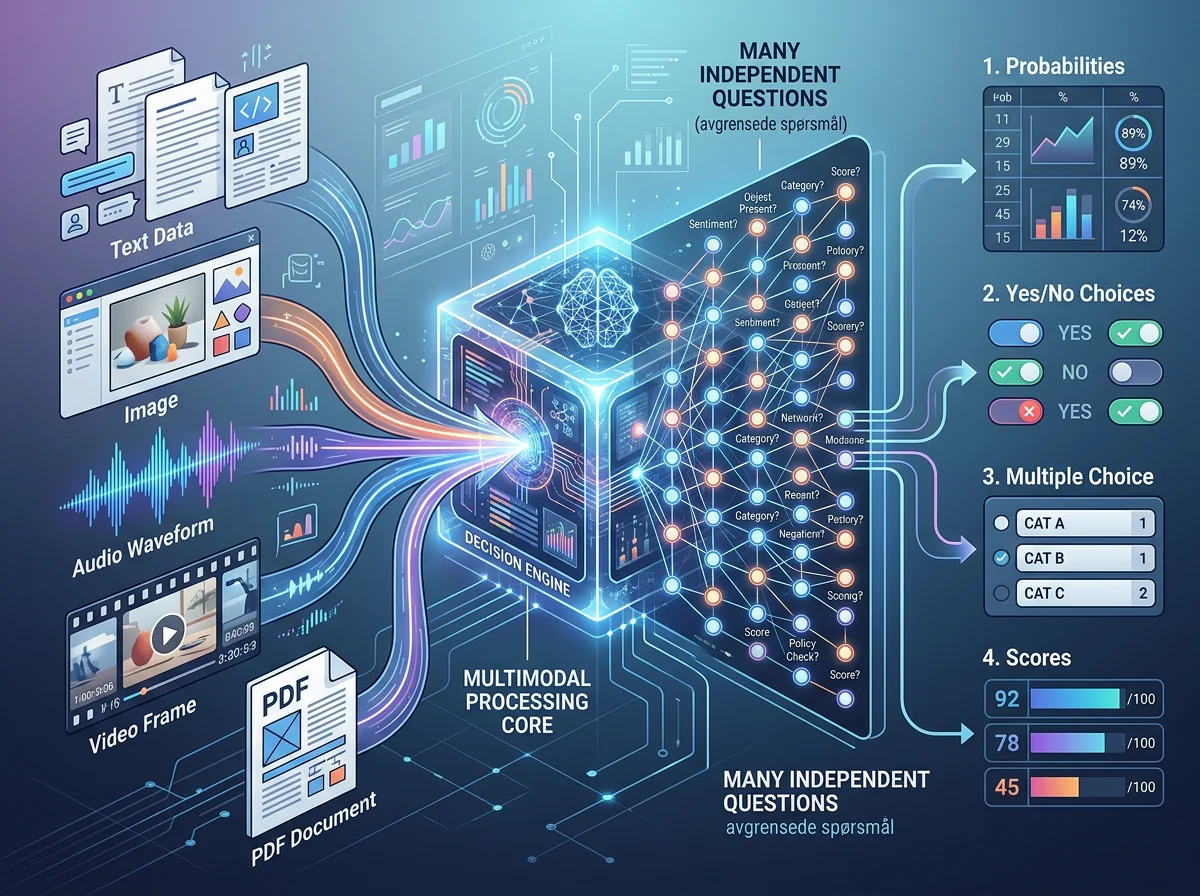
Gemini Decisions API gives developers a cheap model for making bounded choices instead of writing long answers. Gemini Decision 1 can evaluate text, images, audio, video, and PDFs, then return probabilities that your software can act on.
It is built for the small but important decisions scattered throughout an AI workflow: Which model should handle this request? Does the image show damage? Should this case go to a human? Which of five tools is the best fit? You often do not need a polished paragraph. You need a number or a choice that your code can use.
Google is joining Jev and OpenAI in a new category of decision models. The crucial difference is that Gemini’s model is multimodal, can handle up to 1,000 questions in one request, and costs $0.10 per million input tokens. That combination makes it a potentially useful control layer in systems that already work with more than text.
What is the Gemini Decisions API?
Gemini Decisions API is a dedicated endpoint for closed-set choices, powered by gemini-decision-1. According to Google’s November 11, 2026 announcement, one request can combine a shared input with up to 1,000 independent questions and return probabilities, choices, or scores.
The model is not meant to write an email, explain a complicated subject, or hold a conversation. It evaluates alternatives that you define in advance. Google provides three question types: noul for yes or no, choice for selecting between 2 and 255 options, and score for rating an input against an ordered rubric.
Google has adopted Jev’s term noul along with the same three broad question types. That says quite a bit about how quickly this API pattern is taking shape. This is not a chatbot in slightly different packaging. It is a specialist for classification, ranking, and routing.
Why does multimodal input matter?
Gemini Decision 1 can evaluate text, images, audio, video, and PDFs in the same model. That is its clearest distinction from Jev, which is limited to text and JSON, and from OpenAI’s decision model, which supports text and images. Google’s model could, for example, evaluate a damage photo alongside a written customer report, or a call recording alongside account data.
Simon Willison tried the model on a video and asked four yes-or-no questions about its contents. It returned roughly a 92.3% probability that the video showed a robot and about 5% that it showed a dragon. That is one demonstration, not a comprehensive quality test, but it shows how the response format works in practice.
A general generative model can also answer questions like these. The difference is that a decision model is designed to produce a bounded result with a probability, without spending time and money generating an explanation. That makes it suitable as a control layer in front of more expensive models, tools, and people.
It also extends Gemini’s multimodal reach in a more focused direction. One API can evaluate content across several media types without forcing the developer to assemble separate transcription, OCR, and classification pipelines first. That does not remove the need to test quality. It removes some of the plumbing around the decision itself.
How fast is Gemini Decision 1?
Google reports 50-100 milliseconds of model compute and 150-250 milliseconds of end-to-end latency in its measurements with multimodal inputs of up to 16,000 tokens. Latency is said to remain nearly flat from 1 to 100 questions because the model scores the options in a single pass instead of generating an answer token by token.
Those are promising figures for model routing, moderation, and other decisions that sit directly in a user-facing workflow. Google says Gemini Notebook uses the API to select model and reasoning levels, reducing latency by as much as 40% for common questions. These are Google’s own measurements, so treat them as a useful direction rather than a guarantee for your system.
The API has a 262,144-token context window shared between the input and the questions. You can send between 1 and 1,000 questions, but each is evaluated independently. If question two depends on the answer to question one, you must split that workflow into separate calls or compose the logic in ordinary code.
How much does the Gemini Decisions API cost?
Gemini Decision 1 costs $0.10 per million input tokens, while output is free because the model generates no output tokens. Google also offers free access in Gemini AI Studio for prototyping. The international price is already low enough that token cost may be less important than accuracy, latency, and supported input types for many small and midsize workloads.
The price matches OpenAI’s GPT-6 Luna decision model. Jev remains cheaper at $0.042 per million input tokens. At these levels, however, choosing solely by the lowest number would be a mistake. A text-only model is not a substitute when the job depends on audio or video, and a cheaper wrong decision can become expensive very quickly.
The shared input is billed once per request regardless of how many questions you ask. Instructions and criteria inside the questions still count as input. That is a clean pricing model when you need to check many rules against the same document, image, or video clip.
What can developers use it for?
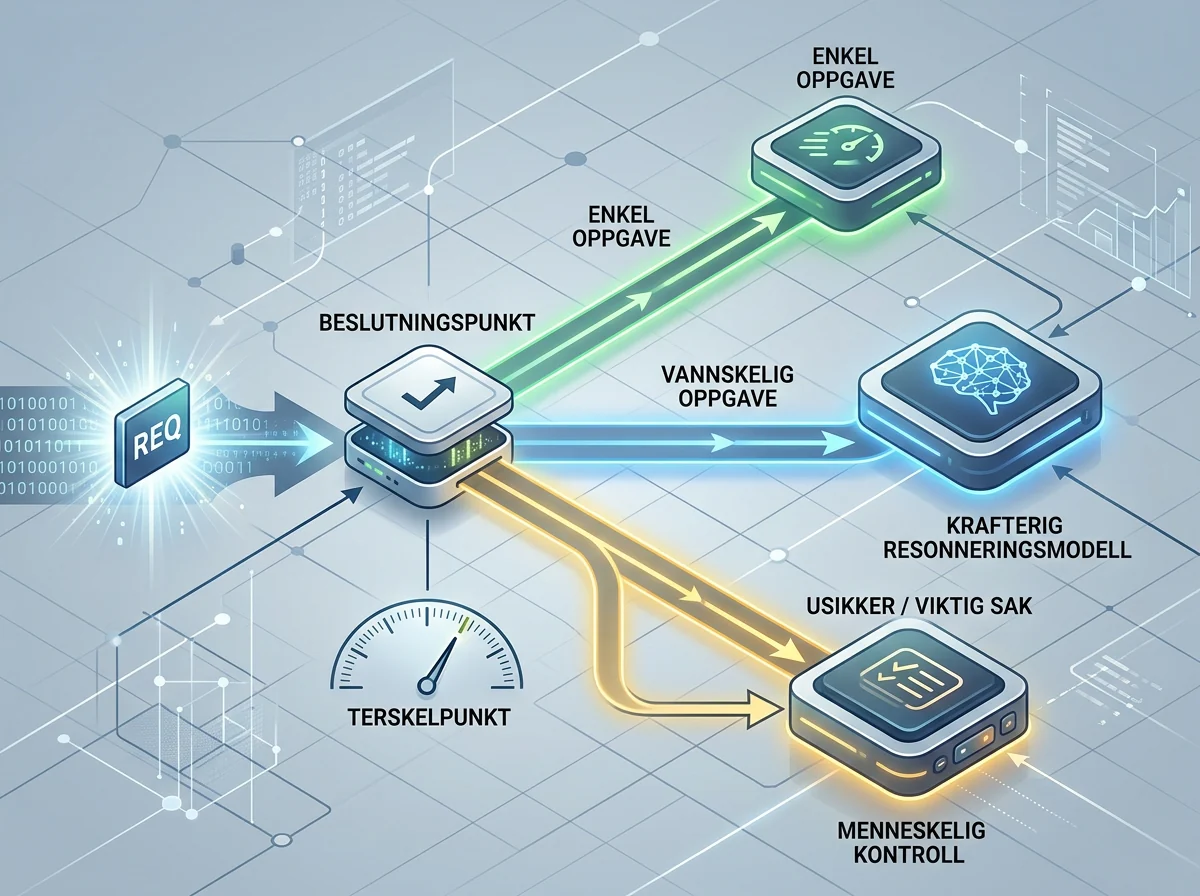
Routing is the most obvious use. A decision model can choose which language model should receive a task, which tool an agent needs, whether context should be compressed, or whether an uncertain case should go to a person. It can also rerank search results, check content against several policies, or produce a score from a fixed rubric.
This can reduce unnecessary calls to large models. If a cheap, low-latency model can send an easy task to a fast model and a difficult task to an expensive reasoning model, the whole system becomes more efficient. That fits how I think AI systems should be built: use the least expensive model that can genuinely solve each stage, not the largest model for absolutely everything.
A practical setup might begin with a handful of narrow questions: Is this a support request? Which product group does it concern? Is confidence below the threshold the business has set? The answers can determine the queue, model, and need for human review. The gain does not come from having the model “think” through the entire process. It comes from letting it do one bounded job quickly enough to stay inside the workflow.
Google also describes several internal examples. Stitch uses the decision model in a fast prototyping mode, a Google Labs product selects reactions from more than 200 emojis, and Google Search uses the API as a safety layer for MCP tools. Each choice is small, but these are exactly the kinds of choices that can sit in the busiest part of a system.
What are the limitations?
Gemini Decisions API is available in v1beta through the Gemini Developer API. It does not currently support context caching, the Batch API, or Flex and Priority processing. Reusing the same input across multiple calls therefore means paying for it again. Google Cloud support was announced but was not available at launch, while integrations with OpenRouter, LangChain, Vercel, and LiteLLM were still rolling out.
There is a more fundamental limitation too: You get a number, not a dependable explanation of why the model made its choice. A probability of 0.82 may be convenient in code, but it does not reveal which signals decided the case. In hiring, credit, healthcare, payments, and other high-risk settings, that is a serious weakness.
Google’s documentation recommends explicit criteria, adversarial evaluation examples, and human or secondary review for consequential actions. It also recommends comparing deterministic values such as dates, numbers, and durations in ordinary code before sending the result to the model. That is sensible. A cheap probability is useful, but it is not ground truth.
Is it better than a regular Gemini model?
Gemini Decision 1 is better when the task is genuinely a closed choice and you need low cost, low latency, and a probability that can feed a threshold. A regular Gemini model remains the right choice when you need prose, explanations, tool calls, multi-step reasoning, or an open-ended answer.
Google says the decision model is nearly five times cheaper than Gemini 3.5 Flash-Lite with the Interactions API across the company’s shared benchmark suite. That is useful as a directional claim, not proof for your workflow. What matters is whether the probabilities are properly calibrated on your own examples and whether the failures land on a side you can tolerate.
I like this direction. AI systems do not only need models that can talk more. They need small, fast control points that can choose the right path without turning every junction into a conversation. Gemini Decisions API looks like a good tool for exactly that, especially when the input goes beyond text.
But do not hand it the keys because a decimal number looks scientific. Test thresholds against your own data, keep a safe fallback for low-confidence cases, and send important or irreversible decisions to a person or an additional check. Probability can help you manage uncertainty. It does not make uncertainty disappear.
Frequently asked questions
Can Gemini Decision 1 analyze video and audio?
Yes. The model accepts text, images, audio, video, and PDFs as shared input. Media can be supplied through the Gemini Files API, a public or signed HTTPS URL, or base64 data. YouTube URLs and direct gs:// URLs are not supported.
How many questions can I ask in one request?
You can send from 1 to 1,000 independent questions in one request within a total 262,144-token context window. Questions can mix yes-or-no, choice, and scoring formats, but they cannot see or depend on each other’s answers.
Does Gemini Decisions API charge for output?
No. Output costs $0 because the model does not generate output tokens. Input costs $0.10 per million tokens. The shared input is billed once per request, while the instructions and criteria inside each question also count toward input usage.
Should Gemini Decision 1 make decisions by itself?
Not for consequential or irreversible actions. Use your own evaluation data to set thresholds, route uncertain cases to a person or another check, and compare deterministic values in regular code. The model returns probabilities, not an explanation that automatically makes the decision safe.