Innhold Show
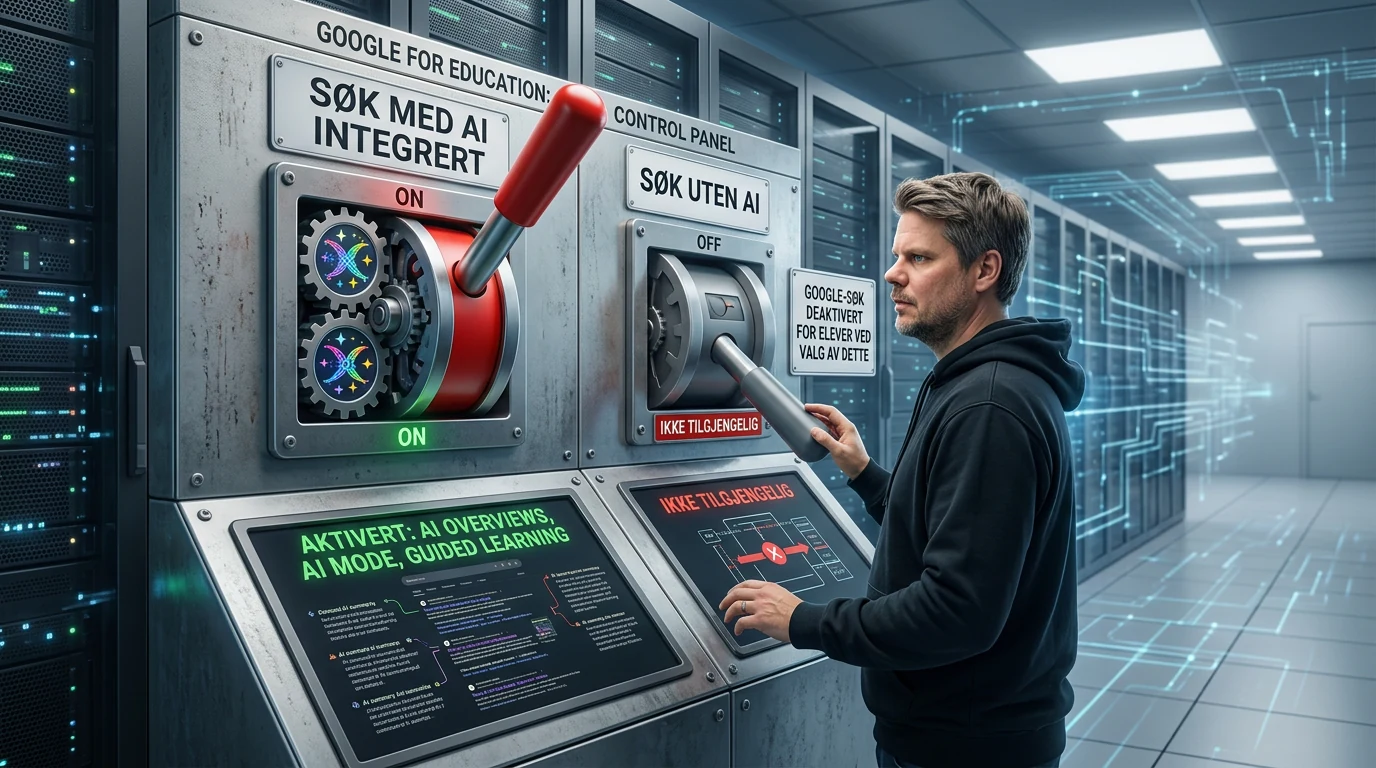
Google is giving schools a fake choice: accept the AI features built into Google Search, or remove Google Search from student accounts. Schools can switch Gemini and Gemini Notebook on or off separately. What they cannot have is conventional Google Search without the generative AI features Google has bundled into it.
That is not a meaningful choice. It is bundling by a company that already has enormous leverage through Search, school accounts, Classroom and Chromebooks. When a school must choose between Google’s AI version of Search and no Google Search at all, Google gets to decide what the word “search” means in the classroom.
I love AI, and I believe schools should teach students how to use it. But schools, teachers and parents must decide where it belongs and when students should use it. Google should not use a service schools already depend on as leverage to force AI in through the back door.
What is changing for Google Search and AI in schools?
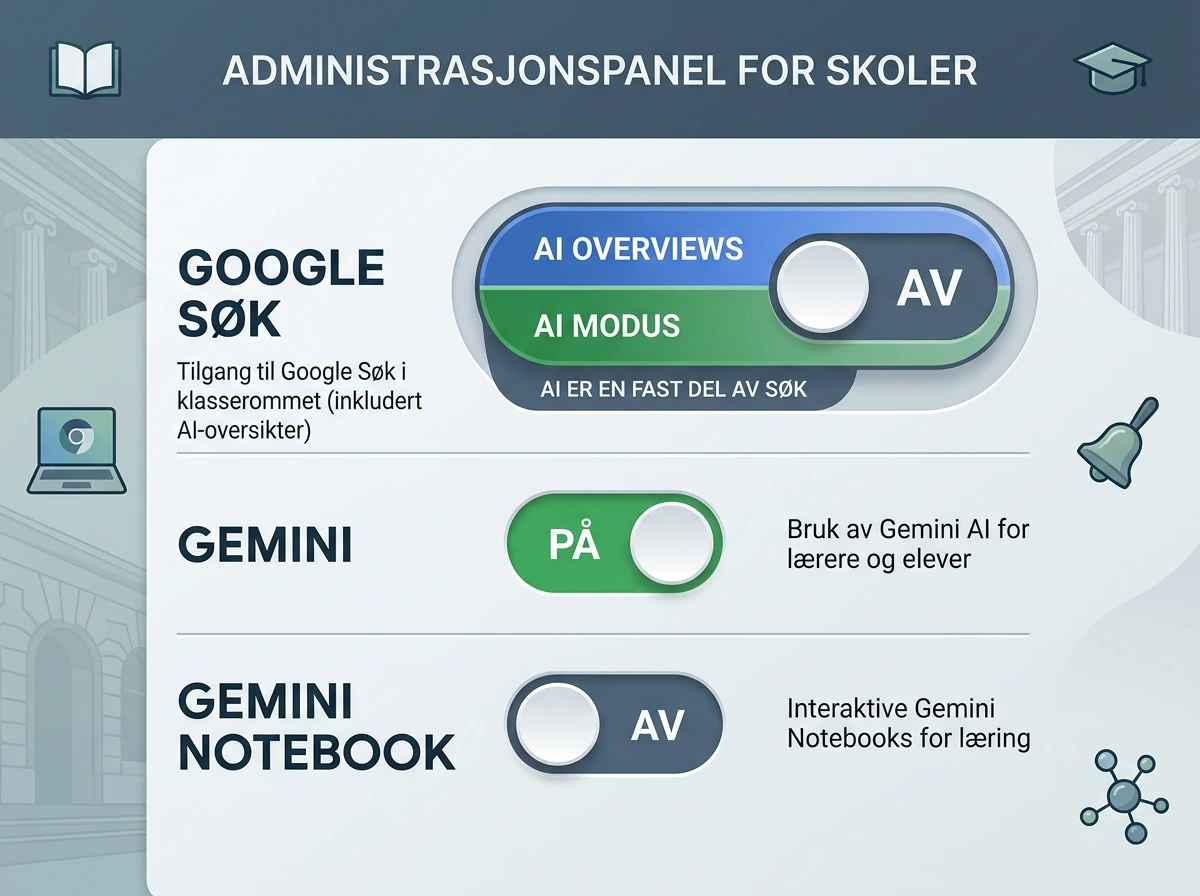
Google plans to make Search, Gemini, Gemini Notebook and Gemini in Classroom unavailable by default for K-12 student accounts. School administrators will then be able to decide separately whether to enable Search, Gemini and Gemini Notebook. According to Google’s November 3, 2026 announcement, schools will receive more details in the months before the changes roll out.
At first glance, that sounds sensible. An administrator can enable Search without enabling the separate Gemini app or Gemini Notebook. Google therefore presents the change as giving schools more control, with a separate decision for each product.
Here is the catch: Search is not being offered as a conventional search product without generative AI. Chris Phillips, Google’s vice president for education, said Search and AI are deeply integrated. A school that does not want AI at all will therefore lose Search as well, and students will see a message saying that the service is unavailable.
TechCrunch describes the distinction clearly: Gemini, Gemini Notebook and Search can be enabled individually, but the AI features inside Search come with Search. There are separate product switches, but there is no separate switch for the generative AI inside the search engine.
Why is this a fake choice?
Schools asked for control over AI, and Google answered with control over products. Those are not the same thing. A school can reject the Gemini app, but it cannot accept conventional web search while rejecting generated answers at the top of the results page.
That difference matters in the classroom. Conventional search gives a student a list of sources that must be opened, read and evaluated. An AI Overview tries to produce the answer before the student has visited those sources. Both tools can have a place in education, but they train different habits and serve different assignments.
Generated overviews can be useful. They can also be wrong, flatten disagreement between sources and tempt students to stop at the first polished answer. A teacher may have sound educational reasons for wanting conventional web search for one task and an AI tool for another. That is not hostility toward technology. It is teaching.
Google describes the bundling as a technical reality because Search and AI are now closely integrated. But Google chose to integrate them that way. The company designed the switch out of the product and now points to the missing switch as the reason schools cannot have it.
It is almost impressively brazen. First make AI inseparable from the product. Then tell customers they have full control, as long as they choose between the entire package and turning Search off.
How much power does Google have in the classroom?
For millions of students, Google is not just one website among many. It is part of the workspace they encounter every day through school-issued Chromebooks, managed student accounts, Classroom and other Google education tools.
That makes “use another search engine” less simple than it sounds. Student accounts and devices are centrally managed. Network filters may be locked down, default settings are controlled by administrators, and lesson plans may assume that Google services are available. A school can change its search engine or platform, but doing so takes training, testing, administration and money.
This dependence gives Google leverage it would not have if Search were merely a random browser tab. Vertical integration can produce good products and rapid deployment. It can also make the line between offering a feature and using existing market power to push it astonishingly thin.
That use of power triggered the backlash. Senator Bernie Sanders called the plan extortion, while Senator Richard Blumenthal accused Google of prioritizing Gemini over students. New York City Mayor Zohran Mamdani argued that no corporation should have the power to dictate how children are taught. Former Federal Trade Commission chair Lina Khan described the move as anticompetitive and pointed to Google’s dominant position.
They have identified the problem, even if the word “unregulated” does not magically make every political remedy wise. The state is not exactly famous for solving technical power problems elegantly. The most practical counterweight is for schools to reduce their dependence, set clear requirements and maintain alternatives they can actually move to.
What is Guided Learning?
Guided Learning is Google’s attempt to make AI in schools more educational. Instead of simply delivering a final answer, the feature is designed to ask questions, break a problem into steps and guide the student through the reasoning. Google has made it available in Classroom and is starting a Search pilot at selected US schools in November 2026.
The examples make sense. A student who pastes in a physics problem should be guided through the concepts. A request for help with a book report should prompt questions that make the student think, not generate a finished paragraph that can be submitted with a new name at the top.
Google also points to its own research showing measurable learning gains. Guided Learning may turn out to be a good tool, but a promising vendor-run pilot is not a reason to remove a school’s ability to choose ordinary search. The feature should be judged on its own results, with teachers and students in real classrooms. It should not slip in as the price of retaining a service schools already use.
The decisive question is not whether Guided Learning might be useful. It may well be. The question is why that usefulness is not allowed to stand on its own.
What should schools do before the change arrives?
School leaders should first demand a written, specific answer from Google about what the Search switch activates. Ask for a list of the generative features included, such as AI Overviews and Guided Learning, along with logging behavior, administrator controls and any differences by student age. “Search on” is not precise enough when the search product contains several AI layers.
Next, test the available options with student accounts under the same policies, network filters and Chromebook settings used in the classroom. A tidy administrator panel does not necessarily reveal the student’s full experience. Document which answers are generated, which sources appear and whether teachers can control features for different groups or assignments.
Schools should also map how deeply locked in they are. Find out whether another search service can be deployed centrally, whether the network filter blocks it and which lesson plans assume Google Search is available. An alternative is not real until it works on a student’s machine on Monday morning.
Finally, give parents and teachers a plain explanation before changing any switches. Do not sell this as “AI on or off.” Explain that Gemini can be off while Search still contains AI, and that rejecting AI entirely under Google’s setup also means losing Search. People can only make an informed choice when they understand the choice they are actually being given.
Google should put the switch back
The clean solution is to let schools enable Google Search without its generative AI features. Guided Learning, Gemini and other AI tools could then be enabled where the school believes they help. That is real control: independent choices that follow the needs of teaching instead of the needs of Google’s product strategy.
Google can believe that AI is the future of search. I also believe AI will play an increasingly important role in how people find and process information. But optimism about the future does not give a company the right to turn today’s dependence into leverage.
Schools need search, sources and digital tools. They also need room to decide when a student should use a language model and when that student should search, read and think independently. If Google truly wants to give schools more control, the solution is simple: give them the switch.
Frequently asked questions
Can schools disable Gemini and still use Google Search?
Yes. A school can enable Search without enabling the separate Gemini app or Gemini Notebook. However, Search will still include Google’s own AI features. Schools do not get a separate option for conventional Google Search without generative AI.
Will Google Search be disabled automatically for students?
Google says Search and the affected AI products will be off by default for K-12 student accounts until a school administrator enables them. The company plans to provide more details before rollout, so schools must verify the timing and implementation locally.
Can students simply use another search engine?
Another search service may be technically available, but school-issued devices are often centrally managed. Network filters, default settings and lesson plans can make switching difficult. Schools should test alternatives with real student accounts and the same management policies used in class.
Is Guided Learning the same as Gemini?
No. Guided Learning is a feature Google is adding to products including Search and Classroom to guide students through a problem step by step. Gemini is a separate AI product. A school can disable Gemini while Search still contains AI features and may include Guided Learning.