
Innhold Show
If your AI agent makes hundreds of model calls for routing, tool use and small coding tasks, Meta Muse Ember could matter far more to the bill than another expensive frontier model. It is built for the work agents repeat all day, with pricing that starts at $0.10 per million input tokens.
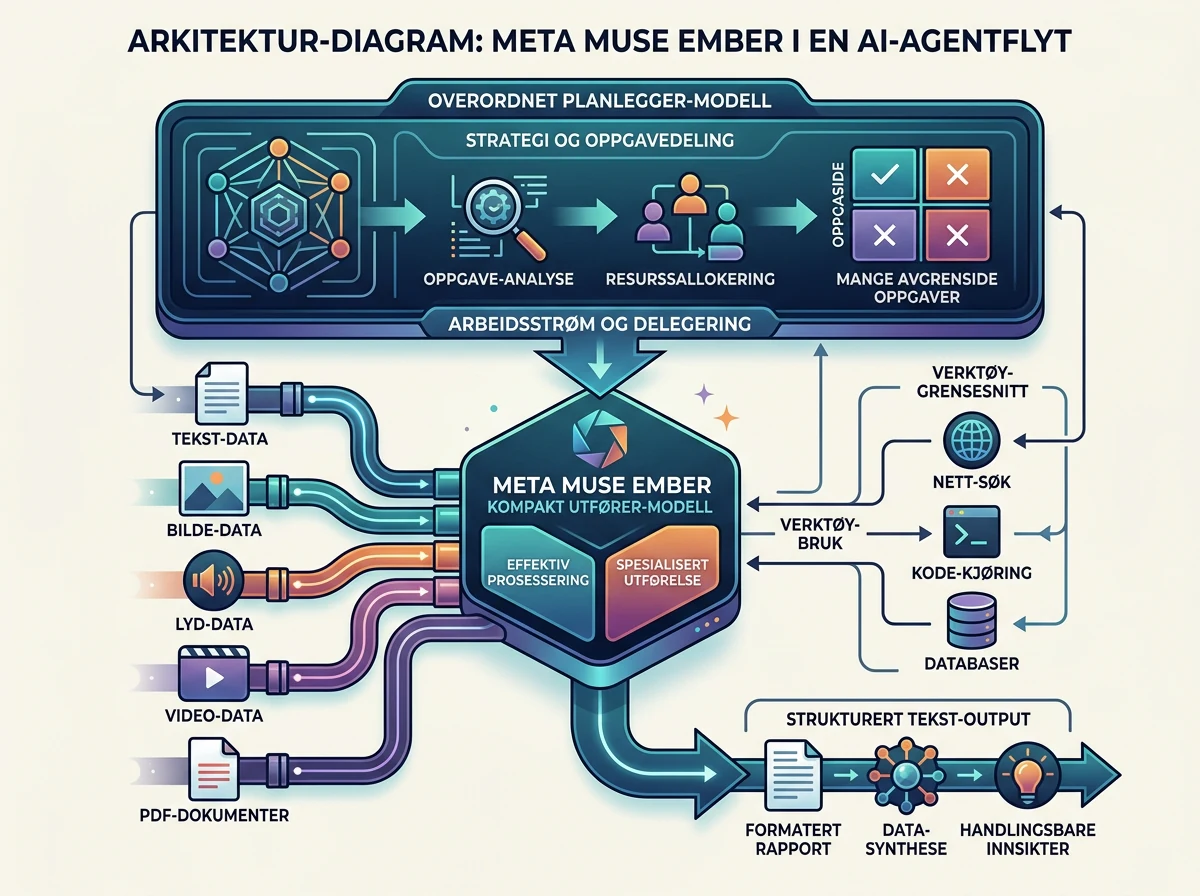
This is not the model Meta expects to solve every difficult problem. Ember is the fast, cheap executor inside a larger agent workflow: a stronger model plans, while Ember handles the many bounded tasks that follow. That division of labor makes sense. There is no reason to pay frontier-model prices to retrieve a record, extract five fields or apply the same rule across 10,000 cases.
My verdict is positive and practical. Muse Ember looks capable of making agent work economically viable at much higher volumes. But I would not let Meta’s benchmark charts choose an architecture for me. What matters is whether Ember completes your repetitive tasks reliably and how much each successful job costs from start to finish.
What is Meta Muse Ember?
Meta Muse Ember is the smallest model in the Muse family, designed for repeated execution work inside AI agents. In Meta’s November 9, 2026 announcement, the company names tool calls, coding subtasks, routing, data extraction and long-document parsing as its core jobs. The model is available as muse-ember-1.0.
The simplest way to understand Ember is as an executor. A larger model can analyze the problem, create a plan and divide it into smaller jobs. Ember takes the volume. That can reduce costs while keeping the most expensive model away from work that does not require its full capability.
Ember is also multimodal rather than text-only. It accepts text, images, audio, video and PDF files, then produces text as output. The same execution model can therefore read screenshots, extract information from scanned documents and process recordings without forcing the agent workflow to send every format to a separate specialist model.
How cheap is Muse Ember?
For requests containing no more than 200,000 input tokens, Muse Ember costs $0.10 per million standard input tokens and $0.50 per million output tokens. Cached input costs $0.004 per million tokens. Those are international list prices for Standard mode in the Meta Model API, not currency conversions from a local price.
That is low enough to change the calculation. Ten million input tokens within the standard tier cost $1, while one million output tokens cost $0.50. The final bill still depends on reasoning effort, response length, retries and how much context can be served from cache. Cheap input does not rescue a workflow that loops, produces bloated answers or repeatedly chooses the wrong tool.
There is another important distinction. Meta’s claim that Ember is cheaper than Claude Haiku 5.5 and GPT-6 Luna is based on estimated cost per task at different reasoning settings. It is not a claim that every individual token always has the lowest list price. Meta’s chart puts Ember at $0.116 per task with a score of 33.9 and $0.136 with a score of 35.8. A model that uses fewer tokens or succeeds in fewer attempts can cost less per completed task even when its token price looks similar.
The low price changes above 200,000 input tokens
Muse Ember has a 1,048,576-token context window, but the cheapest rate does not cover that entire window. Meta’s official pricing table has a separate tier for requests containing more than 200,000 input tokens. Once a request crosses that line, the entire request is billed at the long-context rates, not only the tokens above the threshold.
Above 200,000 input tokens, the price rises to $0.30 per million input tokens, $0.012 for cached input and $1.50 per million output tokens. That is still inexpensive, but it is three times the short-context rate across all three categories.
This is easy to miss when the one-million-token context window gets the large type treatment. If you send a complete repository or a large document collection with every call, the agent can enter the higher tier long before the window is full. Meta also says that a stored conversation continued through previous_response_id counts toward the request’s input. Context discipline is not only about quality here. It is cost control.
What is Ember useful for in practice?
Ember is best suited to bounded tasks that repeat at scale: classification, routing, structured extraction, lookups, tool calls, small code changes and processing large document collections. Meta’s API documentation lists Responses, Chat Completions and Messages as supported endpoints, with reasoning effort from minimal to max.
Consider a customer-support workflow. A larger model can interpret the policy, identify the exceptions and create a plan for handling a category of cases. Ember can then retrieve records, check fields, apply that plan across many cases and update systems in the correct order. Each call may look trivial on its own, but the total becomes expensive when the workflow runs thousands of times.
The same idea applies to coding agents. An advanced model can analyze the architecture and break the work into pieces, while Ember reads files, runs tests and makes narrow changes. Muse Ember supports up to 524,288 output tokens, but that does not make huge responses free or useful. An execution model should get a clear objective, a limited toolset and a compact response format.

How does Ember compare with Haiku and Luna?
Meta’s main claim is that Ember delivers more intelligence per dollar than Claude Haiku 5.5 and GPT-6 Luna across the reasoning settings it compares. On the Artificial Analysis Intelligence Index, Ember reaches 35.8 at its higher setting, close to Haiku’s best result of 36.2 and above Luna’s 27.8. Meta also reports strong results for agent tasks, coding and multimodal work.
I would not buy the whole story from one chart. Several results are Meta’s internal measurements, while the external tests still depend on particular agent harnesses and settings. FrontierCode 2.0-AA is a useful warning: Haiku scores 34.9 percent there, ahead of Ember at 27.2 percent. “Best” depends on the task, the setup and what counts as success.
The benchmarks matter because they suggest Ember is not simply cheap rubbish. They do not prove that it is right for your codebase, documents or customers. For an execution model, stability can matter more than a few extra benchmark points. It must follow the schema, choose the right tool, stop when the job is done and avoid doing the same work three times.
How should a business evaluate a cheap agent model?
Start with tasks that already have clear boundaries and acceptance criteria. Log the number of attempts, token use, incorrect tool calls, human corrections and jobs actually completed. Then compare Ember with your current model on cost per approved result, not merely price per million tokens. A cheap model that needs four attempts can quickly become the expensive option.
Add explicit control gates as well. Give the model only the tools required for the job, require approval before irreversible actions, and escalate to a stronger model or a person when confidence is low. Ember being designed for agent execution does not mean it should receive unrestricted access to customer data, payments or production systems. A low price is not the same thing as low risk.
Finally, route work by difficulty. Use Ember where volume is high and the output can be checked, then send the difficult exceptions to a stronger model. That is the architecture Ember makes genuinely interesting: expensive planning when the problem demands it, cheap execution when the work is known, and a clear path back up when the cheap model is no longer enough.
My verdict on Muse Ember
Muse Ember addresses a real problem. AI agents do not consume tokens only in one large prompt followed by one polished answer. They can burn through enormous volumes on small decisions, tool calls, validation steps and follow-up work. At $0.10 per million input tokens, workflows that cannot justify frontier-model prices at every step become much more realistic.
The most promising part is not Ember beating a competitor in another table. Meta is building for the division of labor that useful agents actually need: costly planning when the problem is difficult, and inexpensive execution once the job is well defined. Ember gives the Muse family a clear bottom layer for high-volume work.
My advice is simple: do not replace everything at once. Pick repetitive tasks with clear quality requirements, run Ember against a stronger model and measure the cost of each correctly completed job. If it holds up there, this could be a seriously useful model. Volume is where the money disappears, and volume is exactly what Ember is built to handle.
Frequently asked questions
Is Meta Muse Ember available now?
Yes. Meta launched Muse Ember on November 9, 2026 as muse-ember-1.0. It is available through the Meta Model API and Muse Code. The API supports Responses, Chat Completions and Messages, while availability and account requirements should be checked in Meta’s current documentation.
Is Muse Ember an open-weight model?
No. Meta provides Muse Ember through the Meta Model API and Muse Code rather than releasing its weights. Do not confuse it with Muse Glimmer, the open-weight model in the Muse family. Ember’s advertised price is an ongoing API charge, not the cost of running it locally.
What does one million tokens cost with Muse Ember?
For requests with up to 200,000 input tokens, one million standard input tokens cost $0.10 and one million output tokens cost $0.50. Requests above the threshold use the higher long-context tier for the entire request, with input at $0.30 and output at $1.50 per million tokens.
Can Muse Ember replace a large model in an AI agent?
It can replace a larger model for some bounded, repetitive tasks, but Ember is designed mainly as an executor inside a broader workflow. A stronger model may still be better for planning, hard exceptions and complex decisions. Measure reliability and cost per approved result before moving an entire workflow.