
Innhold Show
OpenAI reportedly passed $10 billion in quarterly revenue for the first time, while its adjusted operating margin remained at -109%. That is an absurd amount of revenue in three months. It also means the company’s adjusted operating loss was still larger than all the money it brought in.
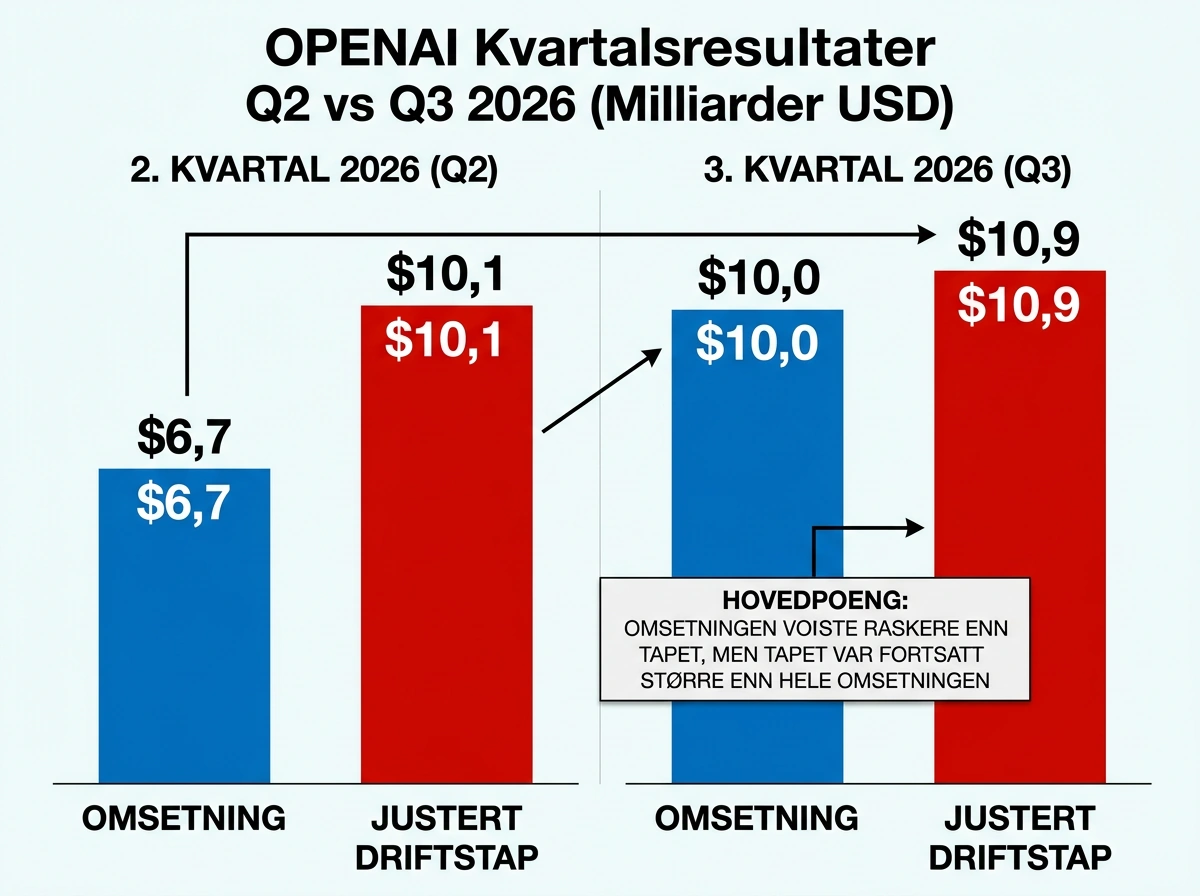
Revenue rose by almost 50% from $6.7 billion in the second quarter, according to figures reported by Bloomberg and relayed by TechCrunch. At the same time, the adjusted operating margin improved from -150% to -109%. OpenAI is selling AI at a pace most software companies can only dream about, but the economics are still upside down: for every dollar of revenue, the adjusted operating loss was approximately $1.09.
I find that growth impressive. Pretending otherwise would be silly. But a revenue record is not proof that the business model works. These numbers show both how quickly the AI market is growing and how staggeringly expensive it remains to compete at the frontier.
What does OpenAI’s third-quarter revenue show?
OpenAI reportedly generated more than $10 billion in revenue during the third quarter of 2026, according to TechCrunch’s account of Bloomberg’s reporting. It is the first reported quarter in which the company has crossed that threshold. Compared with $6.7 billion in the previous quarter, the increase is close to 50%.
That is not a small improvement around the edges. OpenAI added more than $3.3 billion in quarterly revenue in three months. The earlier increase from the first to the second quarter was reportedly about 18%, so the pace of growth accelerated sharply as well.
There is an important caveat. These are source-based figures attributed to anonymous people familiar with the company, not numbers from a public OpenAI quarterly filing. “Reportedly” needs to stay attached to them. The growth is still remarkable, but rounded media figures should not be treated as a complete set of audited accounts.
The adjusted operating loss was larger than revenue
TechCrunch reports an adjusted operating margin of -109% for the third quarter. Applied to the rounded revenue figure of $10 billion, that implies an adjusted operating loss of at least approximately $10.9 billion. This is my calculation from the reported rounded figures, not a separate accounting line disclosed by OpenAI.
The percentages can be confusing because the margin improved while the implied dollar loss still increased. In the second quarter, a -150% margin on $6.7 billion in revenue implies an adjusted operating loss of about $10.1 billion. In the third quarter, the corresponding figure was roughly $10.9 billion. The loss grew, but far more slowly than revenue.
That is real progress. The adjusted loss amounted to about $1.50 for every dollar of revenue in the second quarter and approximately $1.09 in the third. But -109% is not a slightly ugly margin that needs a cosmetic touch-up. OpenAI still depends on enormous amounts of capital to finance model training, inference, data centers, staff and product development.
Why is OpenAI growing so quickly?
TechCrunch attributes the recent gains to strong demand for newer AI models, tighter pricing, discounts and a greater focus on enterprise products and AI agents. That fits a market moving beyond curious chatbot users. More organizations are embedding AI in software, workflows and customer services, and API use generates a very different revenue profile from occasional questions in a browser.
OpenAI also has a distribution machine that almost nobody can copy quickly. The company has said it serves more than one billion ChatGPT users. TechCrunch notes that many are probably free users or customers on the least expensive plans. That reach is extraordinary, but the user count alone says little about profit per customer.
This explains both the opportunity and the problem. One billion users give OpenAI a vast audience for subscriptions, APIs and new products. Yet free and low-cost access is not automatically a good business when every request consumes compute, storage and network capacity. Distribution creates revenue, but in AI it can also become an extremely efficient machine for creating costs.
The enterprise market therefore matters. Businesses generally pay more, consume APIs at greater scale and can adopt systems that remain embedded in their operations for years. OpenAI does not merely need more users. It needs more revenue per user and a lower cost per task if spectacular growth is going to become a sustainable business.
A $50 billion run rate is not annual revenue
Bloomberg’s sources also reportedly put OpenAI’s annual revenue run rate at $50 billion. That number describes what the company would generate over 12 months if revenue continued at the measured pace. It does not mean OpenAI has already booked $50 billion in revenue during a calendar year.
The distinction matters because AI companies are growing so quickly that a year-old figure can feel ancient. A run rate may show current direction better than last year’s accounts, but it can also make a short period of rapid growth look smoother and more permanent than it is. A $10 billion quarter alone corresponds to a simple annual pace of $40 billion. A reported $50 billion run rate suggests revenue was higher near the end of the period than at the beginning.
Comparisons with Anthropic and other private AI companies need care as well. TechCrunch notes that OpenAI and Anthropic do not necessarily calculate annualized revenue in the same way. Anthropic includes sales made by cloud partners, while OpenAI reports only its share of some partner sales. Two enormous run-rate numbers can look directly comparable without measuring exactly the same thing.
The practical rule is simple: check the period, check whether the figure is booked revenue or an annualized pace, and check how the company defines sales through partners. Otherwise, AI finance coverage quickly turns into a contest to stack the largest possible dollar figures on top of one another.
The revenue record does not remove the need for capital
OpenAI has already raised sums that would be almost unimaginable for an ordinary software company. The new revenue makes those investments easier to understand, but it does not make the capital requirement small. The implied adjusted operating loss for the quarter still exceeded the company’s entire revenue.
That is the paradox of frontier AI. Better models attract more paying customers. Those same models require enormous investments in chips, electricity, data centers and research. Greater use expands revenue, but it also increases the cost of serving customers. Winning the market is not enough if each new dollar of sales is still accompanied by more than one dollar of adjusted operating loss.
The margin improvement shows that scale may be helping. Revenue grew much faster than the implied adjusted loss, which is exactly the direction investors want to see. The next question is whether that continues while OpenAI trains new model generations and expands infrastructure. One quarter can demonstrate progress. It cannot prove that the cost curve has been broken.

What do the numbers mean for AI users and businesses?
For ordinary users, the figures show that demand for generative AI is not merely hype performed on a conference stage. People and companies are paying, and they are paying at enormous scale. OpenAI has turned models, APIs and subscriptions into a business with quarterly revenue comparable to that of large, established technology companies.
For businesses, my advice is more practical: do not select a provider simply because it is growing fastest or has raised the most capital. Compare price, model quality, data handling, the ability to switch models and the level of dependence each workflow creates. A fast-growing company can be a strong supplier, but huge losses can also lead to price changes, new product bundles and a much harder push for revenue.
That does not mean OpenAI is about to fall off a cliff. The company has extraordinary distribution, strong products and investors that have repeatedly shown a willingness to finance very large plans. But customers should keep some freedom of movement. An API layer that can switch models, exports of your own data and firm spending limits are sensible regardless of which provider leads this month.
The quarter makes one thing clear: OpenAI has built an enormous revenue machine. Now it has to show that the machine can eventually earn more than it burns.
The record is real progress – not a free pass
It is tempting to choose one of two easy stories. Either OpenAI is an unstoppable money machine, or it is a bonfire that can only survive by feeding it more billions. The reported figures point to both at once. Revenue is growing at a pace that cannot be dismissed, while costs remain so extreme that a quarter with more than $10 billion in sales still produced an even larger adjusted operating loss.
My judgment is straightforward: this was a strong quarter for demand for OpenAI’s products, but it was not a victory for profitability. The margin moved in the right direction. The implied loss still increased. Both statements belong in the same story, or half the story disappears.
Read the headlines about $10 billion and feel free to be impressed. I am. But always check the loss on the line below. That is the price of the AI race, and for now it is higher than OpenAI’s entire quarterly revenue.
Frequently asked questions
How much revenue did OpenAI make in the third quarter of 2026?
OpenAI reportedly generated more than $10 billion in third-quarter revenue, up almost 50% from $6.7 billion in the second quarter. The figure comes from anonymous sources cited by Bloomberg and was not published in a public OpenAI quarterly filing.
Is OpenAI profitable?
Not according to the reported adjusted operating margin. A -109% margin means the adjusted operating loss exceeded revenue. Applied to the rounded revenue figure, it implies a loss of at least approximately $10.9 billion, although OpenAI did not publish that calculation as a separate accounting item.
What does OpenAI’s $50 billion revenue run rate mean?
It means the measured revenue pace would produce about $50 billion over 12 months if it continued. It is not the same as revenue already booked during a calendar year, and comparisons require care because AI companies may count partner sales differently.
Why does OpenAI still lose so much money?
Frontier AI requires huge spending on training and running models, computing infrastructure, data centers, staff and product development. More usage produces more revenue, but it also creates substantial delivery costs. The reported margin improved sharply, yet it remained deeply negative.