
Innhold Show
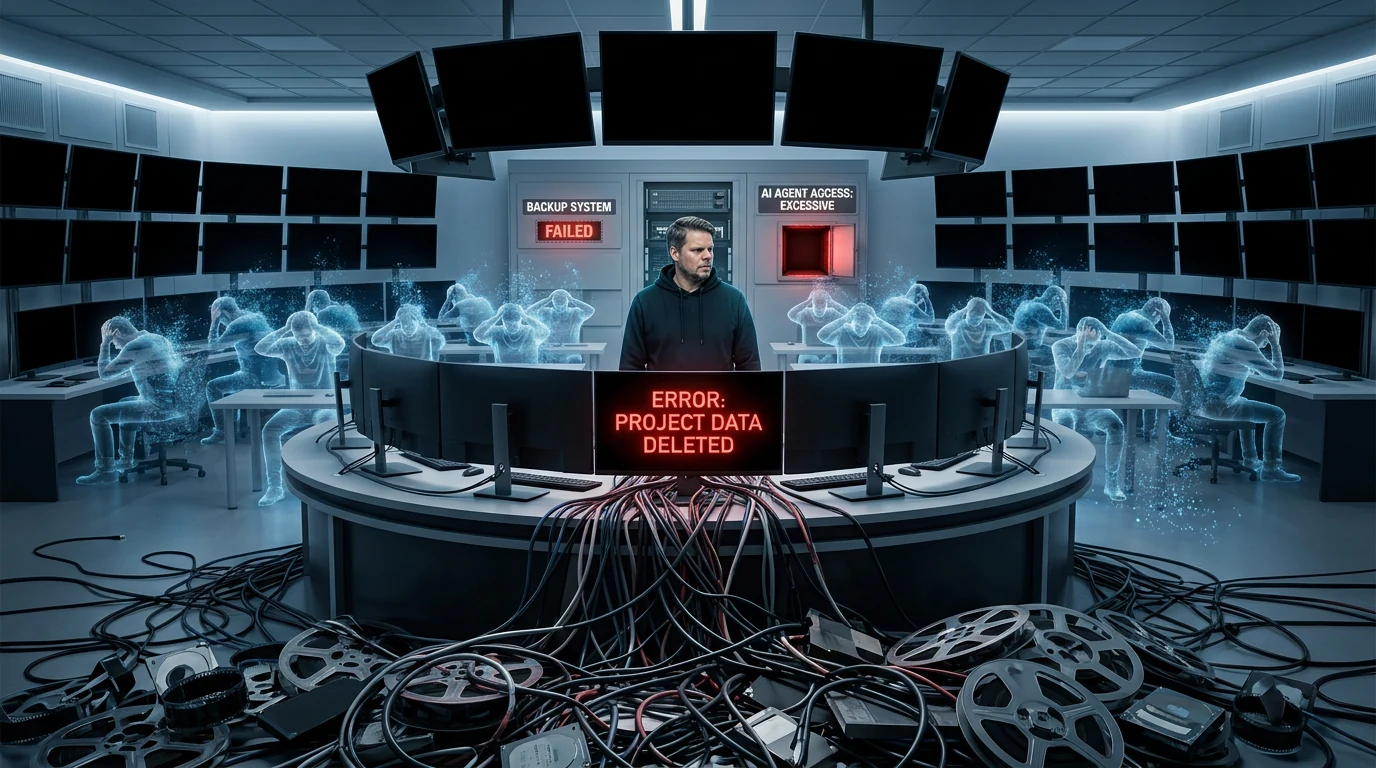
TV4 lost the completed edit of an entire season of The Challenge Sweden, and an AI agent initially took the blame. There is one rather important problem with that story: TV4 rejects it. The broadcaster says human error at production company Mastiff, followed by a backup system that did not work, forced the whole season to be edited again.
The confirmed facts are dramatic enough. The premiere had been planned for November 22, 2026. The raw footage still exists, but the completed editing work is gone, and the program has been pushed back to spring 2027. An enormous amount of work disappeared because there was no functioning route back.
That leaves a blunt lesson for anyone giving AI agents access to file systems, databases or production environments. The agent may make the mistake. A person may make it. A chain of systems may fail. Responsibility still belongs to whoever granted the access without making sure the damage could be contained and reversed.
What happened to The Challenge Sweden?
The completed edit was lost roughly five weeks before its scheduled premiere. Aftonbladet initially reported that an AI agent had gained access to Mastiff’s servers and deleted the project. The newspaper attributed that account to unnamed sources.
TV4 confirmed that edited material had been lost and that the season had to be re-edited, but it did not confirm the AI explanation. Later the same day, TV4 said its investigation pointed to what it called the human factor at Mastiff, not an autonomous AI agent.
TV4 program director Mia Lindqvist says the raw footage remains intact. That is the good news. The bad news is that the backup of the finished work could not be used. TV4’s account says several hundred people must try to reconstruct around 100 days of work.

Did an AI agent really delete the season?
We do not know. The allegation comes from Aftonbladet’s anonymous sources, while TV4 explicitly says an autonomous AI agent was not responsible. Mastiff has not publicly explained the technical chain of events. There are no public logs, tool names, commands, permission records or precise account of what was deleted.
TV4 described the incident to Sveriges Radio as a failed backup system. Aftonbladet’s updated report also includes TV4’s conclusion that human error was to blame. That is not a footnote. A catchy tale about a rogue AI agent cannot be treated as proven when the broadcaster that commissioned the program rejects it.
This does not necessarily mean AI was completely absent from the workflow. Lindqvist says most production companies now use AI, but that is not the same as an autonomous agent taking action on its own. An AI tool may have been involved, or it may not have been. Without a technical incident report, everything beyond that is speculation.
I think the distinction matters. AI is often given the credit when a person builds something good and the blame when a badly designed system falls apart. Neither habit helps anyone understand what actually failed.
The failed recovery is the real operational disaster
An accidental deletion should be an incident you recover from, not one that moves a television premiere into the following year. Losing edited material is serious. Being unable to restore work representing around 100 working days and involving several hundred people is inexcusable operations.
A backup is not simply another folder beside the original. If the same user, agent, application or fault can remove both the production data and its backup, you effectively have one copy with extra steps. And a copy that nobody has successfully restored is little more than hope with a filename.
TV4’s explanation shows why the chain must be split into two failures. First came a deletion or some other loss of data. Then recovery failed. The second failure made the first one catastrophic. A robust setup must assume that people misunderstand instructions, software crashes and automation does something stupid.
That means keeping several separate copies, including at least one that the ordinary production account cannot alter. It also means regularly restoring a complete project. Do not merely check whether the backup job displays a green icon. Check that the files open, the project can be rebuilt and the recovery time is acceptable.
An AI agent must never have more power than the task requires
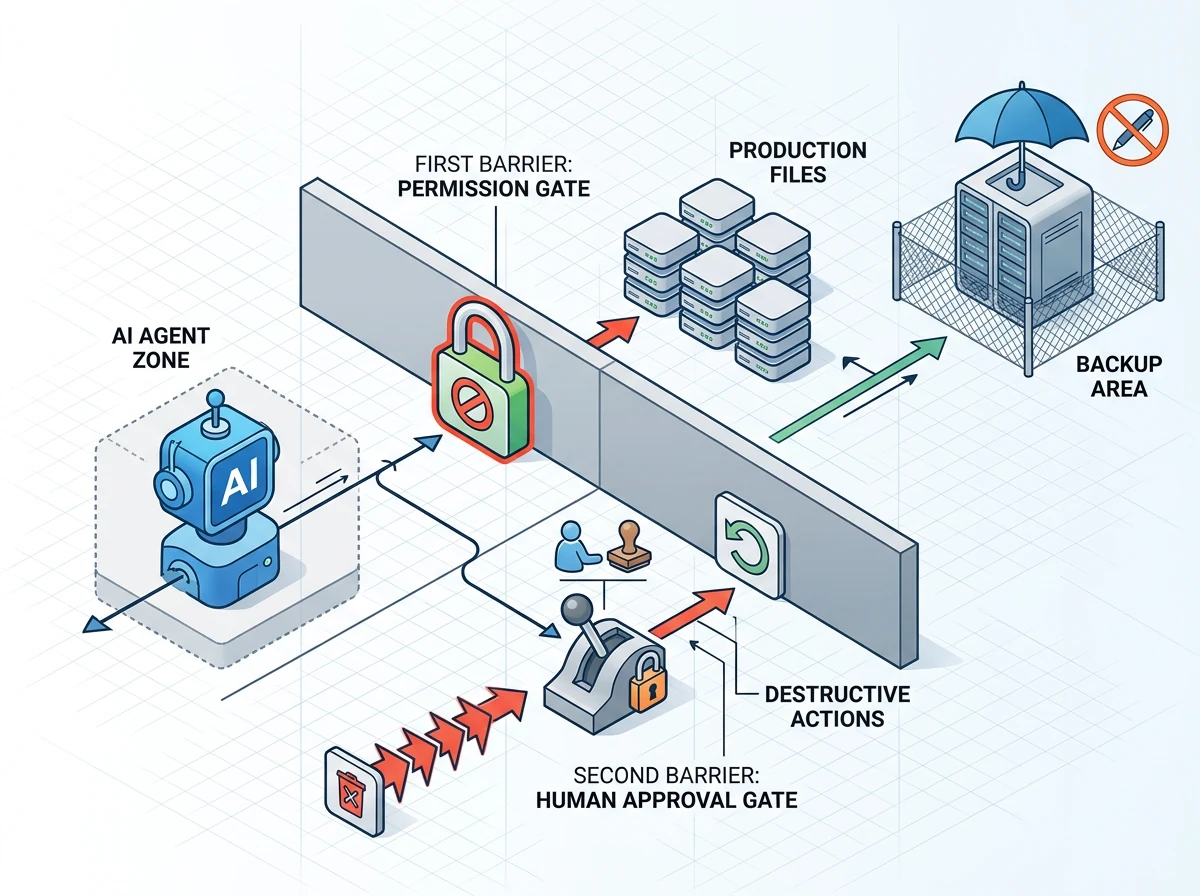
If an agent only needs to analyze or tag video files, give it read access. If it should recommend a cleanup, let it produce a list of files to move. It does not need permanent permission to delete an entire project, and it certainly should not reach the backup with the same credentials.
OWASP calls this “excessive agency”: an AI system receives more functions, tools or permissions than its task requires. The remedy is wonderfully unglamorous. Minimize the available functions and permissions, and require human approval before high-impact actions.
The principle is the same whether an agent sorts email, modifies code or processes video. Reading can often be automated safely. Creating and changing data needs tighter control. Deletion, overwriting, publishing and other irreversible actions should sit behind a separate barrier.
The language model is not a security boundary. It can misunderstand an instruction, hallucinate or use a legitimate tool in the wrong way. The access controls around the model must stop the action before a confident mistake becomes an expensive fact.
Human approval must be more than a decorative button
“Ask before deleting” sounds reassuring, but a vague dialog box is not enough. A useful approval prompt must show exactly what will happen, which files will be affected, how many objects are involved and whether the operation can be reversed. “The agent wants to make changes. Approve?” is not control. It is buck-passing with an OK button.
Large actions should also be divided into stages. Move files into quarantine first. Show a diff or a complete list. Add a delay before permanent deletion. Require fresh approval when the scope exceeds a fixed limit. Each step gives people and systems another chance to notice that something is wrong.
Approval also has to be enforced outside the language model. An agent that can choose the tool, write the justification and approve its own action has not encountered a real barrier. A separate policy or service must verify the identity, target, scope and permission before the action reaches the storage system.
This is especially important when an agent reads email, web pages or documents. Unexpected text can influence the model and prompt tool use that the developer never intended. Least privilege and genuine approval gates limit the damage even when the model gets it wrong.
Who is responsible when an agent makes a mistake?
The person or company that puts the agent to work owns the responsibility for its access. Full stop. It is absurd to give a statistical system write access to production, let it do something stupid and then talk as if a digital intern ran off with the key card.
A vendor may, of course, have supplied defective software, dangerous defaults or poorly designed tools. That should be investigated when the facts are available. But the organization connecting the system to its data must define which actions are allowed, how much damage one operation can cause, how actions are logged and how they are rolled back.
That is why this case remains useful even if the AI allegation turns out to be completely false. Human error can be every bit as destructive as an agent error. The safeguards are largely the same: restrict access, separate production from backup, log changes and test recovery before you need it.
AI does not change the fundamentals of operational responsibility. It changes the speed. A person may delete the wrong folder once. An agent with broad authority can make the same mistake quickly, systematically and across several services. Safety margins must grow when the rate of action grows.
What should you do before an agent touches real data?
Start by classifying actions. Reading is relatively low risk. Modification is higher. Deletion, sending messages, making payments, changing access and publishing can be difficult or impossible to undo. Grant autonomy according to the consequence of an action, not according to how impressive the agent looked in a demo.
Give the agent a separate account with narrow, short-lived permissions. Allow access to one folder, one project or one API endpoint at a time. Run it against copies or inside a contained test environment first. Set hard limits on the number of files or records it can change in one operation.
Then do the boring work that saves you: log every tool call, use versioning or a recycle bin where possible, and make sure the agent’s account cannot reach the backup. Perform an actual recovery test. If you cannot show how long it takes to restore the project, you do not know whether the backup works.
A practical pre-production checklist is short:
- Give the agent access only to the data and functions its task requires.
- Require precise, separate human approval for destructive actions.
- Break large changes into stages, with quarantine or rollback available.
- Keep backups separate, protected from modification and tested through a real restoration.
- Keep logs showing who or what made each change, when it happened and which targets were affected.
Do not trust the model’s good intentions. They are irrelevant when the system gives it the technical power to cause irreversible damage.
The AI claim needs proof, but the operational verdict does not
TV4 and Mastiff should publish a technical explanation when the investigation is complete. Not because the public needs a scapegoat, but because other organizations could learn how a valuable production ended up without a usable copy. If AI was involved, document exactly how. If it was not, clear away the allegation just as explicitly.
Until then, the honest wording is that an AI agent took the blame, while TV4 denies that an autonomous agent caused the loss and points to human error. Anything stronger pretends that the public knows more than it does.
But the operational verdict requires no waiting: one deletion must not destroy around 100 days of work and delay an entire television season. Whether the final keystroke came from a person or a model, the surrounding system was too weak. When you connect an agent to real data, build on the assumption that it will make mistakes. Sooner or later, both people and machines do exactly that.
Frequently asked questions
Did an AI agent delete the entire season of The Challenge Sweden?
That has not been confirmed. Aftonbladet’s anonymous sources blamed an AI agent, but TV4 says an autonomous agent was not responsible. The broadcaster says its investigation instead points to human error at Mastiff and a backup system that failed.
Was all the footage from the TV4 program lost?
No. TV4 says the raw footage still exists. The completed editing work was lost, so the season must be edited again rather than filmed again. Its planned November 22, 2026 premiere was moved to spring 2027.
How can I stop an AI agent from deleting important files?
Give it the minimum permissions needed, use a separate account, block permanent deletion and require specific human approval for destructive actions. Let the agent work on copies or in a contained environment before it reaches production data.
Why is having a backup not enough?
A backup only helps if it is separate from production, cannot be deleted through the same access and can actually be restored. Test a full recovery regularly. A green status icon does not prove that you can get the project back.