Innhold Show
YouTube Music now labels songs in which generative AI played a significant role, but the platform is not treating AI use as an offense in itself. The label gives listeners more information without automatically reducing recommendations or a creator’s eligibility to earn money.
That distinction matters. AI music has moved from curiosity to industry, and streaming services need to separate creative use from mass uploading and outright streaming fraud. Pretending they are all the same is about as precise as calling both a camera and a photocopier “machines that make pictures.”
I make AI music myself and use tools including Suno through its API. That is why I like the basic approach: tell people what they are hearing, but do not judge the music solely by the tool used to make it. Quality, rights, disclosure, and fraud still need to be considered separately.
How does YouTube Music label AI-generated songs?
YouTube Music began rolling out a new label directly on the playback screen on October 14, 2026. YouTube describes the system as a way to show when generative AI played a significant role in a song, such as generating its composition or vocals.
Tapping the label opens a menu with more information about how AI was used. The labels are also coming to the regular YouTube app. This is not just a small detail buried inside YouTube Music, but a shared direction for music across YouTube’s two major playback surfaces.
YouTube works with music partners and also uses its own detection systems. The information does not come from one magical AI detector that is always right. The system combines disclosures from those delivering the music with technical signals and YouTube’s own assessments.
Three metadata categories separate generated music from AI assistance
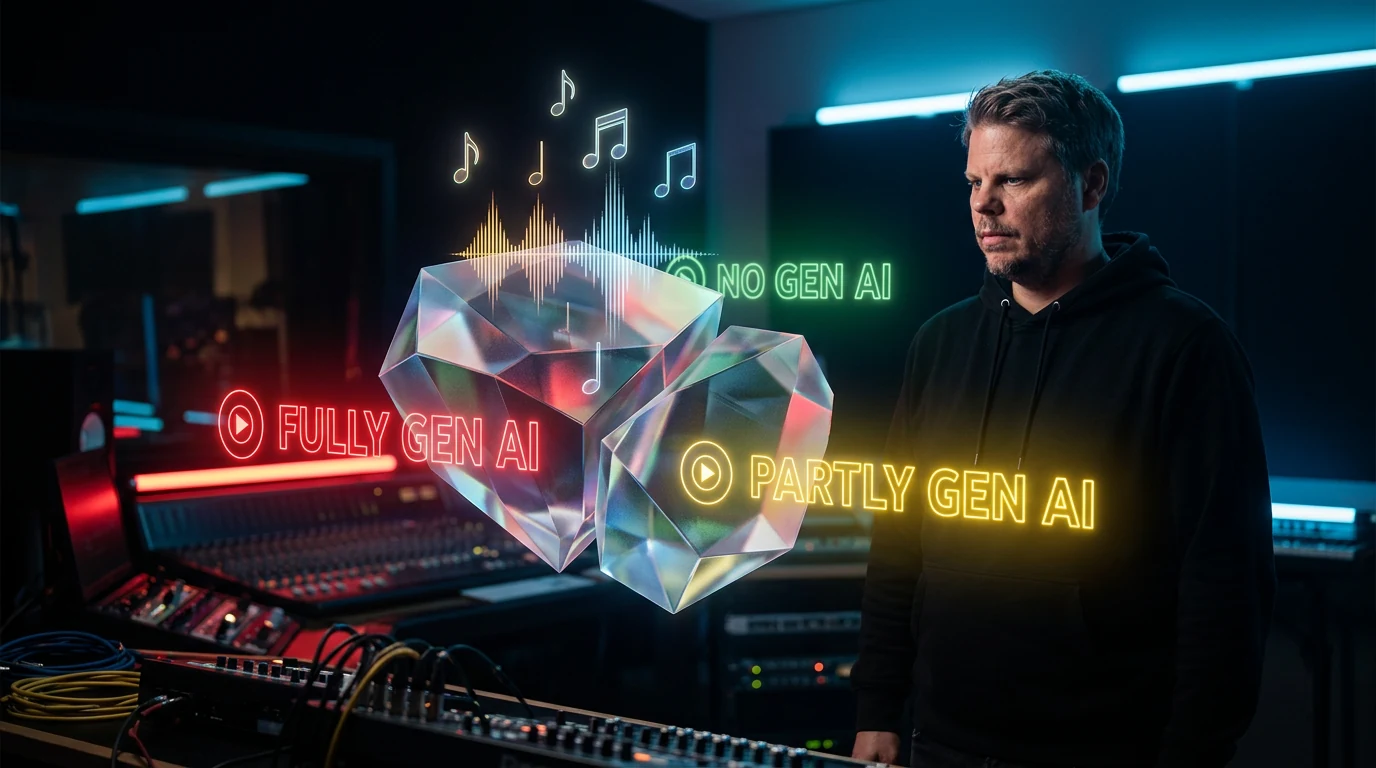
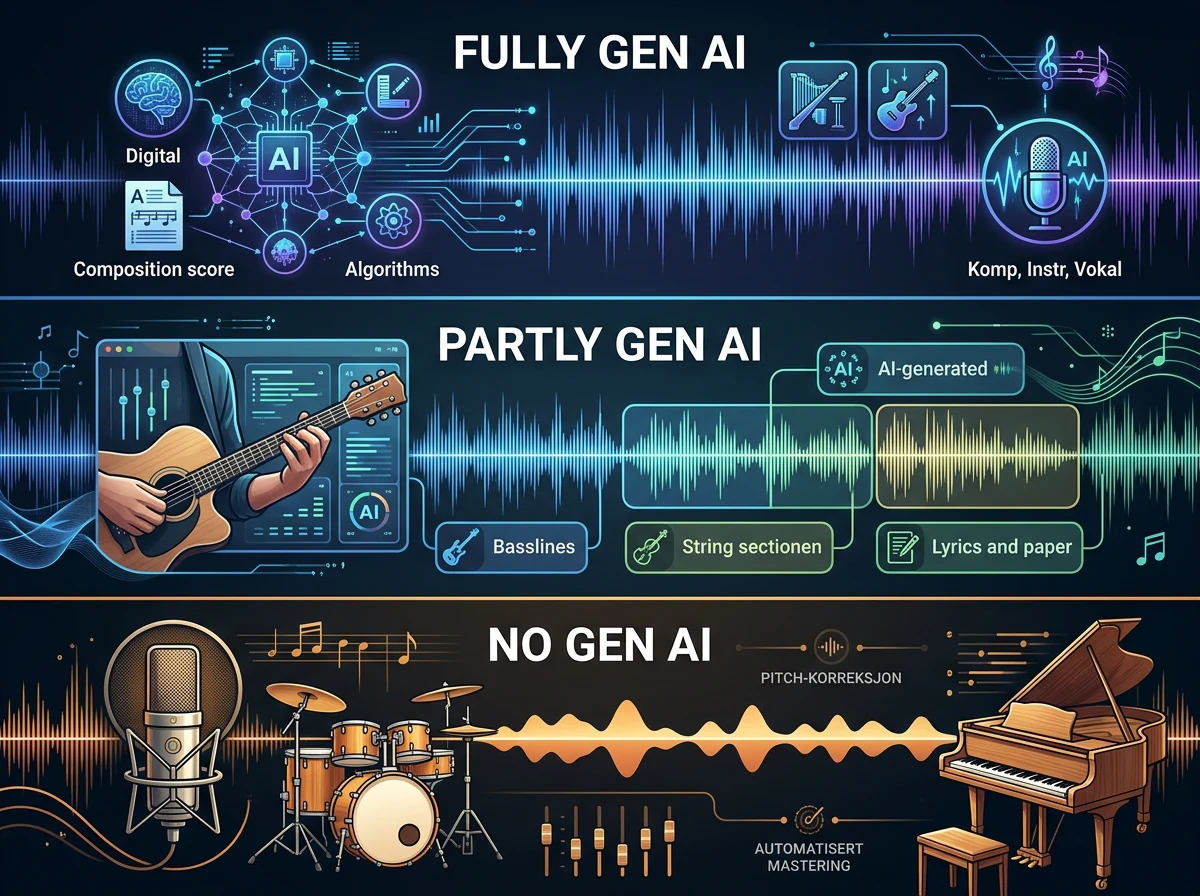
YouTube’s guidance for music partners uses three metadata categories: “Fully Gen AI,” “Partly Gen AI,” and “No Gen AI.” In practical terms, they mean fully AI-generated, partly AI-generated, or no generative AI in the content itself. These are partner disclosures supplied to YouTube, not necessarily three separate public badges shown to listeners.
A song counts as fully AI-generated when its composition, instruments, and vocals were made with generative AI, even if the creator wrote many prompts and went through several iterations. Partly AI-generated music includes cases such as an AI-generated bass line or string section combined with human vocals and instruments. YouTube also places AI-generated parts of lyrics or melodies in this middle category.
The dividing line is not simply whether a computer touched the production. Standard pitch correction on a human vocal and automated mastering are examples that YouTube places under “No Gen AI.” Sensible. Otherwise, almost all modern music production would be shoved into an AI sack that explains absolutely nothing.
The AI label is not a ban or a penalty
The most important point for creators is that a label alone does not make a song ineligible for revenue or recommendations. YouTube says explicitly that disclosure labels by themselves do not limit a video’s audience or its eligibility to earn money.
That does not mean anything goes. YouTube’s normal rules still apply, and missing or inaccurate disclosures can have consequences. Repeated failure to disclose realistic AI-generated or meaningfully altered content can lead to YouTube applying a label itself, removing content, or suspending a channel from the YouTube Partner Program.
The point is that the platform separates the tool from the behavior. An original AI song is not automatically spam. A mass-produced track used to manipulate streams does not become legitimate just because somebody labeled it neatly. This distinction should be obvious, but the streaming business has taken its time getting there.
The same basic principle runs through YouTube’s wider AI rules: labeling, visibility, and monetization are separate decisions. A label gives the listener information. It is not a copyright clearance certificate, a promise of monetization, or a digital pillory.
Why are these labels arriving now?
The volume has become impossible to ignore. Deezer reported in July 2026 that it was receiving about 90,000 fully AI-generated tracks every day. On peak days in June, those tracks accounted for more than half of all new uploads.
That number makes it sound as if the robots have seized the entire stereo, but listening tells a different story. Deezer said fully AI-generated music represented only 1 to 3 percent of streams. Upload volume and actual demand are two very different things.
Deezer has taken a stricter line than YouTube. AI-detected tracks are removed from algorithmic recommendations and editorial playlists, while manipulated streams are excluded from royalty calculations. Deezer also reported that as much as 85 percent of streams on fully AI-generated tracks in 2025 were fraudulent.
That documents a real spam problem. It does not mean that 85 percent of all AI music is fraudulent. The figure applies to streams of fully generated tracks detected by Deezer, on one service and during one defined period. That distinction needs to stay attached to the number, or a dramatic statistic does more harm than good.
What should AI music creators do?
First, get the metadata right. If you deliver music to YouTube through a distributor or partner, you should know whether generative AI created the entire recording, specific parts of it, or none of the content itself. Do not guess “No Gen AI” just because you hope the label will disappear.
If you wrote prompts, chose between versions, and downloaded a finished song from a music generator, YouTube still considers the result fully AI-generated. If you used an AI-generated bass line and built a recording around it with your own vocals and instruments, “Partly Gen AI” is the natural category. Ordinary Auto-Tune on a recorded human vocal is not enough to make a song AI-generated.
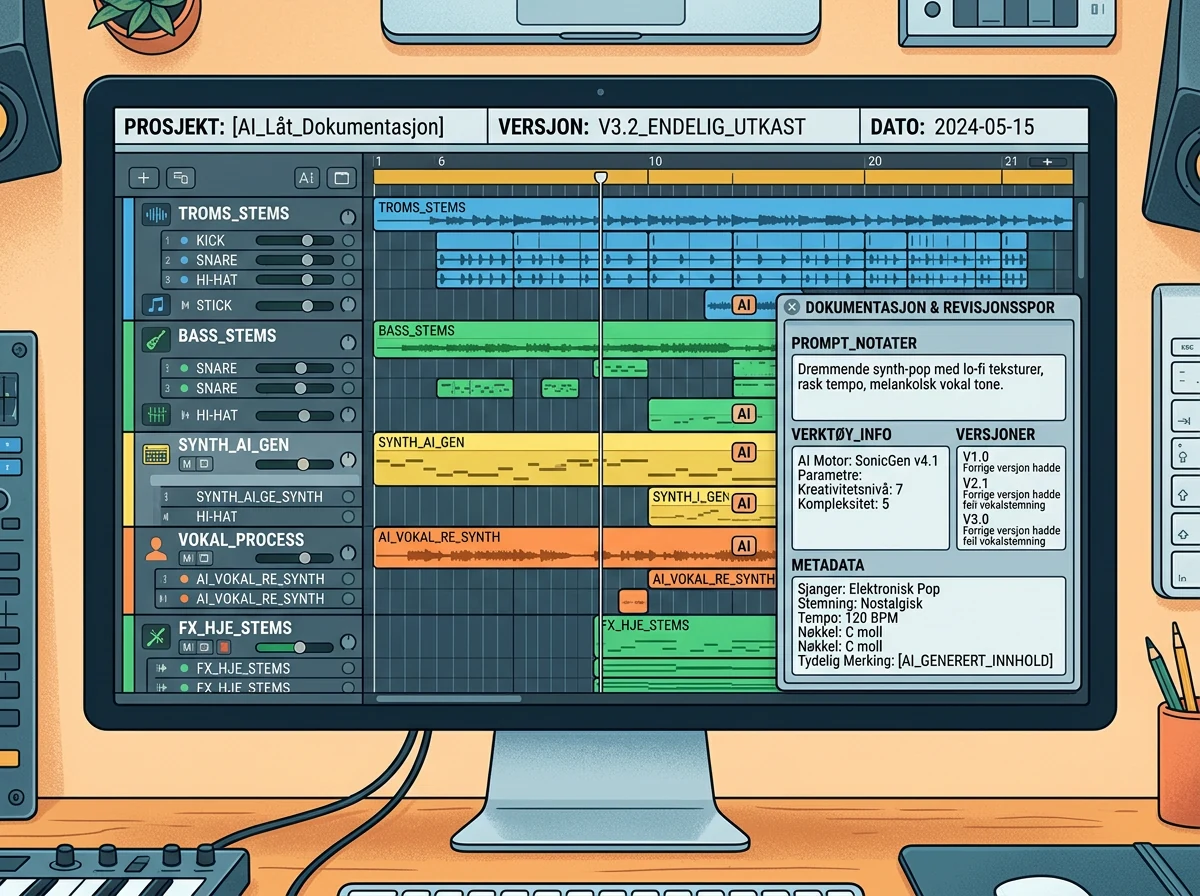
This is also a good reason to keep project files, stems, drafts, and records of the tools you used. YouTube does not require everyone to upload a small forensic archive with each song, but documentation makes it much easier to correct a mistaken label or explain the production process later.
And do not try to hide the AI use. That is a short-term answer to a problem that only becomes more expensive as platforms get better at reading metadata and audio signals. Disclose what was actually used, keep the records, and let the music compete on whether people want to hear it again.
What does the label mean for listeners?
You get more information, not a ready-made quality filter. Tapping the label should tell you whether AI played a significant role, but it does not tell you whether the song is good, whether its rights are in order, or whether the artist spent five minutes or five months on it.
The information is still useful. If you want to support human performers, it may influence what you play. If you are curious about AI music, it becomes easier to understand what you are actually hearing. And if an “artist” with a polished profile picture and 300 new songs a week suddenly appears, you should not need to dig quite as far to understand the setup.
For now, YouTube has not announced a dedicated filter that removes all AI music from search or recommendations. The labels offer transparency, but not necessarily complete control over what appears. Such a filter may arrive later, but it is not part of this launch.
The labels do not solve the hardest problem
The biggest weakness is obvious: the system depends on partners providing accurate information and automated signals catching the rest. If a partner does not supply AI data, the content remains unknown unless YouTube can classify it through other signals.
The boundaries can also get messy in real production work. YouTube treats lyrical brainstorming and AI assistance with a verse as “Partly Gen AI,” while automated mastering belongs under “No Gen AI.” Between those examples are hundreds of workflows in which a model suggests something, a human edits it, and another tool processes it again.
Even so, this is a better starting point than a simple “AI or not AI” stamp. Modern music exists on a spectrum, and three categories at least make room for both fully generated songs and human-made music with limited AI assistance. It will not be perfect. It may be useful.
My verdict is simple: YouTube is right to demand transparency without treating AI as guilt in itself. Now the company needs to apply the labels accurately, punish fraud as fraud, and let listeners decide what they actually want to hear. The label should help us understand the music – not pretend it can determine the music’s value.
Frequently asked questions
Does YouTube Music demonetize AI-generated songs?
No, not simply because they were made with AI. YouTube says an AI disclosure label alone does not limit a video’s audience or eligibility to earn money. The platform’s normal rules on rights, spam, fraud, and content still apply.
What is the difference between fully and partly AI-generated music?
Fully AI-generated means generative AI created the complete content, including composition, instruments, and vocals. Partly AI-generated means AI created specific elements, such as a bass line, vocal, lyric, or melody, while humans supplied other substantial parts.
Does a song need an AI label if it uses Auto-Tune?
No. YouTube’s guidance places ordinary pitch correction of a human vocal under “No Gen AI.” The same applies to automated mastering that adjusts elements such as equalization, compression, and the overall balance of a human-made recording.
Can I filter all AI music out of YouTube Music?
Not through a dedicated filter in this launch. YouTube Music displays a label and more information on the playback screen, but YouTube has not announced a switch that hides all AI-generated music from search results and recommendations.