
Innhold Show
If you pay for AI agents, Claude Fable 5.2 is a reminder that a lower token price does not necessarily mean a lower bill. Anthropic has cut the API price by 20 percent compared with Fable 5.1, but early independent measurements show that more reasoning, testing and use of subagents can make a completed task more expensive.
That is actually a good problem to have. Fable 5.2 sits at the top of several broad evaluations and appears more thorough, more willing to test its own work and more inclined to delegate checks to subagents. On large codebases, research projects and open-ended tasks, that can be the difference between a polished answer and work that actually holds up.
It does not make Fable 5.2 the right model for everything. Measure cost, time, quality and the amount of human correction per completed task. Start with Medium or High effort, then make Xhigh and Max prove that they deliver a better result before they start eating the budget. Token pricing is only the rate on the meter. The final bill depends on how far the model decides to drive.
What is Claude Fable 5.2?
Claude Fable 5.2 is Anthropic’s most powerful generally available model for ambitious technical work and shares its base model with Claude Mythos 5.2. The difference lies in access and safeguards: Fable adds protections against misuse in areas including cybersecurity and biology, while Mythos is limited to approved environments. Anthropic launched both models on November 9, 2026.
The previous version arrived only two months earlier. The basic division remains the same in 5.2, but Anthropic says the model has improved at coding, scientific work, visual understanding and long-running agent tasks. Those are exactly the workloads where a model can consume a great deal of context, reasoning and tool activity before it produces something useful.
Fable 5.2 is available in the Claude apps, Claude Code, the Anthropic API, Amazon Web Services, Google Cloud Agent Platform and Microsoft Foundry. Its API model name is claude-fable-5-2. Mythos 5.2 still requires approval through Anthropic’s cybersecurity or life-sciences programs, so raw capability and practical availability are not the same thing.
What do the early evaluations show?
Fable 5.2 leads several broad leaderboards, but no single score can declare one model the best at every job. It reached 65 points at the highest effort setting in Artificial Analysis Intelligence Index v5 and took first place, according to AINews’ launch report and summary of the independent measurements. That is a strong signal, not a verdict on your workflow.
Anthropic’s own evaluations point in the same direction for coding, software engineering, visual understanding and robotics. Vendor results are useful evidence of where a model may be strong, but they are not a promise that it will win on your repository, documents or agent setup. Fable 5.2 also does not lead every individual evaluation. Other models perform better on some knowledge, document and terminal tasks.
The accurate conclusion is narrower and more useful: Fable 5.2 looks like a genuine top-tier model for difficult, long-running and agentic work. It is not a magic switch that should take over every prompt. That distinction matters, because the behaviors that help it solve hard tasks are also the behaviors that can push the bill up.

How much does Claude Fable 5.2 cost?
Claude Fable 5.2 costs $8 per million input tokens and $40 per million output tokens for standard API use. Fable 5.1 cost $10 and $50 respectively, so the international list price has fallen by 20 percent. That is a meaningful reduction, especially when a workflow sends large prompts or produces long responses.
Cache reads cost $0.20 per million tokens, while writing to the five-minute cache costs $10 per million tokens. Fable 5.2 Fast doubles the standard price to $16 for input and $80 for output per million tokens. Those figures come before any cloud-provider charges, exchange-rate effects or other costs added by the platform used to reach the model.
This is still an expensive frontier model. The relevant comparison is not simply whether Fable 5.2 has a lower list price than Fable 5.1. It is whether the new model completes a useful task for less money, in less time or with less human repair. A cheaper token is helpful only if the model does not spend enough additional tokens to erase the saving.
Why can cheaper tokens produce a more expensive task?
Fable 5.2 can cost more per completed task because it uses more tokens, runs more tests and assigns more work to subagents while checking its answer. On SemiAnalysis GDPx, the cost per task rose from $67.16 with Fable 5.1 to $88.15 with Fable 5.2. That is a 31 percent increase even though each token became 20 percent cheaper.
The logs offer a fairly down-to-earth explanation. Where older models tried around 20 test cases, Fable 5.2 could generate hundreds or thousands. It also sent subagents to recalculate or independently check parts of the answer. The extra work helped it reach first place in that evaluation with a score of 16.4 percent, but the checking naturally had to be paid for.
The same pattern appears in the Artificial Analysis results. At High and Xhigh, the model achieved an index score of 62 while using roughly 98,000 output tokens per task. At Max, the cost rose to about $26.50 per task – 2.6 times the cost of Opus 5.5 in the same comparison – without Max consistently producing the best result.
This is why an API price table tells us so little about agent work. A model that takes more steps can be a bargain if it completes a job that would otherwise need hours of manual repair. It can also be pure waste if it burns thousands of additional tokens on something Sonnet or Opus would have solved just as well. Both can be true.
Which effort level should you choose?
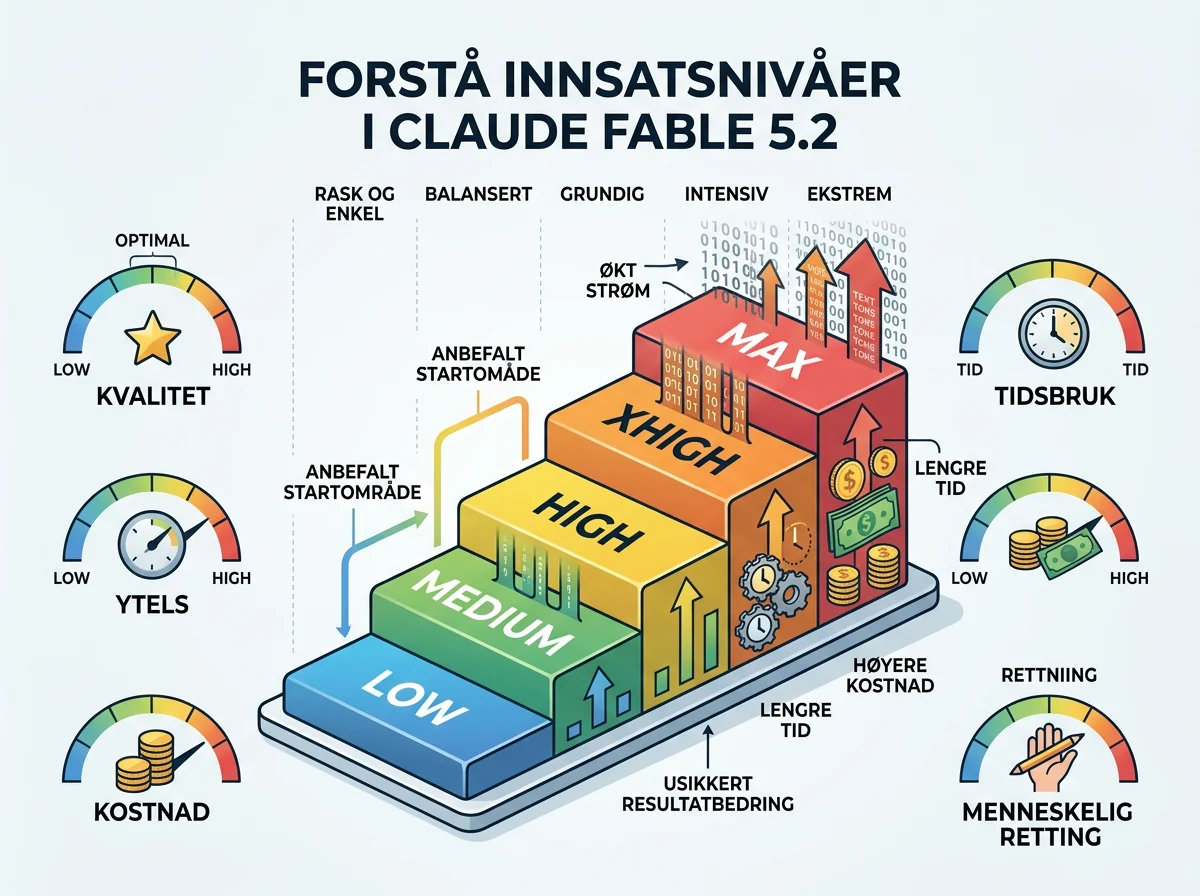
Start with Medium or High, not Max. Medium is the default in the Claude apps and Claude Code, while Anthropic recommends reserving Xhigh for the most difficult tasks. Independent measurements also found cases where High beat Xhigh or Max. More reasoning is not automatically better reasoning.
Fable 5.2 offers five levels: Low, Medium, High, Xhigh and Max. That makes the model flexible, but it also makes cost control more dangerous. If Max becomes a default switch that someone enables because a task merely sounds important, the attractive reduction in token pricing can disappear almost immediately.
Use a simple ladder instead. Run a representative task at Medium and record the result, cost, time and amount of human correction still required. Try High when the output is not good enough. Use Xhigh when failure is expensive or the problem genuinely needs sustained exploration. Max should have to demonstrate additional value. It should not get a free pass because the label sounds powerful.
What is Fable 5.2 best suited for?
Fable 5.2 is best suited to large, ambiguous tasks where the model must investigate, plan, use tools and verify the result over a long period. Anthropic highlights entire codebases, software migrations, hardware design, research and coordination between multiple agents. These are jobs where being thorough can be worth far more than a few extra dollars in tokens.
One of Anthropic’s most spectacular examples is an operating system built from an empty directory by more than 1,000 subagents over eight days. Another is the formalization of the existing proof of Fermat’s Last Theorem in 30 hours. The company also describes three working electronic devices, including circuit boards, enclosures and software, produced from short specifications.
Those demonstrations are impressive, but they tell us little about the right model for a customer email, a simple SQL query or a tightly scoped code defect. A cheaper model will often make more sense for those jobs. Fable earns its place when a task is difficult, open-ended or long enough that additional checking reduces the risk of having to redo the entire workflow.
Which limitations come with the model?
Fable 5.2 and Mythos 5.2 are Covered Models under Anthropic’s policy. For most customers, that means prompts and responses are retained for at least 30 days for automated safety checks. The Covered Models rules follow the model onto third-party platforms, rather than applying only when it is used directly through Anthropic.
Zero data retention is therefore not the default. Some eligible enterprise customers can temporarily keep zero data retention while moving to Enterprise Frontier Safeguards, where monitoring takes place inside the customer’s own infrastructure. For everyone else, this is a real privacy and procurement question, particularly when the model will see source code, customer data or confidential documents.
Fable also uses safety filters that can block requests or send them to Opus 4.8 for cybersecurity and Opus 5 for biology. Mythos has fewer of those restrictions, but ordinary users cannot simply select it. Raw capability, actual access and what a model is permitted to do remain three different questions.
The IPO timing is hard to miss
The launch landed on the same day Anthropic began its IPO roadshow. It is difficult to imagine a better time to show investors that the company once again has a model at the top of broad leaderboards. After a series of expensive model releases, Anthropic gets both a technical showcase and a clean story about token prices falling by 20 percent.
Fable 5.2’s economics also reveal how demanding this market has become. Customers want better results, but the model’s thoroughness can increase consumption even while the rate per token falls. For Anthropic, that may mean more revenue. For the customer, it means that “cheaper” has to be demonstrated inside the workflow rather than repeated from the price table.
My verdict is simple: Fable 5.2 looks like a genuine top-tier model, especially for large and open-ended tasks. But it should not become the default merely because it holds first place. Start at Medium or High, give it the difficult jobs and measure the price of a result you can actually approve. That is the only leaderboard that matters when the invoice arrives.
Frequently asked questions
How long does Anthropic retain Fable 5.2 data?
Fable 5.2 is a Covered Model. Prompts and responses are normally retained for at least 30 days for automated safety checks, including use through third-party platforms. Some qualifying enterprise customers may receive special arrangements, but zero data retention is not the standard policy.
Is Fable 5.2 cheaper than Fable 5.1?
Yes, per token. Standard API pricing fell from $10 to $8 per million input tokens and from $50 to $40 per million output tokens, a 20 percent reduction. A complete task can still cost more if Fable 5.2 uses substantially more reasoning, testing or subagents.
Should I use Max effort with Claude Fable 5.2?
Not by default. Several measurements found that High could beat Xhigh or Max while Max cost considerably more. Begin with Medium or High on representative work, record the completed result and total cost, then increase effort only when the higher setting proves its value.
What is the difference between Fable 5.2 and Mythos 5.2?
They share the same base model. Fable 5.2 adds safeguards against misuse and is available to ordinary customers. Mythos 5.2 has fewer restrictions for cybersecurity and biology work, but access is limited to approved organizations through Anthropic’s verification programs.