Innhold Show
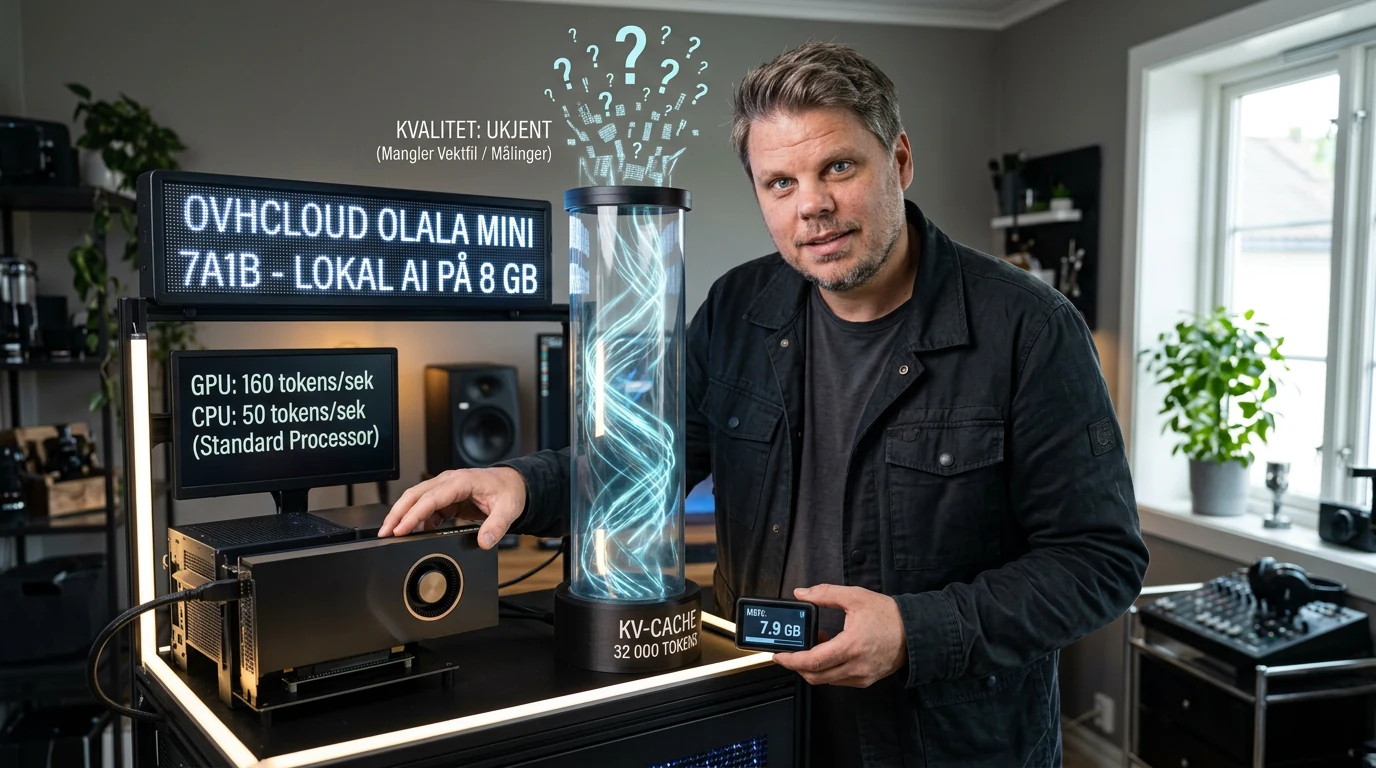
Olala mini 7A1B is OVHcloud’s first in-house language model, designed to run locally on far less hardware than its total size might suggest. OVHcloud says it needs as little as 8 GB of GPU memory, reaches 160 tokens per second on an Nvidia RTX A4500 and can still deliver 50 tokens per second on an ordinary processor.
Those numbers make the model genuinely interesting for developers, small businesses and enthusiasts. A fast local model that does not require an expensive graphics card could run on far more machines than the large models that need a small power station under the desk.
Speed is only half the equation, though. OVHcloud had not published results showing how good the model’s answers were, and the weights were not available when the announcement appeared on November 17, 2026. Olala mini is therefore a promising architecture and a launch worth watching – not a model I can recommend on documented quality yet.
What is Olala mini 7A1B?
Olala mini 7A1B is a language model with 7 billion parameters in total but only 1 billion active parameters for each request. According to OVHcloud’s November 17 announcement, the work is distributed across 256 experts in every layer.
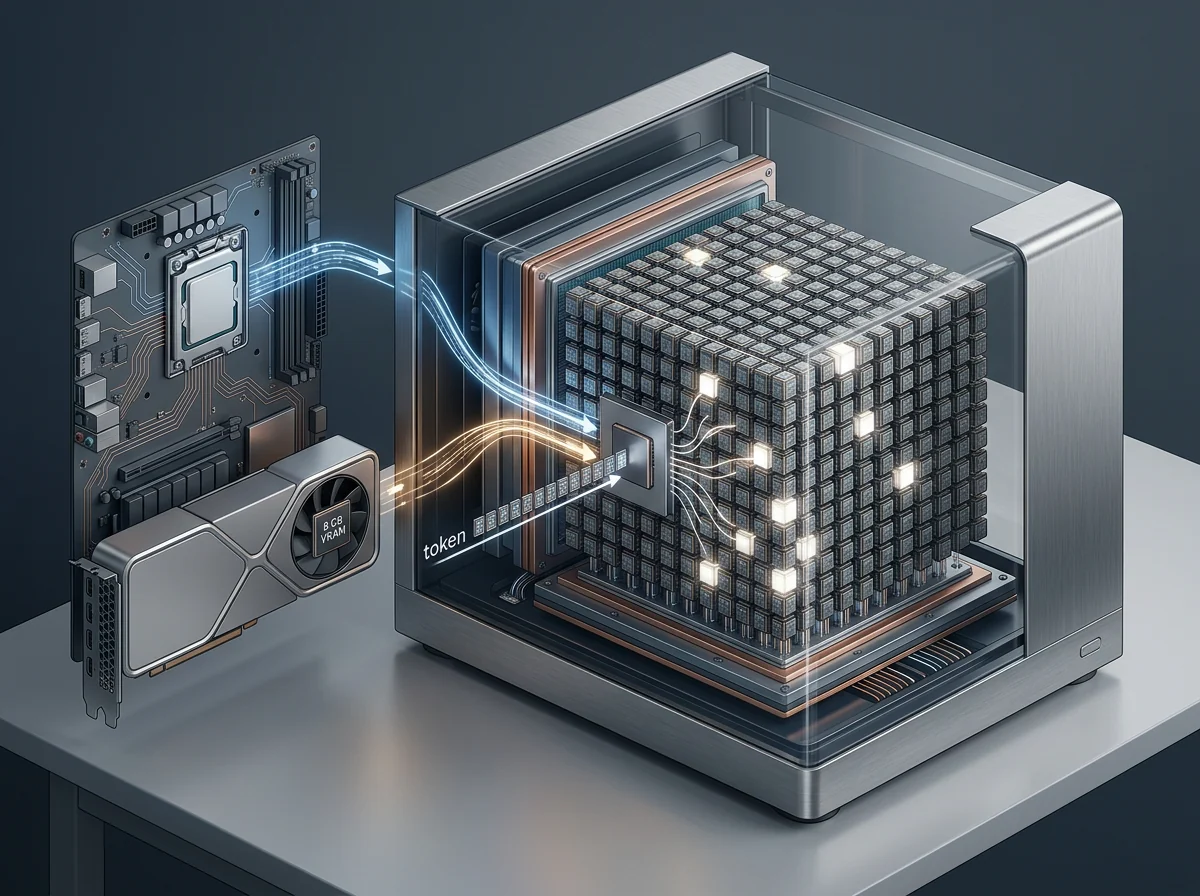
That makes it a Mixture-of-Experts model, usually shortened to MoE. Instead of sending every token through the entire model, the system routes it to a small selection of the available experts. The idea is to provide more total capacity without paying the full memory and compute cost for every part of the model on every answer.
The name 7A1B describes exactly that split: about 7 billion parameters available and roughly 1 billion active at a time. It does not automatically make the model as capable as a dense 7B model or as fast as a dense 1B model. The architecture tells me how much of the network is working, not how well it does the job.
OVHcloud also combines Differential-TPA with Mamba-3 in a hybrid attention architecture. In plain English, the model mixes token attention with a more stream-oriented way of processing sequences. The goal is lower memory use and high throughput, particularly as the input becomes longer.
How little hardware does the model need?
OVHcloud lists 8 GB of GPU memory as the minimum and claims 160 tokens per second on an Nvidia RTX A4500. More strikingly, it says the model can reach 50 tokens per second on a CPU without a GPU. All three figures come from OVHcloud and had not been independently verified at the time of the announcement.
Fifty tokens per second on a CPU is fast enough for text to appear more quickly than most people can read it. If that result holds on readily available hardware, with a useful context length and without the answer quality collapsing, Olala mini could be a strong fit for local assistants, background tasks and small agents where cost and privacy matter more than maximum intelligence.
Important details are missing. The announcement does not name the CPU that delivered 50 tokens per second, the context length used in the test, the number of concurrent users or the inference settings. “Standard processor” is not a reproducible hardware specification. It is a conveniently round phrase in a press release.
The 8 GB claim also needs a proper explanation. OVHcloud describes the model as BF16, while 7 billion BF16 parameters would normally require more than 8 GB for the weights alone. MoE reduces the computation performed for each token, but all the experts usually still need to be stored somewhere. The technical report will need to show whether OVHcloud streams experts from system memory, uses compression or relies on another architectural choice to make the number work.
What does a 32,000-token context mean?
The first release of Olala mini is set to support a 32,000-token context window. That is enough for many conversations, documents and bounded agent tasks, although it is far below the largest context windows on the market. OVHcloud plans a version 1.1 with 128,000 tokens and improved mathematical reasoning before the end of 2026.
Context length is not the same as good understanding across the whole context. A model may technically accept 32,000 tokens and still miss key details, mix facts together or become noticeably less reliable near the limit. That has to be measured once the model and its report are actually available.
For local use, 32,000 tokens is still a sensible starting point. Long contexts consume memory through the KV cache, which does not sit comfortably beside a promise to run on small machines. I would rather see a model use 32,000 tokens well within a realistic memory budget than advertise an enormous limit that few people can use locally.
Is Olala mini open?
OVHcloud says Olala mini will be released on Hugging Face under the Apache 2.0 license. The planned release includes model weights, the pretrained base model, a technical report and documentation related to the EU AI Act. Apache 2.0 is a permissive license that generally allows modification and commercial use.
The words “will be released” matter. On November 17, the model was not visible among OVHcloud’s models on Hugging Face. The official launch was scheduled for the OVHcloud AI Summit on November 19. Until the files appear, this is a promised open-weight release – not a model readers can download and inspect.
When the weights arrive, the report will be almost as important as the download. It should explain routing among the 256 experts, the memory arrangement behind the 8 GB claim, the test machine behind the CPU result and the datasets used to measure quality. Without those details, other people can repeat the marketing but not the measurements.
Open weights and Apache 2.0 are still a good foundation. Local models become more useful when developers can run them offline, adapt them and build them into their own systems without being locked to a single API provider. The promised hardware threshold makes this release especially appealing – provided the performance and quality claims survive contact with independent testing.
What do we know about its quality?
Very little, so far. OVHcloud had not published comparable results for reasoning, coding, instruction following, tool use or long-context performance. That makes it impossible to place Olala mini fairly against other small local models.
The company says Qwant already uses the model to produce short answers in its search engine. According to OVHcloud, responses became 20 percent faster while operating costs fell to one-third of what Qwant paid with its previous model. That is a meaningful production signal, but OVHcloud does not identify the comparison model, the quality threshold or the measurement method.
Faster and cheaper answers are not necessarily better answers. A small model can be excellent for a search feature if it receives good sources and only needs to produce a short summary. That tells us much less about how it handles code, difficult reasoning or autonomous agent runs.
This is why throughput should never stand alone. A model delivering 160 tokens per second is useless if it merely produces mistakes at high speed. At the same time, Olala mini does not need to beat much larger models on every test to be valuable. If it is good enough at bounded tasks, low memory use and high speed may matter far more than a pretty position on a general leaderboard.
How was Olala mini trained?
OVHcloud says it trained Olala mini from scratch on the European supercomputers JUPITER, MeluXina and Jean Zay, using Nvidia GH200, A100 and H100 GPUs. The company values the public compute resources used for the project at €7 million.
That is a substantial amount of compute for a model that activates only 1 billion parameters at a time. This is OVHcloud’s first model family, however, so the work also builds a team, training platform and institutional knowledge that can support later releases. The company has created a dedicated Agentic Lab named OVHai LLM.
The roadmap goes well beyond the mini model. Version 2.0 is supposed to exceed 100 billion parameters, with variants aimed at enterprise agents, cloud DevOps and cybersecurity. OVHcloud also wants to use future models in an encrypted version of OVHai Workspace that can run directly on a workstation.
It is ambitious, but roadmaps are not products. Olala mini first has to show that OVHcloud can deliver capable weights, understandable documentation and reproducible measurements. Then the company can talk credibly about models with more than 100 billion parameters.
Who should pay attention to this model?
Olala mini is most relevant to people who want to run many simple and moderately demanding text tasks locally. That might include classification, summarization, retrieval over private sources, document processing or small agents that call tools within clearly defined boundaries.
Small models become increasingly useful when they can perform one bounded job quickly and cheaply. Olala mini wraps its active billion parameters in a larger expert architecture that could, in theory, provide more specialized capacity without forcing every request through the entire model.
Businesses handling sensitive data may also benefit from running a model without sending text to an external API. Local execution does not solve security by itself, though. The model still has to be tested for prompt injection, unintended data leakage, incorrect tool calls and poor answers before it receives access to internal systems.
The sensible response is curiosity with one hand on the brake. Watch the November 19 launch, read the report and wait for measurements from people who have actually run the weights. If the 8 GB and CPU figures can be reproduced without sacrificing quality, OVHcloud may have built something genuinely useful. If not, it has so far produced a remarkably fast press release.
Frequently asked questions
Can Olala mini run without a graphics card?
OVHcloud claims Olala mini can reach 50 tokens per second on an ordinary processor without a GPU. The company did not specify the CPU or full test setup, so the result should be treated as a vendor claim until the weights and technical report can be checked.
Can I download Olala mini now?
Not when the announcement appeared on November 17, 2026. OVHcloud said the weights, base model and report would be published on Hugging Face under Apache 2.0, with the official launch scheduled for November 19.
Is Olala mini good for coding and AI agents?
That was not documented at announcement. OVHcloud describes Olala as an agentic model family but had not published comparable quality results for coding, tool use or agent tasks. The technical report and independent practical tests will have to answer that question.
What does 7A1B mean in the model name?
It means the model has about 7 billion parameters in total and activates roughly 1 billion for each request. Expert routing reduces the computation required per token, but the name alone says nothing about the quality of the resulting answers.