
Innhold Show
If you make games, films or interactive prototypes, Google Genie 4 offers a glimpse of a seriously powerful workflow: you can move through an AI-generated world, change it with text while it is running and hear it react in real time.
This is a significant step for world models. Google has improved photorealism, physics, human movement and consistency over time, but the real advance is how those pieces work together. You can change the weather or camera angle, add a person or object in the middle of a simulation, and the model tries to keep the rest of the world intact.
Genie 4 is still a research preview, not a finished production tool. Even so, it points rather clearly toward something more consequential than another AI video model: simulations for rapid game prototypes, film planning, interactive learning and, eventually, training robots and AI agents.
What is Google Genie 4?
Google Genie 4 is a world model that generates an interactive simulation frame by frame and sound by sound. According to Google DeepMind’s October 27, 2026 announcement, users can navigate with standard keyboard and mouse controls and change the world with natural-language instructions while it runs.
A world model tries to represent what happens next when something moves, collides, responds to weather or reacts to a user. It cannot simply draw a pretty next frame. It has to keep track of the space, the objects, the actions and their consequences. That makes an interactive world a much harder problem than a short video clip.
Google says the model builds on capabilities from the Gemini family. Gemini Omni helps anchor the simulation in real-world appearance and behavior, while other Gemini models provide the reasoning needed to preserve coherence and continuity. Google is connecting specialized models into a system instead of pretending that one model should do absolutely everything.
You can change the world while it runs
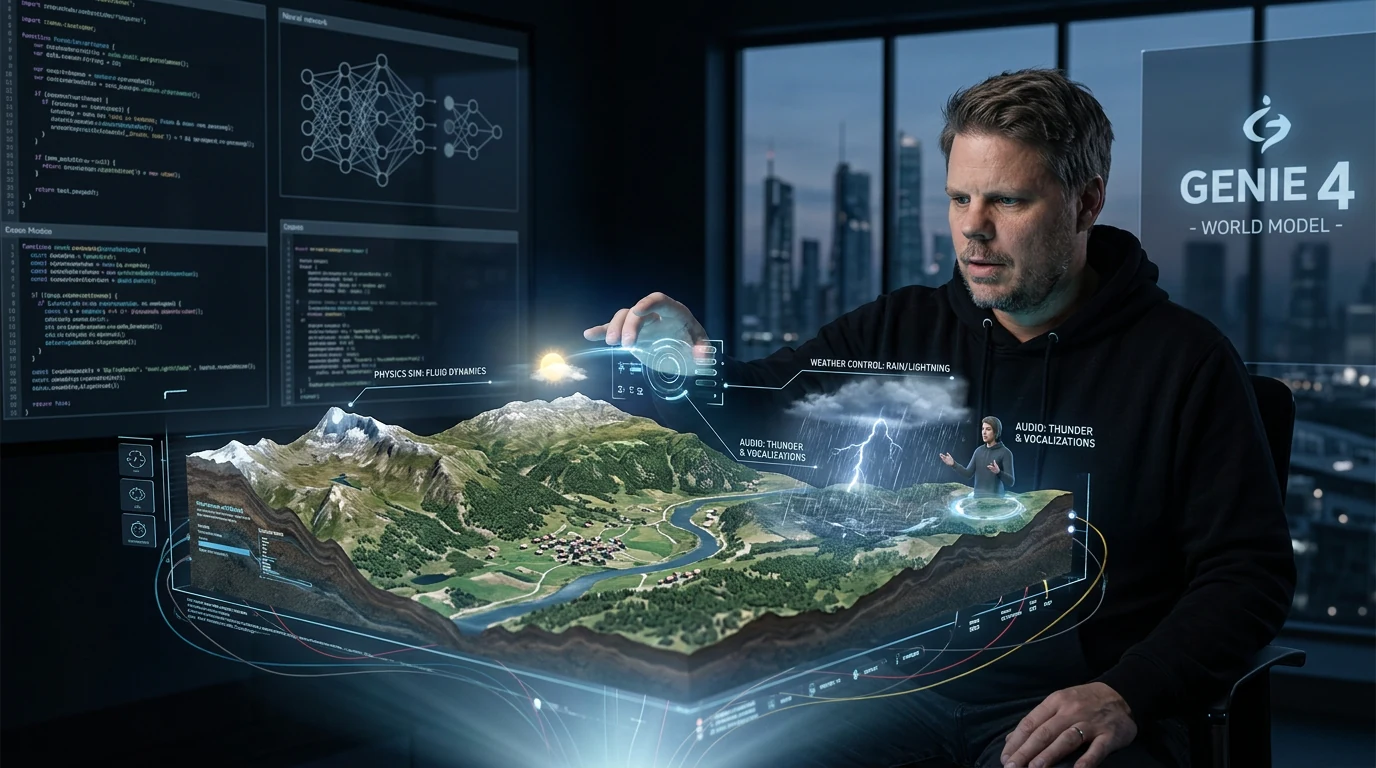
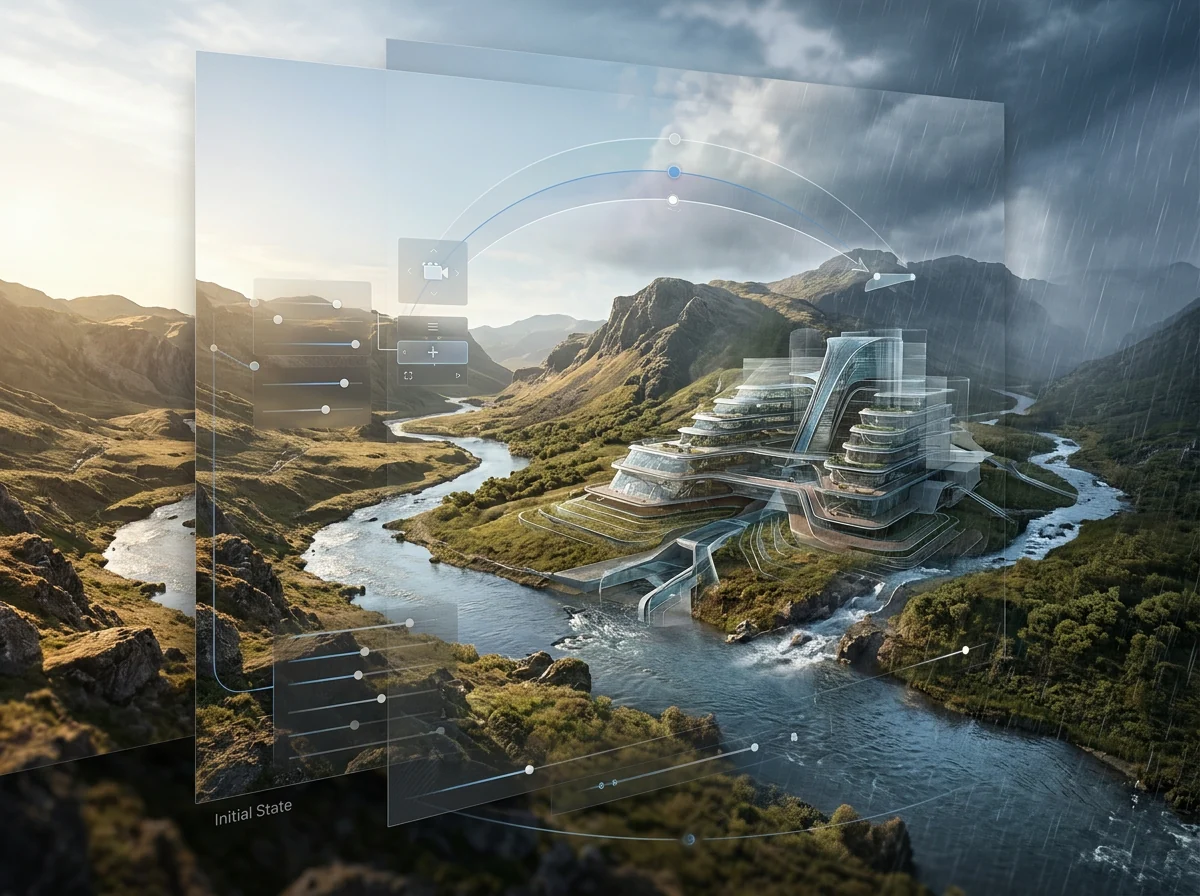
Real-time steering is the most practical new capability. You can tell the system to change the weather, move the camera or introduce a new person or object without restarting the entire generation. Gemini interprets the request in the context of the existing scene and checks new frames as the world develops.
That is the difference between watching a generated sequence and working inside a simulation. A filmmaker could try another camera angle or change the light while the idea is still fresh. A game developer could explore a mechanic before a complete level exists. In theory, a teacher could let students move through a historical scene instead of showing them a static image.
According to TechCrunch’s report on Genie 4, the model can maintain a consistent scene for up to two minutes. That is twice the limit of Genie 3. Two minutes may sound modest, but a real-time model must remember far more than the current view. An object should preferably still exist when you turn around again. Generative worlds have had an unfortunate habit of behaving like a dream after too much late-night food.
Native audio makes the simulation feel alive
Genie 4 is Google’s first world model to generate audio natively in real time. It creates ambient sounds such as wind and water, but it can also produce music and interactive dialogue that respond to events in the world. The soundtrack is part of the simulation rather than something pasted on afterward.
Interactive dialogue is especially exciting. A character can speak and react when the user takes an action or gives a new instruction. That turns a simulated person into an actor in the world rather than an animated decoration. For games, training and storytelling, that is a substantial difference.
This is also an area where Google asks us to keep our feet on the ground. Accurate real-time audio remains an active research problem. The sources do not document how well Genie 4 handles Norwegian dialogue, pronunciation or comprehension, either. The model has audio, but that does not automatically mean it performs well in Norwegian.
Physics and human movement look more convincing
Google highlights better physics and more believable people. Characters are supposed to move more naturally, react to their surroundings and remain controllable as the simulation continues. This is precisely where generated worlds tend to expose themselves, as a body suddenly loses its weight, balance or understanding of the ground beneath it.
The demonstrations include flying objects, crowds, fast movement and first-person perspectives. They look impressive, but they are selected examples from Google. I have not tested Genie 4 myself, and a launch demonstration is not the same as a broad, independent measure of how often the physics actually holds up.
What keeps this release from being mere visual decoration is the combination of physics, people, audio and steering. Photorealism is almost becoming the least interesting part. If the world responds convincingly when a user interferes with it, the model is starting to become a tool for experimentation rather than just viewing.
Gemini can plan while Genie simulates
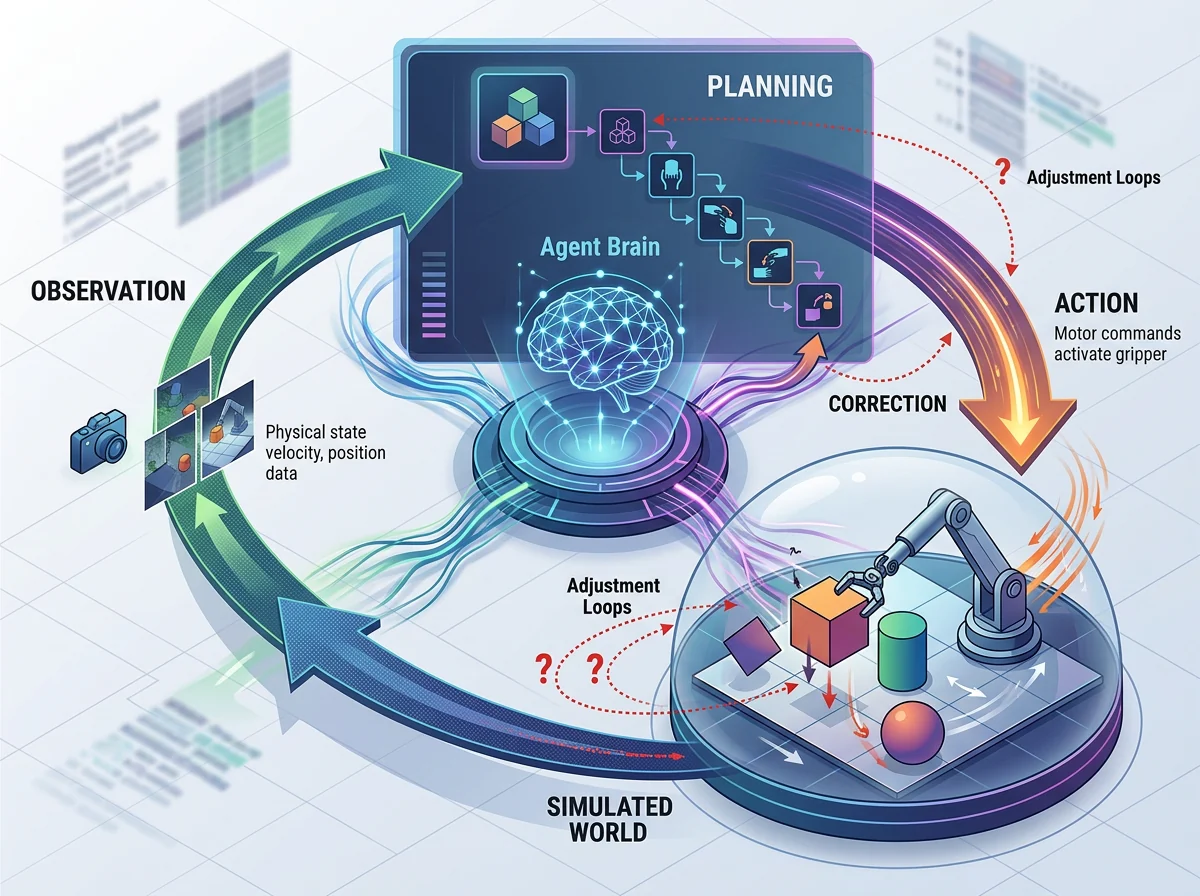
Google also uses Gemini as a directing agent around Genie 4. Gemini can break a goal into steps and inspect new frames to determine whether each step worked. When the world or the user’s instruction changes, the agent can adjust its plan as the simulation continues.
In one research experiment, Google used a Gemini 4 Argon model to break down a robotics task while Genie 4 simulated the steps in real time. The point is not that a robot can now trust a pretty AI world blindly. The point is that the combination could make it faster to create many varied scenarios before trying anything in the physical world.
This is the direction I find most exciting. A language model is good at goals, rules and planning, while a world model represents sensory and physical outcomes. Together they could become far more useful than either model on its own. Google calls these hybrid world models, and the term describes the architecture rather well.
What could Genie 4 be used for?
The nearest-term uses are ideation and prototyping. Filmmakers could explore scenes, camera movements and dialogue before an expensive production. Game developers could move quickly from a description to a simple world and test a visual direction or mechanic before writing all the code. This is sketch mode, not a finished film or game.
Google also points to interactive learning and robotics. In education, a generated world could be used to explore a historical scene, but the word simulation matters. A convincing depiction is not automatically a scientifically or historically accurate one. Pretty graphics are still not evidence.
In the longer term, robotics and agent training may matter most. Robots need large numbers of varied training situations, while real-world trials take time, cost money and can go wrong. If Genie can create useful scenarios quickly, developers could test more situations in simulation first. That is also why world models have become a field of competition in their own right rather than a small branch of AI video.
The limitations are still fundamental
Genie 4 can keep an environment together for short sessions, but details and objects may drift or change over time. The problem becomes more visible after several complex text edits or longer navigation. Google also lists complex interactions between users and independent agents, accurate real-world locations, legible in-world text and accurate audio as unresolved challenges.
Google’s official Genie 4 model page also says that the model cannot reproduce real places with complete accuracy. That is an important limitation for historical environments and training. A convincing scene can still contain errors that are difficult to spot precisely because everything else looks plausible.
Nobody should read two minutes of continuity as two minutes of guaranteed physical truth. This is an early model trying to keep a generated world stable while the user pokes around inside it. The fact that it works at all is impressive. The fact that it still forgets and drifts is not a minor footnote.
Who can access Genie 4?
Google released Genie 4 on October 27 as a research preview for trusted testers. The company says access will expand in the coming weeks to Google AI Ultra subscribers through Project Genie, along with early-access partners using the Gemini API and Google AI Studio. Google has not announced a general release date or a separate price for the model.
For most people, there is therefore little to put into production today. Developers and creators already working on interactive prototypes can follow the waitlist and documentation, but it is too early to build a critical workflow around access that is neither broad nor fully defined.
Genie 4 is still a model worth watching. Google has brought steering, audio, physics, people and agent planning into one real-time system. If it can extend continuity and reduce drift, world models could become a new working layer between an idea and the far more expensive job of building, filming or testing it in reality.
Frequently asked questions
Is Google Genie 4 available to everyone?
No. Google released Genie 4 as a research preview for trusted testers on October 27, 2026. The company says access will expand to Google AI Ultra subscribers through Project Genie and selected Gemini API and Google AI Studio partners, but it has not announced a date for broad public access.
How long can Genie 4 keep a world consistent?
Genie 4 can maintain a consistent scene for up to two minutes, according to TechCrunch, which is twice the limit reported for Genie 3. Google still warns that details and objects can drift during longer navigation or after several changes to the world.
Can Genie 4 generate audio and dialogue?
Yes. Genie 4 generates ambient sound, music and interactive dialogue as part of the world. Google also says accurate real-time audio remains an active research problem, and the available sources do not establish how well the model handles Norwegian speech, pronunciation or comprehension.
Is Genie 4 the same as a normal AI video model?
No. A conventional AI video model primarily produces a sequence to watch. Genie 4 creates a navigable simulation that can change in response to text and user controls while it is running, although its world can still drift and lose consistency over time.