Innhold Show
If you build voice agents in English or five other major European languages, AssemblyAI-TTS-1 makes two difficult things unusually simple: It costs $15 per million characters, and concurrent conversations do not require a separate capacity contract. That combination matters far more than another polished voice demo.
AssemblyAI has been best known for speech to text. With AssemblyAI-TTS-1, the company now supplies the other end of the conversation as a standalone text-to-speech service: Text goes in, streamed audio comes out. The model became generally available on October 27, 2026 and is designed for the short, continuous responses used by voice agents.
There is an important limitation for Norwegian users. The launch languages are English, Spanish, French, German, Italian and Portuguese. Norwegian is not on that list. This is relevant news for developers and businesses serving the six supported languages, but it is not evidence of Norwegian pronunciation or conversation quality.
What is AssemblyAI-TTS-1?
AssemblyAI-TTS-1 is AssemblyAI’s first standalone text-to-speech model. It is built for voice agents and can deliver audio over WebSocket or HTTP. In the official launch announcement, the company claims about 90 milliseconds to first audio, more than 4,000 ready-made voices and the same usage price for stock and cloned voices.
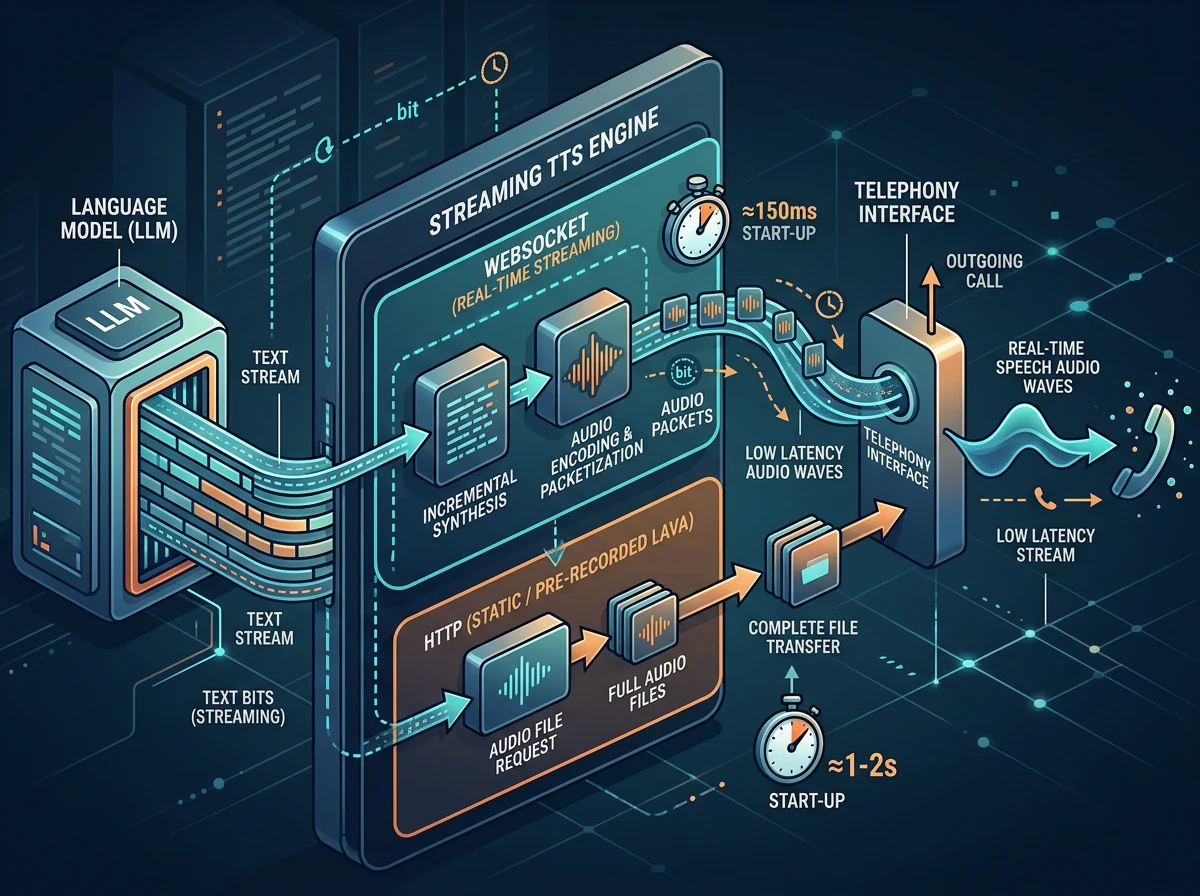
Streaming means the agent does not have to wait for a complete audio file before it starts speaking. A language model can produce its answer piece by piece, the TTS service can synthesize the first part, and the user can hear the beginning while the rest is still being processed. That is how a voice agent avoids the long, artificial pauses that make a conversation feel like an old telephone menu.
The HTTP interface is better suited to cases where the complete text is already available, such as notifications, previews or audio that can be cached. WebSocket is intended for the live conversation. AssemblyAI also provides an OpenAI-compatible speech endpoint, which may reduce integration work when an existing application already uses that API shape.
Why is the price more important than it looks?
The list price is $15 per million characters, or $0.15 per 10,000 characters. Spaces and punctuation count toward the billed total. That gives developers a much simpler number to model than a plan built around named voices, fixed concurrency tiers or separate fees for every capability.
The price includes all six launch languages, the full voice library, voice cloning, word-level timestamps and data processing in either the United States or the European Union. There is no separate voice fee, minimum purchase or concurrency charge on pay-as-you-go. Committed-use volume pricing is available, but a commitment is not the admission ticket.
Character-based pricing also makes the TTS portion fairly easy to estimate before deployment. If an agent produces an average of 2,000 characters of outgoing speech in one conversation, the TTS cost would be about $0.003 for that conversation. That is an example, not a promise about the total cost. Speech recognition, the language model, telephony, storage and the rest of the infrastructure still have to be paid for.
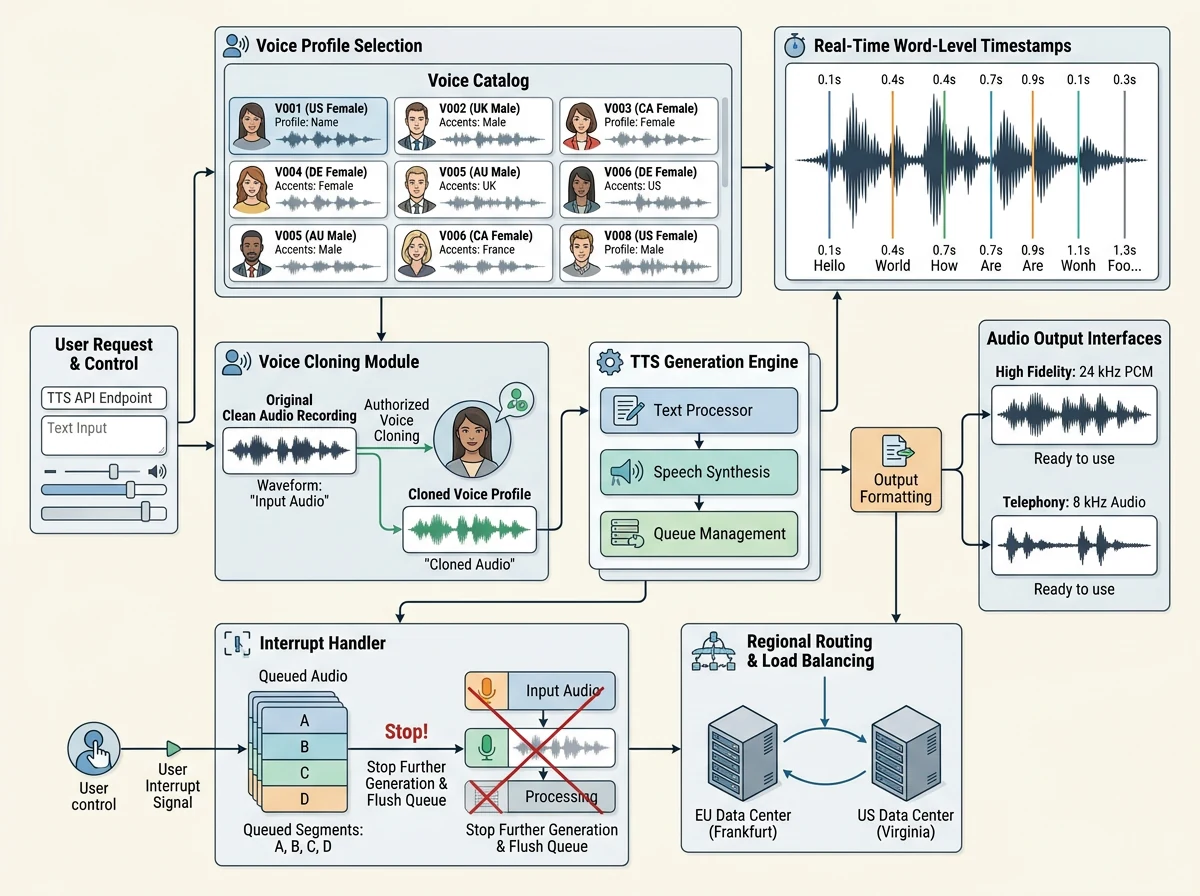
The real bill also depends on how much text the agent sends before the user interrupts. A good integration must stop both audio playback and further generation when an interruption occurs. Otherwise, you are paying for an agent that continues its lecture while the user is already trying to get a word in. That is bad conversation design with an invoice attached.
What does unlimited concurrency actually mean?
AssemblyAI says pay-as-you-go customers do not have to purchase a concurrency tier or sign an annual capacity agreement. Ten and 10,000 simultaneous conversations use the same API and the same per-character price. For a service with unpredictable traffic spikes, that removes a commercial barrier that often appears long before a technical limit.
It does not mean the rest of your system automatically supports 10,000 conversations. WebSocket connections, telephony, language-model capacity, queues, logging and your own application still have to scale and be monitored. “Unlimited concurrency” describes the supplier’s access and pricing model. It is not a claim that your entire architecture is infinite.
This is still useful for small and medium-sized businesses. They can build and pilot a service without negotiating capacity in advance, and they do not have to choose between a standard quota that is too small and a large contract before traffic is known. Pay for the characters you actually send, then load-test the rest of the chain under realistic conditions.
How quickly does the model start speaking?
AssemblyAI markets the model at roughly 90 milliseconds to first audio. In the company’s own comparison, AssemblyAI-TTS-1 started streaming data after 47 milliseconds at the median and 54 milliseconds at the 90th percentile. Those are fast figures, but AssemblyAI measured them from a single client, and they describe time to first byte from the TTS API.
The user experiences a different measurement: the time between finishing a sentence and hearing the agent’s first audible response. Before the TTS service even receives text, the system has to detect the end of the user’s turn, transcribe the audio and get the language model to begin an answer. Network latency, buffering and playback come afterward.
Nobody should sell this as a voice agent with a 47-millisecond response time. The accurate claim is that the TTS component looks fast in the supplier’s measurement. The useful production metric is last audio in to first audible audio out, measured at the median, the 90th percentile and the worst cases. You should also measure how often the agent interrupts incorrectly or keeps speaking after the user starts talking.
What does the API include?
The voice catalog contains more than 4,000 voices with names, descriptions and tags. A voice can also be cloned from a short, clean recording and used through its own voice ID, provided that the user has permission from the person whose voice is being cloned. AssemblyAI says cloned voices have the same usage price as catalog voices.
Word-level timestamps are included. They let an agent know how far playback had progressed when the user interrupted. That matters when the conversation state is updated: The agent should not assume that the user heard the second half of a sentence that never came out of the speaker.
AssemblyAI’s integration example uses the HTTP endpoint POST https://tts.us.assemblyai.com/v1/speech and the WebSocket endpoint wss://tts.us.assemblyai.com/v1/ws. WebSocket can deliver raw 16-bit PCM at 24 kHz, while 8 kHz mu-law and A-law are available for telephony. HTTP can return a complete WAV file.
Separate hosts are available for processing in the United States and the European Union at the same price. That does not automatically settle every privacy and data-processing requirement, but it provides a concrete regional setting for the architecture. Businesses should still review the data-processing agreement, storage, logs, deletion and the treatment of recordings used for voice cloning.
How good is AssemblyAI-TTS-1?
AssemblyAI reports 99.0% word accuracy and 93.7% accuracy across 580 difficult targets that include numbers, codes and abbreviations. The company also reports an average score of 3.85 out of 5 from automated models designed to predict human quality judgments. The methodology is described in detail, but the measurements were still performed and published by the supplier.
The word-accuracy test set includes Seed-TTS English and LibriSpeech. The pronunciation test was transcribed and scored by machine, while naturalness was measured partly through automated preference models. These figures can indicate that the model is technically competitive, but they cannot tell us on their own how customers experience a long conversation, a particular industry or a particular accent.
An independent result is more mixed. MarkTechPost cites Cekura’s benchmark, where AssemblyAI-TTS-1 recorded median streaming latency of 159 milliseconds and reading accuracy of 81.5%. Inworld TTS-2 Flash measured 45 milliseconds and 93.2% at the same list price. The method differs from AssemblyAI’s time-to-first-byte test, so the numbers cannot be placed directly on top of each other. They are still a useful reminder that production traffic is the real test.
AssemblyAI itself says real production traffic is decisive. That is the right standard. Compare completed tasks, interruptions, repetitions, mispronounced names and the frequency of human handoffs. A voice that wins an isolated audio comparison can still be the wrong choice if the agent reads customer numbers badly or becomes exhausting after ten minutes.
Does AssemblyAI-TTS-1 support Norwegian?
No, not at launch. The six documented languages are English, Spanish, French, German, Italian and Portuguese. Every voice is supposed to work across all six when the language is set in the request. AssemblyAI says more languages and accents are coming, but it has not documented Norwegian support or announced a Norwegian release date.
This must not be confused with AssemblyAI’s speech-to-text models, where Norwegian may be supported. A service that can understand Norwegian audio does not automatically have a new TTS model that can speak Norwegian. These are different models with different capabilities.
The launch material also contains no Norwegian quality measurement that could support a judgment about pronunciation, dialects or prosody. The honest assessment is simple: AssemblyAI-TTS-1 is not currently a documented Norwegian TTS option. There is no reason to pretend that an English benchmark answers that question.
Who should consider the model now?
The model is most relevant to developers who already have a voice-agent pipeline and want to replace or compare the TTS component. WebSocket streaming, interruption messages, word-level timestamps and telephony-friendly audio formats make it suitable for customer service, appointment booking, sales, reservations and other conversations with short turns.
Businesses that require Norwegian speech should wait for actual language support and relevant evidence. The same applies to applications that need SSML, a custom pronunciation dictionary or direct controls for speaking rate and emotion. AssemblyAI says those controls are not available yet, although pronunciation dictionaries and emotion tags are planned.
For the supported languages, I would start with a limited slice of real traffic and compare it with the current system. Measure the complete conversation, not just the voice: task completion, first audible response, interruptions, correct names and numbers, cost per resolved request and human handoffs. Track the number of submitted characters as well, because that is what creates the TTS bill.
My initial assessment is cautiously positive. At $15 per million characters, with no capacity contract standing at the door, AssemblyAI-TTS-1 is easy to try and easy to budget. That is good. But the supplier’s tests are the beginning of the evaluation, not the end, and Norwegian voice agents still need to look elsewhere.
Frequently asked questions
How much does AssemblyAI-TTS-1 cost per 10,000 characters?
At the published rate of $15 per million characters, 10,000 characters cost $0.15. Spaces and punctuation count. Speech recognition, the language model, telephony, storage and other infrastructure are separate costs.
Do I need an enterprise agreement for many concurrent calls?
No. AssemblyAI says pay-as-you-go includes unlimited concurrency without an annual contract or a purchased capacity tier. That applies to the TTS service; your application and the other suppliers in the conversation pipeline still have to support the actual traffic.
Can AssemblyAI-TTS-1 replace the TTS service in an existing voice agent?
Yes. The service provides HTTP, WebSocket and an OpenAI-compatible speech endpoint, along with interruption handling, word timestamps and telephony audio formats. The integration still needs to clear queued audio and stop further text generation when the user interrupts.
Can AssemblyAI-TTS-1 speak Norwegian?
Not according to the launch documentation. AssemblyAI-TTS-1 supports English, Spanish, French, German, Italian and Portuguese at launch. Norwegian language support, pronunciation and dialect quality are not documented for this model, even though separate AssemblyAI speech-to-text models may support Norwegian.