
Innhold Show
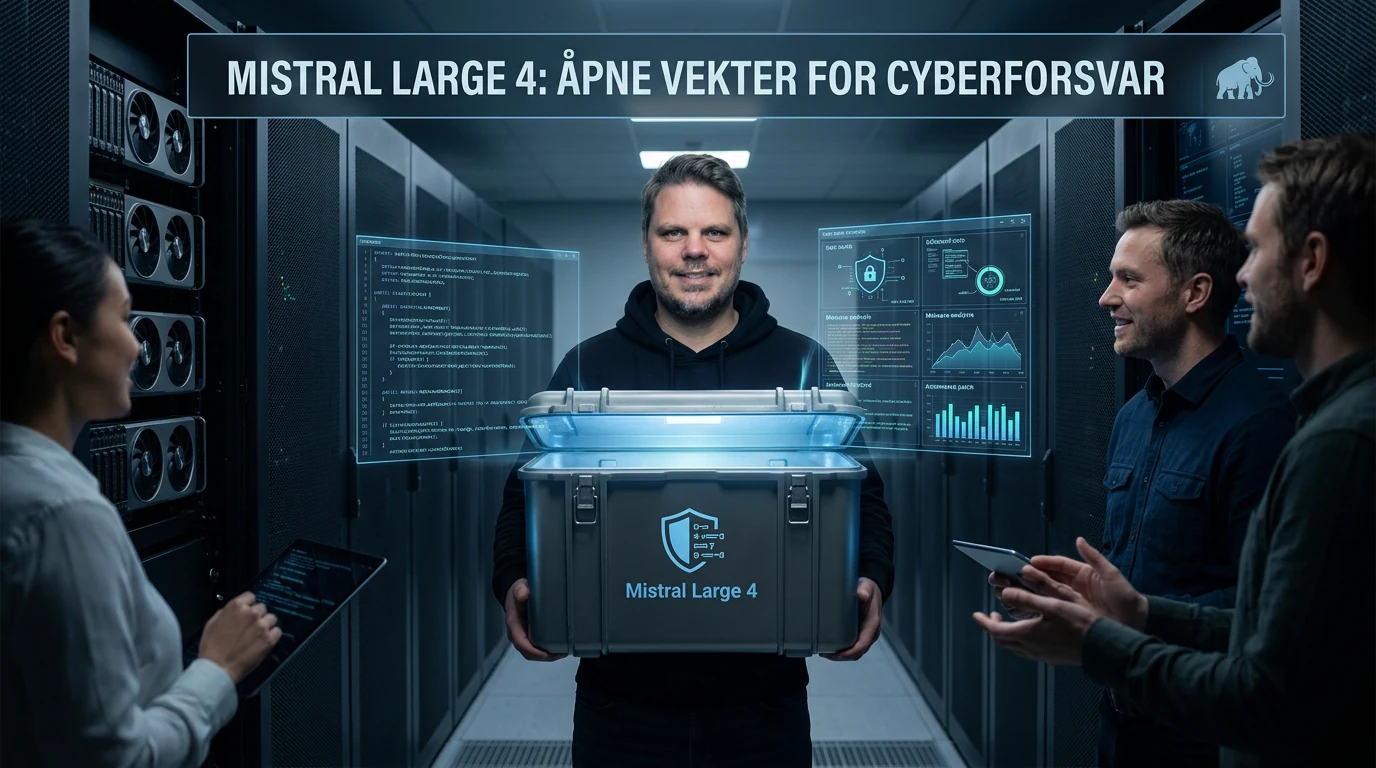
If AI is going to play an important role in your cyber defense, you should be able to own the model, run it on infrastructure you control, and know that an outside provider cannot cut off access in the middle of an incident. On October 29, Mistral released the weights for Mistral Large 4, turning that control from a future promise into something organizations can actually deploy.
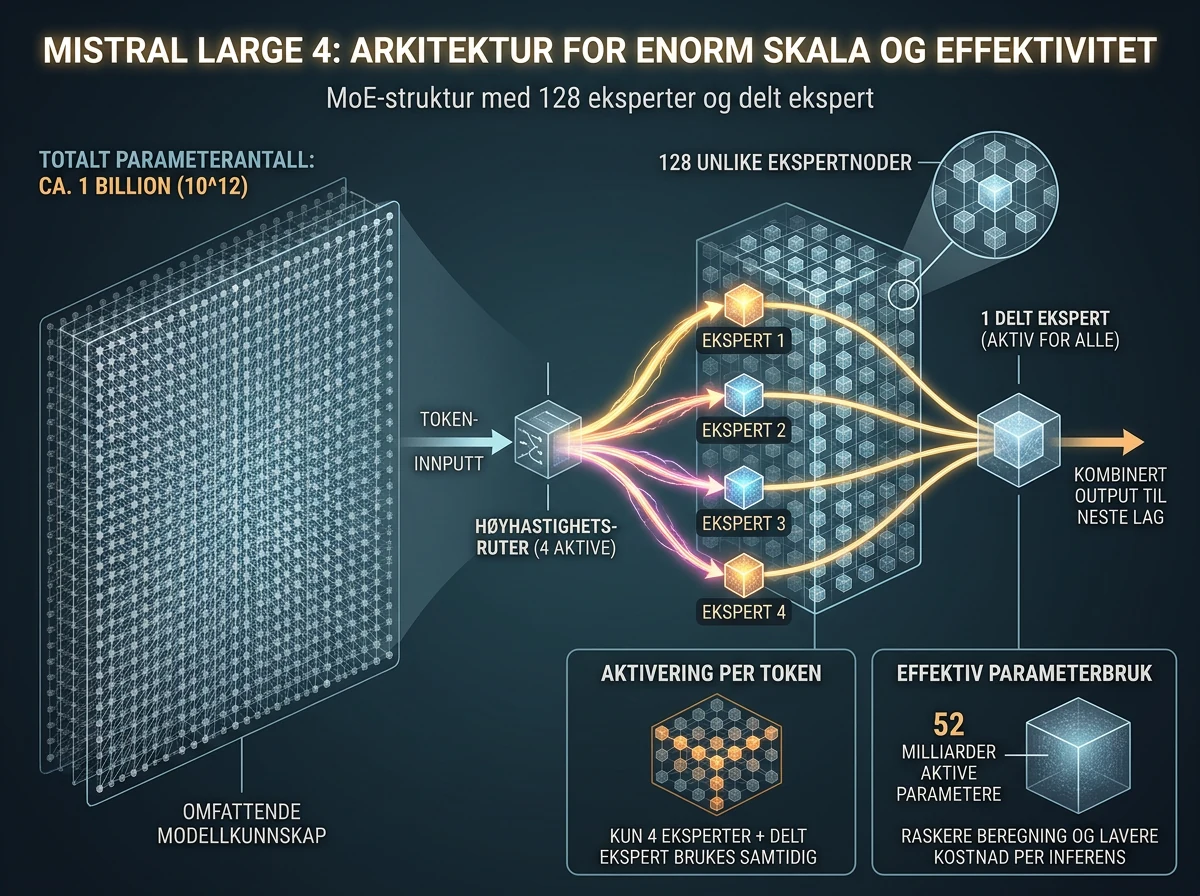
Mistral Large 4, nicknamed Le Chonk, is a natively multimodal Mixture-of-Experts model with roughly 1 trillion parameters in total and 52 billion active parameters. It is aimed particularly at coding, agents, and cybersecurity. The crucial part is ownership: organizations can download, customize, and run the model in their own environment instead of sending every request through a closed cloud service.
I like this direction. A powerful security model with weights you can actually download is an important milestone, especially for organizations working with vulnerabilities, logs, source code, and active incidents that should not leave the building. But this is an enormous model. “Runs locally” means data-center infrastructure and a serious hardware plan, not a sudden new hobby project for an ordinary PC.
What is Mistral Large 4?
Mistral Large 4 is Mistral’s largest model to date. The official Mistral Large 4 model card lists roughly 1 trillion total parameters, 128 routed experts, and four active experts per token. It also has one shared expert, with approximately 52 billion parameters active during inference when embeddings and output layers are included.
That MoE architecture makes the model somewhat less absurd to run than the headline number suggests. The full model still has to be stored and distributed across the hardware, but every token does not use every parameter. Mistral also specifies a 1-million-token context window, text and image input, function calling, strict JSON schema support, and three reasoning levels: low, medium, and high.
The model first appeared in public preview on October 6, when Mistral said the weights would arrive by the end of the month. Their release is therefore a genuine new event, not another announcement of something that may appear later. The weights are available alongside deployment paths for vLLM, SGLang, Transformers, and llama.cpp, plus a quantized NVFP4 checkpoint aimed at Nvidia Blackwell hardware.
Why do open weights matter in cyber defense?
Open weights give an organization control over where the model runs, which data it can access, and which security rules surround it. In Mistral’s announcement of the weight release, the company highlights vulnerability discovery, reproduction, validation, and patching. These are jobs where an unnecessary refusal can stop legitimate defensive work at exactly the wrong moment.
A closed service can change its model, filters, price, or access rules without letting the customer choose the timing. That is usually inconvenient. During an attack, it can be dangerous. If an organization controls both the weights and the deployment environment, an external API provider cannot switch off the exact model already integrated into its incident response.
Control over data matters just as much. Source code, malware samples, internal logs, and details of an unpatched vulnerability are not material you send anywhere without thinking. Self-hosting can keep that work inside the organization’s own networks, access controls, and data-retention boundaries. The model can also be adapted to internal detection rules, threat intelligence, and response workflows.
Open weights do not automatically mean complete openness. You do not get the full training dataset, the complete training recipe, or proof that the model is safe. You do get a fixed model that you can test, monitor, customize, and keep. That is a far better starting point than hoping a service controlled by somebody else behaves the same way next week.
How capable is Mistral Large 4 at cybersecurity?
Mistral reports a score of 51% on the Artificial Analysis Cyber Index. The test covers whether a model can discover a vulnerability in a codebase, reproduce and validate it, and create a patch without breaking existing functionality. That is relevant to defensive work, but it remains a result presented in the vendor’s launch material. It is not a guarantee for your systems.
The company also reports the highest average refusal rate among the open models it compared for malicious cyber requests across JailbreakBench, StrongREJECT, and AgentHarm. The goal is to avoid the stupid extreme where the model either refuses legitimate security work or happily assists with attacks. Mistral says it observed the model rejecting black-box attacks against live targets in production traffic, while also acknowledging that the model may increase real attack capabilities. Its guardrails are still being adjusted.
That warning matters. A model capable of finding and exploiting flaws can help defenders, but the capability does not disappear when the user has bad intentions. Open weights move more responsibility to the operator. Access control, isolated sandboxes, logging, approval gates, and strict limits on tool use are not decorations around the system. They are part of the security system.
I would not choose Mistral Large 4 because one benchmark score looks impressive. Organizations should test it on representative codebases, realistic incidents, and their own tolerance for false positives and missed vulnerabilities. Measure whether it finds real flaws, whether its patches pass the existing test suite, what it overlooks, and which actions it tries to take when tools are available.
This is not a model for one powerful PC
The Le Chonk nickname fits. The official release contains about 1 trillion parameters, and the NVFP4 package for llama.cpp is listed at 619 GB for the main weights alone. The vision encoder, speculative decoding head, context memory, and working capacity come on top of that.
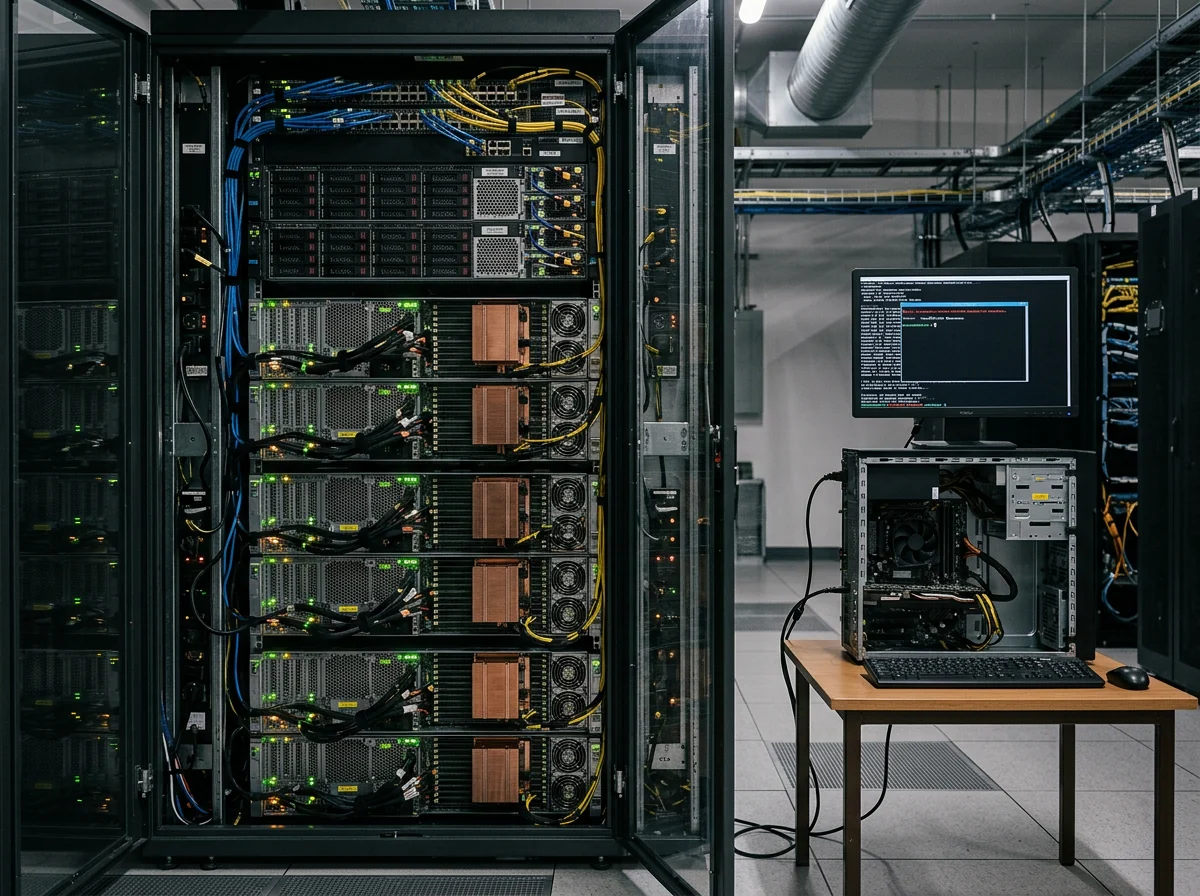
Mistral’s production example for vLLM uses tensor parallelism across eight GPUs. That is an example rather than a universal minimum, but it makes the hardware class clear. An RTX 4090 is an excellent card for a great deal of local AI. It does not turn a model this large into a normal desktop deployment.
For a larger organization, self-hosting, a private cloud, or a specialist hosting partner may still be perfectly realistic. The important difference is that the organization can decide where the weights and data live. For smaller businesses, Mistral’s API, OpenRouter, or a hosting partner will usually be more practical. Mistral lists hosted API pricing at $0.70 per million input tokens, $0.07 per million cached input tokens, and $2.10 per million output tokens. They should still check which parts of the control argument survive in the actual arrangement.
A model this large also creates an ongoing operational bill. Getting it to start once is not enough. You need capacity for expected concurrency, monitoring, updates, redundancy, and people who can operate the system. Before downloading hundreds of gigabytes, decide whether the task truly requires Large 4 or whether a smaller open-weight model can solve a narrowly defined security problem more cheaply and simply.
Is Mistral Large 4 open source?
Mistral describes this as an open-weight release. The weights are available under the Mistral Ecosystem Open-Weight License, a modified MIT license that permits commercial and non-commercial use. According to the model card, operating the model as a Model-as-a-Service business requires a separate commercial license from Mistral.
That is why “open weights” is more accurate than pretending the entire model is open in the same sense as a traditional open-source software project. You can download and run the weights, but the license draws a clear boundary around one specific business model. Any company planning to build a commercial service around Large 4 should read the license instead of relying on a headline.
For internal use, research, customization, and products that fit the license, the release is still extremely valuable. It provides a European option near the frontier and lets organizations build on the same model without being locked to one API. Earlier in October, those weights were a promise attached to a preview. Mistral has now delivered the most important piece.
What should organizations do next?
Start with the use case, not the size of the model. Pick one concrete job, such as vulnerability triage, suspicious-code analysis, or patch suggestions. Build an evaluation set with known findings and measure both what the model catches and what it misses. Run every proposed change through normal tests and human approval.
Then compare three realistic deployment options: your own hardware, private hosting from a provider, and an API. Include GPU capacity, power, expertise, redundancy, and security in the calculation, not just token price or download size. Check the license as well if the model will be offered to customers as part of a service.
Most importantly, treat control as a technical requirement that can be verified. Confirm where data is stored, who can change the model, who can stop access, and how the system rolls back. “AI under your control” is a good slogan. It only becomes valuable when the architecture, contracts, and operations make it true.
Mistral delivered what it promised earlier in October, and that deserves clear applause. Mistral Large 4 is not a model for everyone, but its open weights give security teams a real choice between renting intelligence and owning part of their defense system. In cyber defense, that difference is anything but academic.
Frequently asked questions
Can Mistral Large 4 run on local infrastructure?
Yes. The weights can be downloaded and served with tools including vLLM, SGLang, Transformers, and llama.cpp. The model is enormous, however. Mistral’s production vLLM example uses eight-way tensor parallelism, so “local” means server or data-center infrastructure for most organizations.
How many parameters does Mistral Large 4 have?
Mistral Large 4 has roughly 1 trillion parameters in total and about 52 billion active parameters. Its MoE architecture routes each token through four of 128 routed experts plus one shared expert. The complete model still has to be stored and distributed across the deployment hardware.
Can businesses use Mistral Large 4 commercially?
Yes. The Mistral Ecosystem Open-Weight License allows commercial and non-commercial use. There is an important exception: operating the model as a Model-as-a-Service business requires a separate commercial license from Mistral. Read the current license for the exact planned use.
Is Mistral Large 4 safe enough for autonomous cyber defense?
No vendor benchmark proves that the model should act autonomously in your environment. Test it on your own systems, restrict tools and permissions, use isolated sandboxes, log its actions, and require human approval for risky changes. Strong cyber capabilities increase both the model’s usefulness and the operator’s responsibility.