

Innhold Show
Updating one AI capability should not force you to replace an entire model. Granite Switch 4.1.1 shows what an ordinary AI model patch can look like: IBM leaves the base model alone and updates the specialized components that actually need new capabilities. That may sound less dramatic than launching an entirely new model generation. For anyone who has to run AI systems over time, that is exactly why it matters.
The release is backward compatible with Granite Switch 4.1. Existing integrations can keep the same format and invocation method while the Decision adapter gets new weights and the embedded speech model becomes multilingual. You do not have to move the entire system just because one component has improved.
This is not a new base model disguised as a minor version change. Granite Switch is a composed model built from a stable Granite base, adapters that can be activated on demand and a separate speech encoder. Version 4.1.1 demonstrates why that architecture can be much more practical than treating every new requirement as an excuse to replace one giant, indivisible model.
What is new in Granite Switch 4.1.1?
Granite Switch 4.1.1 is a patch for the 8B and 30B editions of Granite Switch 4.1. According to IBM’s Granite Switch 4.1.1 announcement, the base model was neither recomputed nor retrained. IBM updated the Decision adapter and replaced the embedded speech encoder with a newer Granite Speech model.
Decision is an activated LoRA adapter, commonly shortened to aLoRA, that selects from predefined options and returns a probability distribution. It could route a customer request to the right department, for example, or assess which action an agent should take. Version 4.1.1 gives that adapter improved weights while preserving its prompt format, activation and readout, so existing integrations continue to work as before.
The speech component is Granite Speech 5.0 TurboCTC, a 470-million-parameter model. It can transcribe English, French, German, Spanish, Portuguese, Italian and Japanese, producing punctuated and capitalized text. The Granite Switch 4.1.1 model card lists those same seven languages and shows that the original 4.1 revision supported English speech only.
IBM does have a small documentation mismatch here. The launch article refers to speech in 10 languages, while both the Switch model card and the Granite Speech 5.0 TurboCTC model card name seven. If you are building a real system, the explicit list in the model cards is the safer one to follow.
Why does this look more like a software update?
Ordinary software consists of components that can be versioned separately. Fixing one module does not require rewriting the entire operating system. Granite Switch tries to give a model stack the same quality: the base model supplies general language capability, while smaller adapters and encoders handle clearly defined jobs.
For this patch, IBM only had to train the new speech model and the new weights for the Decision adapter. The rest was not recomputed. Those components could then be composed into a new revision of the same Switch model. That is a much cleaner update story than downloading an entirely new model and crossing your fingers that everything still behaves the same way.
The versioning is concrete rather than decorative. The repository’s main branch points to the latest release, while earlier releases remain available under their own tags. To keep the original 30B edition, you can pin loading to granite-switch-4.1-30b. The patch has the tag granite-switch-4.1.1-30b. That makes controlled rollout, comparison and rollback possible without changing the model name throughout an application.

What does the patch change in day-to-day operations?
The biggest advantage is that capabilities can change at different speeds. A company can keep a base model it has already evaluated while giving a specialized decision function or speech encoder a new revision. That does not eliminate testing, but it makes the change easier to isolate, measure and understand.
Granite Switch 4.1.1 30B combines a 30-billion-parameter base model with a 128K-token context window and two activated adapters: Decision and Guardian Core. The same composed model also contains the 470-million-parameter speech encoder. Chat, decisions, safety assessment and speech-to-text can therefore be served through one endpoint instead of a collection of unrelated model servers.
IBM also provides an 8B edition with the same combination of chat, Decision, Guardian and speech. That makes the architecture more relevant to local and self-hosted systems than it would be if 30B were the only option. The smaller edition will not erase hardware requirements, but it gives teams a realistic second deployment target rather than a one-size-fits-nobody model.
The model uses the Apache 2.0 license and supports both Transformers and vLLM. That matters because a tidy update model is not terribly useful if it exists only behind a single closed API. Here you can pin a revision, run it on infrastructure you control and decide when the patch enters production.
Troubleshooting also becomes more manageable. If a new Decision adapter performs worse on your cases, you know which component and revision changed. You can compare it with the earlier tag without simultaneously having to explain a different base model, a new context length and completely new chat behavior. A smaller change surface does not mean zero risk, but it gives you much better control over what needs to be measured.
For a small development team, that may be the most important lesson. Few teams have the time or hardware to qualify a complete 30B model from scratch whenever one specialist task improves. When the update is isolated, the test suite can be isolated too: decisions against decision cases, speech against speech data and ordinary chat against regression tests. It simply looks more like proper software operations.
This is not a magic update button
Granite Switch 4.1.1 makes the components more modular, but the patch does not install itself in a running model server. IBM describes a workflow in which the required adapters are selected, composed with the base model and deployed as a new checkpoint. That composition still has to be loaded, tested and rolled out as a model revision.
You also cannot plug in any random adapter today and expect it to work. IBM says tutorials and an Adapter SDK for developers and third parties are planned. They are not finished parts of the 4.1.1 release. For now, this patch is strongest as proof that the architecture works for components IBM already controls.
The adapters are tied to the relevant base model and each follows its own contract. Decision returns probabilities across a fixed set of options, while Guardian Core returns a safety assessment. The Granite Core Library contains four families of LoRA adapters, but a composed checkpoint exposes only the adapters that were actually included in it. Modular does not mean interchangeable without rules.
What does the speech update mean for international users?
The seven documented languages are English, French, German, Spanish, Portuguese, Italian and Japanese. That is a useful expansion from the English-only speech component in version 4.1, but it is not universal language support. A language appearing nowhere on that list has no documented transcription quality, dialect coverage or robustness to noise in this release.
The separate speech model was trained on approximately 153,000 hours of multilingual audio and outputs punctuated transcripts. That is useful for the supported languages because the text can move directly into the language model without a separate formatting pass. It still does not tell us how an undocumented language performs, and I have not conducted my own speech test of Granite Switch 4.1.1.
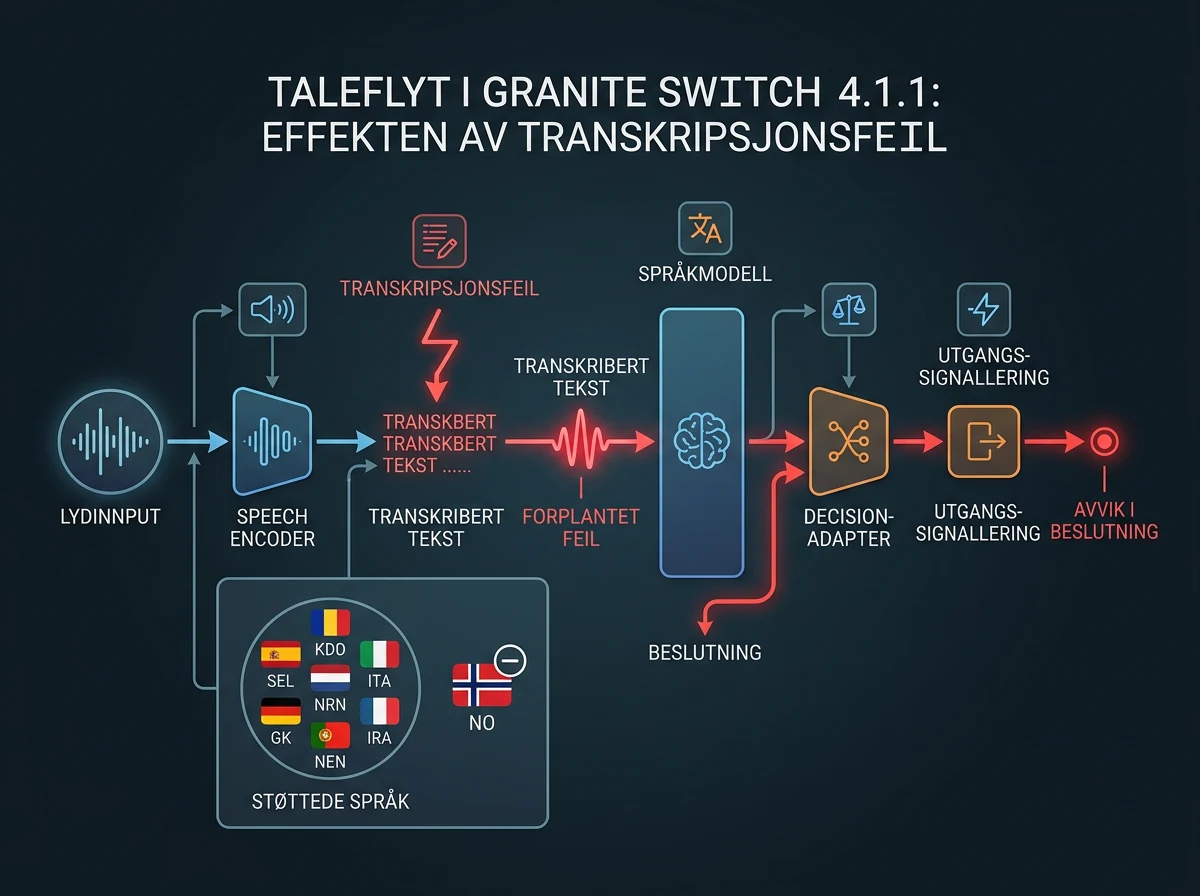
IBM also documents an important technical limitation: the speech encoder and language model were not jointly trained. Audio is transcribed first, then the resulting text is inserted into the conversation context. A transcription error can therefore change what the language model or Decision adapter reacts to without the rest of the system necessarily recognizing the mistake.
Who should consider Granite Switch 4.1.1 now?
The patch is most relevant to teams already evaluating Granite Switch for local or self-hosted workflows. If version 4.1 is in a test environment, 4.1.1 creates a clean opportunity to compare two revisions with the same basic architecture. Pin the old tag, deploy the new one beside it and measure the exact tasks the updated adapter is supposed to perform.
Decision results should support a decision, not masquerade as certified classification in a domain where the model has not been tested. IBM recommends monitoring adapter outputs, particularly in safety-critical uses. A probability is useful information. It is not a waiver of responsibility with decimal places.
For newcomers, the architecture is more exciting than the patch list itself. One checkpoint can already provide chat, safety assessment, fixed-option decisions and speech-to-text. Local models become more useful when they have explicit roles inside a complete workflow, not merely when somebody adds more parameters.
I like the direction IBM is showing here. AI models do not have to remain enormous, indivisible packages that get thrown away whenever one capability improves. A stable base, versioned adapters and controlled rollout are a more mature way to operate models. Granite Switch 4.1.1 is still an early step, but its version number actually means something. That is more than I can say for plenty of AI launches.
Frequently asked questions
Is Granite Switch 4.1.1 a completely new base model?
No. IBM kept the Granite 4.1 base and updated the Decision adapter and embedded speech encoder. That is the point of the patch: new specialist capabilities can be composed with a stable base without retraining the entire model.
Can I keep using Granite Switch 4.1?
Yes. The previous release remains available as a pinned revision. For the 30B edition, the old tag is granite-switch-4.1-30b, while version 4.1.1 has its own tag. You can test the patch before moving production traffic.
Which speech languages does Granite Switch 4.1.1 support?
The model cards list English, French, German, Spanish, Portuguese, Italian and Japanese. IBM’s launch article says 10 languages, but the two model cards explicitly name seven, so that documented list is the safer basis for deployment.
Can developers create their own Granite Switch adapters?
Not through a finished public SDK in this release. IBM says tutorials and an Adapter SDK for custom and third-party adapters are planned. Today, developers can use and compose the available Granite adapters according to each component’s documented setup.