Innhold Show
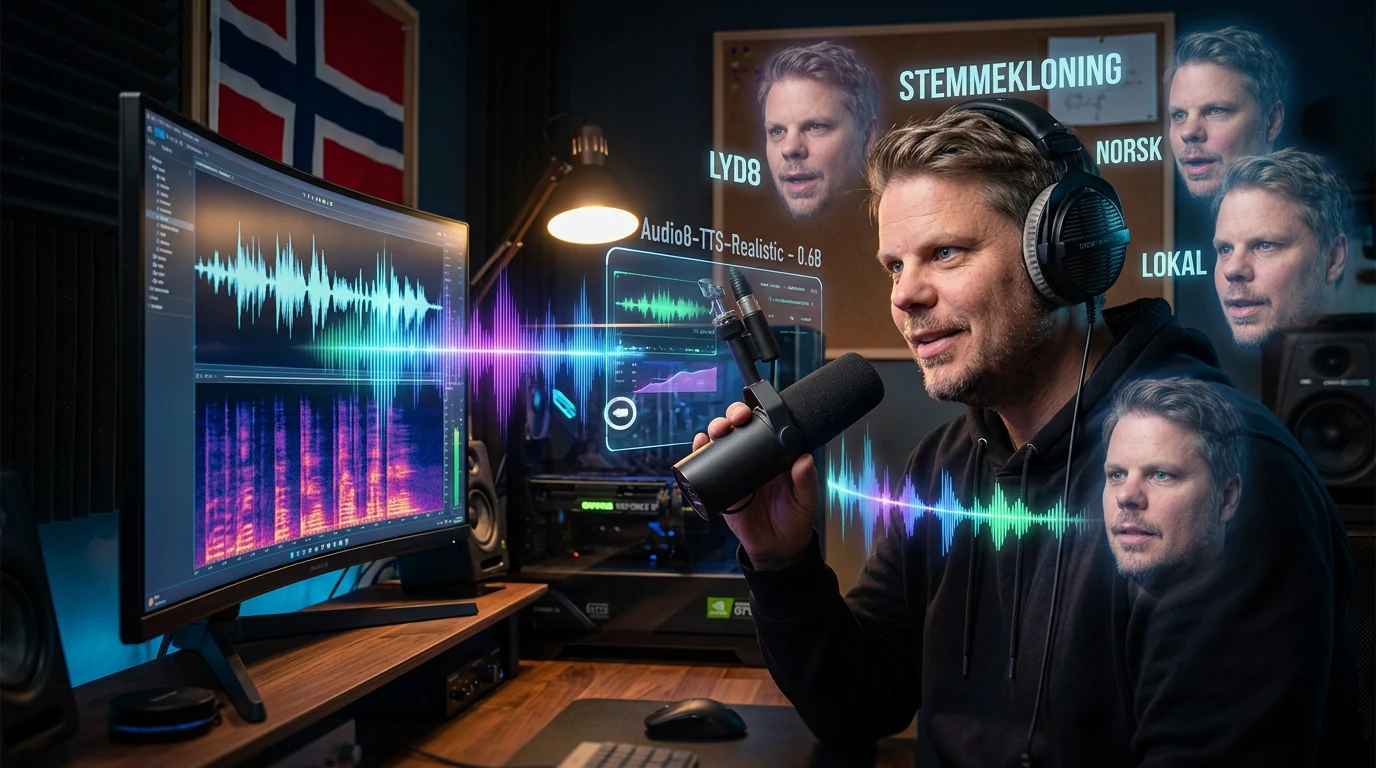
Audio8-TTS-Realistic combines a 601-million-parameter main model with zero-shot voice cloning, 23 languages, and an included 44.1 kHz audio codec. Norwegian is on the list. That makes this model far more interesting than its size might suggest.
You give the model an audio recording and an exact transcript, and it can generate new speech in the voice from that recording without first training a separate voice model. Both the code and model weights are available under Apache 2.0, so this is something you can actually download, run locally, and build on.
The most exciting part is not simply that Edge0 packed so much into a small model. The company finished training with a learned realism critic and GRPO, rewarding speech that more closely resembles human delivery. The results are promising, but Norwegian appearing on a language list is not proof of natural Norwegian speech. That distinction matters.
What is Audio8-TTS-Realistic?
Audio8-TTS-Realistic is an open text-to-speech model with 601,159,424 parameters in its main model. It supports zero-shot voice cloning from a single reference recording, covers 23 languages, and includes its codec, tokenizer, processor, and custom Transformers code in the complete model package on Hugging Face.
Zero-shot means the model does not need separate fine-tuning for the voice you want to use. It receives a clean reference recording together with the exact words spoken in that recording. It can then generate different text using the characteristics of the reference voice. The model can also produce speech without a reference, but voice cloning is its clearest practical value.
The Realistic release builds on Audio8-TTS-Preview-0.6B. It keeps the same basic architecture while expanding language coverage from 11 to 23 languages. The 12 additions are Arabic, Finnish, Hindi, Indonesian, Malay, Norwegian, Portuguese, Russian, Swedish, Thai, Turkish, and Vietnamese.
This is a concrete upgrade, not merely a renamed checkpoint. Edge0 reports better prosody and more expressive delivery while retaining the compact model size. Explicit Norwegian support makes this release relevant to many more people in Norway than the Preview model was.
Why is a 0.6B model interesting?
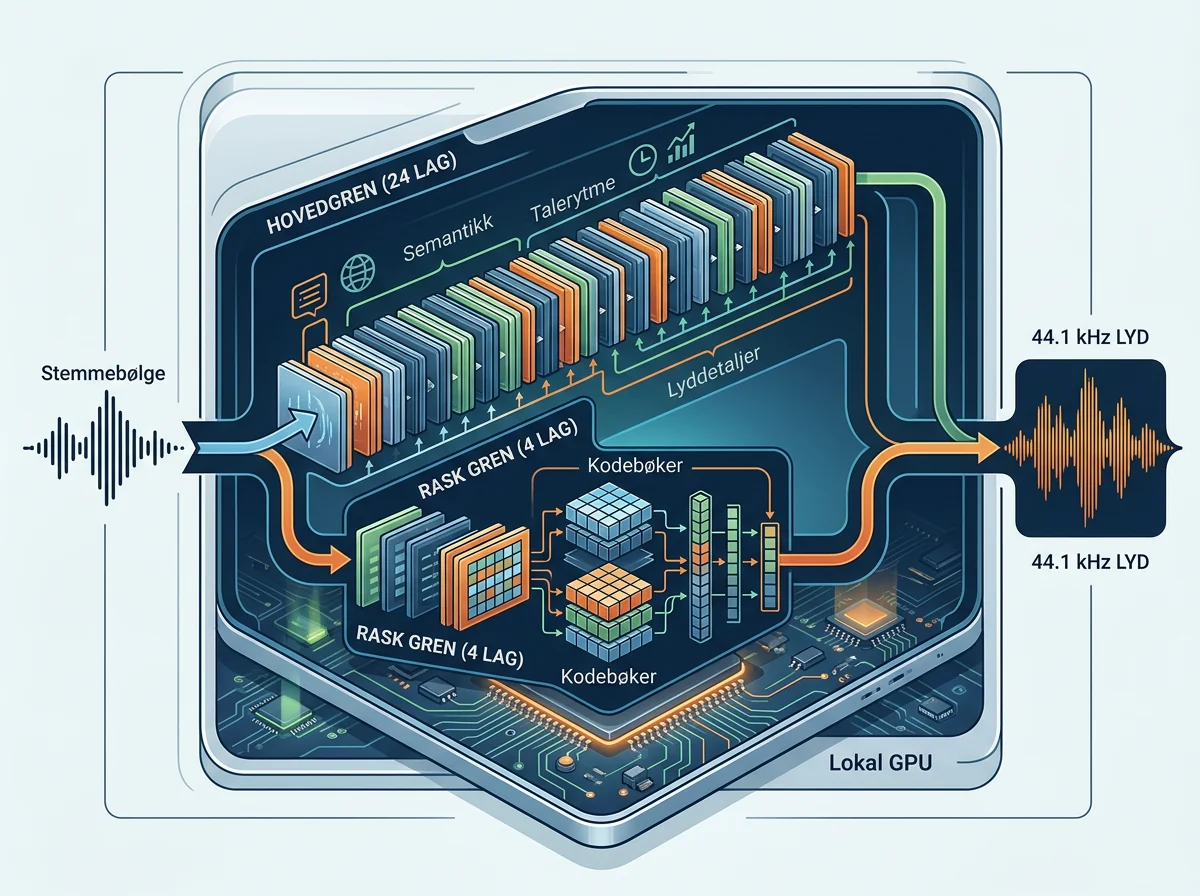
A 0.6B main model is small in today’s speech AI market. Audio8 uses a dual autoregressive architecture in which a slow branch produces one semantic audio token per frame, while a shallower fast branch generates the remaining codebooks. The goal is to keep the sequential work at frame level instead of producing every audio detail one after another.
The slow component has 24 layers and the fast component has 4. Each audio frame contains 10 codes drawn from codebooks with 4,096 entries, and the bundled codec works with 44.1 kHz audio. The codec is not included in the advertised 0.6B parameter count, so the model name describes the main model rather than absolutely everything that must be loaded.
The architecture is inspired by Fish Audio S2 Pro, and its slow branch is based on Qwen2.5 0.5B. There is no magic here. It is fairly sober engineering: spend most of the capacity on the structure of speech, then use a much shallower component for the details within each frame.
Edge0 recommends Python 3.10 or newer and a CUDA-compatible GPU. The Transformers package was validated on an NVIDIA H20 using BF16, PyTorch 2.8.0, and Transformers 4.57.3. That confirms the package loads and generates in that environment. It does not tell us what speed or memory use to expect on a typical consumer GPU.
What does the realism training change?
Edge0 trained a critic to compare generated speech with a human recording of the same sentence and speaker. The critic’s signal was then used during the final GRPO stages, rewarding Audio8 for more human rhythm, prosody, and delivery instead of focusing only on a low word error rate.
That is a sensible move. A TTS model can pronounce every word correctly and still sound as if it is reading an instruction manual with all the life drained out of it. Word error rate and speaker similarity capture important properties, but neither can tell you by itself whether speech feels natural.
In the Audio8-TTS technical report, the researchers describe a critic combining a frozen WavLM frontend with explicit prosodic features. They validated it on 5,600 sentence-speaker groups, covering 89,600 synthetic utterances plus matched human recordings. The final two training stages use GRPO, first with word error rate and speaker similarity as rewards, then with realism as the reward.
Across the nine core languages in CV3, the average word error rate fell from 5.41% after supervised fine-tuning to 4.86% after the realism stage. Speaker similarity rose from 0.639 to 0.661. Across the 13 additional languages, the combined error rate fell from 22.36% to 20.77% over the full post-training process, while similarity increased from 0.638 to 0.679.
The realism stage did not merely improve the critic’s own score. The report also shows gains on more conventional measurements. That is a good sign that the model did not simply learn to game its reward system, although independent listening tests still carry more weight than the developer’s own tables.
How well does Audio8-TTS-Realistic work in Norwegian?
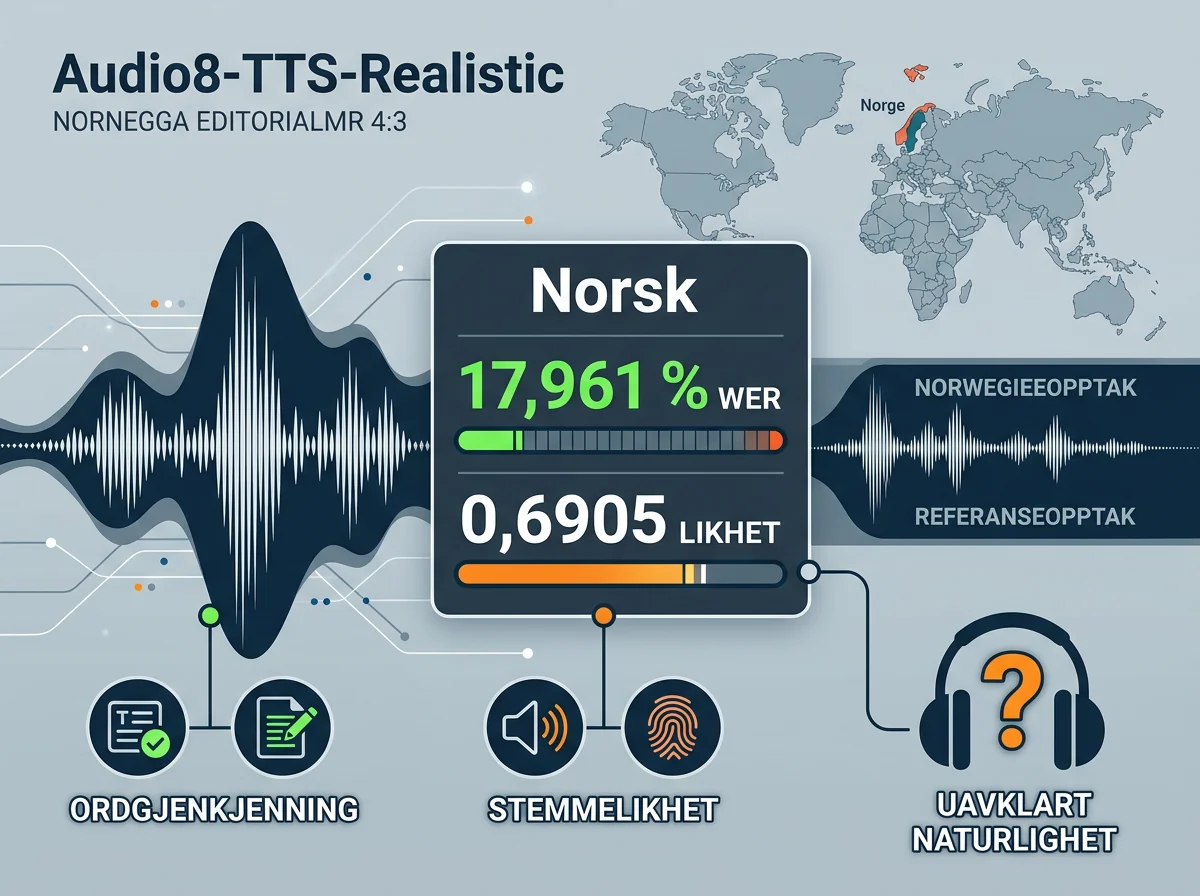
Norwegian is officially listed as one of the 23 supported languages. In Edge0’s CV3 evaluation, Norwegian achieved a word error rate of 17.961% and a speaker-similarity score of 0.6905 across 500 Norwegian items. Those figures prove that Norwegian was included in the evaluation, but they are not a complete assessment of naturalness, pronunciation, or dialects.
Word error rate is measured by transcribing generated speech and comparing the result with the target text. That tells us something about how intelligible the words are to the measuring system. Speaker similarity estimates how closely the output resembles the reference voice. Neither tells us whether intonation, stress, names, numbers, abbreviations, and Norwegian dialects sound natural to a Norwegian listener.
Edge0 warns that quality varies by language and evaluation set. English and Chinese each accounted for about 30% of the supervised fine-tuning data, while every other language contributed no more than 3%. The realism training used Chinese and English prompts in roughly equal proportions. There is therefore good reason not to transfer the claim of improved realism directly to Norwegian.
I have not listened to or tested this model, and the sources do not document a broad human evaluation of Norwegian. It would be wrong to declare that Audio8 sounds natural in Norwegian simply because the language is supported. What we know is that Norwegian appears in both the language list and a concrete machine evaluation. Pronunciation, prosody, and dialect performance remain untested by Norwegian listeners.
How can you run the model locally?
The model can be loaded through Hugging Face Transformers with trust_remote_code=True. You need reference audio, an exact transcript of that recording, and the text you want to generate. The reference should be clean because noise and an inaccurate transcript can reduce both stability and speaker similarity.
The requirement for trust_remote_code=True deserves attention. It means custom Python code from the model repository runs on your machine. Read the files and use an isolated environment before loading a model this way. Open weights do not mean every accompanying line of code should get unrestricted access to the rest of your system.
The official Audio8-TTS repository on GitHub includes command-line inference, batch generation, and an SGLang Omni setup for serving. Its SGLang adapter provides dynamic batching, paged attention, and an OpenAI-compatible speech API. That makes the model more relevant than a pure research demo if you want to build a local service around it.
There is currently no official ONNX export for the Realistic release. The older Preview family has other deployment options, but those cannot be used as evidence for the performance or quality of Realistic. If you want the new realism training, the relevant model ID is Edge0/Audio8-TTS-Realistic-0.6b.
What are the limitations?
Audio8 can mispronounce words, repeat or omit content, or stop too early. Reference audio, its transcript, and the target text share a context of up to 2,048 packed text and audio positions, so long passages should be split into smaller sections. A poor reference recording can also drag the result down noticeably.
Voice cloning requires consent. Running the model locally with open weights does not remove your responsibility to obtain permission to use a voice and to make it clear when audio is synthetic. Copying vocal characteristics may be technically easy. That does not turn every voice into free raw material.
If you need a fully managed service with guaranteed capacity, support, and controlled quality across every language, this is not automatically the answer. The model is most compelling for developers, creative projects, and local deployments where open weights, control over data, and the freedom to build matter more.
Audio8-TTS-Realistic sits in an appealing middle ground: larger than the tiniest speech models, yet compact enough that local zero-shot voice cloning does not have to begin with a multi-billion-parameter model. The Apache 2.0 license and serving tools make that practical distinction more important than another impressive-sounding model card.
My take on Audio8-TTS-Realistic
Audio8-TTS-Realistic is a genuinely exciting release. Not because a model page can attach the word “realistic” to its name, but because Edge0 is publishing a relatively small model with open weights, a usable license, Norwegian language support, and a thoughtful method for training toward more human delivery.
I also appreciate that the model card exposes weaknesses instead of hiding everything behind one average. A Norwegian word error rate of 17.961% is not a number I would put on an advertising poster. It is still far more useful than a vague claim that the model “supports Norwegian” without any Norwegian measurement at all.
My verdict is positive but precise: Audio8-TTS-Realistic looks like a compelling open foundation for local, multilingual voice cloning. It documents that Norwegian is included, but not that natural Norwegian speech has been solved. Do not buy the marketing in advance – and do not dismiss a small model with a serious technical idea behind it.
Frequently asked questions
Is Audio8-TTS-Realistic free to use?
Yes. The code and model weights are released under Apache 2.0, which permits use and modification within the license terms. You still have to cover your own hardware and operating costs, comply with applicable NOTICE requirements, and obtain consent for any voice you clone.
Can Audio8-TTS-Realistic clone a Norwegian voice?
The model supports Norwegian and zero-shot voice cloning from a reference recording with an exact transcript. Norwegian is also included in Edge0’s machine evaluation. There is not enough evidence, however, to promise natural pronunciation across dialects and real recording conditions.
Does Audio8-TTS-Realistic require an NVIDIA GPU?
Edge0 recommends a CUDA-compatible GPU and validated the Transformers version on an NVIDIA H20 using BF16. The model-card example can also select a CPU, but practical CPU speed is not documented for Realistic. No official Realistic ONNX export is currently available.
How long should the reference recording be for voice cloning?
Edge0 does not specify one universal ideal duration in the model card. Use a clean recording with a transcript that matches exactly, and keep the input manageable because the reference audio, transcript, and target text share the model’s context. Noise and transcription errors can weaken stability and similarity.