Innhold Show
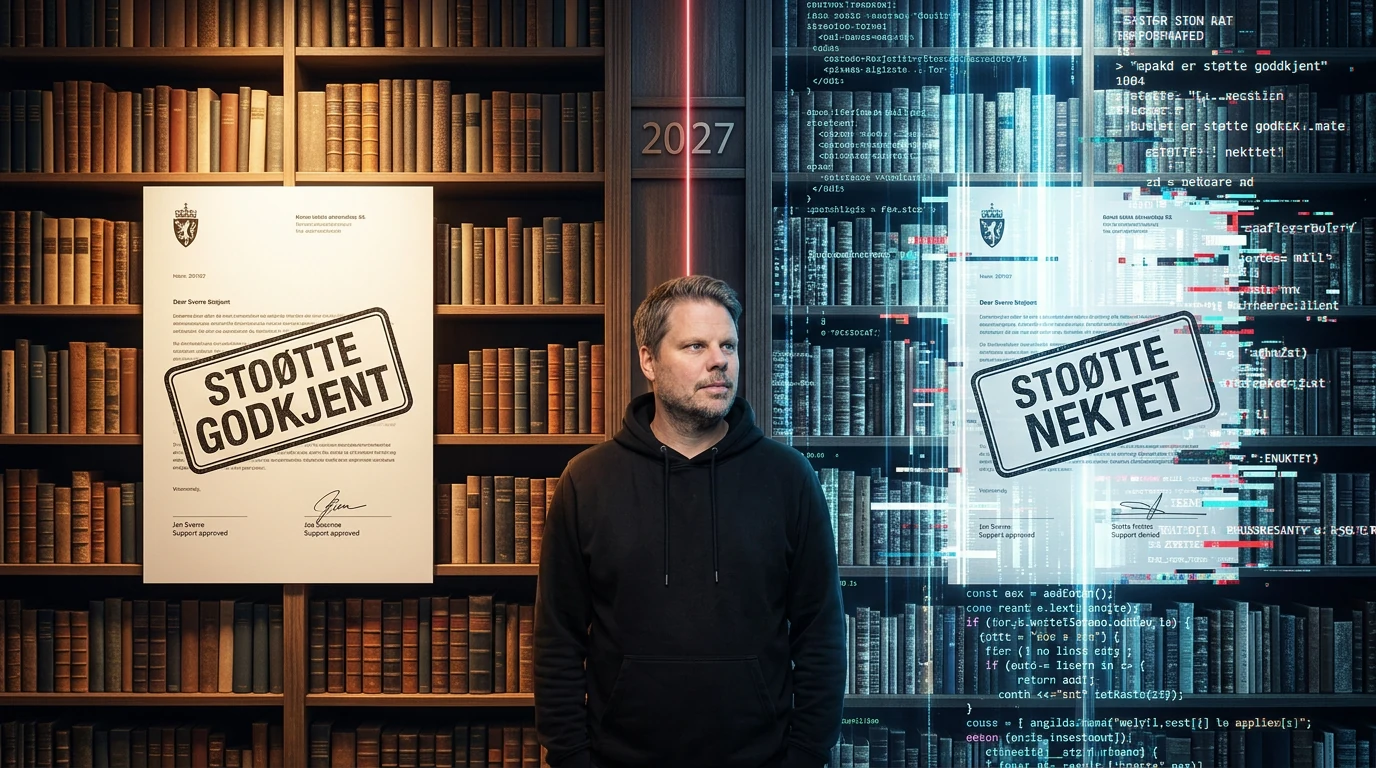
If a finished book contains AI-generated text, translation or illustrations, it could lose access to Arts Council Norway’s literature schemes from 2027. Use AI for proofreading, synonym searches, research, idea development or as a sounding board, however, and the book can still be considered.
That is the essential distinction in the new Norwegian guidelines. This is not a general ban on AI in literature, and nobody is being prohibited from writing, publishing or selling an AI-assisted book. The rules decide which books can be purchased or receive project and production funding through public schemes.
I understand the direction: The money is meant to support human-created work, not mass-produced machine text. But the boundary quickly becomes artificial when one AI-written transition can put an entire book in the same category as a machine-produced manuscript. The state is not exactly famous for handling technological gray areas elegantly, and the control problem may prove at least as important as the neat wording on paper.
What changes for books in Norway from 2027?
From 2027, books created wholly or partly with generative AI will, as a general rule, be ineligible for purchase and funding through Arts Council Norway’s literature production and project schemes. According to the Norwegian Directorate for Cultural Affairs announcement published on October 30, 2026, the guidelines apply across the literature purchasing schemes and the relevant production and project grants.
The rules cover newly written literature, translations and illustrations. If a language model writes text that remains in the published book, the work counts as partly AI-created. The same applies if the model expands a passage, writes a transition, suggests an ending that is retained or modifies elements in an illustration.
Machine translation is included too. If all or part of a text is first translated by software and then revised by a translator, copy editor or editor, the council still regards the result as AI-created. Human editing after the fact does not erase how the translation was initially produced.
Which uses of AI are still allowed?
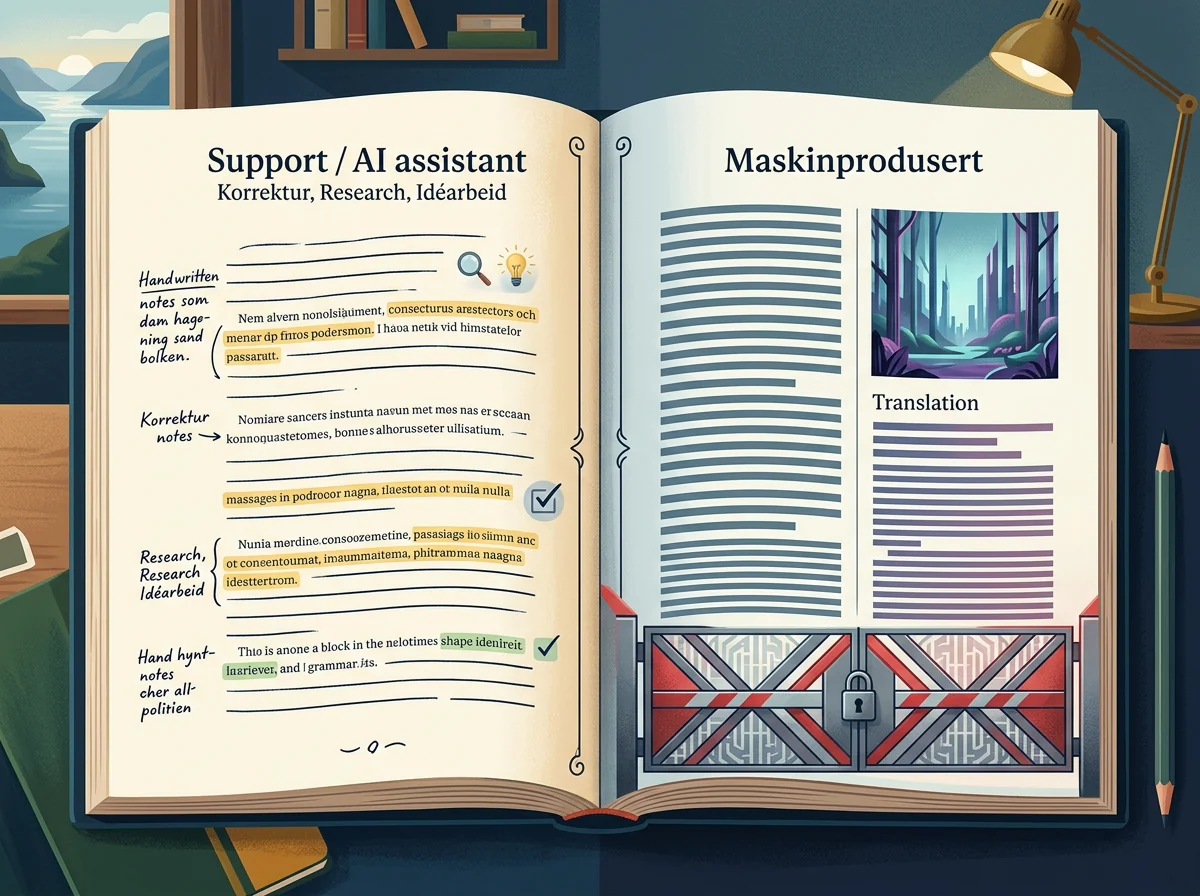
AI can still be used as a support tool without automatically turning the book into an AI-created work. Arts Council Norway specifically lists proofreading, synonym searches, help with grammar and syntax, translation of individual words and expressions, research, idea development and using a language model as a conversational partner.
The decisive question is whether AI supports the author’s own work or whether generated material enters the finished publication. You can ask for alternative words while writing the text yourself. You can use a model to identify questions worth investigating, provided the information is checked. You can discuss an idea. But if the model writes a paragraph that remains in the book, you have crossed the line drawn by the council.
This distinction makes much more sense than a blanket ban on the tool. An author who uses spell-checking, grammar assistance or a sounding board has not handed authorship over to a machine. Private and practical use of AI is legitimate. For these funding schemes, the relevant question is who actually created the text, translation or illustration the reader encounters.
When is a book considered partly AI-created?
The boundary is based on whether generated content becomes part of the publication, not on a stated word count or percentage. Arts Council Norway has not published a minimum threshold. In principle, one retained piece of generated text could therefore be enough for the book to count as partly AI-created.
That makes the rule easy to explain, but not necessarily easy to apply. An author may receive grammar help but not keep a rewritten sentence. A model may suggest ideas but not formulate the transition between them. It may translate an individual expression but not a paragraph that is later heavily revised by a person. Real writing processes contain plenty of cases that do not fit neatly into two boxes.
Norwegian magazine Samtiden’s coverage of the guidelines summarizes the main rule as excluding books with AI-generated text, translation or illustrations from purchasing and literature support. That is accurate. The practical difference between assistance and creation, though, will require more than a short checklist.
Is Norway banning AI literature?
No. The guidelines do not prohibit authors or publishers from creating, publishing or selling books with AI-generated content. They determine which publications Arts Council Norway will support with public funding and purchasing.
That distinction matters. A funding program must be able to set conditions for what it finances. At the same time, exclusion can have serious practical consequences. Arts Council Norway operates eight literature purchasing schemes, and purchased titles are distributed to public libraries across Norway. For a small publisher or a niche title, access to those schemes can matter for both revenue and reach.
This is therefore more than a symbolic statement. The council is using funding as leverage: AI books can still exist in the market, but as a general rule they will not receive this public boost. That is far more accurate than pretending Norway has now “banned AI books.”

What do the rules mean for translators and illustrators?
Translators cannot run all or part of a work through machine translation and then treat the final product as entirely human-created because it was edited afterward. Arts Council Norway looks at how the initial translation was produced, not merely at who performed the last editing pass.
That is close to the position adopted by the Norwegian Association of Literary Translators and the Norwegian Non-Fiction Writers and Translators Association in January 2026. Their guidelines on generative AI state, among other points, that editing AI-generated translations is not considered translation work. They also warn against uploading copyrighted material without the rights holder’s consent.
The same main principle applies to illustrators: AI-generated images in the finished book bring the publication within the restriction. The council also says that modifying elements in illustrations counts. Painting over, compositing or editing an AI-generated starting point may therefore not solve the eligibility problem.
Are there exceptions to the main rule?
Yes, but the exception is narrow. Arts Council Norway says newly written literature may be considered in special cases when the use of AI is well justified on artistic or professional grounds. The technology can therefore be a deliberate part of the work itself, but that choice must be explained and assessed.
The exception does not look like a general escape hatch for ordinary efficiency. Using AI because it is faster or cheaper is not the same as making the interaction between human and machine a documented artistic device. The council has not yet published a catalog of examples that would qualify, so applicants should not read more certainty into the exception than the available guidance supports.
Transparency will matter here. An applicant who used AI in finished text or imagery should describe that use precisely instead of hiding it behind phrases such as “digital processing.” The council says the guidelines may be adjusted as the technology develops. The first cases are therefore likely to shape how this boundary is enforced.
Enforcement is the difficult part
The guidelines clearly state what Arts Council Norway wants to support. The announcement does not explain how the council will determine what happened inside a manuscript, translation or illustration workflow. The enforcement method remains unclear.
The system may end up relying on self-declarations, records of the creative process and investigations when something looks suspicious. That creates an obvious imbalance: The conscientious applicant discloses one retained transition, while the less conscientious applicant simply says nothing. A rule that is easy to evade but strict with those who are open is not particularly elegant.
That does not mean the council should abandon every distinction between human-created and machine-produced literature. It means enforcement must be predictable, proportionate and understandable before a book is submitted. If nobody knows where syntax assistance ends and rewriting begins, cautious authors will avoid useful tools while others simply take their chances.
What should authors and publishers do now?
If a book will be submitted to a purchasing scheme or apply for production or project funding in 2027, the author and publisher should settle their AI policy early. Do not wait until the application is due. Decide which support functions are acceptable in the project, what must not enter the finished publication and how the working process will be documented.
For copyrighted material, you must also check whether the text may be uploaded to the service at all. A literature funding rule does not replace the agreement with the author, translator, illustrator or publisher. Nor does it replace privacy obligations or the AI provider’s terms.
My most useful advice is quite ordinary: Separate help with thinking and language from finished content. Keep control of the text. Document the choices. And if AI genuinely forms part of the artistic expression, say so plainly and explain why. Pretending a generated paragraph was merely “proofreading” is a bad plan.
Arts Council Norway has drawn a clear headline boundary, but creative workflows are messier than the rulebook. The council now has to show that it can apply the distinction without turning every discussion about synonyms into an investigation. Human-created literature deserves protection. Authors also deserve rules that distinguish actual machine production from legitimate use of modern working tools.
Frequently asked questions
Can an author use ChatGPT for proofreading and still receive Norwegian support?
Yes. Arts Council Norway treats proofreading, synonym searches, grammar help and syntax assistance as support functions rather than creation of the book. The boundary is crossed if AI writes or rewrites text that remains in the finished publication.
Do the Norwegian rules also cover AI-generated book illustrations?
Yes. AI-generated illustrations and AI-modified elements in illustrations fall under the main rule. A book containing such material may, as a general rule, be ineligible for purchasing, project funding or production support through the relevant literature schemes.
Can an AI-translated book qualify after a human translator edits it?
As a general rule, no. Arts Council Norway regards machine translation as AI creation even when a translator, copy editor or editor revises the text afterward. Translation of individual words and expressions is listed separately as permitted support use.
Will it become illegal to publish AI-generated books in Norway?
No. The guidelines apply to Arts Council Norway’s purchasing, project and production schemes from 2027. Private parties may still write, publish and sell books with AI-generated content, but those books could lose access to public support and purchasing.