Innhold Show
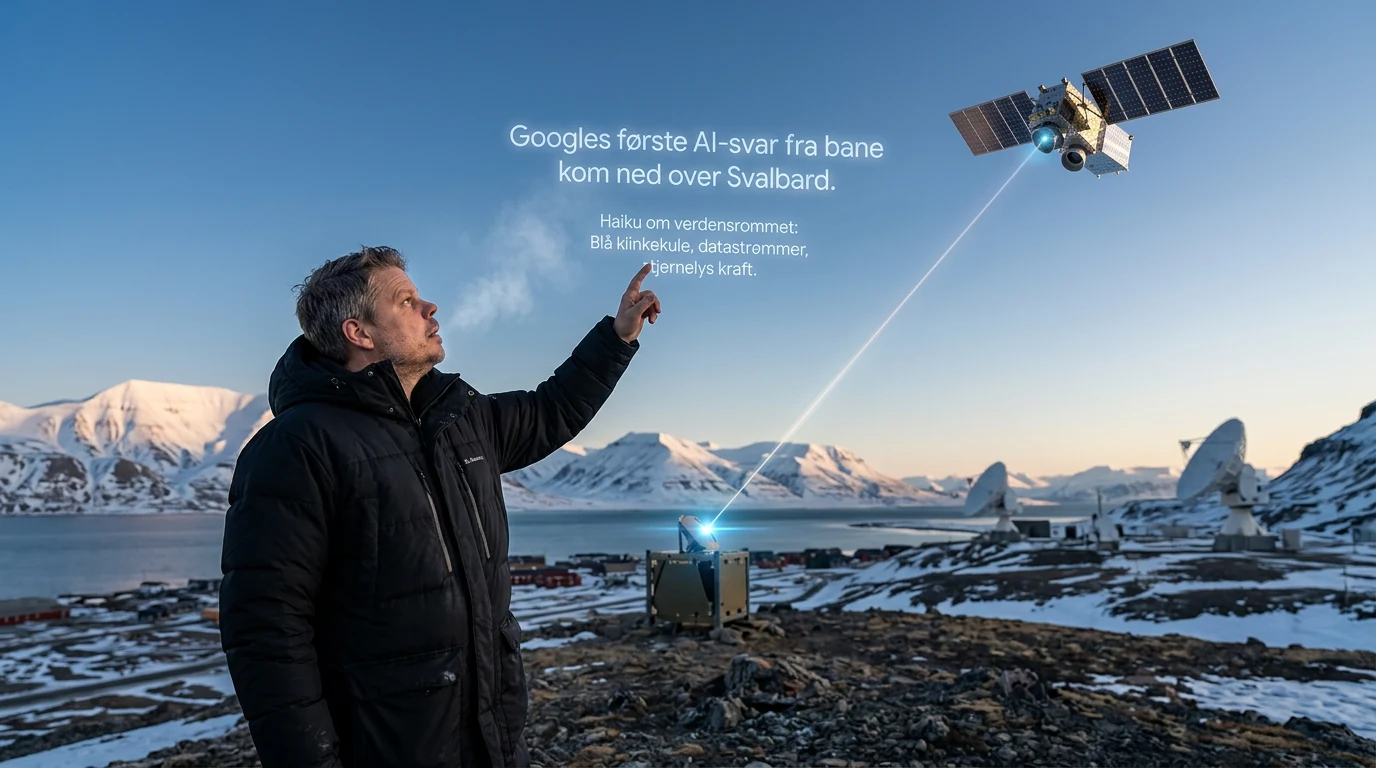
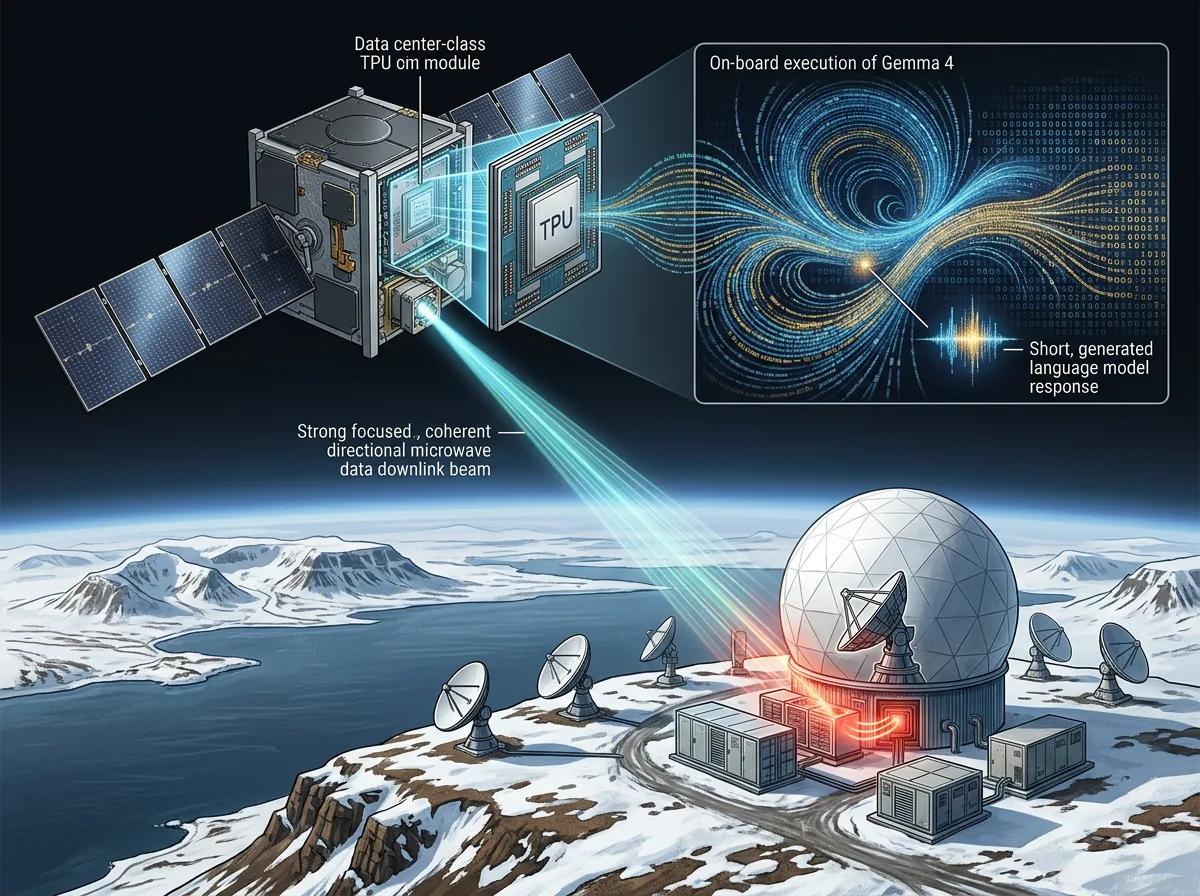
Google’s first AI response from a data center-class TPU in orbit was downloaded while the satellite passed over Svalbard. An open Gemma 4 model was asked to write a haiku about being in space, ran aboard the satellite and sent three short lines back to Earth.
The poem is not the point. The important part is that the entire chain worked: Google uploaded a prompt, the model processed it on the satellite, and the result came back down. It was a tiny workload compared with an AI data center full of accelerators, but it was a wonderfully concrete milestone for Project Suncatcher.
At the same time, it is worth keeping both feet on the ground even when the hardware is in orbit. This test shows that AI inference can run on this prototype in space. It does not show that Google has already solved cooling, radiation, reliable long-term operation, fast links between satellites or the economics of an orbital data center.
What happened over Svalbard?
Google uploaded a prompt to Gemma 4 during a ground-station pass. The model ran aboard a data center-class TPU and wrote a haiku. According to Google’s October 30, 2026 announcement, the response was downloaded as the satellite passed Svalbard, the Norwegian archipelago high in the Arctic.
The response described Earth as a blue marble, data streaming in silence and starlight feeding the system. After the first attempt, the team also tried space-themed limericks and prompts asking about the payload’s telemetry. The milestone therefore rests on more than one text string that happened to appear.
The Norwegian connection is real, but precision matters. Svalbard was below the satellite when the result was downloaded. It did not build the model, processor or satellite, and this was not the first use of any form of AI in orbit. Google’s narrower claim is that this was the first AI response generated by a data center-class TPU in orbit.
That may sound like nitpicking. It is not. Calling this the “first AI in space” would be a much larger and inaccurate claim, because satellites have previously used machine learning for jobs such as image analysis and control. The actual news is that Google moved its own data center technology out of the data center and got it to run a language model in an environment the hardware was never originally designed for.
What did the first AI response prove?
The test proved that the host computer, TPU hardware, model and communications system could work together in orbit. The prototype launched on October 1, and Google spent the following weeks powering up the host and TPU trays and completing early machine learning tests. The haiku was Project Suncatcher’s “Hello World” after that commissioning phase.
It is worth pausing there. A short AI response is a small workload but a substantial system test. A satellite must survive violent vibration during launch, major temperature swings and radiation that can flip bits or damage electronics. Getting the hardware to start and return an actual model output closes the first practical uncertainty.
There is still a very long way from that result to continuous production. Google will now examine how its TPUs perform under thermal stress and radiation exposure over time. One successful haiku cannot tell us how often errors occur, how much useful performance the system can sustain, how much cooling capacity it needs or how long it can operate reliably.
The test also says nothing about training large models in orbit. This was inference: a finished model received an instruction and generated a response. Training is far more demanding because enormous amounts of data and model weights must be distributed across many processors communicating at very high speed. That is the challenge Project Suncatcher ultimately wants to tackle.
Why does Google want to move AI compute into space?
Google is exploring space-based AI infrastructure because satellites in the right orbit can receive almost continuous sunlight. The original Project Suncatcher research estimates that a solar panel in a suitable orbit can produce up to eight times as much power as an equivalent panel on Earth.
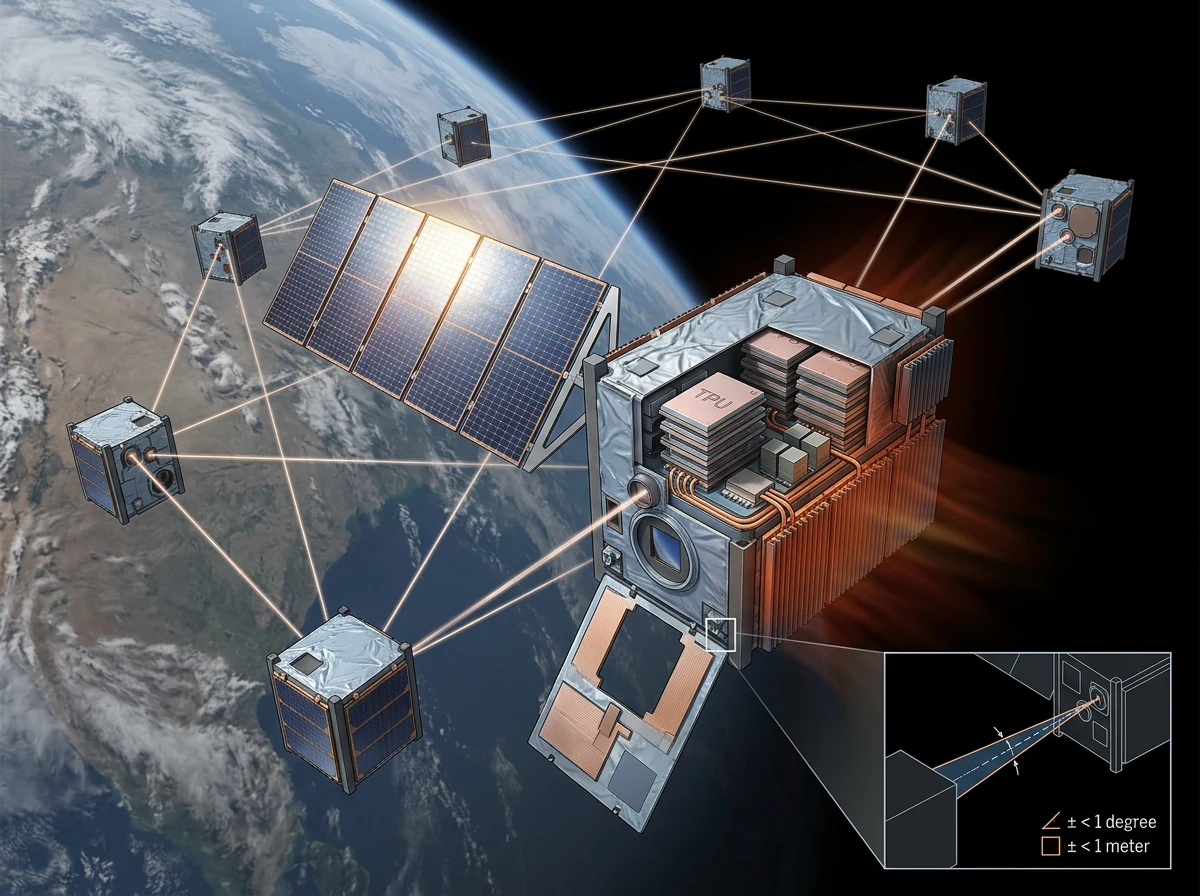
The idea is not one enormous server floating by itself. Google envisions compact constellations of smaller satellites carrying TPUs, solar panels and optical links between the units. Workloads could then be spread across many processors, somewhat like a terrestrial data center, but using laser links through space instead of cables between server racks.
It is a ferociously ambitious design. Large AI systems need both high bandwidth and low latency between processors. Google’s analysis calls for links delivering tens of terabits per second while the satellites fly extremely close to one another with great precision. A ground demonstration has reached 800 gigabits per second in each direction with one transmitter and receiver pair, but space is not an optical bench in a laboratory.
Abundant energy does not make the heat disappear. Data centers on Earth can move heat with air and liquid. A vacuum has no air to carry it away, so the satellite must conduct the heat to radiators and emit it as thermal radiation. The more compute Google packs aboard, the harder that problem becomes. The Sun offers plenty of energy, but it does not include free air conditioning.
Radiation and heat are the next real tests
Radiation can cause temporary computation errors, corrupt data in memory or permanently damage electronics. Before launch, Google exposed Trillium, its sixth-generation TPU, to a proton beam with an energy of 67 megaelectronvolts. The memory system was the most sensitive part and began showing anomalies after a total dose of 2 kilorads.
That was nearly three times Google’s estimate of 750 rads for a shielded five-year mission. The company also reported no permanent failures attributable to total ionizing dose, even at the highest test dose of 15 kilorads on one chip. Those ground results were promising. The prototype in orbit can show how well they hold up when the complete system spends time in the real environment.
Heat is every bit as important. Google has tested cooling systems with heat pipes and radiators inside a thermal vacuum chamber, but the company says some conditions can only be tested in space. Stable AI operation is far more interesting than a brief peak before the hardware has had time to get hot.
That is why I genuinely like this milestone without buying the whole vision in advance. Google did something concrete and measurable. Now comes the part that determines whether Project Suncatcher is the beginning of a new kind of infrastructure or merely an impressive technical demonstration.
The next milestone is two connected satellites in 2027
Google plans to launch two connected satellites in 2027. The goal is to test optical communication between them and find out whether an AI workload can be distributed across hardware flying in formation. That will be a far more important step toward Project Suncatcher’s real vision than asking one model to write a poem.
Precision is the problem. Each satellite must know its own position and the position of its neighbor, point the laser correctly and maintain the connection while both objects move at high speed. Google compares it with hitting a coin-sized target from several kilometers away while both points are moving.
Further ahead, the research describes clusters in which satellites could be only a few hundred meters apart. The analysis suggests that a tight formation might be maintained with relatively modest corrections, but simulation is not the same thing as operating many physical units. Positioning errors, collision risk, maintenance and communication with the ground must all be managed at once.
The economics are uncertain too. Google’s study estimates that launch costs below $200 per kilogram in the mid-2030s could make the energy costs competitive with an equivalent data center on Earth. That is a future projection, not a price Google can order today. The project depends on launches, satellite manufacturing and operations becoming dramatically cheaper.
Svalbard caught a small glimpse of a huge idea
Three lines of poetry from a satellite will not transform the AI market overnight. They do show that Project Suncatcher has moved beyond reports and laboratory tests to working hardware in orbit. This is exactly how enormous technology projects should be judged: one controlled milestone at a time, with a clear line between what has been demonstrated and what remains on the wish list.
The demonstrated part is wonderfully specific. A data center-class TPU survived launch, started in space, ran Gemma 4 and returned the result during a pass over Svalbard. The unproven part is everything required to make the idea useful and economical at scale: sustained workloads, tight formation flight, fast optical links, effective heat removal and many satellites operating as one system.
I think the Svalbard connection is a delightfully Norwegian footnote in a wildly ambitious story. The first response was only a haiku, but the system test behind it was real. Now Google has to show whether the TPUs keep writing after radiation, heat and time have had their say.
Frequently asked questions
Was this the first AI model ever used in space?
No. AI and machine learning have been used aboard satellites before. Google’s narrower milestone was the first AI-generated response from a data center-class TPU in orbit. The specific hardware and end-to-end test matter more than an inaccurate claim about the “first AI in space.”
Which AI model ran on Google’s satellite?
The satellite ran Gemma 4, an open model from Google. The team uploaded a prompt asking for a space-themed haiku. The model processed the instruction aboard the satellite, and the response was downloaded while it passed over Svalbard.
Has Google completed an AI data center in space?
No. The current prototype shows that one satellite can run simple inference on a TPU in orbit. Google still needs to demonstrate reliable operation under heat and radiation, fast links between satellites, precise formation flight and economics that can compete with infrastructure on Earth.
What will Project Suncatcher test next?
Google will measure how the TPUs handle thermal stress and radiation over time. In 2027, it plans to test two connected satellites with optical communication and distributed AI workloads. That will be the next practical test of whether the concept can scale.