Innhold Show
Google AI Search is making people search more, but Google still monetizes AI Mode at a lower level than traditional Search. That is the uncomfortable crack in an otherwise very strong quarter for Alphabet.
Search query growth reached its fastest rate in five years, and Google says its AI investments helped drive that growth. At the same time, revenue growth for Google Search & other slowed from roughly 17 percent in the second quarter to 12 percent in the third quarter of 2026. More questions do not automatically produce equally valuable ad revenue.
This does not mean Google Search is collapsing. The business still brought in $63.35 billion in three months. But The Verge identified a real gap between usage growth and revenue growth: Google has made AI a popular part of Search, but it has not yet shown that AI Mode can monetize as effectively as the familiar page of ads and blue links.
What do Google’s Search numbers show?
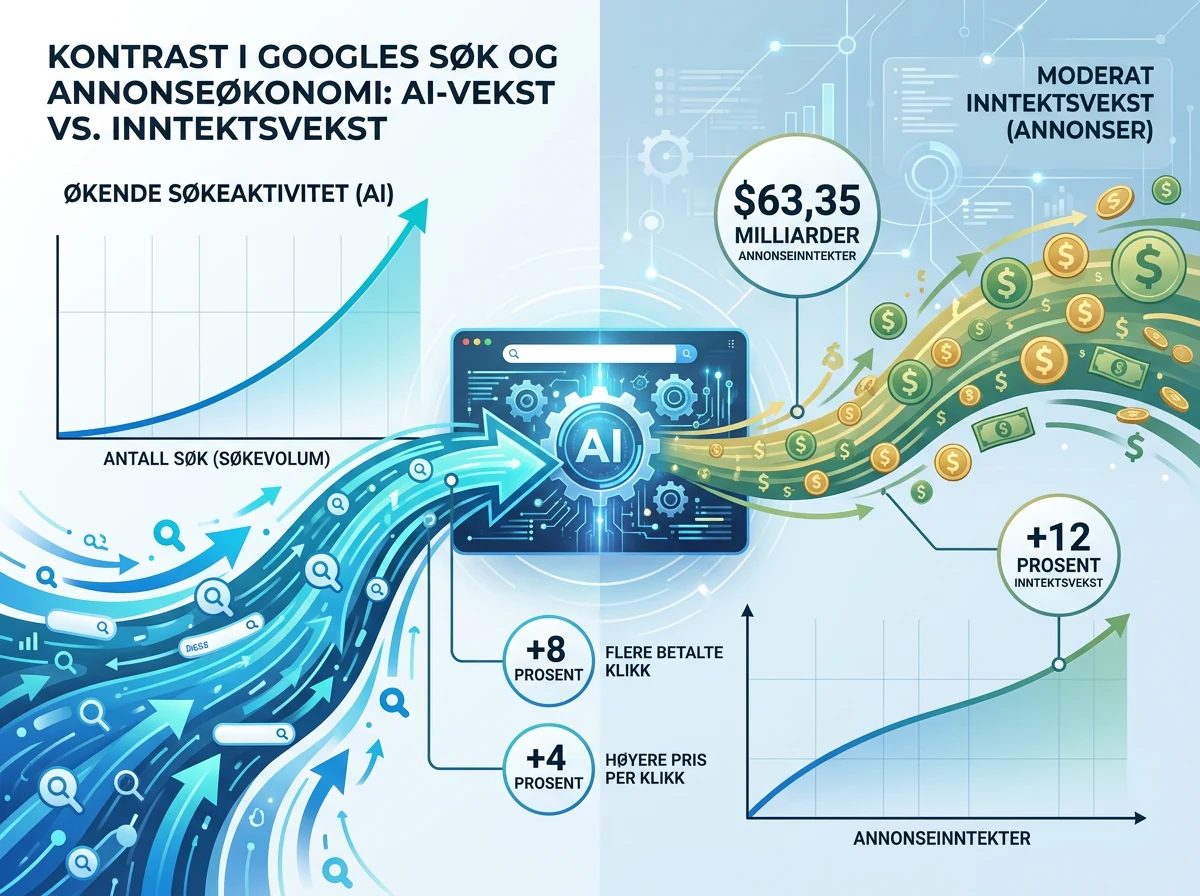
Google Search & other generated $63.35 billion in the third quarter of 2026, up 12 percent from the same period a year earlier. Paid ad clicks rose by 8 percent, while the average cost per click increased by 4 percent. Those are strong numbers by any reasonable standard.
They also show just how much Alphabet still depends on its established Search engine. Google Search & other accounted for almost half of Alphabet’s total quarterly revenue of $127.6 billion. In other words, the AI expansion is being funded by an advertising machine that already works extremely well.
The problem is the pace. Search revenue grew by roughly 17 percent year over year in the second quarter, but by 12 percent in the third, even as Alphabet reported its fastest query growth in five years. Revenue was still rising, but it was not keeping up with the story Google could tell about usage.
Alphabet’s quarterly filing confirms the 8 percent increase in paid clicks and the 4 percent rise in cost per click. It does not report separate revenue for AI Overviews or AI Mode, so nobody outside Google can calculate exactly what an AI query is worth compared with a traditional Search query.
Why does AI Mode earn less?
Google currently monetizes AI Mode at a lower level than traditional Search. Google is expanding ads in its conversational Search experience, but it has not shown whether the gap is merely the result of a cautious rollout or evidence of a more fundamental problem with advertising inside AI answers.
Traditional Google Search is built around commercial intent. If you search for a hotel, a contractor or a new phone, Google can place an ad at the exact moment you may be ready to buy. The advertiser pays for the click, and Google has spent decades refining the placement, auction and measurement behind it.
AI Mode behaves differently. You can ask a long question, receive a synthesized answer and continue through several follow-ups. That can be a better experience for complicated questions, but a conversation does not always contain one obvious place for an ad. Insert too many and the helpful assistant starts to sound like a salesman who has had a little too much coffee.
Google says its ad experiments have produced promising results, and it is scaling ads in both AI Overviews and AI Mode. It is also expanding AI Mode ads internationally and testing multi-turn ads in the United States. Yet the most important admission remains in Alphabet’s own earnings call: rapid AI Mode query growth affected Search growth because monetization in AI Mode was lower.
Has Google monetized AI Search as well as traditional Search?
Not yet, based on Google's own description – but it has not published enough data to compare profitability directly. The company says most AI Mode queries are incremental and many happen early in the purchase journey. That suggests AI can expand how people use Search, but Google has not disclosed figures showing that AI Mode produces the same revenue per query, the same paid-click performance or the same profitability as traditional Search.
That distinction matters. Google can fairly say that its AI investments are contributing to more searches. It can also point to double-digit Search revenue growth. Both claims are true. But when query growth is the strongest in five years while revenue growth slows, it is far too early to declare the monetization problem solved.
Google is still in a better position than almost any other AI company. It does not need every new AI query to make money immediately. Its existing advertising business gives it time to test formats, move users gradually and learn which kinds of conversations eventually lead to a purchase.
Distribution has already done its job. Google can place AI Overviews and AI Mode inside a Search product that billions of people already know. It does not have to persuade the world to adopt an entirely new service first. But distribution solves access and usage. It does not automatically solve the economics.
Does slower growth mean AI is eating Google’s Search business?
Not necessarily. The quarterly numbers show that rapid AI Mode growth and lower monetization in that format are connected, but they do not prove that AI caused the entire decline from roughly 17 percent to 12 percent revenue growth.
Alphabet said foreign exchange was the single largest reason for the slowdown from the second quarter. It also pointed to industry-specific changes, including weaker spending patterns in parts of retail and a return to more normal media and entertainment spending after an unusually strong quarter. Geography, product mix, advertiser demand and comparison periods all affect the result.
There are two easy ways to get this wrong. One is to say AI is destroying Google’s business because growth slowed for one quarter. That does not fit a Search operation growing by 12 percent and generating more than $63 billion. The other is to repeat Google’s record-query-growth message and pretend the money question has already been answered. That does not fit Google’s own admission that AI Mode monetizes at a lower level.
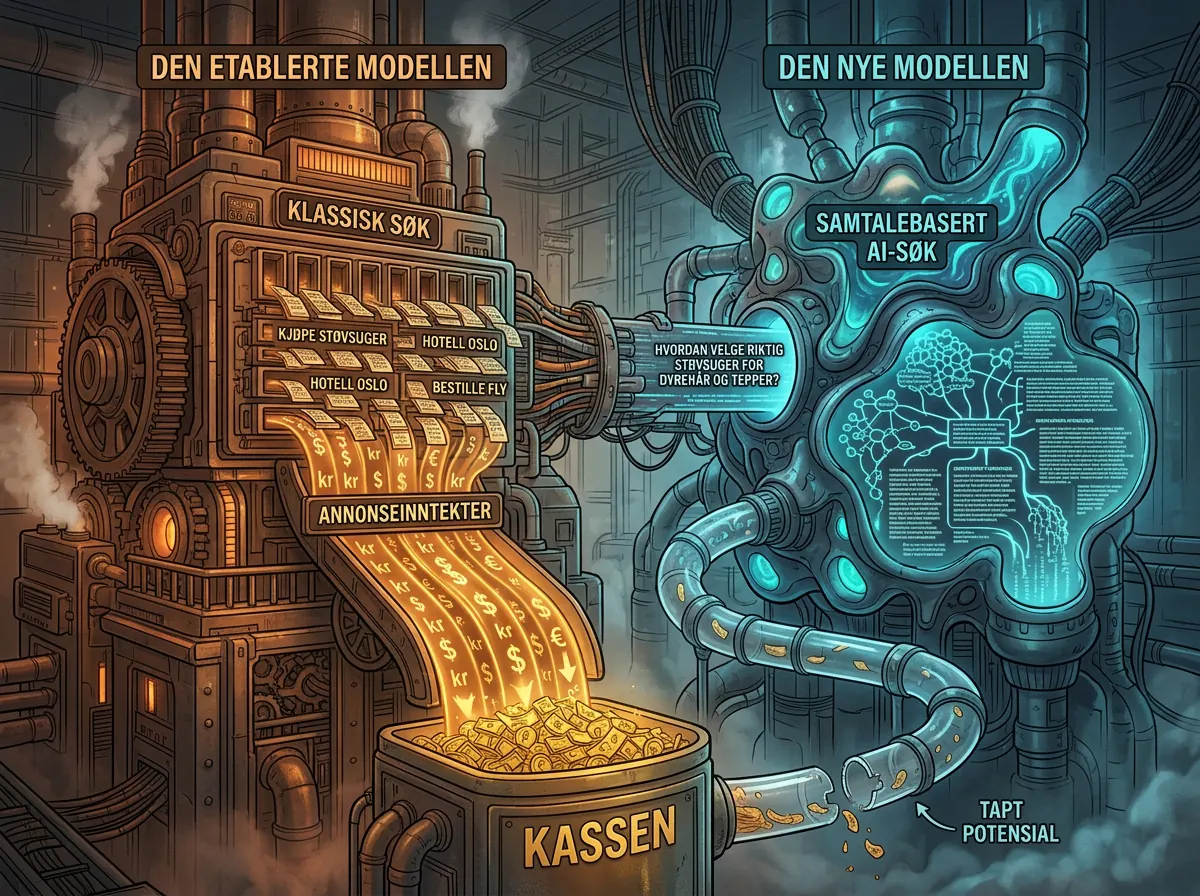
The honest reading sits right there in the numbers: AI is increasing Search usage while changing the advertising inventory Google can sell. The old machine remains enormous and profitable. The new machine is attracting more users, but the connection to the cash register is still a work in progress.
This is not only Google’s problem. The entire AI industry needs to work out how expensive answers, long conversations and agentic tasks can be financed without drowning the product in ads or costly subscriptions. Google has more advertising expertise, more data and more distribution than almost anyone. That is exactly why it matters when even Google has not fully solved this.
What does this mean for websites and small businesses?
More Google searches do not automatically mean more website traffic or more customers for small businesses. When AI Overviews and AI Mode answer questions directly, users can remain inside Google for longer. A business may be mentioned, evaluated or used as a source without receiving a measurable referral click.
Advertisers should also read the familiar metrics more critically. An increase in paid clicks is positive, but it does not tell us how ads inside AI Search perform. Google has not published separate click-through, conversion or pricing figures for AI Mode. Until it does, nobody should assume that an ad inside an AI conversation has the same value as an ad above a clearly commercial query.
For publishers and other content producers, the question is even more direct: who captures the value when Google uses material from the web to create a complete answer? The new Search experience may provide visibility, but visibility does not pay the server bill when the reader never visits the site.
I would follow several signals together: organic traffic, branded searches, direct visits, genuine inquiries and completed sales. Search Console can show the impressions and clicks a site receives, while Google Trends can indicate wider market demand. Neither one alone reveals the whole customer journey when an AI answer sits between the question and the website.
What should you watch next?
First, watch whether Search revenue growth accelerates while AI Mode continues to expand. That would be the clearest evidence that Google has learned to earn more from conversational searches, rather than merely getting people to use them.
Second, look for separate numbers for AI Mode and AI Overviews. As long as Google combines everything inside Google Search & other, it is difficult to distinguish progress in the old advertising engine from progress in the new AI formats. “Promising experiments” sound good on an earnings call. Paid clicks, cost per click, conversion, revenue and operating cost will tell us whether the model truly works.
It is also worth watching how aggressively Google expands advertising inside AI answers. Too few ads mean weaker revenue. Too many could make the answers less useful and weaken trust. Google needs to find the point where the conversation still feels like help while also paying the bill. That is not a small design challenge.
I would not write Google off. Doing so would be rather reckless when its Search business is still growing by 12 percent and generating roughly $63 billion in a quarter. But I would not let record query growth be presented as proof that the AI economics are solved, either.
Google has already shown that it can bring AI to an enormous audience. Now comes the harder test: making the new experience as valuable to the business as it is popular with users. Google has brought people into the new store. The cash register is still lagging behind.
Frequently asked questions
Does Google monetize AI Overviews and AI Mode?
Yes. Google shows and tests ads in both formats, but it does not publish separate revenue or profitability figures for them. In the third quarter of 2026, the company said AI Mode still had lower monetization than traditional Search.
How much did Google Search earn in the third quarter of 2026?
Google Search & other generated $63.35 billion, up 12 percent from the same quarter a year earlier. Paid clicks increased by 8 percent and the average cost per click rose by 4 percent.
Why are ads harder to place in an AI search?
An AI search can become a long conversation without one obvious buying moment. Google must place relevant, profitable ads without making the generated answer feel purchased or constantly interrupted. That balance is less mature than the advertising model behind traditional Search.
Should businesses change how they measure Google traffic?
Yes. Continue tracking rankings and clicks, but also watch branded searches, direct traffic, inquiries and sales. AI answers may influence a customer without sending a conventional referral click, so organic traffic alone no longer shows the full effect.