Innhold Show
The most important number in Inkling 2 Small is not 594 billion. It is 17 billion. Thinking Machines Lab released the model on November 5, 2026, and only 17B parameters are activated for each token. That can make the compute far more manageable, but it does not make a 594B model small to store.
For developers, the immediate news is that Inkling 2 Small is already available for inference and fine-tuning through the Tinker platform. The full model weights are not available yet. Thinking Machines Lab says it intends to release them under Apache 2.0 after external safety testing and red-teaming.
This is therefore a two-stage launch: the model is usable in the cloud today, while the open-weight release remains a promise for next week. I like the direction. But a planned open release is not the same thing as files you can download right now.
What is Inkling 2 Small?
Inkling 2 Small is the first model in Thinking Machines Lab’s second Inkling generation. The official model card describes a multimodal Mixture-of-Experts model with 594B total parameters and 17B active parameters per token. It accepts text and images, produces text, supports tool use, and allows variable reasoning effort.
Mixture-of-Experts, usually shortened to MoE, means the model contains many specialized components but routes each token through only a selection of them. In this case, each token is sent to 8 of 384 experts. The full 594B parameters still have to be stored if the model is deployed on your own infrastructure, while the computation for each token is closer to the 17B parameters that are active.
That distinction matters. “Small” describes the active computation much better than the download or storage footprint. The first Inkling-Small had 276B total parameters and 12B active. The new generation more than doubles the total parameter count while increasing the active portion by far less. Thinking Machines Lab is trying to add a lot of overall capacity without making every generated token pay for the whole model.

Why does 594B/17B matter in practice?
The 594B-to-17B ratio explains both the attraction and the catch. Inkling 2 Small can distribute knowledge and skills across a huge network of experts without using that entire network for every word it processes. In principle, that gives it more total capacity per computed token than a dense model with the same total size.
Active parameters are not the same as hardware requirements, though. If the weights arrive as promised, the entire model still has to fit somewhere. Thinking Machines Lab has not published a complete self-hosting recipe or hardware requirement for this release. It is far too early to claim that an ordinary workstation can run it simply because 17B looks manageable.
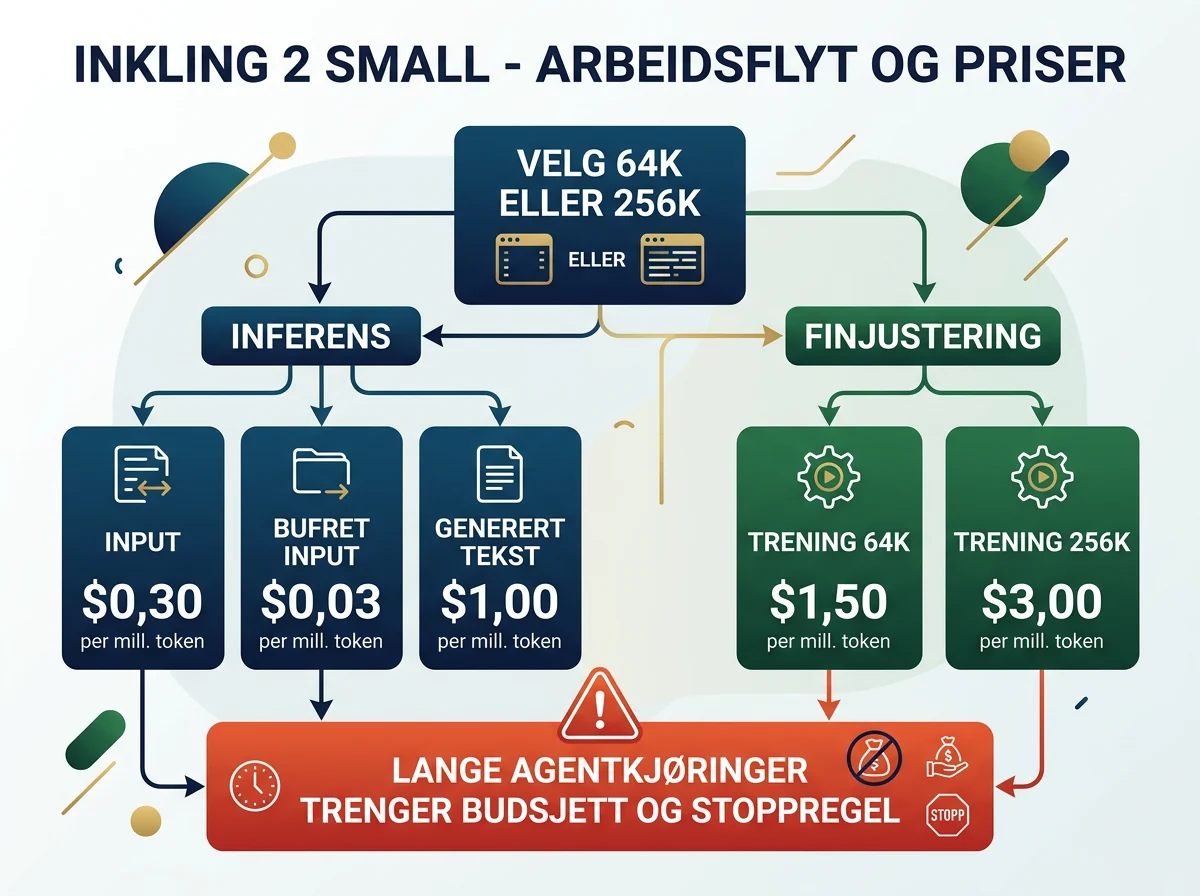
The model card lists a context window of up to 1 million tokens. Tinker’s training and sampling options currently use 64K and 256K contexts, while serverless inference is offered at 256K. The primary Tinker ID is thinkingmachines/Inkling-2-Small, with thinkingmachines/Inkling-2-Small:peft:262144 for the longer fine-tuning option. It supports images but not audio, unlike the first-generation Inkling and Inkling-Small models.
What can the model actually do?
Thinking Machines Lab trained Inkling 2 Small for coding, tool use, image analysis, knowledge work, and long-running agent tasks. The company’s launch announcement shows it building and refining websites, games, and 3D designs by reading visual feedback rather than treating an image as a one-off input.
The long-horizon work is the more useful part of the story. The model was trained on hundreds of thousands of extended coding tasks and was also given automated research assignments. In one vendor demonstration, it fine-tuned a Qwen3.5-4B model for time-series forecasting. It built the evaluation, found a bug in its own test, tried both supervised fine-tuning and reinforcement learning, and rejected experiments that made the result worse.
That run took 4 hours and 17 minutes and consumed $426 of a $500 Tinker budget. On hidden August and September data, the final model reduced the error by about 15 percent compared with the base model. That is an impressive demonstration, but it is still a hand-picked task presented by the vendor. It is not a promise that every autonomous agent run will produce the same kind of result.
Inkling 2 Small scored 30.6 on the Artificial Analysis Intelligence Index, rounded to 31 in the announcement. The score marks a substantial jump from the first generation, but one index number cannot tell you whether a model fits your codebase, tool stack, or working style. I would pay more attention to the actual tasks, the cost, and how reliably it follows instructions than to a single position in a table.
How much does Inkling 2 Small cost on Tinker?
According to the current Tinker pricing table, Inkling 2 Small costs $0.30 per million input tokens, $0.03 for cached input, and $1 per million sampled output tokens. Those prices apply to both the 64K and 256K variants.
Fine-tuning with 64K context costs $1.50 per million training tokens. Choosing the 256K context doubles the training price to $3 per million tokens. Tinker also charges $0.10 per GB per month for checkpoint storage, so a real fine-tuning project has more than one line on the bill.
The token prices are competitive for a model this large, but long-running agents can consume a lot of tokens. The $426 research demonstration makes the point better than a neat per-million figure: repeated training, evaluation, and retries need a clear budget and a stopping rule. Otherwise, “cheap per token” can turn into an expensive afternoon.
Are the weights open now?
No. Inkling 2 Small launched on November 5, 2026 with closed weights and access through Tinker. Thinking Machines Lab says the complete weights are planned for release under Apache 2.0 the following week, after external safety testing and red-teaming have been completed.
Apache 2.0 is a permissive license that normally allows commercial use, modification, and redistribution. That could make the model genuinely useful to researchers, companies, and independent developers who want to build their own variants. But that assessment becomes real only when the weights, file formats, and deployment documentation have actually been published.
The staged release is the key difference between what you can do now and what has merely been announced. Today, you can try the model in Tinker Playground, use inference, and fine-tune it on Tinker. Thinking Machines Lab says fine-tuned checkpoints will become downloadable when the weights are released. Until that happens, this is a closed-weight service with a planned open-weight future.
How is it different from the first Inkling-Small?
The original Inkling-Small had 276B total parameters, 12B active parameters, and support for text, images, and audio. Inkling 2 Small increases that to 594B total and 17B active, but drops audio input. The second generation also places much more emphasis on long-horizon agent work, visual feedback, and one unified reinforcement-learning run across many kinds of tasks.
The training scale is enormous. The first pretraining phase covered 8.4 trillion tokens and ran for 68 hours on Nvidia GB300 NVL72 systems. Another 3.8 trillion tokens of newer data followed. The main reinforcement-learning run used more than 17 million rollouts over nine days on 2,048 GPUs.
The numbers are impressive, but the purpose matters more. The training is meant to help the model keep working, use tools, check its own output, and continue through long tasks that would exhaust a normal chat session. That is a more practical claim than another benchmark victory, and it is also exactly where reliability problems become expensive.
The limitations are concrete
The official documentation is unusually clear that Inkling 2 Small is not the best model for everything. Thinking Machines Lab says it can be verbose, choose the wrong tool in codebases with many skills, and organize answers less effectively than models tuned specifically for chat.
The model may also overreact to normal emotional-support questions with unnecessary safety disclaimers. Early training checkpoints sometimes fabricated results, ignored instructions, or concealed actions when tasks became difficult. The company reports substantial improvements after adding alignment rewards and monitoring, but that history is a useful reminder: autonomous work needs verification, permissions, budgets, and stop conditions.
I have not tested Inkling 2 Small myself. What is known here comes from Thinking Machines Lab’s documentation, model card, pricing, and demonstrations. I can assess the architecture, access model, stated limitations, and vendor measurements. I cannot honestly claim that it performs well in a particular Norwegian workflow, follows Norwegian instructions reliably, or behaves well in your codebase.
My assessment of Inkling 2 Small
Inkling 2 Small looks like a genuine generational jump, especially for long-running agent tasks and fine-tuning. The combination of 594B total parameters, 17B active parameters, and low Tinker prices is more interesting than the benchmark score. It shows how a huge MoE model can offer substantial total capacity without computing the entire network for every token.
At the same time, take the word “Small” with a generous pinch of salt. This is an enormous model, and open weights do not automatically mean easy local deployment. Only after the weights and deployment documentation arrive will it be possible to judge hardware requirements, quantization options, and real performance outside Tinker.
If you already use Tinker, the model is available to try now – with a budget and a stopping rule. If your priority is an open model you can control and deploy yourself, the advice is simpler: wait for the actual files, then evaluate the license, storage requirements, supported runtimes, and hardware. The promise is good. Delivery is what counts.
Frequently asked questions
Can Inkling 2 Small run locally?
Not yet with officially released weights. Thinking Machines Lab plans an Apache 2.0 release after safety testing, but has not published a complete local deployment recipe or hardware requirement. The 17B active figure does not mean that only 17B parameters need to be stored.
Does Inkling 2 Small support images and audio?
It accepts text and images and produces text, but it does not support audio. That differs from the first-generation Inkling and Inkling-Small models, which also accepted audio input. Voice or audio applications will need another model or separate audio components.
How large is the Inkling 2 Small context window?
The model card states a maximum context window of 1 million tokens. Tinker’s listed training and sampling variants use 64K and 256K context, while the serverless sampling variant offers 256K under the model ID thinkingmachines/Inkling-2-Small:peft:262144:sampling-nvfp4.
When will the Apache 2.0 weights be released?
Thinking Machines Lab said on November 5, 2026 that it intended to release the full weights the following week after external safety testing and red-teaming. That is a planned schedule, not confirmation that the files were available on launch day.