Innhold Show
If you need to turn a long meeting recording into text, Nvidia has released a model that can do far more than write down the words. Nemotron 3.5 Transcribe can process recordings up to one hour long, separate speakers, create timestamps, translate speech and answer questions about the audio.
The most important limitation needs to be clear from the start: This is an offline model for completed recordings. It cannot listen to a live audio stream and respond as the conversation unfolds. That makes it relevant to meetings, media archives, customer calls and documentation – not the real-time ears of a voice agent that must react while you speak.
Nvidia released the model on October 28, 2026 with open weights and support for 40 languages. It is an exciting package for developers who want to control transcription themselves. At the same time, “40 languages” is a rough headline that hides enormous differences in quality. For Norwegian users in particular, the documentation is far less convincing than the launch headline.
What is Nemotron 3.5 Transcribe?
Nemotron 3.5 Transcribe is an open-weight speech and audio model that combines automatic speech recognition with a language model. Nvidia’s model card lists 40 languages, recordings up to one hour and a 65,536-token context window. The model accepts audio, text instructions and optional context as input.
The name includes 30B-A4B, but the complete system is larger than that label may suggest. Hugging Face lists about 34 billion parameters in total, with approximately 4.3 billion active during inference. That is possible because of a mixture-of-experts architecture in which only parts of the model process each token. The audio encoder is included in the active parameter count.
This is not just another form of basic dictation. You can request verbatim or cleaned-up transcription, word-level timestamps, speaker labels, language identification and translation. You can also give the model a list of specialist terms or names as context. That could be useful when a meeting covers products, medicine or technical terms that ordinary speech recognition tends to chew into nonsense.

What can the model do with a recording?
The biggest practical value is that several processing stages can be combined in one model. A meeting recording can be transcribed with speaker labels and timestamps, while the text instruction controls whether the result should be verbatim or cleaned up. Nvidia also describes event tagging, language identification, personally identifiable information redaction and questions about the content of the audio.
TechCrunch reports that the model can translate 31 languages to and from English and distinguish as many as eight speakers. That makes it relevant to meeting minutes and interviews where one undifferentiated block of text is not enough. Speaker diarization does not mean the model knows who the people are, though. It separates the voices as speaker 0, speaker 1 and so on.
The published results look strong across several English and multilingual tests. Nvidia reports an average word error rate of 4.71 percent across nine English datasets and 10.98 percent on a long-form test. On multi-speaker tests, the average is 15.80 percent cpWER, a metric that considers both the words and the speaker to whom they were assigned. These are useful technical signals, but they do not guarantee the same performance with your microphones, accents or specialist vocabulary.
Why does it not work with live speech?
Nemotron 3.5 Transcribe processes a recording as a completed audio input. Nvidia explicitly says that internal audio chunking does not turn the model into streaming ASR. It may process the audio extremely quickly after receiving it, but high throughput and genuine streaming are two different things.
You feel that difference when someone interrupts a voice agent. A streaming model must continuously accept small pieces of audio, maintain context and return provisional text with low latency. Nemotron 3.5 Transcribe is built to analyze a recording, not to drive a conversation as it happens.
That does not make offline processing old-fashioned or inferior. A long recording gives the model more context, and many jobs benefit more from a carefully processed final result than from seeing the first sentence appear before the second has been spoken. For meetings, podcasts, customer calls and archives, accuracy, speaker labels and context may matter more than immediate partial text.
How well does Nemotron work with Norwegian?
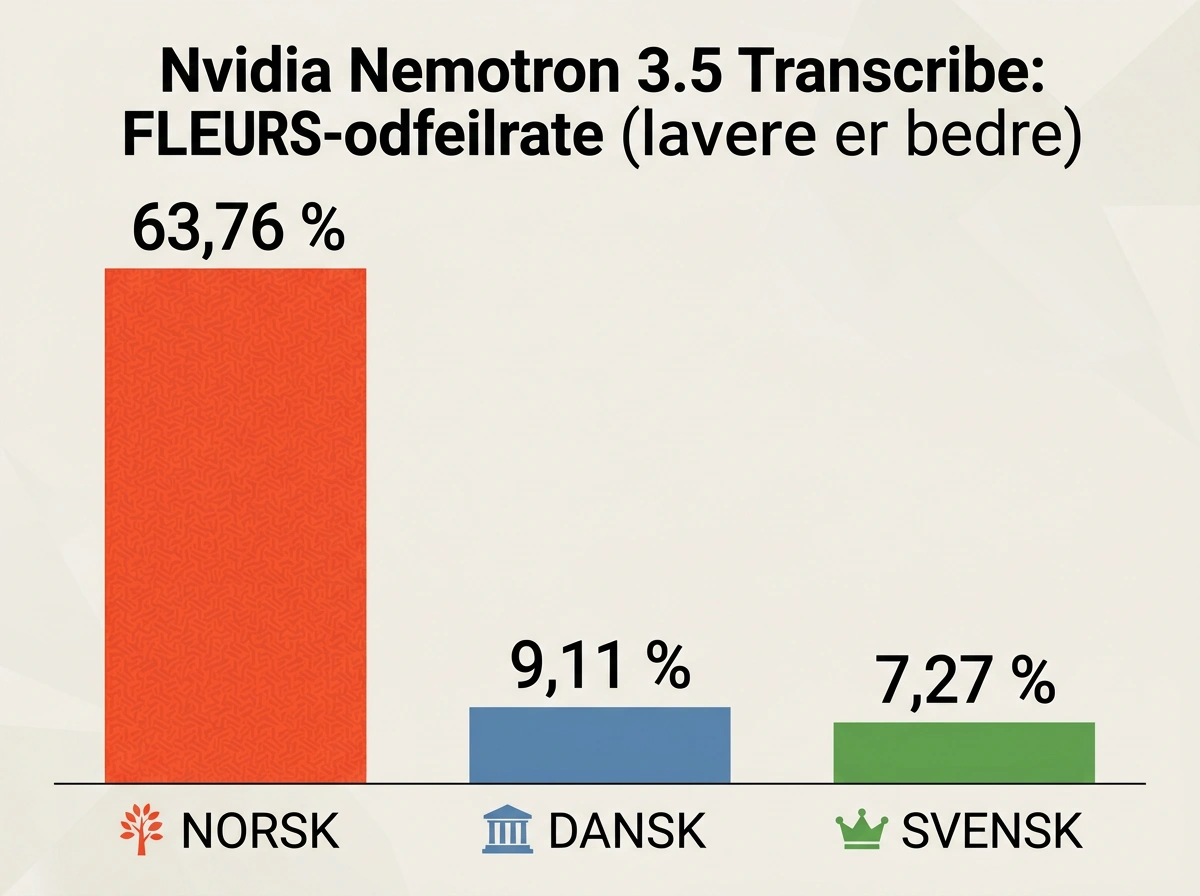
Nvidia includes Norwegian among the 40 languages, but its documentation does not support the claim that the model is good at Norwegian. In the language matrix, Norwegian sits in the lowest tier, “Supported,” which Nvidia explains may require fine-tuning. The fields for Norwegian ASR, speech translation, multi-speaker transcription and code-switching are not specified.
There is one concrete transcription figure: Nvidia’s FLEURS evaluation shows a 63.76 percent word error rate for Norwegian. Lower is better, and that result is dramatically worse than Danish at 9.11 percent and Swedish at 7.27 percent in the same table. The model card does not explain exactly why the Norwegian result is so poor.
The model also has Norwegian speech-translation results, but a translation test does not document strong Norwegian transcription. It tells us nothing reliable about Norwegian dialects, noisy meetings or overlapping speech either. I have not tested this model myself, so the honest assessment is straightforward: Norwegian appears in the material, but Nvidia’s own numbers are not good enough for me to choose it for Norwegian production without a proper evaluation on the organization’s actual recordings.
Can you run the model locally?
Yes. The weights are available in BF16, FP8 and NVFP4, and the model can be used commercially or non-commercially under the OpenMDW 1.1 license. Open weights do not mean every computer is a sensible target, however. Nvidia’s documented vLLM setup uses one H100 with 80 GB of memory, and that is the configuration developers can rely on the quick start to cover.
Nvidia says an optimized NIM build running on one RTX PRO 6000 Blackwell Server Edition GPU can process up to 2,238 seconds of audio per second and return a 30-second recording in 0.13 seconds. That is tremendous throughput. But the company also states that these optimizations were not included in the open-source release at launch and that the NeMo Speech integration was expected to be roughly twice as slow.
The model can be served through an OpenAI-compatible endpoint with vLLM or run directly with Hugging Face Transformers. Nvidia maintains the speech integration in NeMo Speech, while the model card provides the commands and recommends temperature 0 with reasoning disabled for transcription. For a business, local deployment means more control over audio files, but it also means responsibility for GPU capacity, security, logging and maintenance.
Who is the model actually for?
Nemotron 3.5 Transcribe is best suited to workflows with many completed audio files that need more structure than plain text. Meeting platforms can use speaker labels and timestamps. Media companies can make long recordings searchable. Contact centers can analyze conversations after they end, and specialist organizations can supply a vocabulary list to help the model with names and terminology.
It is a poor fit when the primary requirement is a responsive voice agent. That job needs a streaming model and a complete chain for interruptions, turn-taking and low latency. Nvidia’s model may still improve documentation or analysis after the call, but it does not replace the real-time component.
Norwegian organizations face an additional decision before they even get to the hardware: Is the quality good enough for the audio they actually have? The published Norwegian FLEURS result says no to assuming that it is. A limited evaluation should measure word errors, names, numbers, technical vocabulary and speaker changes on representative recordings. Only then can you compare its cost and quality with a smaller model or a hosted API.
My assessment of Nemotron 3.5 Transcribe
This is a serious model for offline audio work. An hour of audio context, instruction-controlled transcription, speaker labels, timestamps and the ability to ask questions about a recording give developers a lot to build with. The availability of several weight precisions and a familiar API format also makes it more practical than a research demo.
But Nvidia has not released a direct ElevenLabs competitor for live conversations. The word “voice” now covers so many different things that it easily turns into mush. Nemotron 3.5 Transcribe is essentially a very powerful document reader for audio files. That is useful. It is simply not the same thing as a voice agent that hears you here and now.
For Norwegian, my verdict is simple: The documentation is too weak. The language is on the list, but a 63.76 percent word error rate in Nvidia’s own FLEURS evaluation is not a minor footnote. Until better Norwegian evidence or solid independent testing appears, judge the model by the strength it has actually documented: advanced processing of long recordings, particularly in languages where Nvidia shows production-ready results.
Frequently asked questions
Is Nemotron 3.5 Transcribe free to use?
The weights can be downloaded and used commercially or non-commercially under the OpenMDW 1.1 license. That does not make operation free. You still pay for hardware, electricity, storage and the work required to deploy, secure and maintain the system.
Can Nemotron 3.5 Transcribe be used for meetings?
Yes. The model is designed for completed recordings and can return transcription, speaker labels and word-level timestamps. Nvidia supports recordings up to one hour. You should still measure quality with the languages, microphones and meeting conditions you intend to use.
Does Nvidia Nemotron 3.5 Transcribe support Norwegian?
Norwegian is listed among the 40 languages, but Nvidia places it in the “Supported” tier and does not specify ordinary ASR support in the language matrix. A published FLEURS evaluation reports a 63.76 percent word error rate, so the documentation does not support a claim of strong Norwegian quality.
Can the model power a low-latency voice agent?
Not as the real-time transcription engine. Nemotron 3.5 Transcribe is an offline model that processes recordings, and Nvidia explicitly says its internal audio chunking does not make it streaming ASR. It can analyze a conversation afterward, while live interaction requires a separate streaming model.